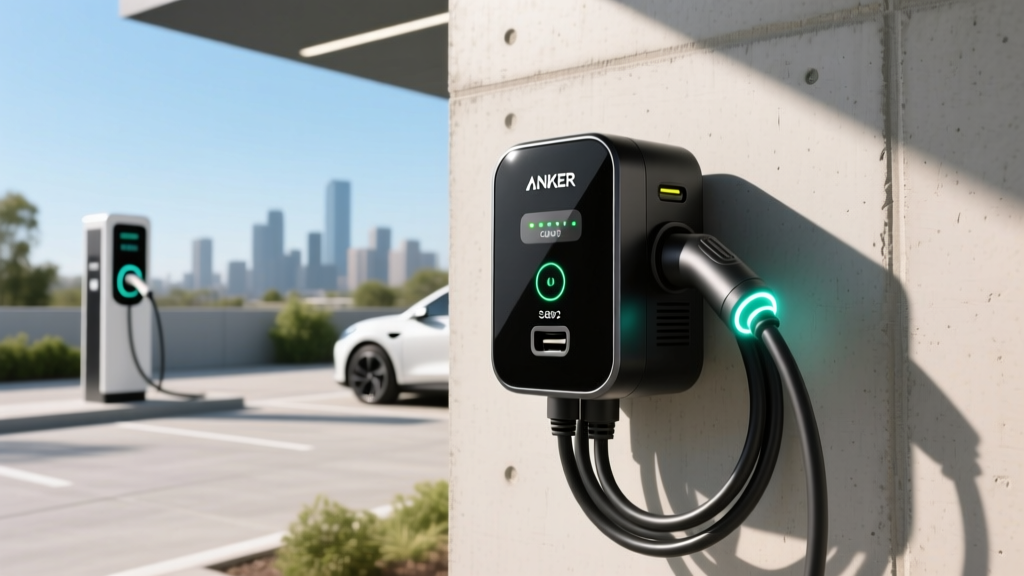
If you've been shopping for a high-output Level 2 home EV charger, you've likely encountered the Anker Solix C2000 Gen 2 charger — a unit that promises up to 19.2 kW of power delivery, smart app features, and broad connector compatibility. But does it actually deliver those speeds in practice, and what does your home's electrical system need to support it? We break down the specs, installation realities, connector compatibility, and real-world charging times to help you decide if this is the right wallbox for your garage.
Quick Verdict: Who Should Buy the Anker Solix C2000 Gen 2 Charger
The Anker Solix C2000 Gen 2 is best suited for EV owners with large battery packs (80+ kWh) who want to minimize overnight charging time and whose homes can support a dedicated 80-amp / 240V circuit. At 19.2 kW peak output, it can add roughly 55–70 miles of range per hour to a capable vehicle — significantly faster than the 11.5 kW that most 48-amp home chargers deliver. However, the unit demands serious electrical infrastructure. If your panel is already near capacity or you're in an older home, the installation cost can rival or exceed the charger's price. For owners with 200-amp service and available headroom, this is one of the most powerful residential Level 2 chargers available in 2026.
Understanding Charging Levels: kW Power vs. kWh Energy
Before evaluating any charger, it's essential to distinguish between kW (kilowatts — the rate of power delivery, like water pressure from a hose) and kWh (kilowatt-hours — the total energy stored, like gallons in a tank). A 19.2 kW charger delivers energy at a rate of 19.2 kilowatts; running it for one hour would push 19.2 kWh into your battery (minus minor losses). This distinction matters because charger marketing often emphasizes peak kW, but your actual charging time depends on your battery's kWh capacity and the vehicle's onboard charger limit.
| Level | Voltage | Max Power (kW) | Typical Miles Added/Hour | Use Case |
|---|---|---|---|---|
| Level 1 | 120V AC | 1.4–1.9 kW | 3–5 mi/hr | Overnight trickle, PHEVs, low-mileage drivers |
| Level 2 | 240V AC | 3.3–19.2 kW | 12–70 mi/hr | Home wallbox, workplace, destination charging |
| DC Fast Charge | 400–900V DC | 50–350 kW | 150–1,200+ mi/hr | Highway road trips, rapid top-ups |
The Anker Solix C2000 Gen 2 operates at Level 2 — meaning it delivers AC power to your vehicle's onboard charger, which then converts it to DC for the battery. This is critical: if your EV's onboard charger is rated for only 11.5 kW (common on base-trim models), plugging into a 19.2 kW charger won't magically push 19.2 kW into the car. The vehicle caps the intake. Always check your EV's onboard charger rating before investing in a high-output unit.
Anker Solix C2000 Gen 2 Charger: Key Specifications
| Specification | Detail |
|---|---|
| Peak Power Output | 19.2 kW (80A @ 240V) |
| Adjustable Amperage | 16A / 24A / 32A / 40A / 48A / 80A via app |
| Connector Options | NACS (native Tesla) or J1772 (CCS1 vehicles via adapter) |
| Cable Length | 25 ft (7.6 m) |
| Wi-Fi / Smart Features | Yes — Anker Solix app, scheduling, energy tracking, OTA updates |
| Indoor/Outdoor Rating | NEMA 4 (indoor and outdoor rated) |
| Hardwired or Plug | Hardwired required at 80A; NEMA 14-50 plug option at 40A max |
| Energy Star Certified | Yes |
| Warranty | 3 years |
| Approximate Unit Price | $599–$699 (MSRP, varies by connector) |
The adjustable amperage is a standout feature. If your electrical panel can't support a full 80A dedicated circuit, you can dial the charger down to 48A or 40A via the app, which reduces the circuit requirement to a 60A or 50A breaker respectively. This flexibility makes the C2000 Gen 2 future-proof: install it on a 60A circuit now, and upgrade the panel later to unlock full 19.2 kW.
Electrical Requirements and Home Installation Cost
Running the Anker Solix C2000 Gen 2 at its full 80A output requires a dedicated 100-amp, 240V circuit (NEC code mandates that continuous loads use only 80% of a breaker's rated capacity, so 80A continuous draw needs a 100A breaker). This is substantial. Many modern homes have 200-amp main panels, and dedicating 100A to a single circuit may consume half your panel's capacity — leaving insufficient room for HVAC, electric range, dryer, and other loads.
When a Panel Upgrade Becomes Necessary
Homes built before 2000 frequently have 100A or 150A main service. In these cases, adding a 100A EV circuit will almost certainly require a panel upgrade to 200A or even 400A, or the installation of a secondary sub-panel. A load calculation performed by a licensed electrician is the first step — they'll measure your existing demand and determine available headroom. Don't skip this: an overloaded panel is a fire hazard and a code violation.
| Item | Typical Cost Range | Notes |
|---|---|---|
| Anker Solix C2000 Gen 2 unit | $599–$699 | Price varies by connector type |
| Electrician labor (standard install) | $500–$1,500 | Short run from panel to garage, conduit, wiring |
| Electrical materials (wire, conduit, breaker) | $150–$400 | 6 AWG copper for 48A; 2 AWG for 80A |
| Permit and inspection | $50–$300 | Required in most jurisdictions |
| Panel upgrade (if needed) | $1,500–$4,000+ | 200A upgrade; 400A can exceed $5,000 |
| Total (no panel upgrade) | $1,300–$2,900 | Most homes with adequate panel capacity |
| Total (with panel upgrade) | $2,800–$7,200+ | Older homes or high-demand households |
For homeowners who can't justify the cost of a 100A circuit, running the C2000 Gen 2 at 48A on a 60A breaker is a practical compromise. You'll get 11.5 kW — still excellent for overnight charging and compatible with the onboard chargers in most current EVs. The National Electrical Contractors Association recommends always hiring a licensed electrician familiar with NEC Article 625 (EV charging system requirements).
Connector Compatibility: NACS, CCS1, and Adapters
As of 2026, the North American Charging Standard (NACS), originally developed by Tesla, has been adopted by nearly every major automaker for new vehicles. However, millions of CCS1-equipped EVs remain on the road. Here's how the Anker Solix C2000 Gen 2 fits into this landscape:
| EV Brand / Model (2025–2026) | Native Connector | Charger Version Needed | Adapter Required? |
|---|---|---|---|
| Tesla Model 3 / Y / S / X | NACS | NACS version | No |
| Ford F-150 Lightning, Mustang Mach-E (2025+) | NACS | NACS version | No |
| Hyundai Ioniq 5/6, Kia EV6/EV9 (2025+) | NACS | NACS version | No |
| Rivian R1T / R1S (2025+) | NACS | NACS version | No |
| VW ID.4 (2024 and earlier) | CCS1 | J1772 version + CCS adapter | Yes — CCS1-to-J1772 adapter (~$100–$200) |
| Chevrolet Bolt EV/EUV (pre-2026) | CCS1 | J1772 version + CCS adapter | Yes |
| BMW i4 / iX (2024 and earlier) | CCS1 | J1772 version + CCS adapter | Yes |
Anker offers the C2000 Gen 2 in both NACS and J1772 connector versions. If you drive a CCS1 vehicle, the J1772 version paired with a quality CCS1 adapter works, but adds bulk at the connection point. For households with both a NACS and a CCS1 vehicle, buying the NACS version and using a NACS-to-J1772 adapter for the older car is often the cleaner solution. Nissan Leaf owners using CHAdeMO should note that no common Level 2 adapter exists for CHAdeMO-to-J1772; a dedicated J1772 charger with a separate CHAdeMO adapter (available from third parties like Lectron) is the workaround.
Real-World Charging Times: What 19.2 kW Actually Means
The headline 19.2 kW figure is a peak rate. In practice, your charging speed depends on three factors: (1) your EV's onboard charger capacity, (2) the battery's state of charge (charging slows above ~80% to protect cell health), and (3) ambient temperature (cold batteries charge slower unless preconditioned).
| Vehicle | Battery (kWh usable) | Onboard Charger | @ 19.2 kW | @ 11.5 kW | @ 7.7 kW (32A) |
|---|---|---|---|---|---|
| Tesla Model Y Long Range | 75 kWh | 11.5 kW | ~5.5 hrs* | ~5.5 hrs | ~7 hrs |
| Ford F-150 Lightning Ext. Range | 131 kWh | 19.2 kW | ~6.5 hrs | ~10 hrs | ~14 hrs |
| Hyundai Ioniq 5 (2026, NACS) | 84 kWh | 10.9 kW | ~6 hrs* | ~6 hrs | ~8.5 hrs |
| Chevrolet Silverado EV | 200 kWh | 19.2 kW | ~9 hrs | ~15 hrs | ~21 hrs |
| BMW iX xDrive50 | 105 kWh | 11 kW | ~7.5 hrs* | ~7.5 hrs | ~11 hrs |
*Vehicle onboard charger caps intake below 19.2 kW; charger delivers at vehicle's maximum rate.
The F-150 Lightning and Silverado EV are where the 19.2 kW output truly shines — these trucks have massive batteries that would take 15+ hours on a standard 48A charger. If you regularly drive your electric truck hard and need a full recharge overnight, the C2000 Gen 2 at 80A is one of the few residential options that can do it.
Cost to Charge: Home vs. Public vs. Gas
One of the strongest arguments for home Level 2 charging is cost. Electricity rates vary significantly by region and time of use, but charging at home during off-peak hours is almost always cheaper than public DC fast charging — and dramatically cheaper than gasoline per mile.
| Scenario | Rate | Cost per Mile (3 mi/kWh EV) | Annual Cost (12,000 mi) |
|---|---|---|---|
| Home off-peak (national avg) | $0.12/kWh | $0.04 | $480 |
| Home peak rate | $0.25/kWh | $0.083 | $1,000 |
| Public Level 2 (network avg) | $0.30/kWh | $0.10 | $1,200 |
| DC Fast Charge (network avg) | $0.45/kWh | $0.15 | $1,800 |
| Gas vehicle (25 MPG, $3.50/gal) | $3.50/gal | $0.14 | $1,680 |
| Gas vehicle (25 MPG, $4.50/gal) | $4.50/gal | $0.18 | $2,160 |
At off-peak residential rates, a home-charged EV costs roughly $0.04 per mile — about one-quarter the cost of gasoline. Even at public DC fast-charging rates, EVs remain competitive with or cheaper than gas. The Anker Solix C2000 Gen 2's smart scheduling feature lets you set charging windows to coincide with your utility's lowest rates, maximizing savings. Many utilities offer time-of-use (TOU) plans specifically designed for EV owners; check with your local provider.
Equipment Comparison: Anker Solix C2000 Gen 2 vs. Competitors
Anker Solix C2000 Gen 2
- Power: Up to 19.2 kW (80A)
- Connector: NACS or J1772
- Cable: 25 ft
- Smart Features: App control, scheduling, OTA updates, energy dashboard
- Price: ~$599–$699
- Best For: Large-battery EVs, trucks, future-proofing
Tesla Wall Connector
- Power: Up to 11.5 kW (48A)
- Connector: NACS (native) or J1772 adapter
- Cable: 24 ft
- Smart Features: Wi-Fi, OTA, power-sharing with 2nd unit
- Price: ~$475
- Best For: Tesla owners, simpler installs
ChargePoint Home Flex
- Power: Up to 12 kW (50A)
- Connector: J1772 (CCS via adapter) or NACS
- Cable: 23 ft
- Smart Features: App, Alexa, scheduling, energy reports
- Price: ~$549–$699
- Best For: Multi-EV households, CCS/NACS flexibility
The Anker Solix C2000 Gen 2 is the clear power leader in this group. If your EV supports a 19.2 kW onboard charger (currently the F-150 Lightning Extended Range and Silverado EV are the main beneficiaries), no other mainstream residential charger matches it. For most sedans and crossovers with 11–12 kW onboard chargers, the Tesla Wall Connector or ChargePoint Home Flex will deliver identical speeds at a lower installation cost. The decision comes down to whether you want to pay the infrastructure premium now for future-proofing.
Safety, Code Compliance, and Installation Best Practices
EV chargers draw significant continuous current — often for 8+ hours at a time. This makes proper installation non-negotiable. Key requirements and recommendations:
- Dedicated circuit: Your charger must have its own breaker — never share a circuit with other appliances. NEC Article 625 requires this for all EV supply equipment.
- GFCI protection: The 2023 NEC update (adopted by most states by 2026) requires GFCI protection for all indoor and outdoor EV charging outlets. Hardwired units like the C2000 Gen 2 at 80A typically have built-in ground-fault protection, but verify with your electrician.
- Outdoor rating: The C2000 Gen 2 carries a NEMA 4 rating, meaning it's sealed against rain, snow, and splashing water — suitable for outdoor mounting without an additional weatherproof enclosure.
- Wire gauge: At 80A continuous (100A breaker), you need 2 AWG copper or 1/0 AWG aluminum wire. Undersized wire creates heat buildup and fire risk. Your electrician will calculate the correct gauge based on run length.
- Permit and inspection: Most municipalities require a permit for EV charger installation. The inspection ensures the work meets NEC and local code. Skipping this can void your homeowner's insurance coverage in the event of an electrical fire.
Smart Features and the Anker Solix App Experience
The C2000 Gen 2 connects via Wi-Fi to the Anker Solix app, which provides:
- Scheduled charging: Set start/stop times to align with off-peak electricity rates or solar production windows.
- Energy monitoring: Track kWh consumed per session, weekly, and monthly — useful for tax or employer reimbursement records.
- Amperage adjustment: Dial the output up or down without touching the breaker — essential if you're sharing panel capacity with a new heat pump or solar inverter.
- Over-the-air updates: Firmware improvements and new features delivered remotely.
- Multi-user access: Grant family members access to controls and monitoring.
The app interface is straightforward, though as of early 2026 it lacks integration with some utility demand-response programs that competitors like ChargePoint and Emporia support. If your utility offers financial incentives for participating in grid-balancing programs (where they briefly pause your charging during peak demand), check whether the Solix app supports your provider before committing.
Federal Tax Credit and Incentives for Home Charging
The IRS §30C Alternative Fuel Vehicle Refueling Property Credit offers a tax credit of up to 30% of the cost of home EV charging equipment and installation, capped at $1,000. This applies to both the charger hardware and the electrician's labor. Key eligibility requirements for 2026:
- The equipment must be installed at your primary residence in the United States.
- The property must be placed in service during the tax year.
- The credit is subject to income limitations and is non-refundable (it can reduce your tax liability to zero but won't generate a refund beyond that).
- Equipment must meet applicable NEC and local code requirements.
Additionally, many utilities and state energy offices offer rebates for Level 2 charger installations — sometimes $250–$750 or more. These stack with the federal credit. Check the AFDC incentive database for programs in your ZIP code. Always consult a tax professional for advice specific to your situation — incentive rules change, and eligibility depends on your individual tax circumstances.
Frequently Asked Questions
How much does it cost to install a home EV charger?
A typical Level 2 installation with no panel upgrade runs $1,300–$2,900 including the charger unit, electrician labor, materials, and permit. If your home needs a panel upgrade (common in pre-2000 homes or those with 100A service), total costs can reach $2,800–$7,200+. Always get a load calculation from a licensed electrician before committing to a high-amperage charger.
How fast will each charging level add range?
Level 1 (120V) adds roughly 3–5 miles per hour. Level 2 (240V) adds 12–70 miles per hour depending on amperage and your vehicle's onboard charger. DC fast charging adds 150–1,200+ miles per hour but is intended for road-trip top-ups, not daily use. The Anker Solix C2000 Gen 2 at 19.2 kW sits at the top of the Level 2 range, adding up to ~70 miles per hour to vehicles with compatible 19.2 kW onboard chargers.
Which connector/charger is compatible with my EV?
For 2025–2026 models from Tesla, Ford, Hyundai, Kia, Rivian, and most other brands adopting NACS, order the NACS version of the charger. For older CCS1-equipped vehicles (pre-2025 VW, BMW, Chevrolet Bolt), order the J1772 version and use a CCS1 adapter. Check your vehicle's charge port or owner's manual to confirm.
How much does charging cost per mile vs gas?
Home off-peak charging averages about $0.04/mile — roughly one-quarter the cost of gasoline at $3.50/gallon in a 25 MPG vehicle ($0.14/mile). Even public DC fast charging at $0.45/kWh ($0.15/mile) remains competitive with gasoline. The savings widen as gas prices rise and are most pronounced for drivers who can charge at home overnight on time-of-use rates.
What electrical upgrades might I need?
The most common upgrade is a panel capacity increase. Homes with 100A or 150A main service often need a 200A or 400A upgrade to support an 80A EV circuit alongside existing loads. Other potential upgrades include: running new conduit from the panel to the garage, replacing undersized service entrance wires, or adding a sub-panel closer to the charging location to reduce wire run costs. A licensed electrician's load calculation is the definitive first step.
Is the Anker Solix C2000 Gen 2 worth the 80A installation?
If you own an EV with a 19.2 kW onboard charger (like the F-150 Lightning Extended Range or Chevy Silverado EV) and your electrical panel can support it — yes. The time savings on large battery packs are substantial. For EVs with 11.5 kW onboard chargers, the 80A circuit won't charge any faster than a 48A circuit, so you'd be paying for infrastructure capacity you can't use today. The smart play: install the C2000 Gen 2 at 48A on a 60A circuit now, and upgrade the circuit later when you buy a vehicle that can accept 19.2 kW.