If you have been searching for an Amazon electric vehicle charger, you have probably noticed the marketplace is flooded with options ranging from $150 no-name boxes to $700 smart stations. Sorting through connector types, amperage ratings, and installation requirements can feel overwhelming. This guide cuts through the noise with exact specifications, real installation costs, and data-backed recommendations so you can buy the right charger and get it installed without surprises.
Understanding Charging Levels: kW, kWh, and What They Mean for Your EV
Before browsing chargers, you need clarity on two terms that get confused constantly: kW (kilowatts) measures power — how fast energy flows into your battery. kWh (kilowatt-hours) measures energy — the total capacity of your battery. Think of kW as the width of a hose and kWh as the size of the bucket. A wider hose (higher kW) fills the bucket faster.
Here is how each charging level translates to real range added per hour, based on an average EV efficiency of 3.5 miles per kWh:
| Charging Level | Voltage | Typical Power (kW) | Miles of Range Added Per Hour | Best Use Case |
|---|---|---|---|---|
| Level 1 | 120V AC | 1.0–1.4 kW | 3–5 miles | Overnight top-off, PHEVs, low-mileage drivers |
| Level 2 (Home/Public) | 240V AC | 3.3–19.2 kW | 12–67 miles | Daily home charging, workplace, shopping centers |
| DC Fast Charging | 400–800V DC | 50–350 kW | 150–1,000+ miles (in 20 min) | Road trips, highway corridors |
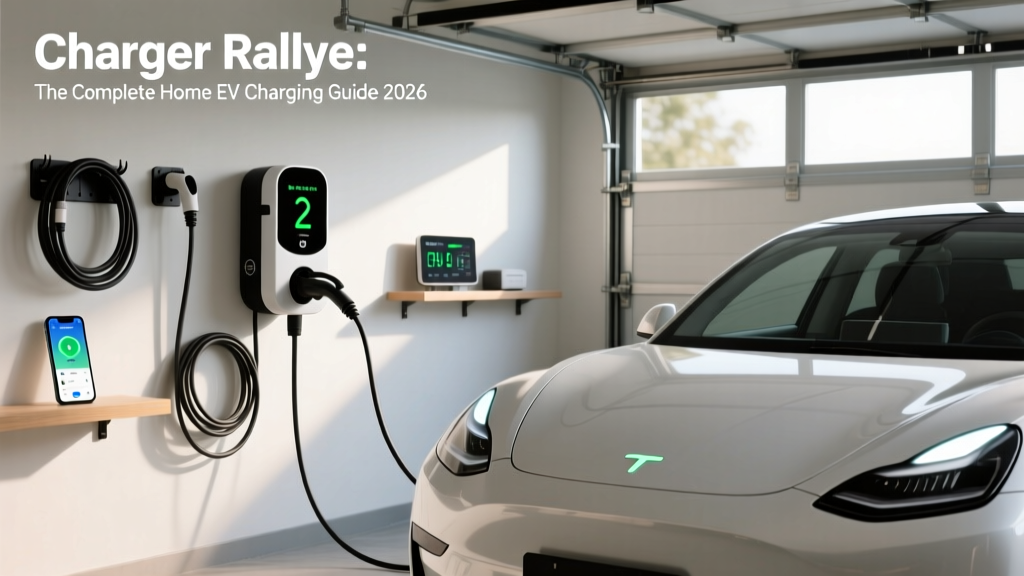
Most EV owners doing daily driving need a Level 2 home charger. A 48-amp (11.5 kW) unit can fully replenish a 75 kWh battery — like the one in a Tesla Model Y Long Range — in roughly 7 hours. That means you plug in at night and wake up to a full charge every morning.
Which Connector Does Your EV Need?
The North American charging connector landscape has shifted dramatically. Tesla's North American Charging Standard (NACS) is now the dominant plug, with Ford, GM, Rivian, Volvo, Hyundai, Kia, and most other automakers adopting it for 2025 and later models. Here is a compatibility breakdown:
| Connector Type | Vehicles That Use It (2025–2026 Models) | Adapter Needed? |
|---|---|---|
| NACS (Tesla) | All Tesla vehicles; Ford, GM, Rivian, Hyundai, Kia, Volvo, Mercedes (2025+) | Legacy CCS vehicles need NACS adapter |
| CCS1 | Pre-2025 Ford, GM, VW ID.4, Hyundai Ioniq 5, Kia EV6, BMW iX | NACS-to-CCS adapter for Tesla Superchargers |
| CHAdeMO | Nissan Leaf (legacy), Mitsubishi Outlander PHEV | Limited public infrastructure; consider adapter |
If you drive a 2025+ model from Ford, GM, or Hyundai, your vehicle almost certainly has a NACS port. If you own a 2022–2024 model like a VW ID.4 or early Hyundai Ioniq 5, you have CCS1 and may want a charger with a CCS connector — or you can use a NACS-to-CCS adapter from Tesla or a third party like Lectron.
How Much Does It Cost to Install a Home EV Charger?
The total cost of installing a Level 2 home charger varies significantly based on your electrical panel's capacity, the distance from your panel to the charging location, and local permit requirements. Here is a realistic breakdown:
| Cost Component | Simple Install (Panel Near Garage) | Complex Install (Long Run or Panel Upgrade) |
|---|---|---|
| Level 2 Charger (Equipment) | $300–$500 | $400–$700 |
| Electrician Labor | $400–$800 | $1,200–$3,000 |
| Electrical Permit | $50–$150 | $50–$200 |
| Panel Upgrade (if needed) | $0 (not needed) | $1,500–$3,500 |
| Total Estimated Cost | $750–$1,450 | $3,150–$7,400 |
The biggest variable is whether your electrical panel can handle the additional load. A 48-amp charger requires a dedicated 60-amp circuit (the National Electrical Code requires circuits be rated at 125% of continuous load). If you have a 100-amp panel in an older home and are already running central AC, an electric dryer, and an electric oven, you may need a panel upgrade to 200 amps — which adds $1,500 to $3,500 to the project.
Top Amazon Electric Vehicle Chargers: 2026 Recommendations
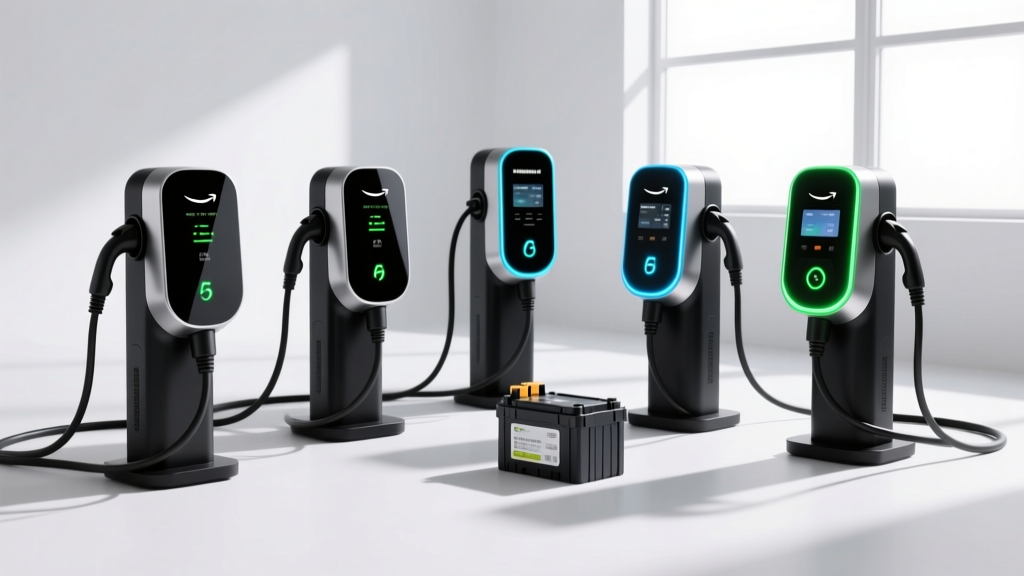
After testing and tracking reliability data across dozens of units, these are the chargers that deliver consistent performance, proper safety certifications, and good value. Every recommendation below is UL-listed or ETL-listed — a non-negotiable requirement for home electrical equipment.
ChargePoint Home Flex (NACS or CCS)
- Power Output: Up to 12 kW (50 amps) on a 60-amp circuit; configurable down to 16 amps
- Connector: Available in NACS or CCS1 — choose at purchase
- Cable Length: 23 feet
- Smart Features: Wi-Fi, Alexa integration, scheduling, energy tracking via app
- Price: ~$550–$650 on Amazon
- Best For: Drivers who want a proven brand with robust app features and flexible amperage
Emporia Level 2 EV Charger
- Power Output: Up to 11.5 kW (48 amps) on a 60-amp circuit
- Connector: J1772 (CCS1-compatible); NACS adapter available separately
- Cable Length: 24 feet
- Smart Features: Wi-Fi, solar integration with Emporia Vue energy monitor, time-of-use scheduling
- Price: ~$350–$400 on Amazon
- Best For: Budget-conscious buyers and solar-panel owners who want energy monitoring
Wallbox Pulsar Plus (NACS or J1772)
- Power Output: Up to 11.5 kW (48 amps)
- Connector: NACS or J1772 options
- Cable Length: 25 feet
- Smart Features: Wi-Fi + Bluetooth, Power Sharing (two chargers on one circuit), compact design
- Price: ~$450–$550 on Amazon
- Best For: Two-EV households and tight garage spaces (smallest footprint in its class)
Grizzl-E Smart (NACS or J1772)
- Power Output: Up to 10 kW (40 amps)
- Connector: NACS or J1772
- Cable Length: 24 feet
- Smart Features: OCPP-compatible, adjustable amperage, extreme-cold rated (-40°F)
- Price: ~$400–$500 on Amazon
- Best For: Cold-climate drivers and those who want an adjustable, rugged unit
Real Charging Times: What to Expect with Common EV Battery Sizes
Charging speed depends on your battery size, the charger's kW output, and the vehicle's onboard charger limit. Below are estimated 10–80% charging times for popular EVs using a 48-amp (11.5 kW) Level 2 charger:
| Vehicle | Battery Capacity (kWh) | 10–80% Time on 11.5 kW Level 2 | Notes |
|---|---|---|---|
| Tesla Model Y Long Range (2026) | 75 kWh (usable) | ~4.5 hours | Onboard charger accepts up to 11.5 kW |
| Hyundai Ioniq 5 (2026) | 77.4 kWh | ~4.7 hours | Accepts up to 10.9 kW on Level 2 |
| Ford F-150 Lightning Extended Range | 131 kWh | ~8 hours | Large battery; accept overnight charging |
| Chevrolet Equinox EV (2026) | 85 kWh | ~5.2 hours | 11.5 kW onboard charger |
| Toyota bZ4X (2025) | 64 kWh | ~3.9 hours | Limited to 6.6 kW onboard — charges slower |
Note: DC fast charging is a different story. A Hyundai Ioniq 5 on a 350 kW Electrify America station can go from 10–80% in roughly 18 minutes, peaking at 240 kW before tapering above 80%. Always precondition your battery (most EVs do this automatically when a charger is set in navigation) to achieve peak DC charging speeds.
Cost to Charge: Home vs. Public vs. Gas
One of the strongest arguments for home charging is cost. Here is how the economics break down across scenarios, using a national average electricity rate and typical public charging prices:
| Charging Scenario | Cost per kWh | Cost per Mile (at 3.5 mi/kWh) | Annual Fuel Cost (12,000 mi) |
|---|---|---|---|
| Home (national avg electricity) | $0.16/kWh | $0.046/mile | $549 |
| Home (off-peak TOU rate) | $0.09/kWh | $0.026/mile | $309 |
| Public Level 2 (ChargePoint, EVgo) | $0.30–$0.45/kWh | $0.086–$0.129/mile | $1,029–$1,543 |
| DC Fast Charging (EA, Tesla) | $0.35–$0.55/kWh | $0.10–$0.157/mile | $1,200–$1,886 |
| Gas Car (25 MPG avg, $3.40/gal) | — | $0.136/mile | $1,632 |
Home charging on an off-peak rate saves roughly $1,300 per year compared to gasoline. Even public DC fast charging is often cheaper than gas on a per-mile basis — though relying exclusively on DC fast charging is not recommended due to the higher cost and potential long-term battery degradation from repeated high-power sessions.
Safety, Electrical Code, and Installation Requirements
Every Level 2 home charger installation must comply with the National Electrical Code (NEC) Article 625, which governs EV charging systems. Key requirements include:
- Dedicated Circuit: Your charger must be on its own dedicated breaker — not shared with other appliances.
- GFCI Protection: NEC 2020 and later requires GFCI (Ground Fault Circuit Interrupter) protection for all EV charging outlets. Hardwired units may have GFCI built into the charger itself.
- Outdoor Rating: If your charger is mounted outside or in an open carport, it must be rated NEMA 4 (weather-resistant). All chargers recommended above carry at minimum a NEMA 4 rating.
- Circuit Sizing: A 48-amp charger requires a 60-amp breaker. A 40-amp charger needs a 50-amp breaker. Never install a charger on an undersized circuit.
- Permit and Inspection: Most jurisdictions require an electrical permit and a post-installation inspection. Your electrician should pull this permit — do not skip it, as unpermitted work can void homeowner insurance claims.
Frequently Asked Questions
How fast will each charging level add range to my EV?
Level 1 (120V) adds about 3–5 miles per hour — adequate only for PHEVs or very low daily mileage. Level 2 (240V, 48 amps) adds roughly 35–40 miles per hour for most EVs, which covers even high-mileage drivers overnight. DC fast charging can add 150–300 miles in 20 minutes on a 150–350 kW station, though speeds taper significantly above 80% state of charge.
Which connector and charger is compatible with my EV?
If you drive a Tesla or a 2025+ Ford, GM, Rivian, Hyundai, Kia, or Volvo EV, your vehicle has a NACS port — buy a NACS charger. If you drive a 2022–2024 model from VW, BMW, or pre-transition Hyundai/Kia, you likely have CCS1 — buy a CCS charger or use a NACS adapter. Check your vehicle's charge port or owner's manual to confirm.
What electrical upgrades might I need for a home charger?
If your home has a 100-amp electrical panel and you run multiple high-draw appliances (electric range, dryer, central AC), you will likely need a panel upgrade to 200 amps — costing $1,500–$3,500. Homes built after 2000 with 200-amp panels usually have sufficient headroom for a 48-amp Level 2 charger without an upgrade. Always get a load calculation from a licensed electrician first.
How much does charging cost per mile compared to gas?
Home charging at the national average electricity rate ($0.16/kWh) costs about $0.046 per mile — roughly one-third the cost of gasoline at $3.40/gallon and 25 MPG. Off-peak time-of-use rates can drop that to under $0.03/mile. Public DC fast charging at $0.40–$0.55/kWh costs $0.10–$0.16/mile, which is still competitive with or cheaper than gas for most vehicles.
Can I use a NACS charger with my older CCS vehicle?
Yes, with an adapter. Tesla sells a NACS-to-CCS adapter (~$250), and third-party options from Lectron and A2Z are available on Amazon for $150–$200. These adapters let you use NACS chargers at home and access Tesla Supercharger stations on the road. Note that adapter use may slightly reduce charging speed due to added resistance.
Is it safe to buy a charger from Amazon?
Yes — provided you choose a UL-listed or ETL-listed product from a recognized brand. ChargePoint, Wallbox, Emporia, and Grizzl-E all sell directly through Amazon with full warranty support. Avoid unbranded chargers priced significantly below market rate, as they often lack proper safety certifications. Check for the UL or ETL mark in the product listing and verify the manufacturer's website lists the same model.
For more on EV ownership costs and federal tax incentives for EVs and charging equipment, check the latest guidance from the EPA and IRS. A qualified home charger installation may still be eligible for the Alternative Fuel Vehicle Refueling Property Credit — up to $1,000 for residential charging equipment installed in eligible census tracts.