Why All-Wheel-Drive EVs Have Unique Charging Needs
If you own or are shopping for an all-wheel-drive electric vehicle — whether it's a Tesla Model Y Long Range AWD, a Ford Mustang Mach-E GT, a Hyundai Ioniq 5 AWD, or a Rivian R1S — you've likely searched for the right "all wheel drive charger" and found confusing results. Here's the truth: there is no special charger required for all-wheel-drive EVs. AWD is a drivetrain configuration (dual motors powering front and rear axles), not a charging standard. Every AWD EV uses the same charging ports and protocols as its rear-wheel-drive siblings.
What does differ for AWD EV owners is the practical reality: AWD models tend to carry larger battery packs (often 75–100+ kWh usable), consume more energy due to dual-motor weight and drivetrain losses, and are frequently driven in cold, snowy climates where range drops 20–30% and charging speeds can slow without proper battery preconditioning. That means choosing the right home charger and understanding public charging becomes even more critical to keep your AWD EV practical year-round.
This guide covers every charging level, real installation costs, connector compatibility for 2026 model-year AWD EVs, and the per-mile economics compared to gas — with the exact numbers you need to plan your setup.
Charging Levels Explained: kW, Miles Per Hour, and 10–80% Times
The single most important distinction in EV charging: kW (kilowatts) measures power — how fast energy flows into your car. kWh (kilowatt-hours) measures energy — how much your battery holds. Think of kW as the width of a hose and kWh as the size of the bucket. Confusing these is the most common mistake in EV discussions.
| Level | Voltage | Power (kW) | Miles of Range Added Per Hour | Typical Use Case |
|---|---|---|---|---|
| Level 1 | 120V AC | 1.0–1.4 kW | 3–5 mi/hr | Overnight trickle, PHEVs, emergencies |
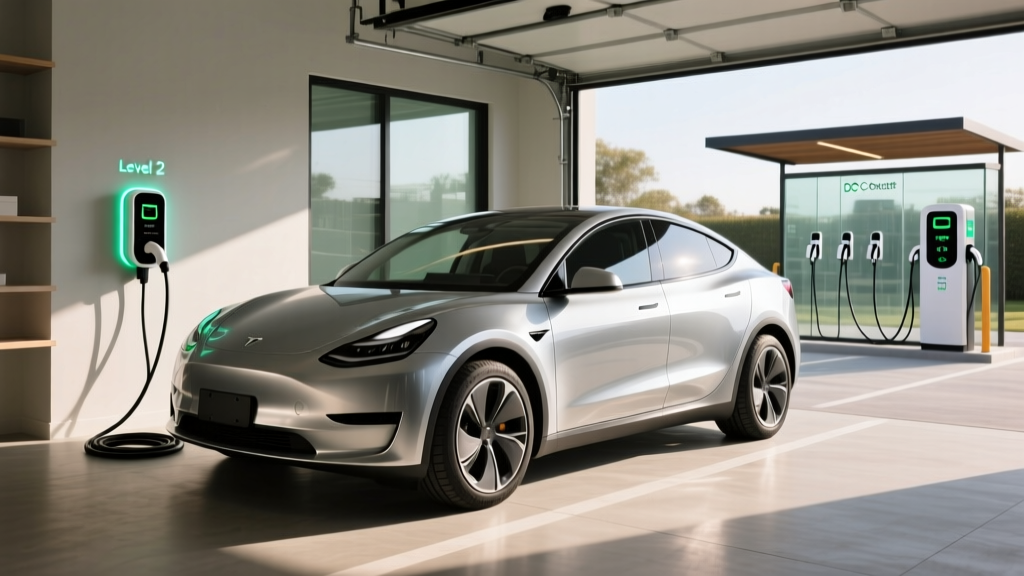
| Level 2 | 240V AC | 3.3–19.2 kW | 12–70 mi/hr | Home daily charging, workplace, hotels |
| DC Fast | 400–800V DC | 50–350 kW | 150–1,200+ mi/hr (peak) | Road trips, highway corridors, rapid top-ups |
Real-world 10–80% charging times for common AWD EV battery sizes:
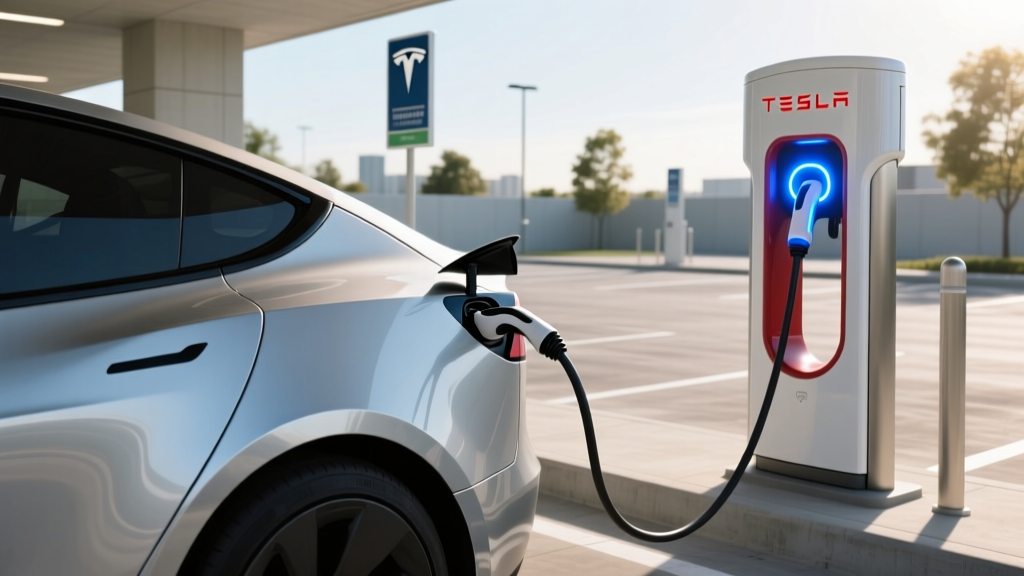
- Tesla Model Y Long Range AWD (~75 kWh usable, 4680 cells): ~25–28 min at a V4 Supercharger (250 kW peak), tapering significantly above 80%.
- Hyundai Ioniq 5 AWD (~77.4 kWh usable, 800V architecture): ~18 min at a 350 kW DC fast charger — one of the fastest production EVs to charge.
- Ford Mustang Mach-E GT AWD (~91 kWh usable): ~35–40 min at a 150 kW Electrify America station; ~28 min at a 250+ kW station.
- Rivian R1S Dual-Motor AWD (~128 kWh Max Pack): ~45–55 min at 200+ kW, given the massive battery.
Remember: peak kW is not sustained kW. Charging curves taper as the battery fills, especially above 60–70% SoC. A "250 kW" charger may only deliver that rate between 10–40% SoC before stepping down. Always plan around the 10–80% window for road trips.
Home Charger Installation: Electrical Requirements, Costs, and Panel Upgrades
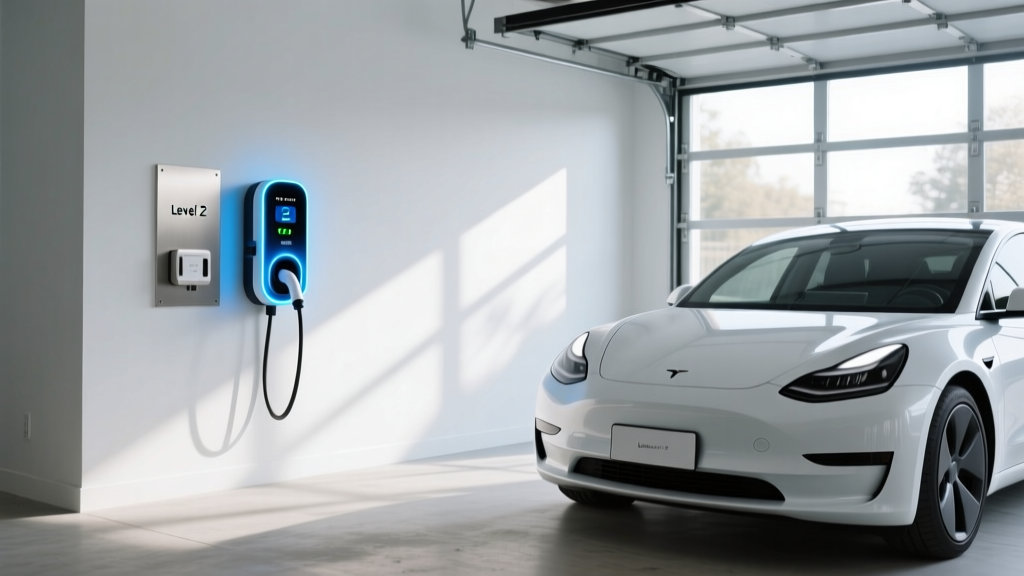
For AWD EV owners with larger batteries, a Level 2 home charger is practically mandatory. Level 1 (120V) at 1.4 kW would take 50+ hours to fill a 75 kWh battery — unusable for daily driving. A properly installed Level 2 charger at 240V/48A (11.5 kW) will replenish a typical AWD EV overnight in 7–9 hours.
Electrical Requirements
- Circuit: Dedicated 50A or 60A breaker (for 40A or 48A continuous charging, respectively). NEC requires circuits rated at 125% of continuous load.
- Wire: 6 AWG copper for 50A; 4 AWG for 60A runs. Longer runs may require thicker gauge to prevent voltage drop.
- Outlet vs. hardwire: NEMA 14-50 outlet offers portability; hardwired units allow higher amperage (48A+) without GFCI breaker nuisance trips and are preferred by many electricians in 2026.
- Panel capacity: Your home's main panel must have enough spare capacity. A 200A panel with significant existing load may need an upgrade to 300–400A, especially if you also run electric heat, a dryer, and an electric oven.
| Cost Component | Simple Install (Panel Nearby) | Complex Install (Long Run / Panel Upgrade) |
|---|---|---|
| Level 2 Charger Equipment | $400–$700 | $500–$800 |
| Electrician Labor | $500–$1,200 | $1,500–$3,500 |
| Permit & Inspection | $50–$200 | $100–$300 |
| Panel Upgrade (if needed) | $0 | $2,000–$5,000 |
| Total Estimated Range | $950–$2,100 | $4,100–$9,600 |
Panel upgrade reality check: Homes built before 2000 often have 100A or 150A panels. Adding a 50A EV circuit to an already-loaded 100A panel is a fire risk and likely won't pass inspection. Budget $2,500–$5,000 for a panel upgrade to 200A+ if needed. Some utilities offer rebates for panel upgrades tied to EV adoption — check with your local provider.
Connector Compatibility: NACS, CCS1, and CHAdeMO for AWD EVs
The connector landscape has shifted dramatically. As of 2026, the North American Charging Standard (NACS) — originally Tesla's proprietary connector — is the dominant standard. Most legacy CCS1 vehicles can access Tesla Superchargers via adapter, and nearly all new 2025–2026 AWD EVs ship with native NACS ports.
| AWD EV Model (2025–2026) | Native Connector | Adapter Needed? | Supercharger Access |
|---|---|---|---|
| Tesla Model Y / Model 3 AWD | NACS | None | Native |
| Hyundai Ioniq 5 AWD | NACS (2025+) | None | Native |
| Ford Mustang Mach-E AWD | NACS (2025+) | None | Native |
| Rivian R1S / R1T | NACS | None | Native |
| Kia EV6 AWD (2024) | CCS1 | NACS-to-CCS adapter | Via adapter |
| VW ID.4 AWD (2024) | CCS1 | NACS-to-CCS adapter | Via adapter |
| Nissan Ariana e-4ORCE AWD | NACS (2025+) | None | Native |
Key note for used-EV buyers: If you purchase a 2023–2024 model-year AWD EV with a CCS1 port, you'll need a NACS-to-CCS adapter (~$150–$250) to access the Tesla Supercharger network, which now exceeds 30,000 stalls in North America. CHAdeMO is effectively dead for new vehicles — only legacy Nissan Leaf models (which are FWD) still use it.
Level 2 Home Charger Recommendations for AWD EVs
AWD EVs with 75–130 kWh batteries benefit from higher-amperage Level 2 chargers to ensure overnight replenishment. Here are the top picks for 2026, selected for reliability, power output, smart features, and cable management.
ChargePoint Home Flex (Gen 2)
- Power: Up to 12 kW (50A) on a 60A circuit
- Connector: NACS (native); CCS adapter available
- Cable: 23 ft
- Smart features: Wi-Fi, scheduling, energy tracking, Alexa
- Price: ~$550
- Best for: Most AWD EVs; flexible amperage via DIP switch
Tesla Wall Connector
- Power: Up to 11.5 kW (48A) on a 60A circuit
- Connector: NACS
- Cable: 24 ft
- Smart features: Wi-Fi, OTA updates, power sharing (dual units on one circuit), load management
- Price: ~$475
- Best for: Tesla owners and NACS-native vehicles; best value
Emporia Level 2 EV Charger
- Power: Up to 11.5 kW (48A) on a 60A circuit
- Connector: J1772 (NACS adapter included in 2025+ models)
- Cable: 24 ft
- Smart features: Wi-Fi, energy monitoring, solar integration, scheduling
- Price: ~$400
- Best for: Budget-conscious buyers with solar panels
Grizzl-E Smart
- Power: Up to 10 kW (40A) on a 50A circuit
- Connector: J1772 or NACS
- Cable: 24 ft
- Smart features: Wi-Fi, OCPP compatibility, adjustable amperage
- Price: ~$500
- Best for: Extreme cold climates (-40°F rated), outdoor installs
For AWD EVs with larger packs (90+ kWh like the Mach-E Extended Range or Rivian Max Pack), prioritize 48A chargers on a 60A circuit to ensure a full overnight charge. A 32A or 40A charger will work but may require 10–12 hours for a full fill.
Cost to Charge: Home vs. Public vs. Gas — Per-Mile Economics
The financial case for home charging is overwhelming, but public DC fast charging narrows the gap — and in some cases, exceeds gas costs per mile. Here's the real math for an AWD EV averaging 3.0 mi/kWh (a realistic combined figure for dual-motor SUVs like the Model Y or Ioniq 5).
| Charging Scenario | Price | Cost Per kWh | Cost Per Mile (3.0 mi/kWh) | Annual Cost (12,000 mi) |
|---|---|---|---|---|
| Home (off-peak utility rate) | $0.08–$0.14/kWh | $0.11 avg | $0.037 | $440 |
| Home (standard rate) | $0.15–$0.22/kWh | $0.18 avg | $0.060 | $720 |
| Public Level 2 (workplace/mall) | $0.20–$0.40/kWh | $0.30 avg | $0.100 | $1,200 |
| DC Fast (Electrify America/EVgo) | $0.35–$0.55/kWh | $0.45 avg | $0.150 | $1,800 |
| Tesla Supercharger (2026 avg) | $0.25–$0.40/kWh | $0.32 avg | $0.107 | $1,280 |
| Gas AWD SUV (25 MPG, $3.40/gal) | $3.40/gallon | — | $0.136 | $1,632 |
The takeaway: Home-charged AWD EVs cost 60–75% less per mile than a comparable gas AWD SUV. But if you rely exclusively on DC fast charging, your per-mile cost can exceed gas. This is why home Level 2 installation is the single highest-ROI investment for EV ownership.
According to fueleconomy.gov, the 2026 Tesla Model Y Long Range AWD achieves 122 MPGe combined (28 kWh/100 mi), while the Hyundai Ioniq 5 AWD hits 110 MPGe (31 kWh/100 mi). These figures assume moderate temperatures and mixed driving — expect 15–25% higher consumption in sub-freezing weather or sustained highway speeds above 75 mph.
Safety, Code Compliance, and Outdoor Installation
EV charging involves sustained high-amperage draw for hours — far more demanding than any other household appliance. Cutting corners here is a fire risk.
- Dedicated circuit: Your Level 2 charger must be on its own dedicated breaker — never shared with other loads.
- GFCI protection: The 2023 NEC (adopted by most jurisdictions by 2026) requires GFCI protection for outlets used for EV charging. Hardwired installations often sidestep nuisance GFCI trips that plague NEMA 14-50 outlets on some panels.
- Outdoor rating: If your charger is installed outdoors (garage-less homes, driveways), ensure it carries a NEMA 4 or IP65 rating for weather resistance. All chargers listed above meet this standard.
- Permit and inspection: Most municipalities require an electrical permit for a new 240V circuit. The inspection verifies wire gauge, breaker sizing, grounding, and GFCI compliance. Do not skip this — unpermitted work can void homeowner's insurance claims.
- Cable management: Use a wall-mounted holster or retractable reel to keep cables off the ground, preventing trip hazards and connector contamination.
Always hire a licensed electrician experienced with EV charger installations. The National Electrical Code (NEC) Article 625 governs EV charging equipment — your installer should reference it directly.
Cold-Weather Charging Tips for AWD EV Owners
AWD EVs are popular in snow-belt states precisely because of their traction — but cold weather creates specific charging challenges:
- Preconditioning is essential: Most AWD EVs (Tesla, Hyundai/Kia, Ford) will warm the battery to optimal charging temperature when you navigate to a DC fast charger in the nav system. Without preconditioning, a cold battery may accept only 30–50 kW at a 250 kW station until it warms up, adding 15–20 minutes to your stop.
- Range loss is real: Expect 20–30% less range in sustained sub-30°F driving due to cabin heating, battery resistance, and denser air. A Model Y AWD rated at 310 miles EPA may deliver 220–250 miles in winter highway conditions. Plan charging stops accordingly.
- Garage charging helps: Even an unheated garage keeps the battery above the worst cold-soak temperatures, improving charge acceptance and reducing preconditioning energy use.
- Schedule charging: Use your charger's smart scheduling to charge during the warmest part of the day (or off-peak overnight rates) and finish just before departure, so the battery stays warm for your commute.
Frequently Asked Questions
Do I need a special charger for an all-wheel-drive EV?
No. AWD is a drivetrain configuration, not a charging standard. Any Level 2 or DC fast charger compatible with your EV's connector (NACS, CCS1) will work identically for AWD and RWD versions of the same model. The key consideration is that AWD EVs often have larger batteries, making a higher-amperage Level 2 home charger (48A recommended) more important for overnight replenishment.
How much does it cost to install a home EV charger?
A straightforward Level 2 installation with the panel nearby typically costs $950–$2,100 (equipment + electrician + permit). Complex installs requiring long wire runs, conduit, or a panel upgrade can range from $4,100–$9,600. Always get 2–3 quotes from licensed electricians and verify they include permit and inspection in the estimate.
How fast will a Level 2 home charger add range to my AWD EV?
A 48A Level 2 charger (11.5 kW) adds roughly 30–38 miles of range per hour to a typical AWD EV SUV. That's enough to fully replenish a 75 kWh battery (Tesla Model Y LR AWD) in about 7 hours, or a 91 kWh battery (Mach-E Extended Range AWD) in about 8.5 hours — both comfortably overnight.
Which connector does my AWD EV use?
For 2025–2026 model-year AWD EVs, most now use the NACS connector natively (Tesla, Hyundai, Ford, Rivian, GM, Nissan, Volvo). Older CCS1 vehicles (2022–2024 model years from VW, Kia, BMW) require a NACS-to-CCS adapter (~$150–$250) for Supercharger access. CHAdeMO is obsolete for new vehicles.
Is home charging cheaper than gas for an AWD vehicle?
Yes, significantly. Home-charged AWD EVs cost roughly $0.04–$0.06 per mile vs. $0.14 per mile for a 25 MPG gas AWD SUV at $3.40/gallon — a 60–70% savings. Over 12,000 annual miles, that's $900–$1,200 in annual fuel savings. However, exclusive reliance on public DC fast charging can push costs above gas, so home installation is key.
What electrical upgrades might I need for a home charger?
If your home has a 100A or 150A electrical panel that's already heavily loaded (electric heat, dryer, oven, A/C), you may need a panel upgrade to 200A or higher ($2,000–$5,000). A licensed electrician will perform a load calculation per NEC Article 220 to determine if your existing panel can support a dedicated 50A or 60A EV circuit. Some utilities and states offer rebates for panel upgrades — check IRS §30D and your local utility for current incentive availability.