Choosing the right all electric charger setup—whether for your garage, driveway, or road trips—hinges on understanding three variables: how fast you need to add range, what your home's electrical panel can support, and which connector your EV uses. This guide breaks down every charging level with exact kW speeds, real installation costs with line-item breakdowns, and specific equipment recommendations available in 2026.
Before we get to the hardware, a critical distinction: kW (kilowatts) measures power—the rate at which electricity flows into your car, like water pressure from a hose. kWh (kilowatt-hours) measures energy—the total amount stored in your battery, like gallons in a tank. A 10 kW charger delivering power for 5 hours adds 50 kWh of energy. Confusing these two is the single most common mistake new EV owners make, and it leads to wildly wrong expectations about charging times and costs.
Charging Levels Explained: Speed, Power, and Real-World Range Addition
Every EV sold in the US can use three tiers of charging. The speed difference between them is enormous—from a trickle that barely covers a daily commute to a flood that adds 200 miles in 20 minutes.
| Level | Voltage | Max Power (kW) | Miles of Range Added Per Hour | Typical Use Case |
|---|---|---|---|---|
| Level 1 | 120V AC | 1.2–1.9 kW | 3–5 miles | Overnight top-up, low daily mileage, PHEVs |
| Level 2 | 240V AC | 3.3–19.2 kW | 12–75 miles | Daily home charging, workplace, destinations |
| DC Fast (Level 3) | 400–800V DC | 50–350+ kW | 150–1,200 miles (equivalent) | Road trips, commercial fleets, quick top-ups |
A few real-world notes on these figures: Level 1 charging from a standard 120V household outlet delivers roughly 1.4 kW continuously—enough for a plug-in hybrid with 30 miles of electric range, but painfully slow for a long-range BEV with an 80+ kWh battery. Level 2 is where most EV owners live day-to-day; a 48-amp (11.5 kW) home charger adds roughly 40–45 miles per hour, meaning a full overnight session easily replenishes 200+ miles of range. DC fast charging speeds vary wildly by vehicle: a Hyundai Ioniq 5 with its 800V architecture can peak at 240 kW and hit 10–80% in about 18 minutes, while a Chevy Equinox EV peaks around 150 kW and takes roughly 30 minutes for the same session.
Home Installation: Electrical Requirements, Panel Upgrades, and Real Costs
The most common question from prospective EV owners: How much does it cost to install a home EV charger? The answer depends heavily on your home's existing electrical infrastructure. Here's the breakdown.
Baseline electrical requirements for Level 2: A typical home Level 2 charger runs on a 240V circuit—the same voltage as your electric dryer or oven. Most EV owners install a 40-amp or 60-amp dedicated circuit, which supports chargers rated at 32 amps or 48 amps respectively (electrical code requires the circuit to be rated at 125% of the continuous load, so a 48A charger needs a 60A circuit).
When do you need a panel upgrade? Most homes built after 1990 have a 200-amp electrical panel, which typically has enough spare capacity for a 40–60A EV circuit. Older homes with 100-amp panels often need an upgrade to 200 amps—this is the single biggest cost variable. An electrician will perform a load calculation to determine if your panel has headroom.
| Component | Cost Range | Notes |
|---|---|---|
| Level 2 Charger Equipment | $350–$750 | Smart Wi-Fi chargers with 25-ft cable; hardwired or NEMA 14-50 plug |
| Electrician Labor (standard install) | $500–$1,500 | Running conduit and wire from panel to garage/carport; assumes panel has capacity |
| Electrical Permit | $50–$200 | Required in most jurisdictions; varies by municipality |
| Panel Upgrade (if needed) | $1,500–$3,500 | Upgrading from 100A to 200A service; older homes may require this |
| Trenching (long runs) | $500–$2,000 | If charger is far from panel (detached garage, driveway post) |
| Total — Simple Install (no panel upgrade) | $900–$2,450 | Most common scenario for newer homes |
| Total — Complex Install (with panel upgrade) | $2,400–$6,000+ | Older homes or long wire runs |
Safety and code considerations: Your installation must include a dedicated circuit (not shared with other major appliances). If you use a NEMA 14-50 outlet rather than hardwiring, the National Electrical Code (NEC) requires a GFCI breaker for outlets installed in garages—this adds roughly $50–$100 to the breaker cost. For outdoor installations, ensure your charger carries a NEMA 4 or NEMA 4X weatherproof rating. All work should be performed by a licensed electrician and inspected per local code. The National Fire Protection Association's NEC guidelines govern these requirements.
Federal incentive: The IRS residential clean energy credit (formally extended and modified under current rules) may cover a portion of home charging equipment and installation costs. Eligibility depends on your tax situation, and the credit has specific requirements—consult a tax professional and check IRS.gov for current-year rules.
Connector Compatibility: NACS, CCS, and CHAdeMO in 2026
The connector landscape has consolidated dramatically. Here's what fits what in the current market.
| Connector | Brands Using It (2026 Models) | Notes |
|---|---|---|
| NACS (Tesla/SAE J3400) | Tesla (all models), Ford, GM, Rivian, Volvo, Polestar, Hyundai, Kia, Mercedes-Benz, BMW, and most others | Industry standard as of 2025–2026; smaller, lighter connector; access to Tesla Supercharger network |
| CCS1 (Combo) | Legacy models from VW, BMW, older Ford/GM EVs; some remaining inventory | Being phased out on new vehicles; CCS-to-NACS adapters widely available |
| CHAdeMO | Nissan Leaf (discontinued), Mitsubishi Outlander PHEV (legacy) | Effectively discontinued in the US; very limited new infrastructure |
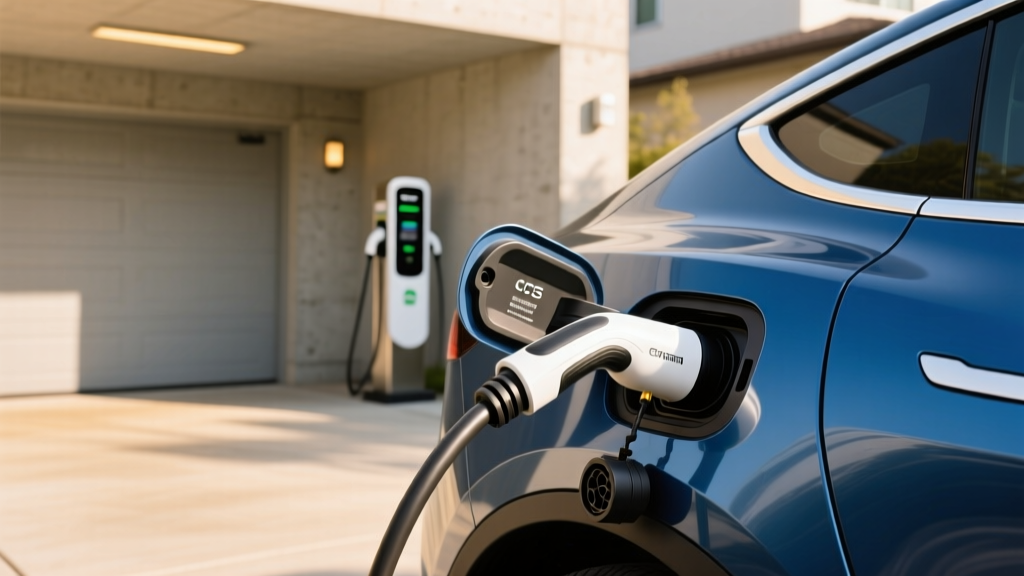
Adapter needs: If you own a CCS-equipped EV (like a 2023–2024 VW ID.4 or Ford Mustang Mach-E built before the NACS transition), you'll need a CCS-to-NACS adapter to access the Tesla Supercharger network—the largest and most reliable DC fast-charging network in North America. Ford and GM provide these adapters to owners of qualifying vehicles. Third-party adapters from brands like Lectron and A2Z are available for $150–$250. For home Level 2 charging, virtually all chargers ship with a J1772 connector, which works with every non-Tesla EV; Tesla owners use the included J1772-to-NACS adapter (a small, passive dongle).
Cost to Charge: Home vs. Public vs. Gas — The Per-Mile Math
Charging cost is where EVs deliver their biggest ongoing savings—but the gap narrows significantly if you rely exclusively on public DC fast charging. Here's how the numbers stack up.
| Scenario | Rate | Cost for 60 kWh (≈200 mi) | Cost Per Mile |
|---|---|---|---|
| Home — Off-Peak Utility Rate | $0.08–$0.12/kWh | $4.80–$7.20 | $0.024–$0.036 |
| Home — Average US Residential Rate | $0.16/kWh | $9.60 | $0.048 |
| Public Level 2 (ChargePoint, EVgo L2) | $0.25–$0.40/kWh | $15.00–$24.00 | $0.075–$0.12 |
| DC Fast Charging (Electrify America, Tesla Supercharger) | $0.30–$0.55/kWh | $18.00–$33.00 | $0.09–$0.165 |
| Gas Car (30 MPG avg, $3.40/gallon) | $3.40/gal | ~$22.67 (for 200 mi) | ~$0.113 |
The takeaway: Home charging at off-peak rates delivers fuel cost at roughly one-quarter to one-third the price of gasoline. Even at average residential rates, you're paying about $0.05 per mile versus $0.11+ for gas. But frequent reliance on DC fast charging at $0.40–$0.55/kWh can push your per-mile cost close to or even above that of an efficient gas car. This is why home charging access is the single most important factor in EV ownership economics.
Many utilities offer time-of-use (TOU) plans that drop rates to $0.06–$0.10/kWh during overnight hours (typically 11 PM – 6 AM). Setting your EV or charger to charge during these windows maximizes savings. According to fueleconomy.gov, EVs convert over 77% of electrical energy from the grid to power at the wheels, compared to just 12–30% for gasoline vehicles—this efficiency gap is why even at higher electricity rates, EVs often still cost less per mile.
Charging Time Examples: 10–80% by Battery Size and Charger Type
Here's how long real charging sessions take for common battery sizes and charger power levels. All times assume a 10–80% session (the standard fast-charging window; charging above 80% slows dramatically to protect battery health).
| Battery Size | Example Vehicle | Level 2 (11.5 kW / 48A) | DC Fast (150 kW peak) | DC Fast (250 kW peak) | DC Fast (350 kW peak) |
|---|---|---|---|---|---|
| 60 kWh usable | Chevy Equinox EV | ~4 hours | ~32 min | N/A (vehicle max ~150 kW) | N/A |
| 77 kWh usable | Ford Mustang Mach-E ER | ~5 hours | ~38 min | ~28 min | N/A (vehicle max ~150 kW) |
| 84 kWh usable | Hyundai Ioniq 5 (800V) | ~5.5 hours | ~35 min | ~18 min | N/A |
| 100 kWh usable | Tesla Model S / Rivian R1T | ~6.5 hours | ~45 min | ~25 min | ~20 min (R1T Max) |
Note that these are approximate times based on average sustained charge rates, not peak rates. A vehicle with a 250 kW peak might average 160–180 kW across the 10–80% session due to the charge curve taper. Battery temperature, ambient temperature, and state of health all affect real-world charging speed.
Equipment Recommendations: Top Level 2 Chargers for 2026
These are the chargers we recommend based on reliability, features, and value. All support the J1772 connector standard (compatible with every EV via adapter for Tesla) and are available in hardwired or plug-in configurations.
ChargePoint Home Flex
- Power Output: Up to 12 kW (50A) on a 60A circuit; adjustable down to 16A
- Connector: J1772 (NACS adapter included for Tesla vehicles)
- Cable Length: 23 feet
- Smart Features: Wi-Fi, app scheduling, energy tracking, Alexa integration
- Price: ~$550–$650
- Best For: Flexibility—adjustable amperage lets you match your circuit capacity without buying a different unit
Emporia Vue Level 2 Charger
- Power Output: Up to 11.5 kW (48A) on a 60A circuit
- Connector: J1772
- Cable Length: 24 feet
- Smart Features: Wi-Fi, app control, integrates with Emporia Vue energy monitor for whole-home tracking, solar-aware charging
- Price: ~$400–$500
- Best For: Budget-conscious buyers who want smart features and solar integration
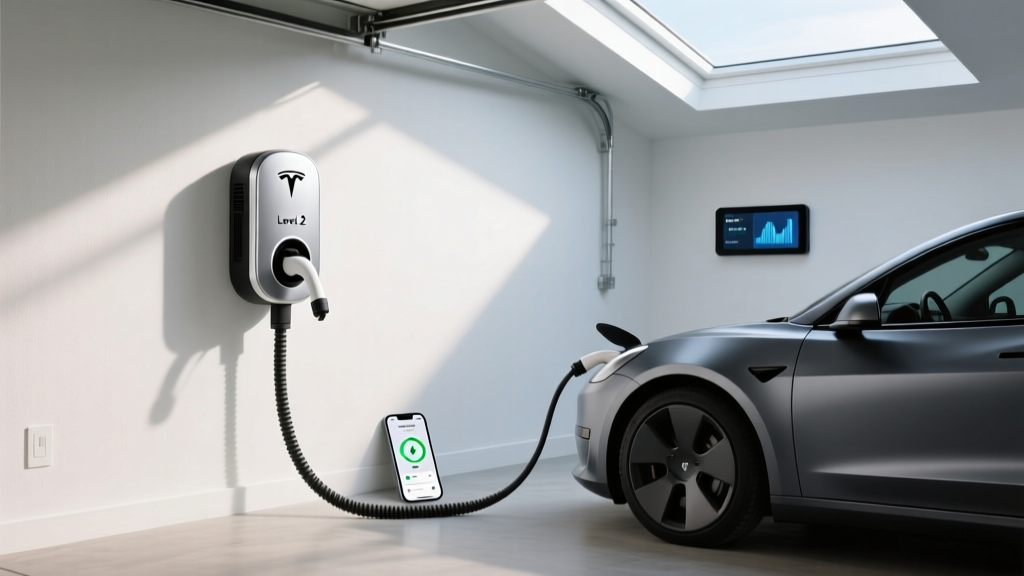
Tesla Wall Connector
- Power Output: Up to 11.5 kW (48A) on a 60A circuit
- Connector: NACS (native Tesla); J1772 adapter available separately
- Cable Length: 24 feet
- Smart Features: Wi-Fi, OTA updates, power sharing between multiple units, integrated Tesla app
- Price: ~$475
- Best For: Tesla owners who want a clean, native solution without adapters
Grizzl-E Smart
- Power Output: Up to 10 kW (40A) on a 50A circuit
- Connector: J1772
- Cable Length: 24 feet
- Smart Features: Wi-Fi, OCPP protocol support, works with multiple energy management platforms
- Price: ~$450–$550
- Best For: Extreme durability (built in Canada, rated to -40°F) and open-protocol compatibility
What to look for: Choose a charger rated for at least 40 amps (requiring a 50A circuit) to future-proof your setup. A 25-foot cable gives you flexibility for different parking orientations. Wi-Fi connectivity enables scheduling (charge during off-peak hours automatically) and energy tracking. If your charger will be outdoors, confirm a NEMA 4 weatherproof rating. Hardwired installations are generally preferred over plug-in NEMA 14-50 outlets because they eliminate the GFCI breaker requirement and reduce points of failure.
Public Charging Networks: What to Expect in 2026
Public DC fast-charging infrastructure has expanded significantly. The Tesla Supercharger network—now open to non-Tesla EVs with NACS connectors or adapters—remains the most reliable option, with over 30,000 stalls across North America and uptime consistently above 95%. Electrify America operates the second-largest network with roughly 5,000 stalls, many capable of 150–350 kW. EVgo, ChargePoint, and Blink fill in additional coverage, particularly in urban areas and along highway corridors.
When planning road trips, use apps like A Better Routeplanner (ABRP) or PlugShare to check real-time station availability, read user reviews, and verify connector types. Not all DC fast chargers deliver their rated power—older 50 kW CHAdeMO stations are still listed on some maps but won't serve modern NACS/CCS vehicles at useful speeds. Aim for stations rated at 150 kW or higher for meaningful session speeds.
One practical tip: precondition your battery before arriving at a DC fast charger. Most modern EVs (Tesla, Hyundai/Kia E-GMP vehicles, Ford, GM Ultium) do this automatically when you navigate to a charger in the built-in navigation system. Preconditioning warms the battery to optimal temperature, which can cut your 10–80% charge time by 30–50% in cold weather.
Frequently Asked Questions
How much does it cost to install a home EV charger?
A standard Level 2 home charger installation costs between $900 and $2,450 when your electrical panel has sufficient capacity. This includes $350–$750 for the charger unit, $500–$1,500 for electrician labor, and $50–$200 for permits. If your home needs a panel upgrade from 100A to 200A service, add $1,500–$3,500, bringing the total to $2,400–$6,000+. Always get quotes from at least two licensed electricians.
How fast will each charging level add range?
Level 1 (120V) adds 3–5 miles of range per hour—suitable for PHEVs or very low daily mileage. Level 2 (240V, 48A) adds roughly 40–45 miles per hour, covering most daily driving needs overnight. DC fast charging adds the equivalent of 150–200+ miles in 15–30 minutes depending on vehicle architecture and charger power. These figures assume moderate efficiency (~3–4 mi/kWh); larger, less efficient vehicles like electric trucks will add fewer miles per kWh.
Which connector/charger is compatible with my EV?
For 2025–2026 model year EVs: virtually all new vehicles use NACS (the Tesla connector, now standardized as SAE J3400). This includes Tesla, Ford, GM, Hyundai, Kia, Rivian, Volvo, BMW, and Mercedes-Benz. Older EVs (2024 and prior) may have CCS1 connectors—these can use CCS-to-NACS adapters ($150–$250) to access the Supercharger network. CHAdeMO is effectively discontinued. For home Level 2 charging, all non-Tesla EVs use J1772; Tesla uses NACS with a small J1772 adapter included with the vehicle.
How much does charging cost per mile vs gas?
Home charging at average US electricity rates ($0.16/kWh) costs approximately $0.04–$0.05 per mile for a typical EV getting 3–4 miles per kWh. Off-peak utility rates can drop this to $0.02–$0.04 per mile. By comparison, a gas car averaging 30 MPG at $3.40/gallon costs about $0.11 per mile. Public DC fast charging at $0.40–$0.55/kWh costs $0.09–$0.17 per mile—closer to gas prices, which is why home charging access is critical to EV economics.
What electrical upgrades might I need?
The most common upgrade is a panel capacity increase from 100A to 200A service ($1,500–$3,500), required in older homes that lack spare capacity for a 40–60A dedicated EV circuit. Other potential upgrades include: adding a new double-pole breaker, running new conduit and 6 AWG or 4 AWG copper wire from the panel to the charger location, and trenching if the charger is in a detached garage or far from the panel. Homes with 200A panels built after ~1990 typically need no panel upgrade. Your electrician's load calculation will determine this definitively.
Can I charge my EV with solar panels?
Yes. If you have a home solar system, your EV can charge on solar-generated electricity during the day. Smart chargers like the Emporia Vue or systems integrated with solar inverters (Enphase, SolarEdge) can prioritize solar production for EV charging, effectively reducing your fuel cost to near zero during sunny months. However, most solar systems produce 5–10 kW—enough for Level 2 charging but not DC fast charging.
Is it safe to charge an EV in the rain or outdoors?
Yes. EV chargers rated NEMA 4 or NEMA 4X are designed for outdoor use in rain, snow, and dust. The connector and vehicle inlet are engineered to be weather-sealed when mated. Never use a damaged cable or a charger with visible corrosion, and ensure your installation includes proper GFCI protection if using a plug-in outlet configuration.