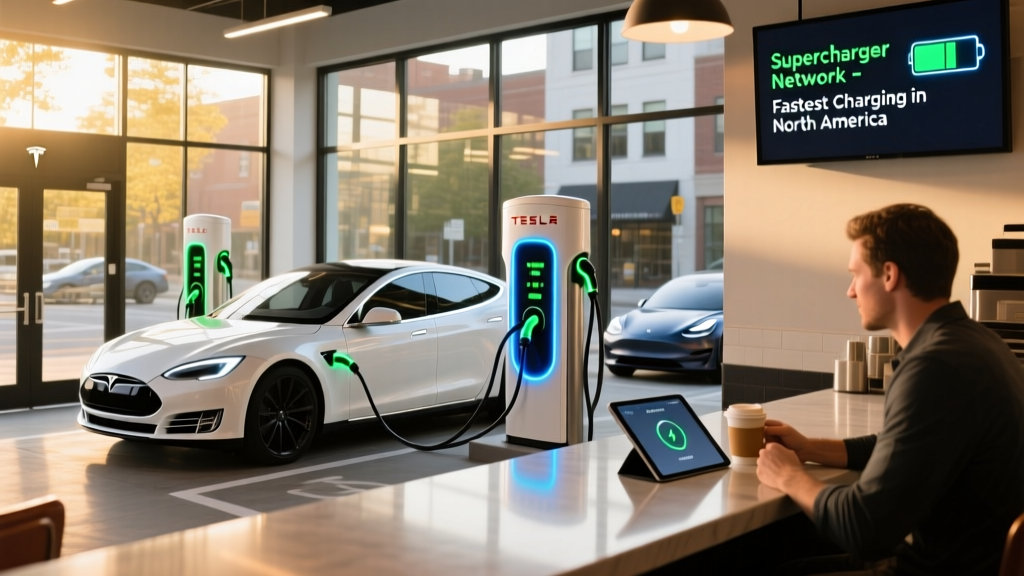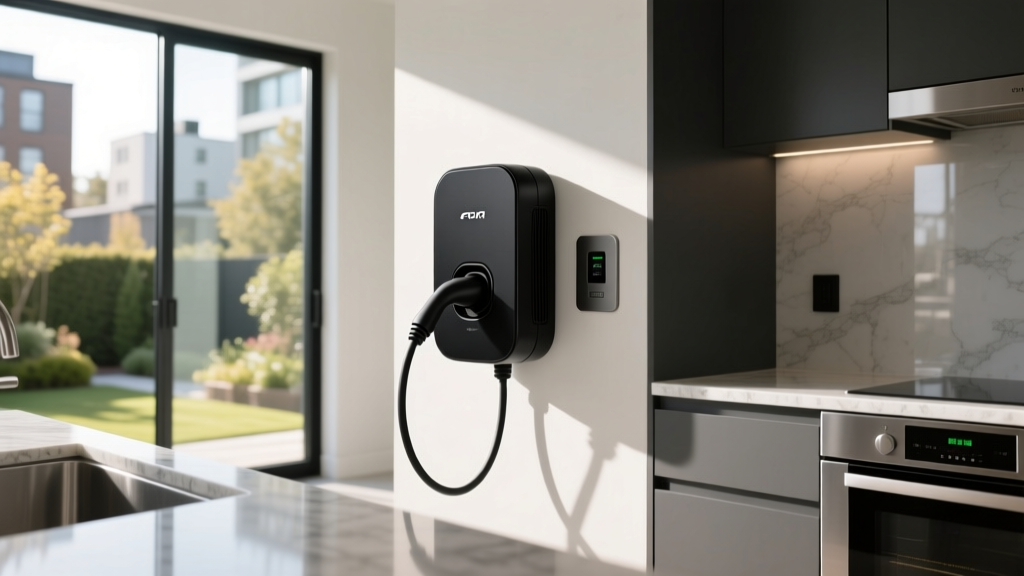
Let's be honest: you spent months picking the right EV, and now the charger hanging on your garage wall looks like a beige medical device. For design-conscious EV owners, the hardware matters almost as much as the car. That's why the all black charger has become one of the most searched aesthetics in home EV equipment — a matte or gloss black unit that blends with modern architecture instead of clashing with it.
But looks can't be the only criteria. A charger that looks great but delivers only 16 amps, ships with a 12-foot cable, or lacks a NEMA 4 outdoor rating will frustrate you within weeks. This guide pairs the best all-black Level 2 home chargers available in 2026 with a complete installation primer: electrical requirements, real costs, connector compatibility, and the per-mile economics versus gasoline.
Charging Levels Explained: kW, Speed, and Real-World Times
Before picking hardware, understand what each charging level actually delivers. The most common mistake new EV owners make is confusing kW (power — the rate energy flows) with kWh (energy — the battery's capacity). Think of kW as the width of the hose and kWh as the size of the bucket.
| Level | Voltage | Power (kW) | Miles Added per Hour | Typical Use |
|---|---|---|---|---|
| Level 1 | 120V | 1.0–1.4 kW | 3–5 mi/hr | Overnight trickle, PHEVs |
| Level 2 (home) | 240V | 7.2–11.5 kW | 25–45 mi/hr | Daily home charging |
| Level 2 (public) | 208/240V | 6.6–19.2 kW | 22–65 mi/hr | Workplace, retail, hotels |
| DC Fast (Level 3) | 400–800V DC | 50–350 kW | 150–1,000+ mi/hr | Road trips, highway corridors |
For a typical 75 kWh battery (think Tesla Model Y, Hyundai IONIQ 5, Ford Mustang Mach-E), expect these real-world 10–80% times:
- Level 1 (1.4 kW): 45–55 hours — not practical for BEVs.
- Level 2, 48A / 11.5 kW: ~6.5 hours — perfect overnight fill.
- DC Fast, 150 kW peak: 18–25 minutes, though the charge curve tapers sharply above 80% SoC.
- DC Fast, 350 kW (800V architecture, e.g., IONIQ 5, Porsche Taycan): 10–80% in ~18 minutes under ideal thermal conditions.
Remember: peak kW is not sustained kW. A "250 kW" charger may only hold that rate between 10–40% SoC before tapering. Battery temperature, ambient weather, and pack chemistry (LFP vs. NMC) all shape the curve.
Best All Black Home EV Chargers for 2026
These units earn the "all black" label honestly — matte or gloss black enclosures with black cables and minimal contrasting trim. I've prioritized hardwired or NEMA 14-50 models with at least 40A output, 20+ foot cables, and smart scheduling features.
ChargePoint Home Flex (Black)
- Output: Up to 11.5 kW (48A) on 60A circuit
- Connector: J1772 (NACS adapter included for newer trims)
- Cable: 23 ft
- Smart: Wi-Fi, Alexa, scheduled charging, utility TOU integration
- Outdoor: NEMA 4 rated
- Price: ~$599
Verdict: The benchmark. Flexible amperage via DIP switches means one unit fits 20A to 60A circuits.
Tesla Wall Connector (Black)
- Output: Up to 11.5 kW (48A) on 60A circuit
- Connector: Native NACS — no adapter needed for Tesla vehicles
- Cable: 24 ft
- Smart: Wi-Fi, OTA updates, power-sharing for multi-unit installs
- Outdoor: NEMA 4 rated
- Price: ~$420
Verdict: Best value for Tesla owners and post-2025 NACS-equipped Ford, GM, Rivian, and Volvo EVs.
Emporia Level 2 Smart Charger (Black)
- Output: Up to 11.5 kW (48A) on 60A circuit
- Connector: J1772
- Cable: 24 ft
- Smart: Pairs with Emporia Vue home energy monitor for solar-aware charging
- Outdoor: NEMA 4
- Price: ~$399
Verdict: Strong pick for solar homes; the energy-monitoring integration is unmatched at this price.
Grizzl-E Smart (Matte Black)
- Output: Up to 10 kW (40A) on 50A circuit
- Connector: J1772 or NACS (configurable)
- Cable: 24 ft
- Smart: OCPP-compatible, works with multiple apps
- Outdoor: IP67, built in Canada for -40°C
- Price: ~$549
Verdict: The cold-weather tank. If you live where winters bite, this is the durable choice.
Lectron V-BOX Pro (Black)
- Output: Up to 11.5 kW (48A)
- Connector: J1772 or NACS variant
- Cable: 20 ft
- Smart: Basic app, no Wi-Fi scheduling
- Outdoor: IP66
- Price: ~$299
Verdict: Budget pick if smart features aren't a priority. Solid hardware, limited software.
How Much Does It Cost to Install a Home EV Charger?
This is where the real sticker shock hits. The charger itself is the cheap part. The electrical work — especially in homes built before 2010 — is where budgets stretch.
| Component | Typical Range | Notes |
|---|---|---|
| Charger hardware | $300–$650 | Varies by brand and amperage |
| Electrician labor (2–6 hrs) | $400–$1,800 | Higher if panel is far from garage |
| Permit and inspection | $75–$300 | Required in most jurisdictions |
| New 60A circuit, short run | $200–$600 | Panel has spare capacity, <30 ft run |
| Electrical panel upgrade (200A) | $1,800–$4,500 | Needed on older 100A service panels |
| Trenching (detached garage) | $1,000–$3,500 | Per-linear-foot cost adds fast |
| Total — simple install | $800–$1,600 | Existing panel capacity, short run |
| Total — complex install | $3,000–$6,500+ | Panel upgrade + long conduit run |
The panel upgrade is the single biggest variable. A 100-amp panel in a 1970s split-level may have no headroom for a continuous 48A load (the NEC requires continuous loads to use only 80% of circuit capacity — so a 48A charger needs a 60A breaker). Always have a licensed electrician perform a load calculation before quoting.
Some utilities offer rebates of $250–$1,000 for Level 2 installs, and the federal Alternative Fuel Vehicle Refueling Property Credit (§30C) covers 30% of home charger hardware and install costs up to $1,000, subject to census-tract eligibility. Confirm current-year rules with a tax professional.
Connector Compatibility: NACS, CCS1, CHAdeMO, and Adapters
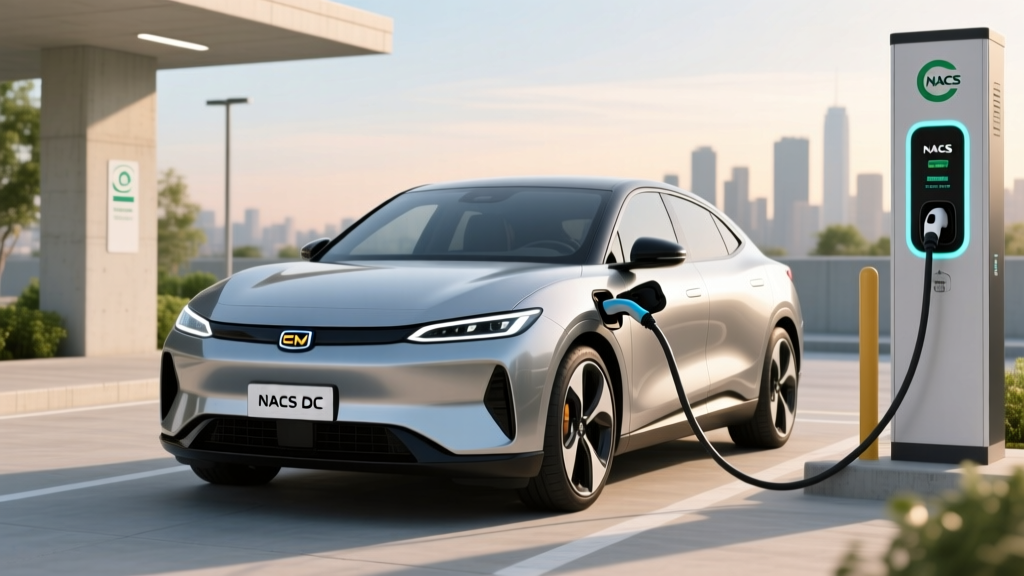
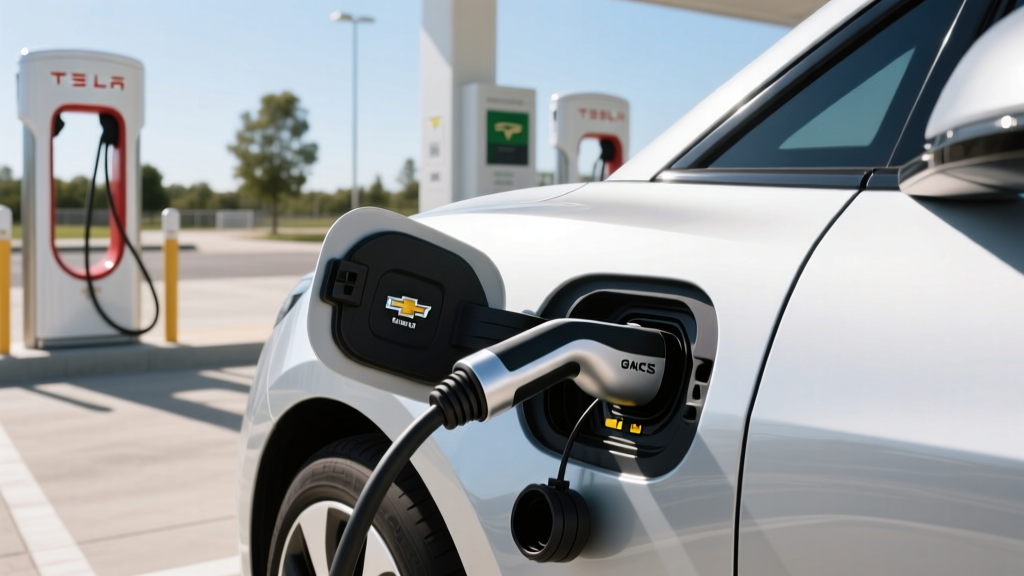
North America has largely converged on the NACS (North American Charging Standard) — the connector Tesla pioneered and opened to the industry starting in 2023. By the 2026 model year, virtually every new BEV sold in the U.S. ships with a native NACS port: Tesla, Ford, GM, Rivian, Volvo, Polestar, Hyundai, Kia, BMW, and more.
| Connector | Brands | Adapter Needed for Home? |
|---|---|---|
| NACS (native) | Tesla, Ford, GM, Rivian, Hyundai, Kia, Volvo, Polestar, BMW, Mercedes (newer), Lucid, Toyota (bZ) | None — buy a NACS Wall Connector |
| J1772 (legacy Level 2) | Older Nissan Leaf, pre-2025 models, some used EVs | J1772 charger + NACS-to-J1772 adapter if car is NACS |
| CCS1 (legacy DC fast) | Pre-2025 VW ID.4, older Chevy Bolt, pre-NACS models | N/A for home — relevant only at public DC stations |
| CHAdeMO | Nissan Leaf (older), Mitsubishi Outlander PHEV | Becoming rare; adapter options limited |
For a new 2026 EV, buy a NACS wall connector unless you also own a J1772-equipped legacy vehicle. For mixed fleets, the ChargePoint Home Flex with a NACS adapter gives you flexibility.
Cost Per Mile: Home Charging vs. Public vs. Gasoline
Electricity pricing varies wildly by region and time of day. Here's a realistic breakdown using a 2026 Hyundai IONIQ 5 (EPA combined efficiency ~30 kWh/100 mi, or ~3.33 mi/kWh per fueleconomy.gov).
| Scenario | $/kWh | Cost per 100 mi | Cost per mile |
|---|---|---|---|
| Home, off-peak (TOU rate) | $0.10 | $3.00 | $0.030 |
| Home, standard rate (national avg) | $0.17 | $5.10 | $0.051 |
| Public Level 2 (ChargePoint, EVgo) | $0.30–$0.45 | $9.00–$13.50 | $0.09–$0.135 |
| DC Fast (Electrify America, Tesla Supercharger) | $0.35–$0.55 | $10.50–$16.50 | $0.105–$0.165 |
| Gasoline (30 MPG combined, $3.40/gal) | — | $11.33 | $0.113 |
The math is clear: home charging at off-peak rates costs roughly one-quarter of gasoline per mile. Public DC fast charging, however, often matches or exceeds gasoline cost — it's a road-trip convenience, not a daily strategy. If you can't charge at home, a PHEV or HEV may be a more economical choice than a BEV.
Electrical Requirements, Safety, and Code
Before you order a charger, confirm these with a licensed electrician:
- Circuit sizing: A 48A charger requires a 60A dedicated circuit (NEC 80% rule for continuous loads). A 40A charger needs a 50A circuit.
- Wire gauge: Typically 6 AWG copper for 60A; 8 AWG for 40A — but long runs may require upsizing to mitigate voltage drop.
- GFCI protection: NEC 2020/2023 requires GFCI breakers for receptacle-based (NEMA 14-50) EV charging circuits. Hardwired units often bypass this requirement, which is one reason electricians prefer hardwired installs.
- Outdoor rating: If the charger mounts outside or in an unsealed garage, insist on NEMA 4 (splash-proof) or IP66/IP67 rating.
- Permit: Most municipalities require an electrical permit and post-install inspection. Skipping this risks insurance denial if a fire occurs.
- Panel headroom: Your electrician will run a load calculation per NEC Article 220. If the calculation shows insufficient capacity, a panel upgrade or a smart load-management device (like the Emporia Smart Load Center) may be required.
Real-World Charging Times: What to Actually Expect
Manufacturer-published charge times assume ideal conditions: battery preconditioned, ambient temperature 68–77°F, starting at 10% SoC, and sustained peak kW. In practice, expect these scenarios:
- Cold weather (below 32°F): Add 20–40% to charge time. LFP batteries are especially sluggish when cold unless preconditioned.
- Highway road-trip DC charging: Plan for 25–35 minutes per stop, not the "18 minutes" marketing claims — you'll arrive at 15–20% SoC, and the taper above 70% eats time.
- Level 2 overnight: A 48A/11.5 kW charger refills ~75 kWh of usable battery in 6.5 hours. Most owners use 20–30% per day, so 2–3 hours of plug-in is sufficient.
Preconditioning matters enormously for DC fast charging. When you navigate to a fast charger in Tesla, Ford, or Hyundai's nav system, the car warms the battery to optimal temperature en route. Skipping this (using a third-party app, or arriving at a charger cold) can halve your peak charge rate.
Frequently Asked Questions
How much does it cost to install a home EV charger?
A straightforward install on an existing 200A panel with a short conduit run typically costs $800–$1,600 total (hardware + electrician + permit). Complex installs requiring a panel upgrade, long wire runs, or trenching to a detached garage can reach $3,000–$6,500. Always get two or three quotes from licensed electricians.
How fast will each charging level add range?
Level 1 (120V) adds 3–5 miles per hour — fine for PHEVs, impractical for BEVs. Level 2 (240V, 48A) adds 30–45 miles per hour, enough to refill most EVs overnight. DC fast charging adds 150–1,000+ miles per hour at peak, but sustained rates taper significantly above 60–70% SoC.
Which connector/charger is compatible with my EV?
For 2026 models, nearly all new EVs use the NACS connector natively. If you own an older J1772-equipped EV or a CHAdeMO vehicle (older Nissan Leaf), you'll need a matching charger or an adapter. Check your owner's manual or the charge-port door for the connector type before purchasing.
How much does charging cost per mile vs gas?
Home charging at off-peak rates averages $0.03/mile — roughly one-quarter the cost of gasoline at $3.40/gallon and 30 MPG. Public DC fast charging, however, often costs $0.10–$0.17/mile, matching or exceeding gasoline. The economic case for EVs depends heavily on home charging access.
What electrical upgrades might I need?
The most common upgrade is a new dedicated 50A or 60A circuit with appropriate wire gauge and breaker. Older homes with 100A or 150A panels may need a full panel upgrade to 200A ($1,800–$4,500). Detached garages may require trenching for conduit. Your electrician's load calculation will determine what's needed.
Does the federal tax credit cover home charger installation?
The §30C Alternative Fuel Vehicle Refueling Property Credit covers 30% of charger hardware and installation costs, up to $1,000. However, eligibility is restricted to property placed in service in eligible census tracts (low-income or non-urban). Rules change frequently — verify current-year eligibility with a tax professional before relying on the credit.
Should I get a hardwired or plug-in (NEMA 14-50) charger?
Hardwired units avoid the NEC GFCI breaker requirement for receptacles, eliminate one failure point (the receptacle itself can overheat under continuous load), and often allow higher amperage. Plug-in units offer portability — you can take the charger when you move. Most electricians recommend hardwired for permanent installations.
The all-black aesthetic is a legitimate filter, but don't let it be the only one. Prioritize a 48A output, a 23+ foot cable, NEMA 4 outdoor rating, and smart scheduling — then pick the black unit that fits your electrical setup and connector needs. Your charger will hang on the wall for years and serve every EV you own next. Buy accordingly.