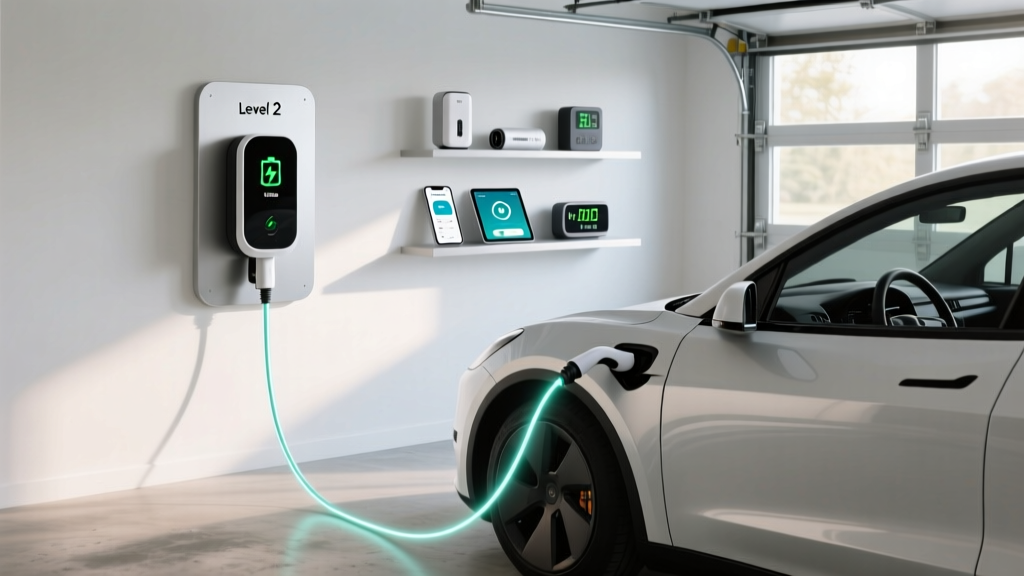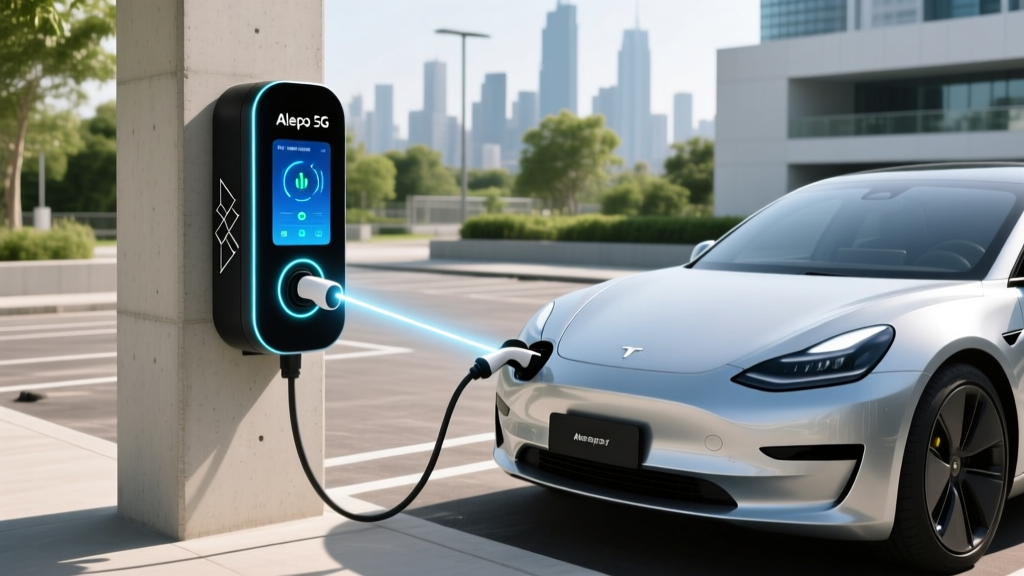
The promise of a "smart" EV charger has evolved past simple Wi-Fi scheduling. Today's connected chargers use cellular networks to deliver over-the-air firmware updates, real-time energy analytics, and remote diagnostics without relying on your home router. The Alepo 5G charging system represents a new tier of networked Level 2 equipment aimed at fleet operators, multi-family housing, and tech-forward homeowners who want granular control over their charging sessions. But 5G connectivity is only valuable if the underlying hardware — the kilowatt output, the connector, the installation requirements — actually meets your vehicle's needs.
This guide breaks down what the Alepo 5G platform offers, then zooms out to cover the full landscape of home and public EV charging in 2026: charging speeds, electrical requirements, connector compatibility, installation costs, and the real cost per mile compared to gasoline. Whether the Alepo system is on your shortlist or you are simply evaluating smart chargers, the fundamentals below apply to every EV on the road.
What Are the Alepo 5G Charging System Features?
Alepo's 5G-enabled charging platform integrates a cellular modem directly into the charger housing, bypassing the need for a home Wi-Fi network. This matters in garage installations where router signals are weak, and it matters more for commercial or multi-unit-dwelling deployments where network security and uptime are non-negotiable. Core Alepo 5G charging system features include:
- 5G/LTE fallback connectivity for real-time session monitoring, remote start/stop, and OTA updates independent of local Wi-Fi.
- Dynamic load management that adjusts amperage draw based on available panel capacity — useful in older homes with 100A or 150A service where a full 48A continuous draw might trip the main breaker during peak loads.
- Session-level energy metering accurate to ±1%, enabling precise cost tracking and, for commercial sites, sub-metering for tenant billing.
- OCPP 2.0.1 compliance (Open Charge Point Protocol), meaning the charger can integrate with third-party network management platforms like ChargePoint, EV Connect, or AmpUp rather than being locked to a single app ecosystem.
- Integrated RFID authentication for access control in shared or semi-public installations.
- Type 2 or NACS connector options depending on market, with power output configurable up to 19.2 kW (80A) on compatible hardware revisions.
The 5G connectivity is a differentiator for fleet and property managers who need to monitor dozens of chargers without deploying separate networking infrastructure. For a single-family homeowner with strong Wi-Fi in the garage, the practical advantage narrows — you still get OTA updates and remote monitoring, but a well-positioned Wi-Fi charger like the Emporia VUE or ChargePoint Home Flex accomplishes much of the same at lower hardware cost.
Charging Levels Explained: Speeds in kW and Miles Per Hour
Before evaluating any charger — Alepo or otherwise — you need to understand the three charging tiers and how they translate to actual range recovery. The distinction between kW (kilowatts, the rate of power delivery) and kWh (kilowatt-hours, the total energy stored in your battery) is the single most important piece of EV literacy. Think of kW as the speed of water flowing through a hose, and kWh as the total volume of the tank you are filling.
| Level | Voltage / Amperage | Max Power (kW) | Miles of Range Per Hour | Typical 10–80% Time (75 kWh battery) | Best For |
|---|---|---|---|---|---|
| Level 1 | 120V / 12A | 1.4 kW | 3–5 mi/hr | ~38 hours | Overnight top-up, PHEVs, emergency use |
| Level 2 | 240V / 16–80A | 3.8–19.2 kW | 12–60+ mi/hr | 4–12 hours (varies by amperage) | Daily home/workplace charging |
| DC Fast Charge | 400–900V DC | 50–350+ kW | 150–1,200+ mi/hr | 15–35 minutes | Road trips, highway corridor travel |
A few realities that spec sheets gloss over:
- Level 2 speed depends on your car's onboard charger. A 48A charger delivers up to 11.5 kW on a 240V circuit, but if your EV's onboard charger maxes out at 7.6 kW (like some base-trim models), you will never exceed that rate regardless of the charger's capability.
- DC fast charging follows a taper curve. A vehicle rated for 250 kW peak charging may sustain that rate only between 10–40% State of Charge (SoC), then progressively reduce power to protect battery health. A "15-minute 10–80%" claim assumes ideal battery temperature and low starting SoC.
- Cold weather slows everything. A battery at 30°F can accept DC fast charge at roughly half its rated speed until thermal management warms it. Preconditioning — available on most modern EVs when you navigate to a charger — mitigates this significantly.
Home Installation: Electrical Requirements and Real Costs
Installing a Level 2 home charger is an electrical project, not a plug-and-play appliance setup. The total cost depends on your home's existing electrical panel, the distance from panel to charger location, and local permit requirements.
Electrical Requirements
Most Level 2 chargers, including the Alepo 5G platform at its common 48A configuration, require:
- A dedicated 240V circuit with a breaker rated 125% above the charger's continuous draw. A 48A charger needs a 60A breaker; a 32A charger needs a 40A breaker. This is a National Electrical Code (NEC) requirement, not a recommendation.
- 6 AWG copper wire (or 4 AWG aluminum) for a 60A circuit, run in conduit where exposed.
- A NEMA 14-50 receptacle (for plug-in chargers) or direct hardwiring (for hardwired units, which many jurisdictions now require for circuits above 50A).
- GFCI protection — required by NEC 2020 and later for all EV charging receptacles. Many modern chargers include integrated GFCI, but your breaker may also need to be GFCI-type, which adds $50–$120 to the breaker cost.
Panel Upgrade: The Hidden Cost
Homes built before 2000 often have 100A or 150A main service panels. Adding a 60A EV circuit to an already loaded 100A panel can exceed the panel's capacity, especially if you also run electric heat, an electric dryer, and an electric range. A licensed electrician will perform a load calculation (NEC Article 220) to determine whether your panel can handle the additional draw.
If an upgrade is needed — typically to 200A service — expect to pay $1,500 to $4,000 for the panel swap, depending on your utility's requirements and whether a new meter base or service drop is involved. This is the single largest variable in home charger installation and the one most online cost calculators ignore.
Installation Cost Breakdown
| Component | Typical Range | Notes |
|---|---|---|
| Level 2 charger (equipment) | $350 – $800 | Smart Wi-Fi/5G chargers at the higher end; basic units lower |
| Electrician labor (standard install, <30 ft run) | $500 – $1,500 | Varies by region; hardwired and longer runs cost more |
| Permit and inspection | $50 – $250 | Required in most jurisdictions; some utilities bundle this |
| Panel upgrade (if needed) | $1,500 – $4,000 | 100A to 200A service; not needed in most newer homes |
| Conduit, wire, breaker, receptacle | $150 – $500 | Materials; included in most electrician quotes |
| Total (no panel upgrade) | $1,050 – $3,050 | Most common scenario for homes with 200A service |
| Total (with panel upgrade) | $2,550 – $7,050 | Older homes with 100A service |
Some utilities offer rebates of $250–$500 for Level 2 charger installation, and the federal Residential Clean Energy Credit may cover 30% of equipment and installation costs up to $1,000 through 2032, subject to eligibility. Check your utility's EV program page and consult a tax professional for your specific situation.
Connector Compatibility: NACS, CCS1, and CHAdeMO in 2026
The connector landscape has consolidated significantly since 2023, when Ford, GM, Rivian, and most other major automakers committed to adopting the North American Charging Standard (NACS), originally developed by Tesla. By 2026, NACS is the dominant connector for new EVs sold in North America, though CCS1 remains on hundreds of thousands of vehicles on the road.
| Connector | Brands Using It (2026 Models) | DC Fast Charge Network Access | Adapter Availability |
|---|---|---|---|
| NACS (Tesla standard) | Tesla, Ford, GM, Rivian, Hyundai/Kia (newer), Volvo, Polestar, Fisker | Tesla Supercharger network (17,000+ stalls), plus growing third-party NACS stations | CCS-to-NACS adapters available ($150–$250) for legacy CCS vehicles |
| CCS1 | VW ID.4 (pre-2025), BMW iX (pre-2026), legacy models still on road | Electrify America, EVgo, ChargePoint, Ionity (EU) | NACS-to-CCS adapters from Tesla and third parties |
| CHAdeMO | Nissan Leaf (discontinued after 2025), Mitsubishi Outlander PHEV (older) | Limited and declining network | No practical adapter to NACS/CCS for DC fast charging |
For home Level 2 charging, the connector situation is simpler. All Level 2 chargers sold in North America use either a NACS connector or a J1772 connector (the legacy Level 2 standard). Every EV sold in the US includes a J1772 inlet or a NACS inlet, and adapters between the two are widely available for $50–$100. The Alepo 5G platform ships in both NACS and J1772 variants, so confirm your vehicle's inlet before ordering.
For DC fast charging on road trips, your connector determines network access. A NACS-equipped EV in 2026 has the widest network reach, including the Tesla Supercharger network now open to non-Tesla vehicles via the NACS standard. CCS1 vehicles retain access to Electrify America and EVgo, though station counts are growing more slowly than NACS deployments. If you drive a CHAdeMO vehicle, plan routes carefully — PlugShare remains the best tool for checking live connector availability.
Cost to Charge: Home vs. Public vs. Gas Per Mile
The economic case for EV charging hinges on where and when you charge. Home charging on an off-peak utility rate is dramatically cheaper than gasoline per mile; relying exclusively on DC fast charging narrows the gap substantially.
| Scenario | Rate ($/kWh) | Vehicle Efficiency | Cost Per Mile | Annual Cost (12,000 mi) |
|---|---|---|---|---|
| Home Level 2, off-peak utility rate | $0.09 – $0.14 | 3.0 mi/kWh (100 MPGe) | $0.03 – $0.047 | $360 – $564 |
| Home Level 2, standard flat rate | $0.15 – $0.20 | 3.0 mi/kWh | $0.05 – $0.067 | $600 – $804 |
| Public Level 2 (workplace, retail) | $0.20 – $0.40 | 3.0 mi/kWh | $0.067 – $0.133 | $804 – $1,596 |
| DC Fast Charge (Electrify America, EVgo) | $0.35 – $0.55 | 3.0 mi/kWh | $0.117 – $0.183 | $1,404 – $2,196 |
| Gasoline (25 MPG combined, $3.40/gal) | — | 25 mi/gal | $0.136 | $1,632 |
Key takeaways:
- Home off-peak charging saves $1,000–$1,300 annually versus gasoline for a driver covering 12,000 miles. Over five years, that is $5,000–$6,500 in fuel savings — enough to offset a meaningful portion of the EV price premium.
- Exclusive DC fast charging can cost more than gasoline at the upper end of public pricing. This is why home charging access is the single most important factor in EV ownership satisfaction.
- Time-of-use (TOU) utility plans are essential. If your utility offers an EV-specific rate with off-peak pricing below $0.10/kWh between 10 PM and 6 AM, schedule your charging sessions accordingly. Most smart chargers, including the Alepo 5G, support scheduled charging natively.
Equipment Recommendations: Smart Level 2 Chargers Compared
The Alepo 5G occupies a specific niche — cellular-connected, OCPP-compliant, fleet-ready. For most single-family homeowners, a Wi-Fi-connected charger is sufficient and less expensive. Here is how the leading options compare across the criteria that matter: power output, connector, cable length, smart features, and price.
Alepo 5G Smart Charger
- Power Output: Up to 19.2 kW (80A) / common config: 11.5 kW (48A)
- Connector: NACS or J1772 (select at order)
- Cable Length: 25 ft standard
- Smart Features: 5G/LTE connectivity, OCPP 2.0.1, dynamic load management, RFID access, OTA updates, session energy metering
- Price: ~$650–$900 (hardware only)
- Best For: Multi-unit dwellings, fleet depots, commercial properties, homes without reliable Wi-Fi in garage
ChargePoint Home Flex
- Power Output: Up to 12 kW (50A), configurable down to 16A
- Connector: NACS or J1772
- Cable Length: 23 ft
- Smart Features: Wi-Fi, Alexa/Google Home integration, scheduled charging, energy tracking via ChargePoint app
- Price: ~$550–$650
- Best For: Single-family homes wanting a proven, widely supported smart charger
Emporia VUE Smart Charger
- Power Output: Up to 11.5 kW (48A)
- Connector: J1772 (NACS adapter available)
- Cable Length: 24 ft
- Smart Features: Wi-Fi, whole-home energy monitoring integration, solar-aware charging, scheduled and delayed charging
- Price: ~$400–$500
- Best For: Budget-conscious buyers, homes with solar panels, energy-monitoring enthusiasts
Tesla Wall Connector
- Power Output: Up to 11.5 kW (48A)
- Connector: NACS (includes J1772 adapter in box)
- Cable Length: 24 ft
- Smart Features: Wi-Fi, OTA updates, power sharing between multiple units, Tesla app integration
- Price: ~$475
- Best For: Tesla owners, multi-Tesla households (power sharing reduces install cost for second unit)
For a typical homeowner with a 200A panel and a single EV, the ChargePoint Home Flex or Tesla Wall Connector delivers the best balance of price, features, and reliability. The Alepo 5G earns its premium when you need cellular connectivity, OCPP compliance for fleet management software, or dynamic load management in a panel-constrained environment.
Safety, Code, and Installation Best Practices
EV chargers draw sustained high current for hours — a duty cycle more demanding than almost any other household appliance. Cutting corners on installation creates fire risk. Here is what a correct installation looks like:
- Dedicated circuit: Your EV charger must be on its own breaker, shared with nothing else. No outlet splits, no daisy-chaining.
- Correct wire gauge: 6 AWG copper minimum for 48A continuous (60A breaker). Undersized wire heats up under sustained load and is a leading cause of residential electrical fires.
- GFCI protection: Required by NEC 625.54 for all EV charging outlets. If your charger is hardwired, GFCI protection at the breaker is still recommended and may be required by your local inspector.
- Outdoor rating: If your charger is installed outdoors or in an unenclosed carport, it must carry a NEMA 4 or IP65 rating for water and dust ingress. All chargers listed above meet this standard.
- UL or ETL listing: Only install chargers that carry a UL (Underwriters Laboratories) or ETL (Intertek) safety certification mark. Uncertified chargers sold on marketplace sites may lack critical safety components and will likely fail inspection.
- Permit and inspection: Most jurisdictions require an electrical permit for EV charger installation. The inspection verifies wire gauge, breaker sizing, grounding, and GFCI compliance. Skipping the permit risks insurance claim denial if an electrical fire occurs.
Always hire a licensed electrician familiar with NEC Article 625 (Electric Vehicle Charging System Equipment). The National Fire Protection Association publishes the NEC, and your local authority having jurisdiction (AHJ) may have amendments specific to EV charging.
Frequently Asked Questions
How much does it cost to install a home EV charger?
For a home with an adequate 200A electrical panel and a charger location within 30 feet of the panel, expect to pay $1,050 to $3,050 total including equipment, electrician labor, materials, and permit. If your home has an older 100A panel that needs upgrading to 200A, add $1,500 to $4,000, bringing the total to $2,550–$7,050. Get at least two quotes from licensed electricians and confirm they include the permit cost.
How fast will each charging level add range?
Level 1 (120V) adds approximately 3–5 miles of range per hour — sufficient only for plug-in hybrids or very low daily mileage. Level 2 (240V) at 48A adds roughly 30–40 miles per hour for a typical EV with 3.0 mi/kWh efficiency, fully replenishing most batteries overnight. DC fast charging at 150–250 kW can add 150–300 miles in 20–30 minutes, though the charge rate tapers significantly above 80% SoC to protect battery health.
Which connector or charger is compatible with my EV?
For 2026 model-year vehicles, most new EVs use the NACS connector. Vehicles from model years 2020–2024 predominantly use CCS1. The Nissan Leaf (now discontinued) used CHAdeMO. For home Level 2 charging, any J1772 or NACS charger will work with any EV using a widely available adapter ($50–$100). For DC fast charging, your vehicle's built-in connector determines which networks you can access — NACS gives the broadest access in 2026.
How much does charging cost per mile compared to gas?
Charging at home on an off-peak utility rate of $0.12/kWh costs roughly $0.04 per mile for an EV averaging 3.0 mi/kWh. A gasoline car averaging 25 MPG at $3.40 per gallon costs about $0.136 per mile. That is a 70% per-mile savings for home-charged EVs. However, exclusive reliance on DC fast charging at $0.45/kWh pushes EV cost to roughly $0.15 per mile — slightly above gasoline.
What electrical upgrades might I need?
The most common upgrade is a panel upgrade from 100A to 200A service, needed in older homes where the existing panel lacks capacity for a 60A EV circuit on top of existing loads (HVAC, dryer, range). Your electrician will perform an NEC Article 220 load calculation. Some utilities offer "make-ready" programs that cover part of the panel upgrade cost. In rare cases, the utility may need to upgrade the service drop (the wires from the pole to your meter), which can add lead time but is typically at no cost to you.
Does the Alepo 5G charger qualify for any tax credits or incentives?
The federal Residential Clean Energy Credit (IRC §25D) covers 30% of the cost of EV charging equipment and installation, up to $1,000, for equipment placed in service through 2032. This applies to the Alepo 5G as it is a qualified EV charging unit. Additionally, many utilities and state energy offices offer separate rebates of $250–$750 for smart charger installation. Eligibility varies by income, location, and equipment certification — consult your utility's EV program page and a tax professional before claiming.