Why AGM Compatible Chargers Matter for EV Owners
Every electric vehicle on the road carries two batteries: the high-voltage traction pack that propels the car, and a 12V auxiliary battery that powers the electronics, door handles, infotainment, and safety systems. In many modern EVs — including Tesla's Model 3 and Model Y refreshes, the Hyundai Ioniq 5, and the Ford F-150 Lightning — that 12V battery is an Absorbent Glass Mat (AGM) unit rather than a traditional flooded lead-acell battery. AGM batteries offer better vibration resistance, longer cycle life, and maintenance-free operation, but they demand specific charging profiles that generic trickle chargers simply cannot provide.
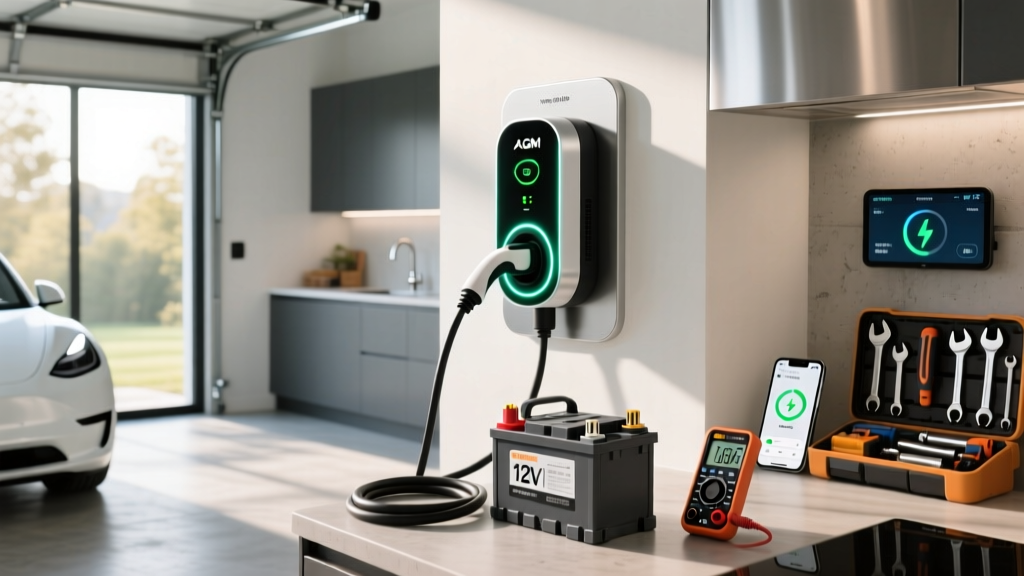
An AGM compatible charger delivers a precise multi-stage charge cycle — bulk, absorption, and float — with voltage limits calibrated to AGM chemistry (typically 14.4V absorption, 13.6V float). Using a standard lead-acid charger on an AGM cell risks overcharging, gassing, and premature failure. For EV owners who store their vehicles for extended periods, tow a trailer, or live in extreme climates, a dedicated AGM charger is a small investment that prevents the dead-12V scenario that strands more EVs than you might think.
Throughout this guide, we use kW (kilowatts) to describe charging power — how fast energy flows into a battery — and kWh (kilowatt-hours) to describe energy capacity — how much the battery holds. Think of kW as the width of a hose and kWh as the size of the bucket. Confusing these two is the single most common EV literacy gap, and it leads to bad purchasing decisions.
EV Charging Levels Explained: Speeds, Power, and Range Per Hour
Before selecting equipment, you need to understand the three charging tiers available to EV owners. Each level delivers dramatically different power (kW) and therefore different miles of range added per hour of charging.
| Level | Voltage | Power (kW) | Miles of Range per Hour | Typical Use Case |
|---|---|---|---|---|
| Level 1 | 120V AC | 1.0–1.4 kW | 3–5 mi/hr | Overnight top-ups, PHEVs, emergency |
| Level 2 | 240V AC | 3.3–19.2 kW | 12–75 mi/hr | Home daily charging, workplace, retail |
| DC Fast Charge | 200–900V DC | 50–350 kW | 150–1,200 mi/hr | Road trips, highway corridors |
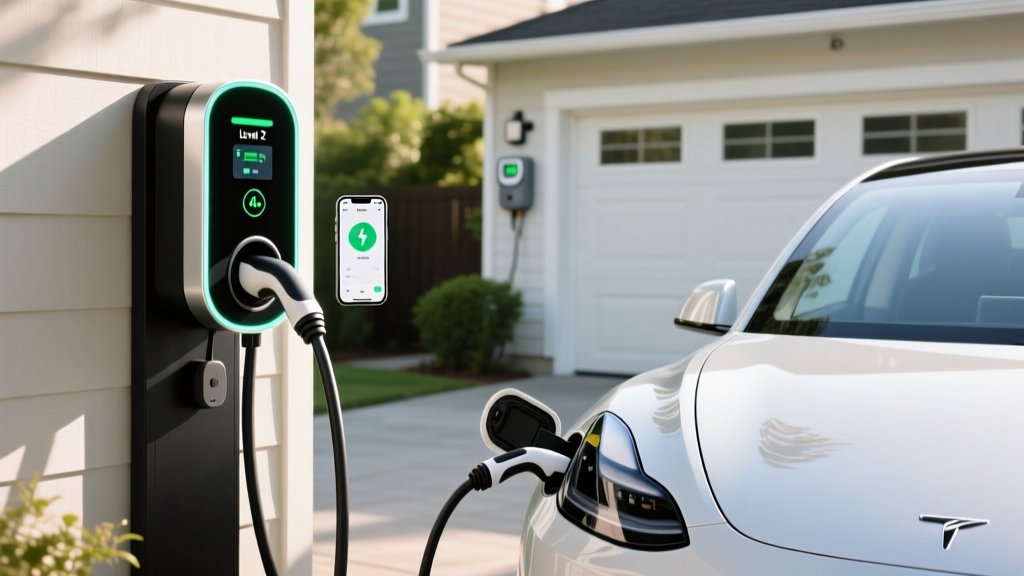
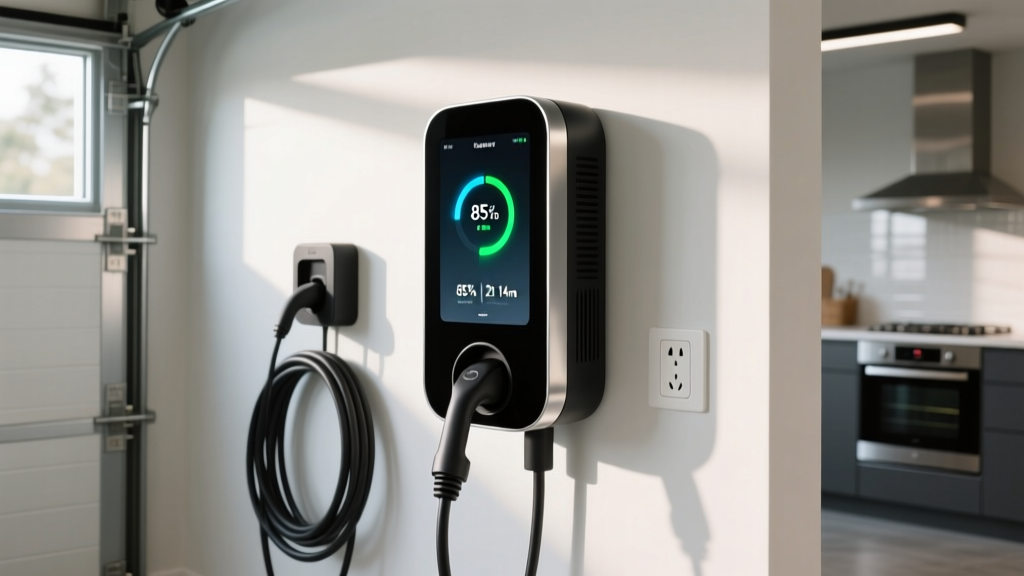
Level 2 home charging is where most EV owners spend 80–90% of their charging time. A 48-amp Level 2 station delivering 11.5 kW on a 240V/60A circuit can fully replenish a 77 kWh battery (Ford Mustang Mach-E Extended Range) in roughly 7–8 hours, or add approximately 35–40 miles of range per hour. For most daily commutes of 30–60 miles, a Level 2 session of 1–2 hours is more than sufficient.
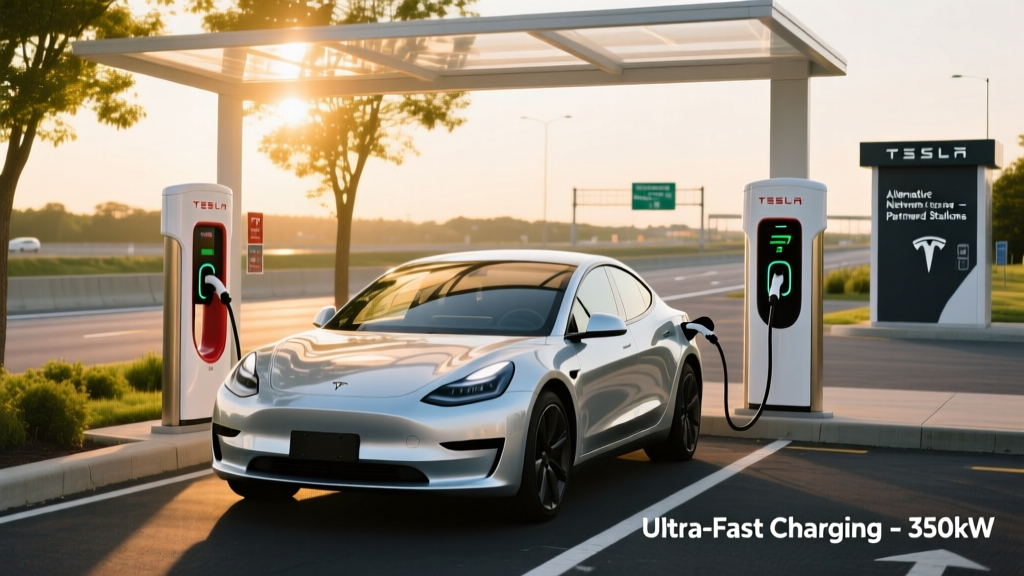
DC fast charging operates on a different principle entirely. Peak power (e.g., 250 kW) is only sustained for a portion of the session — typically between 10% and 50% state of charge (SoC). Above 80% SoC, the charge curve tapers sharply to protect battery health. A vehicle rated for 250 kW peak might only average 120–150 kW across a full 10–80% session. This is why manufacturers quote 10–80% times rather than 0–100% times. For example, the Hyundai Ioniq 5 with its 800V architecture achieves a 10–80% charge in approximately 18 minutes at a 350 kW charger, while the Tesla Model Y Long Range achieves 10–80% in roughly 25–27 minutes at a 250 kW Supercharger.
Home Level 2 Installation: Electrical Requirements, Permits, and Costs
Installing a Level 2 home charger is not a simple plug-and-play project. It requires a dedicated 240V circuit, proper amperage sizing, and in many jurisdictions, a permitted electrical inspection. Here is what the process involves and what you should budget.
Electrical Requirements
Most Level 2 chargers draw between 16 and 48 amps. The National Electrical Code (NEC) requires that continuous loads (defined as operating for 3+ hours) use no more than 80% of a circuit's rated capacity. This means:
- 32-amp charger: requires a 40-amp breaker and 8 AWG copper wire
- 40-amp charger: requires a 50-amp breaker and 6 AWG copper wire
- 48-amp charger: requires a 60-amp breaker and 4 AWG copper wire
The circuit must be dedicated — sharing it with a dryer, HVAC, or other major appliance is a code violation and a fire risk.
Panel Upgrade Considerations
If your home has a 100-amp service panel (common in homes built before 1990), adding a 60-amp EV circuit may exceed your panel's capacity. An electrician will perform a load calculation per NEC Article 220 to determine whether a panel upgrade to 200 amps is necessary. Panel upgrades typically cost $1,500–$3,000 and may require a utility service upgrade as well, adding another $500–$2,000 depending on your provider.
Permits and Inspections
Most municipalities require an electrical permit for new 240V circuits. Permit fees range from $50 to $300 depending on jurisdiction. The inspection ensures proper wire gauge, breaker sizing, grounding, and GFCI protection where required (NEC 2020 and later mandate GFCI for EV receptacles in garages).
| Component | Low Estimate | High Estimate | Notes |
|---|---|---|---|
| Level 2 EVSE (charger unit) | $350 | $750 | 32A–48A smart chargers |
| Electrical permit | $50 | $300 | Varies by municipality |
| Electrician labor (standard install) | $400 | $1,200 | 2–4 hours, panel-adjacent install |
| Wire, conduit, breaker | $100 | $400 | Depends on run length and gauge |
| Panel upgrade (if needed) | $1,500 | $3,000 | 100A → 200A service |
| Total (no panel upgrade) | $900 | $2,650 | Typical suburban home |
| Total (with panel upgrade) | $2,400 | $5,650 | Older homes with 100A panels |
The federal government does not currently offer a direct tax credit for residential EV charger installation — the previous §30C Alternative Fuel Infrastructure Tax Credit expired for most residential installations. However, many utilities and state agencies offer rebates of $250–$1,000 for Level 2 equipment and installation. Check with your local utility and the Alternative Fuels Data Center for current programs in your state.
Connector Compatibility: NACS, CCS1, and CHAdeMO
The North American charging landscape has consolidated heavily around the North American Charging Standard (NACS), originally developed by Tesla. As of the 2025–2026 model years, nearly every major automaker — Ford, GM, Rivian, Volvo, Polestar, Mercedes-Benz, BMW, Hyundai, Kia, and others — has adopted NACS for new vehicles. The Combined Charging System (CCS1) connector remains on many 2021–2024 models still on the road, while CHAdeMO is effectively legacy, found only on older Nissan Leaf and Mitsubishi Outlander PHEV models.
| Connector | Brands Using It (2026) | Adapter Needed for Cross-Network Charging? |
|---|---|---|
| NACS (Tesla standard) | Tesla, Ford, GM, Rivian, Volvo, Polestar, Hyundai, Kia, Mercedes, BMW, Nissan (new Ariya) | CCS adapter for Electrify America / older public stations |
| CCS1 | Legacy 2021–2024 models (VW ID.4 early, Chevy Bolt pre-2025, some Hyundai/Kia) | NACS adapter required for Tesla Supercharger access |
| CHAdeMO | Nissan Leaf (2011–2024), Mitsubishi Outlander PHEV (older) | Limited network; no practical adapter to NACS/CCS |
For home Level 2 charging, all vehicles use the J1772 connector standard — including Tesla, which ships a J1772 adapter with every vehicle. This means any Level 2 home charger with a J1772 plug will work with any EV sold in North America. The connector fragmentation primarily affects DC fast charging on public networks.
If you own a CCS1-equipped EV and want access to Tesla's Supercharger network (now open to non-Tesla vehicles via the "Magic Dock" adapter at select stations), you will need the manufacturer-specific CCS-to-NACS adapter. Ford and GM provide these adapters to owners; aftermarket options from Lectron and A2Z are available for $150–$300.
Cost to Charge: Home vs Public vs DC Fast Charging Per Mile
One of the strongest economic arguments for EV ownership is the lower per-mile energy cost compared to gasoline. But that advantage varies dramatically depending on where and when you charge.
| Scenario | Rate ($/kWh) | Cost per 300-Mile Fill/Charge | Cost per Mile | Equivalent Gas Price |
|---|---|---|---|---|
| Home off-peak (utility TOU rate) | $0.08–$0.12 | $7.20–$10.80 | $0.024–$0.036 | $0.75–$1.10/gal |
| Home standard rate (no TOU) | $0.13–$0.18 | $11.70–$16.20 | $0.039–$0.054 | $1.20–$1.65/gal |
| Public Level 2 (ChargePoint, EVgo) | $0.25–$0.45 | $22.50–$40.50 | $0.075–$0.135 | $2.30–$4.10/gal |
| DC Fast Charge (Electrify America, Tesla) | $0.30–$0.55 | $27.00–$49.50 | $0.090–$0.165 | $2.75–$5.05/gal |
| Gasoline vehicle (30 MPG, $3.50/gal) | — | $35.00 | $0.117 | $3.50/gal |
These figures assume an EV efficiency of approximately 3.0 miles per kWh (roughly 112 MPGe), which is typical for a midsize crossover like the Tesla Model Y or Hyundai Ioniq 5. More efficient vehicles like the Lucid Air (4.5+ mi/kWh) will cost even less per mile; larger vehicles like the Ford F-150 Lightning (2.0–2.3 mi/kWh) will cost more.
The takeaway is clear: home charging on an off-peak time-of-use (TOU) rate delivers fuel cost savings of 70–80% versus gasoline. Exclusive reliance on public DC fast charging, however, can erode those savings substantially — in some markets, DC fast charging costs approach or exceed the equivalent gasoline cost per mile. This is why home Level 2 installation is the single most impactful decision for EV ownership economics.
Recommended AGM Compatible Chargers and Level 2 EVSE Equipment
Below are our top equipment picks across two categories: AGM compatible chargers for maintaining your EV's 12V battery, and Level 2 EVSE units for daily traction-battery charging.
Best AGM Compatible Chargers (12V Battery Maintenance)
NOCO GENIUS10 (10A)
- Output: 10 amps, 12V
- AGM Mode: Dedicated AGM/Lithium selectable profile
- Features: Temperature compensation, desulfation mode, force mode for deeply discharged batteries
- Cable Length: 6.5 ft
- Price: ~$100
- Best For: Larger AGM batteries (70Ah+), long-term storage maintenance
CTEK MXS 5.0 (4.3A)
- Output: 4.3 amps, 12V
- AGM Mode: AGM-specific option with higher absorption voltage (14.7V for cold AGM)
- Features: 8-step charge cycle, recond mode, IP65 weatherproof
- Cable Length: 5.2 ft
- Price: ~$80
- Best For: Standard AGM batteries, outdoor/garage use in harsh climates
Battery Tender Plus 1.25A (AGM Compatible)
- Output: 1.25 amps, 12V
- AGM Mode: AGM-safe float voltage (13.2V)
- Features: Spark-proof, reverse polarity protection, compact form factor
- Cable Length: 12 ft (with quick-connect harness)
- Price: ~$50
- Best For: Continuous maintenance of smaller AGM batteries, budget pick
Victron Blue Smart IP22 (15A)
- Output: 15 amps, 12V
- AGM Mode: Fully configurable via Bluetooth app — set exact absorption/float voltages
- Features: Bluetooth monitoring, adaptive charge algorithm, storage mode
- Cable Length: 6 ft
- Price: ~$160
- Best For: Tech-savvy owners who want granular control and SoH monitoring
Best Level 2 Home EV Chargers (240V Traction Battery)
ChargePoint Home Flex (up to 50A)
- Power Output: Up to 12 kW (50A on 240V)
- Connector: J1772 (works with all EVs)
- Cable Length: 23 ft
- Smart Features: Wi-Fi, app scheduling, Alexa integration, energy reporting
- Price: ~$550
- UL Listed: Yes; NEMA 4 outdoor rated
Emporia Vue Level 2 Charger (48A)
- Power Output: Up to 11.5 kW (48A on 240V)
- Connector: J1772
- Cable Length: 24 ft
- Smart Features: Integrates with Emporia energy monitor, solar-aware charging, TOU scheduling
- Price: ~$400
- UL Listed: Yes; NEMA 4 outdoor rated
Tesla Wall Connector (48A)
- Power Output: Up to 11.5 kW (48A on 240V)
- Connector: NACS (Tesla native); includes J1772 adapter in box for non-Tesla EVs
- Cable Length: 24 ft
- Smart Features: Wi-Fi updates, power sharing with second unit, load management
- Price: ~$475
- UL Listed: Yes; NEMA 3R outdoor rated
Grizzl-E Smart (40A)
- Power Output: Up to 9.6 kW (40A on 240V)
- Connector: J1772
- Cable Length: 24 ft
- Smart Features: OCPP compatible, adjustable amperage (16/24/32/40A), rugged build
- Price: ~$450
- UL Listed: Yes; IP67 weatherproof, -40°C rated
Safety, Code Compliance, and Best Practices
EV charging equipment handles significant electrical power for hours at a time. Safety is not optional — here are the non-negotiable requirements:
- Dedicated circuit: Your Level 2 charger must be on its own breaker. No sharing with dryers, ovens, or workshop equipment.
- GFCI protection: NEC 2020 (Article 625.54) requires ground-fault circuit interrupter protection for EV receptacles. Many modern EVSE units have built-in GFCI; if yours does not, the breaker must be a GFCI type.
- Outdoor rating: If your charger is mounted outside or in an unenclosed carport, it must be rated NEMA 4 (weatherproof) or IP65/IP67. Indoor-only units in an outdoor mount are a code violation and a shock hazard.
- Wire gauge: Undersized wire is a fire risk. Always follow NEC ampacity tables — 6 AWG copper for 50A circuits, 4 AWG for 60A. Aluminum wire requires one size larger.
- Hardwired vs plug: Chargers rated above 40 amps are typically hardwired (no plug), which eliminates the receptacle as a failure point. If using a NEMA 14-50 receptacle, ensure it is an industrial-grade unit (Hubbell, Bryant) — residential-grade 14-50 outlets have been linked to overheating incidents with sustained EV loads.
- Cable management: A 24-foot charging cable is heavy and can be a trip hazard. Use a cable holster or retractable reel to keep the cord off the ground when not in use.
Frequently Asked Questions
How much does it cost to install a home EV charger?
A standard Level 2 home charger installation runs $900–$2,650 when your electrical panel has sufficient capacity. This includes the charger unit ($350–$750), electrician labor ($400–$1,200), wire and conduit ($100–$400), and the permit ($50–$300). If your home has an older 100-amp panel that requires upgrading to 200 amps, add $1,500–$3,000 to the total, bringing the range to $2,400–$5,650.
How fast will each charging level add range?
Level 1 (120V) adds approximately 3–5 miles of range per hour. Level 2 (240V) adds 12–75 miles per hour depending on the charger's amperage and your vehicle's onboard charger capacity. DC fast charging adds 150–1,200 miles per hour at peak power, though the rate tapers significantly above 80% SoC. For practical purposes, a 48-amp Level 2 charger delivering 11.5 kW adds roughly 35–40 miles per hour for a typical midsize EV crossover.
Which connector/charger is compatible with my EV?
For home Level 2 charging, every EV sold in North America uses the J1772 connector, so any J1772 Level 2 charger will work with any vehicle. For DC fast charging, check whether your vehicle uses NACS (most 2025–2026 models), CCS1 (many 2021–2024 models), or CHAdeMO (older Nissan Leaf). Adapters are available to cross between NACS and CCS networks. Consult your owner's manual or the manufacturer's website for your specific model year.
How much does charging cost per mile vs gas?
Home charging on an off-peak utility rate ($0.08–$0.12/kWh) costs approximately $0.024–$0.036 per mile — roughly 70–80% less than a 30 MPG gasoline car at $3.50/gallon ($0.117/mile). Public DC fast charging at $0.35–$0.55/kWh costs $0.090–$0.165 per mile, which narrows or eliminates the cost advantage depending on your local gas prices. Maximizing home charging is the key to EV fuel savings.
What electrical upgrades might I need?
The most common upgrade is a panel replacement from 100 amps to 200 amps, required when your existing panel cannot support a new 40–60 amp dedicated circuit alongside your home's other loads. Older homes may also need a utility service drop upgrade, new grounding electrodes, or replacement of outdated wiring (aluminum branch circuits, knob-and-tube). A licensed electrician will perform an NEC Article 220 load calculation to determine exactly what is needed before any work begins.
Can I use a regular battery charger on my EV's AGM 12V battery?
No. Standard flooded lead-acid chargers often use higher absorption voltages (14.8V+) and different float profiles that can overcharge and damage AGM batteries. Always use a charger with a dedicated AGM mode that limits absorption to approximately 14.4V and float to 13.2–13.6V. The NOCO GENIUS10 and CTEK MXS 5.0 both offer proper AGM profiles and are widely recommended for EV auxiliary battery maintenance.