The Acura ZDX marks Honda's premium entry into the electric SUV segment, built on GM's Ultium platform and sharing its bones with the Cadillac Lyriq. But knowing the EPA range sticker is only half the battle. To actually live with this EV day-to-day, you need to understand how to replenish its 102 kWh battery pack efficiently, affordably, and safely—whether you're plugging in at home or relying on public infrastructure.
This guide pairs the ZDX's specific charging capabilities with a practical breakdown of home installation, public charging networks, connector compatibility, and the real cost of electrons versus gasoline. If you're evaluating the Acura ZDX range as a daily driver, the charging setup you choose will determine whether that range feels liberating or limiting.
Acura ZDX Range and Charging Specs at a Glance
Before we map out charging infrastructure, here are the ZDX's hard numbers. The 2024–2025 Acura ZDX comes in two main drivetrain configurations with different battery sizes and range ratings.
| Specification | ZDX RWD (A-Spec) | ZDX AWD (A-Spec) | ZDX Type S |
|---|---|---|---|
| Battery (usable) | 85 kWh | 102 kWh | 102 kWh |
| Chemistry | NMC (Ultium) | NMC (Ultium) | NMC (Ultium) |
| EPA Range | 313 mi | 304 mi | 278 mi |
| Real-World Range (highway/cold) | ~250–275 mi | ~245–265 mi | ~220–245 mi |
| Max DC Fast Charge | 190 kW | 190 kW | 190 kW |
| 10–80% DCFC Time | ~42 min | ~42 min | ~42 min |
| Level 2 AC Acceptance | 11.5 kW (48A) | 19.2 kW (80A) | 19.2 kW (80A) |
| 0–60 mph | ~7.0 sec | ~5.7 sec | ~4.5 sec |
| Horsepower | 340 hp | 490 hp | 500 hp |
| Base MSRP | $57,850 | $61,850 | $69,850 |
| Battery Warranty | 8 yr / 100,000 mi | 8 yr / 100,000 mi | 8 yr / 100,000 mi |
Charging Levels Explained: Speeds, Times, and Range Added
EV charging operates at three distinct tiers. The critical distinction to internalize: kW (kilowatts) measures power—how fast energy flows—while kWh (kilowatt-hours) measures energy—the total capacity of the battery. Think of kW as the width of a hose and kWh as the size of the bucket.
| Level | Voltage | Max Power (kW) | Miles of Range Added per Hour | Typical Use Case |
|---|---|---|---|---|
| Level 1 | 120V AC | 1.4 kW | ~4 mi/hr | Emergency / overnight trickle |
| Level 2 | 240V AC | 11.5–19.2 kW | ~35–60 mi/hr | Home daily charging, workplace |
| DC Fast Charge | 400V+ DC | Up to 190 kW | ~200+ mi in 30 min | Road trips, highway corridors |
What This Means for the ZDX Specifically
Level 1 (standard 120V outlet): At 1.4 kW, fully recharging the ZDX AWD's 102 kWh battery from 10% would take roughly 65 hours. This is viable only as a backup or for plug-in hybrid owners with smaller batteries. For a full EV like the ZDX, Level 1 is not a practical daily strategy.
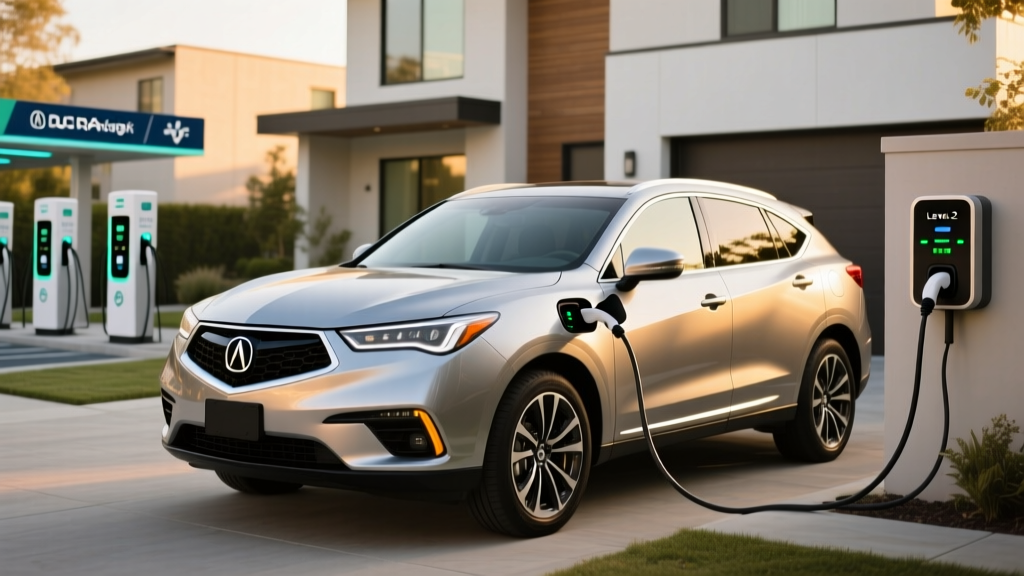
Level 2 (240V home or public charger): This is where the ZDX lives day-to-day. The RWD model accepts up to 11.5 kW (48 amps), while the AWD and Type S can accept up to 19.2 kW (80 amps)—one of the fastest Level 2 rates available on any consumer EV. At 19.2 kW, you'd add roughly 55–60 miles of range per hour, or fully recharge from 10% in about 5.5 hours. At 11.5 kW (RWD), expect about 35 miles per hour and a full charge in ~8 hours.
DC Fast Charging: The ZDX peaks at 190 kW on compatible CCS chargers. In optimal conditions (battery preconditioned, 10–80% SoC window), expect roughly 42 minutes. However, like all EVs, the ZDX follows a charging curve: peak speed is sustained only up to about 40–50% SoC, then tapers significantly. Charging from 80–100% on DCFC is painfully slow and unnecessary—save that for Level 2 overnight.
Home Charger Installation: Electrical Requirements and Costs
Installing a Level 2 home charger is the single biggest quality-of-life upgrade for ZDX ownership. Here's what it actually takes—and costs.
Electrical Requirements
To unlock the ZDX AWD/Type S's 19.2 kW acceptance rate, you need a dedicated 240V / 100-amp circuit (the charger itself draws 80A continuous, and electrical code requires circuits rated 125% of continuous load). This is a substantial circuit—comparable to running an electric oven and dryer simultaneously.
For the RWD model's 11.5 kW acceptance, a 240V / 60-amp circuit (48A continuous draw) is sufficient, which is the same spec most EV owners install.
Panel upgrade reality: Most homes built before 2000 have 100-amp or 150-amp main electrical panels. Adding a 60A or 100A dedicated EV circuit may max out your panel's capacity, requiring a 200-amp service upgrade. This is the single most expensive variable in home charging installation. Newer homes (200A panels) often have sufficient headroom.
Installation Cost Breakdown
| Component | Basic Install (60A, short run) | Complex Install (100A, panel upgrade) |
|---|---|---|
| Level 2 Charger Equipment | $500–$800 | $600–$1,200 |
| Electrician Labor | $500–$1,200 | $1,500–$3,000 |
| Electrical Permit | $50–$150 | $100–$250 |
| Panel Upgrade (if needed) | N/A | $2,000–$5,000 |
| Conduit / Wiring Materials | $100–$300 | $300–$800 |
| Total Estimated Cost | $1,150–$2,450 | $4,500–$10,250 |
Get at least three quotes from licensed electricians. Ask specifically about your panel's remaining capacity (they'll calculate existing load vs. panel rating). The federal Residential Clean Energy Credit does not cover EV charger equipment under current rules, though some state and utility programs offer rebates of $250–$1,000 for charger installation—check your local utility.
Connector Compatibility: NACS, CCS, and the ZDX
The Acura ZDX ships with a CCS1 (Combined Charging System) port, which is the current standard for GM-based Ultium vehicles. However, the connector landscape is shifting rapidly as Tesla's NACS (North American Charging Standard) gains adoption across the industry.
| Connector Type | ZDX Native Support? | Adapter Needed? | Network Access |
|---|---|---|---|
| CCS1 | Yes (native) | No | Electrify America, EVgo, ChargePoint DC, most non-Tesla networks |
| NACS (Tesla) | No (native) | Yes — CCS-to-NACS adapter ($200–$300) | Tesla Supercharger network (15,000+ stalls) |
| CHAdeMO | No | Not practical (rare, expensive adapter) | Largely deprecated in North America |
| J1772 (Level 2 AC) | Yes (CCS includes J1772) | No | All public Level 2 stations, home chargers |
Practical advice: Buy a CCS-to-NACS adapter. Tesla's Supercharger network remains the most reliable and geographically complete DC fast-charging network in North America. With an adapter, the ZDX gains access to thousands of additional fast chargers—a significant advantage for road trips. Acura has confirmed NACS adapter compatibility for the ZDX; confirm firmware updates with your dealer. (Acura ZDX Official)
Cost to Charge: Home vs. Public vs. Gas Comparison
Charging economics vary enormously depending on where and when you plug in. Here's a realistic breakdown for the ZDX AWD with its 102 kWh battery.
| Scenario | Rate ($/kWh) | Cost for 10–80% (71 kWh) | Cost per Mile (304 mi range) |
|---|---|---|---|
| Home (off-peak utility rate) | $0.08–$0.12 | $5.70–$8.50 | $0.02–$0.03/mi |
| Home (standard residential avg) | $0.14–$0.18 | $9.95–$12.80 | $0.03–$0.04/mi |
| Public Level 2 (ChargePoint, etc.) | $0.25–$0.49 | $17.75–$34.80 | $0.06–$0.11/mi |
| DC Fast Charge (Electrify America) | $0.35–$0.55 | $24.85–$39.05 | $0.08–$0.13/mi |
| Tesla Supercharger (w/ adapter) | $0.28–$0.40 | $19.90–$28.40 | $0.07–$0.09/mi |
| Gasoline equivalent (25 MPG SUV, $3.50/gal) | — | — | $0.14/mi |
The takeaway: Home charging at off-peak rates makes the ZDX roughly 4–5× cheaper per mile than a comparable gasoline SUV. Even public DC fast charging undercuts gasoline on a per-mile basis. But if you rely exclusively on public DCFC at peak rates, your savings narrow to roughly 30–40% over gas. Home charging access is the economic linchpin of EV ownership.
Recommended Home Chargers for the Acura ZDX
Because the ZDX AWD and Type S can accept up to 19.2 kW AC, pairing them with an undersized charger wastes capability. Here are our picks across budgets and power levels.
Best for ZDX AWD/Type S (19.2 kW capable)
ChargePoint Home Flex (hardwired, 80A config)
- Power Output: Up to 19.2 kW (80A)
- Connector: J1772 (CCS-compatible)
- Cable Length: 23 ft
- Smart Features: Wi-Fi, app scheduling, energy tracking
- Price: ~$700 (charger only)
- Requires: 100A dedicated circuit
Best Value for ZDX RWD (11.5 kW)
Emporia Vue Level 2 (48A)
- Power Output: 11.5 kW (48A)
- Connector: J1772
- Cable Length: 24 ft
- Smart Features: Wi-Fi, app control, solar integration
- Price: ~$400
- Requires: 60A dedicated circuit
Premium Pick with NACS Option
Tesla Wall Connector (NACS)
- Power Output: Up to 11.5 kW (48A) on non-Tesla vehicles
- Connector: NACS native (ZDX needs NACS-to-CCS adapter for charging)
- Cable Length: 24 ft
- Smart Features: Wi-Fi, OTA updates, power sharing
- Price: ~$475
- Requires: 60A dedicated circuit
Our recommendation: If you own the AWD or Type S, invest in a hardwired 80A-capable charger like the ChargePoint Home Flex configured at 80A. You'll cut overnight charging time by nearly 40% compared to a 48A unit. For the RWD, any quality 48A charger fully saturates the onboard charger.
Safety, Electrical Code, and Installation Best Practices
EV charging draws sustained high current for hours—more like a kiln than a kitchen appliance. Cutting corners here creates fire risk.
- Dedicated circuit: Your Level 2 charger must have its own dedicated breaker. Sharing a circuit with other appliances is a code violation and a fire hazard.
- GFCI protection: NEC 2020 and later require GFCI (ground-fault circuit interrupter) protection for EV outlets. Hardwired chargers may not require a GFCI breaker in all jurisdictions—confirm with your electrician and local code.
- Outdoor rating: If your charger is installed outdoors (garage-adjacent or driveway), ensure the unit carries a NEMA 4 or IP65 weatherproof rating. All chargers listed above qualify.
- Hardwired vs. plug: Chargers above 40A (i.e., anything over ~9.6 kW) should be hardwired directly to the panel—there's no standard plug/receptacle rated for 80A continuous residential use. Hardwiring also eliminates a failure point.
- Permit and inspection: Always pull an electrical permit. A post-installation inspection catches wiring errors and protects your home insurance coverage. Unpermitted work can void claims in the event of an electrical fire.
Frequently Asked Questions
How much does it cost to install a home EV charger for the Acura ZDX?
A straightforward 60-amp Level 2 installation runs $1,150–$2,450 including equipment, electrician labor, materials, and permit. If your home needs a 100-amp circuit (to unlock 19.2 kW charging on AWD/Type S models) or a panel upgrade, expect $4,500–$10,250. Get multiple quotes and verify your panel's remaining capacity first.
How fast will each charging level add range to my ZDX?
Level 1 (120V) adds roughly 4 miles per hour—impractical for daily use. Level 2 (240V) adds 35–60 miles per hour depending on your charger and trim (RWD caps at 11.5 kW; AWD/Type S at 19.2 kW). DC fast charging adds roughly 200+ miles in 30 minutes at peak rate, but tapers significantly after 80% SoC.
Which connector does the Acura ZDX use, and can I charge at Tesla Superchargers?
The ZDX uses a CCS1 connector natively. You can charge at Tesla Superchargers using a CCS-to-NACS adapter ($200–$300), which opens access to 15,000+ Tesla stalls. For Level 2 home and public charging, the CCS port accepts the standard J1772 connector without any adapter.
How much does charging the ZDX cost per mile compared to gas?
Charging at home at off-peak rates costs roughly $0.02–$0.04 per mile—about 4–5× cheaper than a 25 MPG gasoline SUV at $3.50/gallon ($0.14/mi). Even public DC fast charging at $0.40–$0.55/kWh costs $0.08–$0.13 per mile, still below gasoline. Home charging is where the economics shine.
What electrical upgrades might my home need for a ZDX charger?
The ZDX AWD/Type S can accept 19.2 kW, which requires a 100-amp dedicated circuit. Homes with 100A or 150A main panels will likely need a 200-amp panel upgrade ($2,000–$5,000) to accommodate this load safely. The RWD model's 11.5 kW acceptance needs only a 60A circuit, which most 200A panels can handle without upgrade. An electrician's load calculation will determine your specific needs.
Does the Acura ZDX qualify for the federal EV tax credit?
Under current IRS §30D rules, the ZDX's eligibility depends on battery sourcing requirements, buyer income caps ($150K single / $300K joint), and MSRP limits ($80,000 for SUVs). The ZDX's MSRP falls under the cap, but critical-mineral and battery-component sourcing rules change annually. Check the latest eligibility list at fueleconomy.gov and consult a tax professional. The credit can be transferred to the dealer at point of sale as an upfront discount.