Quick Verdict: Is the ABB Terra AC Worth It for Home?
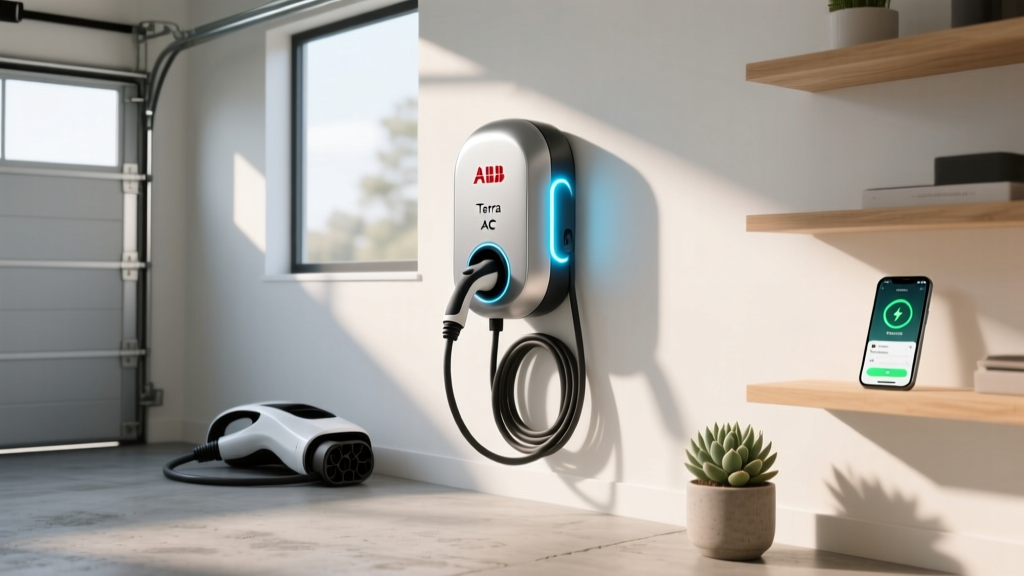
ABB is best known to EV drivers for its Terra DC fast-charger line at highway rest stops, but the Swiss-Swedish industrial giant also makes a serious Level 2 home unit: the ABB Terra AC wallbox. Available in 7.4 kW, 11 kW, and 22 kW variants (single- and three-phase), it targets the European and North American markets with a compact, IP55-rated enclosure and OCPP 1.6J connectivity. For US buyers on a typical 240V/48A split-phase circuit, the relevant SKU is the 11.5 kW (48A) model — roughly comparable to a ChargePoint Home Flex or Tesla Wall Connector in capability, but with ABB's industrial build quality and smart-grid features aimed at solar homes and fleet depots.
Bottom line: if you're already an ABB electrical customer (panel, breakers, solar inverter) or want OCPP-level control for a multi-vehicle household, the Terra AC is a credible pick at roughly $650–$750 before install. If you just want a plug-and-play NACS unit for a single Tesla, the Tesla Wall Connector remains simpler and $150 cheaper.
Charging Levels Explained: kW, Miles Per Hour, and Where ABB Fits
Before sizing a charger, understand the three EV charging tiers. kW (kilowatts) measures power — how fast energy flows. kWh (kilowatt-hours) measures energy — the size of the battery being filled. Confusing them is the single most common EV mistake.
| Level | Voltage | Typical Power (kW) | Miles of Range Added Per Hour | Use Case |
|---|---|---|---|---|
| Level 1 | 120V AC | 1.0–1.4 kW | 3–5 mi/hr | Overnight top-up, PHEVs, low-mileage drivers |
| Level 2 | 208–240V AC | 3.3–19.2 kW | 12–75 mi/hr | Home daily charging, workplace, retail |
| DC Fast (Level 3) | 400–800V DC | 50–350 kW | 150–1,000+ mi/hr | Road trips, highway corridors |
The ABB Terra AC wallbox is a Level 2 unit. On a 48A/240V circuit, it delivers up to 11.5 kW — enough to add roughly 37–44 miles of range per hour for a typical modern EV (efficiency ~3.0 mi/kWh). A 75 kWh battery going from 10–80% (~52.5 kWh needed) charges in about 5 hours on the Terra AC, versus 10+ hours on a 32A unit.
Home Installation: Electrical Requirements, Panel Upgrades, and Real Costs
The headline price of the Terra AC wallbox is only part of the equation. Installation varies wildly depending on your home's electrical panel, the distance from panel to parking spot, and local code.
What the ABB Terra AC Requires
- Voltage: 208–240V AC (single-phase in North America)
- Amperage: 32A or 48A depending on SKU; the 48A model requires a 60A dedicated breaker per NEC 2023 Article 625 (continuous loads must be derated to 80% of breaker rating)
- Wire gauge: 6 AWG copper THHN for 48A runs up to ~50 ft; 4 AWG for longer runs
- Circuit: Dedicated — no sharing with dryers, ranges, or HVAC
- GFCI: NEC 2020+ requires GFCI protection for EV outlets; hardwired units like the Terra AC often have built-in ground-fault monitoring, but your AHJ (Authority Having Jurisdiction — i.e., local inspector) has final say
- Outdoor rating: IP55 (dust-protected, water-jet resistant) — suitable for exterior mounting in rain and snow, but not submersion or ice accumulation
Installation Cost Breakdown
| Line Item | Typical Cost Range | Notes |
|---|---|---|
| ABB Terra AC wallbox (hardware) | $650–$750 | 48A/11.5 kW model; 32A version ~$550 |
| Permit (electrical) | $50–$200 | Varies by municipality; some utilities bundle |
| Electrician labor (standard install, <30 ft run) | $400–$900 | Hardwired; includes conduit, breaker, termination |
| Long wire run (30–80 ft) | +$200–$600 | Extra copper + conduit; 6 AWG is expensive |
| Panel upgrade (100A → 200A service) | $1,800–$4,000 | Required on older homes with no spare capacity |
| Utility make-ready rebate | –$200 to –$1,000 | Check PG&E, ConEd, Xcel, etc.; some cover panel |
| Total (typical no-upgrade install) | $1,100–$1,850 | Hardware + labor + permit |
| Total (with panel upgrade) | $2,900–$5,850 | The real cost surprise for pre-1990 homes |
The federal Residential Clean Energy Credit (IRC §25D) expired for standalone EV chargers at the end of 2025, but the Alternative Fuel Vehicle Refueling Property Credit (§30C) remains in effect through 2026 for qualifying census tracts — up to 30% of hardware + install, capped at $1,000 for residential. Check your census tract via the AFDC locator before assuming eligibility.
Connector Compatibility: NACS, CCS1, and Adapter Realities in 2026
As of the 2026 model year, virtually every new light-duty EV sold in North America ships with a NACS (Tesla-standard) charge port. Ford, GM, Rivian, Hyundai/Kia, Volvo/Polestar, and BMW have all switched. CCS1 is now effectively a legacy connector, though millions of CCS-equipped EVs (2019–2024 models) remain on the road.
| Connector | Vehicles Using It (2026) | ABB Terra AC Compatibility |
|---|---|---|
| NACS (J3400) | Tesla, Ford, GM, Rivian, Hyundai/Kia, Volvo, Polestar, BMW, most new EVs | Available as NACS-attached-cable SKU in North America |
| CCS1 | Legacy: 2019–2024 VW ID.4, Hyundai Ioniq 5 (early), Ford Mach-E (early), Bolt EV/EUV | Type 1 J1772 variant; use CCS adapter on vehicle side |
| CHAdeMO | Nissan Leaf (discontinued), Mitsubishi Outlander PHEV (older) | Not applicable to Level 2; CHAdeMO is DC-only |
If you own a 2022–2024 CCS-equipped EV and buy the NACS-attached Terra AC, you'll need a NACS-to-CCS adapter (Tesla sells one for ~$250; Lectron and A2Z make third-party options). The reverse — CCS-to-NACS — is rarely needed since NACS vehicles charge on NACS hardware natively. For the cleanest install, match the charger's attached cable to your vehicle's port and skip the adapter.
Cost to Charge: Per-Mile Economics vs. Gasoline
The financial case for home Level 2 charging rests on one number: your cents per kWh. Here's how common scenarios stack up for a 2026 Hyundai Ioniq 6 SE Long Range (EPA efficiency ~4.0 mi/kWh, per fueleconomy.gov):
| Charging Scenario | Price per kWh | Cost per Mile (Ioniq 6) | Equivalent Gas MPG at $3.50/gal |
|---|---|---|---|
| Home, off-peak TOU (overnight) | $0.09 | $0.023 | 152 MPG |
| Home, blended average (US avg) | $0.17 | $0.043 | 82 MPG |
| Public Level 2 (ChargePoint, EVgo L2) | $0.35–$0.49 | $0.088–$0.123 | 29–40 MPG |
| DC fast charging (EA, Tesla Supercharger) | $0.40–$0.65 | $0.100–$0.163 | 22–35 MPG |
| Gasoline baseline (28 MPG combined sedan) | — | $0.125 | 28 MPG |
At home off-peak rates, the ABB Terra AC delivers fuel costs equivalent to 150+ MPG. Even at public DC fast-charger rates, most EVs still undercut a 28 MPG gas car. The economic sweet spot is unambiguous: charge at home whenever possible, and treat DC fast charging as a road-trip expense, not a daily habit.
Charging Time Examples: 10–80% on the ABB Terra AC
Level 2 charging follows a largely linear curve until about 90% SoC, so 10–80% times are straightforward to estimate. Divide usable kWh × 0.7 by the charger's sustained kW (assume ~10.8 kW sustained on an 11.5 kW unit after losses):
- Tesla Model Y Long Range (75 kWh usable): ~4.9 hours
- Ford F-150 Lightning Extended Range (131 kWh usable): ~8.5 hours (overnight + morning)
- Hyundai Ioniq 5 (77.4 kWh usable): ~5.0 hours
- Chevrolet Equinox EV (85 kWh usable): ~5.5 hours
- Toyota RAV4 PHEV (18.1 kWh usable): ~1.2 hours — overkill speed, a 32A unit suffices
For daily commuting (30–60 miles), even a 30-minute top-up on the Terra AC restores 20+ miles — more than enough. The 11.5 kW rating pays off on road-trip recovery nights, when you arrive home at 15% SoC and need the car full by morning.
Equipment Comparison: ABB Terra AC vs. the Alternatives
ABB Terra AC W11 (48A / 11.5 kW)
- Power: 11.5 kW @ 240V/48A
- Connector: NACS attached (NA) or Type 1/Type 2 (global)
- Cable length: 20 ft (6 m) standard
- Smart features: OCPP 1.6J, Wi-Fi + Ethernet, RFID, ABB Ability cloud, solar-aware load balancing
- Enclosure: IP55, IK10 impact-rated
- Price: ~$650–$750
- Warranty: 3 years
- Best for: Solar homes, ABB ecosystem users, multi-EV load management
Tesla Wall Connector (48A / 11.5 kW)
- Power: 11.5 kW @ 240V/48A
- Connector: NACS attached (24 ft cable)
- Smart features: Wi-Fi, OTA updates, Power-Share (two units on one circuit), Tesla app
- Enclosure: IP55 indoor/outdoor
- Price: ~$495
- Warranty: 4 years
- Best for: Tesla owners, simple install, best value
ChargePoint Home Flex (up to 50A / 12 kW)
- Power: 12 kW @ 240V/50A (dip-switch adjustable 16–50A)
- Connector: J1772 attached (23 ft); NACS via adapter
- Smart features: Alexa, app scheduling, detailed kWh tracking
- Enclosure: NEMA 4 outdoor
- Price: ~$699
- Warranty: 3 years
- Best for: Mixed-fleet households (CCS + NACS via adapter)
Emporia Level 2 (48A / 11.5 kW)
- Power: 11.5 kW @ 240V/48A
- Connector: J1772 or NACS
- Smart features: Whole-home energy monitoring integration, solar tracking
- Enclosure: NEMA 4
- Price: ~$399 (budget leader)
- Warranty: 3 years
- Best for: Cost-sensitive buyers who want smart features
Safety, Code, and the Panel-Upgrade Gotcha
Three safety items separate a clean install from a headache:
- Dedicated circuit: The Terra AC must have its own breaker. Sharing with a dryer or HVAC is a code violation and a fire risk.
- Load calculation: Before your electrician pulls wire, they'll perform a NEC Article 220 load calculation on your panel. A 200A panel with electric range, dryer, and central AC may have no headroom for a 60A EV circuit — triggering a $2,000+ panel upgrade or requiring a smart load-management device (ABB offers one) that throttles the charger when other loads spike.
- GFCI + outdoor mounting: Hardwired units bypass the GFCI receptacle requirement in many jurisdictions, but outdoor installations in wet climates should use a weatherproof junction box and drip loop. Confirm with your inspector.
One under-discussed issue: 12V battery drain. Some EVs left plugged in for weeks (airport parking, vacation) will keep contactors closed and slowly drain the 12V auxiliary battery. The Terra AC's OCPP scheduling can be configured to pulse-charge and prevent this — a feature most consumer chargers lack.
Frequently Asked Questions
How much does it cost to install an ABB electric car charger at home?
Expect $1,100–$1,850 total for a standard install (hardware + electrician + permit) on a modern 200A panel with the parking spot within 30 feet. Homes needing a panel upgrade can see $3,000–$5,800. Utility rebates and the §30C credit (up to $1,000 in qualifying census tracts) can offset 20–30%.
How fast will each charging level add range?
Level 1 (120V): 3–5 mi/hr. Level 2 on the ABB Terra AC at 11.5 kW: roughly 37–44 mi/hr depending on vehicle efficiency. DC fast charging: 150–1,000+ mi/hr but tapers sharply above 80% SoC.
Which connector is compatible with my EV?
For 2025–2026 model-year EVs from Tesla, Ford, GM, Rivian, Hyundai/Kia, BMW, and Volvo/Polestar, order the NACS-attached Terra AC SKU. For older CCS1 vehicles (2019–2024 VW ID.4, early Mach-E/Ioniq 5), use the J1772 variant with a vehicle-side CCS adapter, or buy a NACS unit and add a NACS-to-CCS adapter (~$250).
How much does charging cost per mile vs. gas?
At home off-peak rates ($0.09/kWh), a 4 mi/kWh EV costs about 2.3¢ per mile — equivalent to a 150 MPG gas car. Even at the US average residential rate ($0.17/kWh), you're at ~4.3¢/mile (82 MPG equivalent). Gasoline at $3.50/gal in a 28 MPG sedan is 12.5¢/mile.
What electrical upgrades might I need?
Most homes built after 2000 with a 200A panel need only a new 60A breaker and a wire run. Older homes (pre-1990, 100A service) or homes with heavy electric loads (heat pump, EVSE, range, dryer) may need a panel upgrade ($1,800–$4,000) or a smart load-management relay that throttles the charger during peak draws. Your electrician's load calculation is the deciding factor.
Is the ABB Terra AC compatible with solar panels and home batteries?
Yes — this is one of its differentiators. Via OCPP and the ABB Ability cloud, the Terra AC can modulate charge rate in real time to match excess solar production, effectively charging your EV for "free" from rooftop generation. It integrates cleanly with ABB's own solar inverters and the REACT-2 home battery.