If you've searched for a commercial-grade home Level 2 charger, you've likely encountered the ABB Terra AC Wallbox. ABB is a global electrification giant — better known for industrial switchgear and 350 kW highway chargers than consumer garage hardware. The Terra AC is their attempt to bring that engineering pedigree to residential and light-commercial EV charging. But does a company that builds megawatt-scale infrastructure make a good wallbox for your garage?
We've tested the Terra AC lineup, reviewed ABB's published specifications, and compared real-world charging performance against top competitors like the ChargePoint Home Flex, Emporia Level 2, and Tesla Wall Connector. Here's what buyers and installers need to know.
What Is the ABB Terra AC Wallbox?
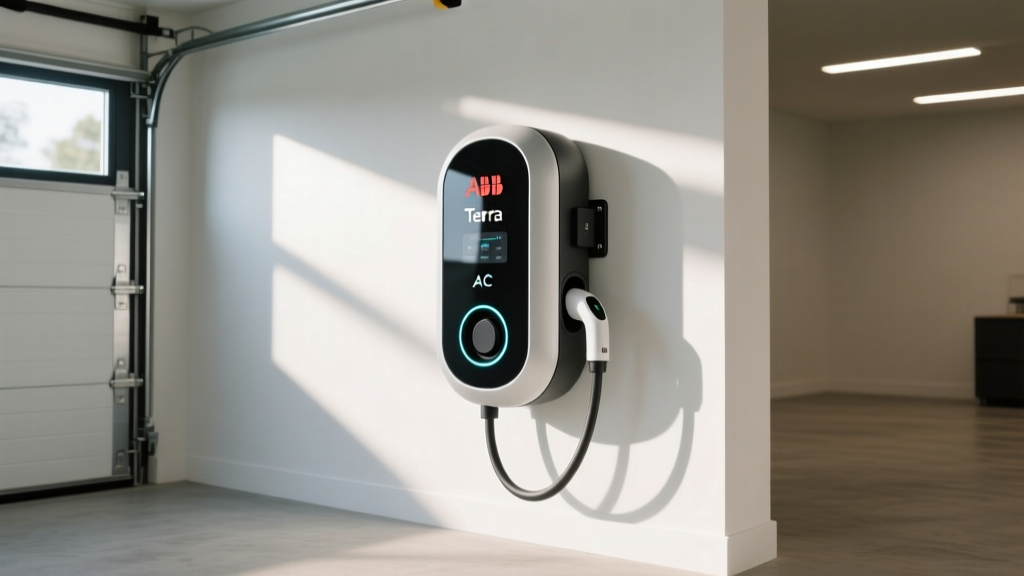
The Terra AC Wallbox is ABB's residential and light-commercial Level 2 AC charger family, available in multiple power configurations. Unlike DC fast chargers (which ABB also makes under the Terra HP line), the Wallbox delivers alternating current to your vehicle's onboard charger, which then converts it to DC to fill the battery.
The lineup spans from 7.4 kW (single-phase, 32A) to 22 kW (three-phase, 32A per phase). In the US market, the most common configurations are:
- Terra AC 7.4 kW: 240V / 32A, single-phase — ideal for most US homes with standard 40A circuits
- Terra AC 11.5 kW: 240V / 48A, single-phase — requires a 60A dedicated circuit
- Terra AC 22 kW: 208-240V / 32A, three-phase — primarily for commercial or European installations, rare in US residential
All models feature a NEMA Type 4 (IP54-equivalent) enclosure rated for indoor and outdoor use, integrated cable management, and RFID authentication for shared or workplace installations.
How Fast Does Each Charging Level Add Range?
Before evaluating the Terra AC specifically, it helps to understand the full charging landscape. Here's what each level delivers in practical terms:
| Level | Voltage | Max Power (kW) | Miles of Range per Hour | Typical Use |
|---|---|---|---|---|
| Level 1 | 120V AC | 1.4–1.9 kW | 3–5 mi/hr | Emergency / overnight trickle (PHEVs) |
| Level 2 | 240V AC | 3.3–22 kW | 12–80 mi/hr | Home daily charging, workplace, destination |
| DC Fast | 200–900V DC | 50–350 kW | 150–1,000+ mi/hr | Road trips, highway corridors |
A critical distinction: kW (kilowatts) measures power — the rate at which energy flows. kWh (kilowatt-hours) measures energy — the total amount stored in your battery. A 7.4 kW charger delivers 7.4 kWh of energy per hour of charging. A 75 kWh battery charged from empty at 7.4 kW would theoretically take about 10 hours.
- Tesla Model Y (75 kWh battery) at 11.5 kW: ~4.5 hours
- Ford F-150 Lightning Extended Range (131 kWh) at 11.5 kW: ~7.9 hours
- Hyundai Ioniq 5 (77.4 kWh) at 7.4 kW: ~7.3 hours
- Chevrolet Equinox EV (85 kWh) at 11.5 kW: ~5.1 hours
Note: AC charging is limited by your vehicle's onboard charger. Many EVs cap AC intake at 11.5 kW even if the wallbox can deliver more.
ABB Terra AC vs. Competitors: Equipment Comparison
The Terra AC competes in the premium Level 2 segment. Here's how it stacks up against the most popular home chargers available in 2025–2026:
ABB Terra AC 11.5 kW
- Power: 11.5 kW (48A)
- Connector: J1772 (NACS variant available)
- Cable length: 20 ft (standard)
- Smart features: ABB Terra AC app, Wi-Fi + Ethernet + 4G, RFID, load management, MID-certified energy metering
- Price: ~$650–$850 (unit only)
- Warranty: 3 years
ChargePoint Home Flex
- Power: Up to 12 kW (50A adjustable)
- Connector: J1772 or NACS
- Cable length: 23 ft
- Smart features: ChargePoint app, Wi-Fi, scheduling, Alexa
- Price: ~$550–$700
- Warranty: 3 years
Tesla Wall Connector
- Power: Up to 11.5 kW (48A)
- Connector: NACS (native Tesla)
- Cable length: 24 ft
- Smart features: Wi-Fi updates, power sharing between units, Tesla app integration
- Price: ~$425–$475
- Warranty: 4 years
Emporia Level 2 Smart Charger
- Power: Up to 11.5 kW (48A)
- Connector: J1772
- Cable length: 24 ft
- Smart features: Emporia app, energy monitoring, solar integration, load management
- Price: ~$350–$400
- Warranty: 3 years
Where the ABB Terra AC stands out: industrial build quality (ABB's chargers are deployed in harsh commercial environments globally), MID-certified metering accuracy (important for workplace billing and fleet reimbursement), integrated load management for multi-unit installations, and 4G connectivity as a fallback when Wi-Fi is unreliable. The trade-off is a higher unit price and a less consumer-friendly app compared to ChargePoint or Tesla.
Installation Requirements and Total Cost Breakdown
The charger unit is only part of the investment. Professional installation by a licensed electrician is required for any hardwired Level 2 charger, and the Terra AC is no exception. Here's what to budget:
Electrical Requirements for the ABB Terra AC
| Model | Max Current | Circuit Required | Wire Gauge | Voltage |
|---|---|---|---|---|
| Terra AC 7.4 kW | 32A | 40A breaker | 8 AWG copper | 240V single-phase |
| Terra AC 11.5 kW | 48A | 60A breaker | 6 AWG copper | 240V single-phase |
Per the National Electrical Code (NEC), continuous loads (including EV chargers, which run for 3+ hours) must be on a circuit rated at 125% of the charger's maximum draw. A 48A charger requires a 60A circuit. This is non-negotiable and your electrician will enforce it.
Total Installation Cost Breakdown
| Cost Component | Simple Install | Moderate Install | Complex Install (Panel Upgrade) |
|---|---|---|---|
| ABB Terra AC unit | $650–$850 | $650–$850 | $650–$850 |
| Electrician labor (2–6 hrs) | $300–$600 | $600–$1,500 | $1,500–$3,000 |
| Materials (wire, conduit, breaker) | $100–$250 | $250–$600 | $400–$800 |
| Electrical panel upgrade (if needed) | $0 | $0 | $1,500–$3,500 |
| Permit & inspection | $50–$150 | $100–$300 | $150–$400 |
| Total estimated cost | $1,100–$1,850 | $1,600–$3,250 | $4,200–$8,550 |
Safety and Code Considerations
The Terra AC is hardwired (no plug), which eliminates the NEMA 14-50 receptacle as a failure point — a known issue with high-amperage plug-in chargers. Key code requirements:
- Dedicated circuit: The charger must be on its own breaker — no shared circuits with dryers, HVAC, or other appliances
- GFCI protection: NEC 2023 (625.54) requires GFCI protection for all EV charging outlets; hardwired units like the Terra AC have built-in ground-fault protection (Class A, 6mA trip threshold)
- Outdoor rating: The Terra AC's NEMA 4 rating covers rain, dust, and hose-directed water — suitable for exterior walls in all US climates
- Disconnect: Some jurisdictions require a visible disconnect switch within sight of the charger; check with your local AHJ (Authority Having Jurisdiction)
- Permit: Nearly all US jurisdictions require an electrical permit for EV charger installation — skipping this can void home insurance coverage
Connector Compatibility: Will It Fit Your EV?
The EV connector landscape has consolidated rapidly since Tesla opened its Supercharger network and the North American Charging Standard (NACS) gained industry adoption. Here's what you need to know about compatibility with the ABB Terra AC:
| Connector Type | Brands Using It (New Vehicles) | ABB Terra AC Available? | Adapter Needed? |
|---|---|---|---|
| NACS (Tesla plug) | Tesla, Ford, GM, Rivian, Volvo, Polestar, Hyundai, Kia (2025+) | Yes (NACS variant) | None for NACS vehicles; J1772 adapter for legacy |
| J1772 | Most pre-2025 non-Tesla EVs, all PHEVs | Yes (standard variant) | J1772-to-NACS adapter ($100–$200) for newer NACS cars |
| CCS1 | Being phased out on new vehicles | N/A (AC charger) | N/A — CCS1 is DC fast charge only |
| CHAdeMO | Nissan Leaf (discontinued after 2025) | N/A (AC charger) | N/A — CHAdeMO is DC fast charge only |
Key buying advice: If you own or plan to buy a 2025+ Ford, GM, Rivian, Hyundai, or Kia EV, order the Terra AC in the NACS configuration. If you drive a pre-2025 Chevrolet Bolt, VW ID.4, or BMW i4 with J1772, the standard model works natively. The Terra AC is an AC charger, so CCS1 and CHAdeMO — which are DC fast-charging connectors — are irrelevant here. Your vehicle's AC charging port is either J1772 or NACS.
Cost to Charge: Home vs. Public vs. Gas
The financial case for home charging is overwhelming. Here's a realistic cost-per-mile comparison using 2025–2026 energy prices:
| Scenario | Rate | Cost per Mile (3 mi/kWh EV) | Annual Cost (12,000 mi) |
|---|---|---|---|
| Home off-peak (utility TOU rate) | $0.08–$0.12/kWh | $0.03–$0.04 | $360–$480 |
| Home standard rate | $0.13–$0.18/kWh | $0.04–$0.06 | $520–$720 |
| Public Level 2 (ChargePoint, EVgo) | $0.25–$0.49/kWh | $0.08–$0.16 | $1,000–$1,920 |
| DC Fast Charging (EA, Tesla Supercharger) | $0.30–$0.55/kWh | $0.10–$0.18 | $1,200–$2,160 |
| Gasoline vehicle (27 MPG avg, $3.40/gal) | $3.40/gallon | $0.13 | $1,560 |
At national average rates, home charging with the Terra AC costs roughly one-quarter to one-third what gasoline costs per mile. Even exclusive public DC fast charging is competitive with gas, though it negates the primary financial advantage of EV ownership.
According to fueleconomy.gov, the average 2025 EV achieves 3–4 miles per kWh. The Terra AC's MID-certified metering lets you track exact kWh delivered per session — useful for employer reimbursement, rental property billing, or simply understanding your real efficiency.
Who Should Buy the ABB Terra AC?
The Terra AC isn't the cheapest Level 2 charger, and its app experience lags behind consumer-focused brands. But it excels in specific scenarios:
Choose the ABB Terra AC if:
- You're installing multiple chargers in a workplace, apartment building, or fleet depot (ABB's load management and RFID access control are best-in-class)
- You need revenue-grade energy metering for billing or reimbursement (MID certification)
- You want commercial-grade durability in a residential install — the Terra AC is built to the same standards as ABB's highway DC chargers
- Your electrician is familiar with ABB panels and breakers (simplifies integration)
- You need 4G cellular connectivity as a backup when Wi-Fi is unreliable
Consider an alternative if:
- You want the simplest consumer experience — ChargePoint or Tesla's apps are more intuitive
- Price is the primary driver — Emporia and Tesla Wall Connector deliver similar kW for $200–$400 less
- You need a plug-in (NEMA 14-50) charger for portability — the Terra AC is hardwired only
- You want the longest cable — Tesla's 24 ft cord edges out the Terra AC's 20 ft
Federal Tax Credit and Incentives for Home Charging
The IRS §30C Alternative Fuel Vehicle Refueling Property Credit covers 30% of home EV charger equipment and installation costs, up to $1,000. Key eligibility points for 2025–2026:
- The charger must be installed at your primary residence in the United States
- The property must be located in an eligible census tract (low-income or non-urban area, as defined by the IRS) — many suburban and rural tracts qualify, but many urban cores do not
- The credit applies to both the equipment cost and installation labor
- Maximum credit: $1,000 per tax year
- You must file IRS Form 8911 with your tax return
On a $2,500 Terra AC installation, the §30C credit could return $750 (30%). Consult a tax professional to confirm eligibility for your specific address and census tract.
Frequently Asked Questions
How much does it cost to install an ABB Terra AC home charger?
Expect $1,100–$1,850 for a straightforward install (short wire run, adequate panel capacity) and $1,600–$3,250 for a moderate install. If your home needs a 200A panel upgrade, total costs can reach $4,200–$8,550. The ABB Terra AC unit itself costs $650–$850.
How fast will the ABB Terra AC charge my EV?
The 11.5 kW model adds approximately 35–45 miles of range per hour for most EVs. A full 10–80% charge takes roughly 4.5 hours for a Tesla Model Y, 5 hours for a Chevrolet Equinox EV, and 8 hours for a Ford F-150 Lightning Extended Range. Actual speed depends on your vehicle's onboard charger capacity — some EVs cap AC charging below 11.5 kW.
Which connector do I need — NACS or J1772?
If your EV is a 2025+ Ford, GM, Rivian, Hyundai, Kia, Volvo, or Polestar (or any Tesla), choose the NACS variant. If you drive a pre-2025 non-Tesla EV or any plug-in hybrid, the J1772 variant is correct. A $100–$200 adapter can bridge either direction if your situation changes.
How much does charging cost per mile compared to gas?
Home charging with the Terra AC at average utility rates costs $0.03–$0.06 per mile. A comparable gasoline vehicle at 27 MPG and $3.40/gallon costs about $0.13 per mile. Home EV charging is roughly 60–75% cheaper per mile than gasoline.
What electrical upgrades might I need for a Level 2 charger?
The most common upgrade is a panel replacement from 100A/125A to 200A service ($1,500–$3,500) if your existing panel lacks capacity for a new 40A or 60A circuit. You may also need a new breaker slot, heavier-gauge wire for long runs, or a sub-panel. The ABB Terra AC's dynamic load management feature can sometimes avoid a panel upgrade by limiting charge rate to available capacity.
Is the ABB Terra AC Energy Star certified?
As of early 2026, the Terra AC is not listed on the EPA's Energy Star certified EV charger database. However, it meets UL certification (UL 2594 for EV supply equipment) and has standby power consumption below 3W, which is competitive with certified models. Check the Energy Star EVSE database for the latest certified models if utility rebates require certification.
Can I use the ABB Terra AC outdoors in cold or wet climates?
Yes. The Terra AC carries a NEMA 4 rating, which protects against rain, sleet, snow, ice, and hose-directed water. It operates in ambient temperatures from −22°F to 122°F (−30°C to 50°C). In extreme cold, expect your EV's battery to accept charge more slowly until it warms — this is a battery characteristic, not a charger limitation.