ABB has become one of the most recognizable names in electric-vehicle supply equipment (EVSE), manufacturing everything from compact residential Level 2 wallboxes to multi-megawatt DC fast chargers deployed at highway rest stops. For EV shoppers and current owners, the practical question is whether ABB hardware fits their specific charging scenario — and what it takes to install it correctly.
This guide breaks down the ABB electric vehicle charging lineup, the electrical requirements for home installation, real-world charging speeds in kW, connector compatibility across automakers, and what you'll actually pay per mile compared to gasoline.
Understanding Charging Levels: Speeds in kW and Miles Per Hour
Before selecting ABB hardware or any EVSE, you need to understand the three charging tiers and what they deliver in practical terms. Power is measured in kilowatts (kW), which tells you the rate of energy delivery. Energy capacity in your battery is measured in kilowatt-hours (kWh) — these are not interchangeable.
| Level | Voltage | Typical kW Output | Miles of Range Added Per Hour | Best Use Case |
|---|---|---|---|---|
| Level 1 | 120V AC | 1.4 – 1.9 kW | 3 – 5 mi/hr | Overnight top-up for PHEVs or low-mileage BEV drivers |
| Level 2 | 240V AC | 7.2 – 19.2 kW | 20 – 65 mi/hr | Daily home charging; the standard for BEV owners |
| DC Fast (Level 3) | 400–800V DC | 50 – 350+ kW | 150 – 1,200+ mi/hr (peak) | Road trips, fleet depots, quick top-ups on the go |
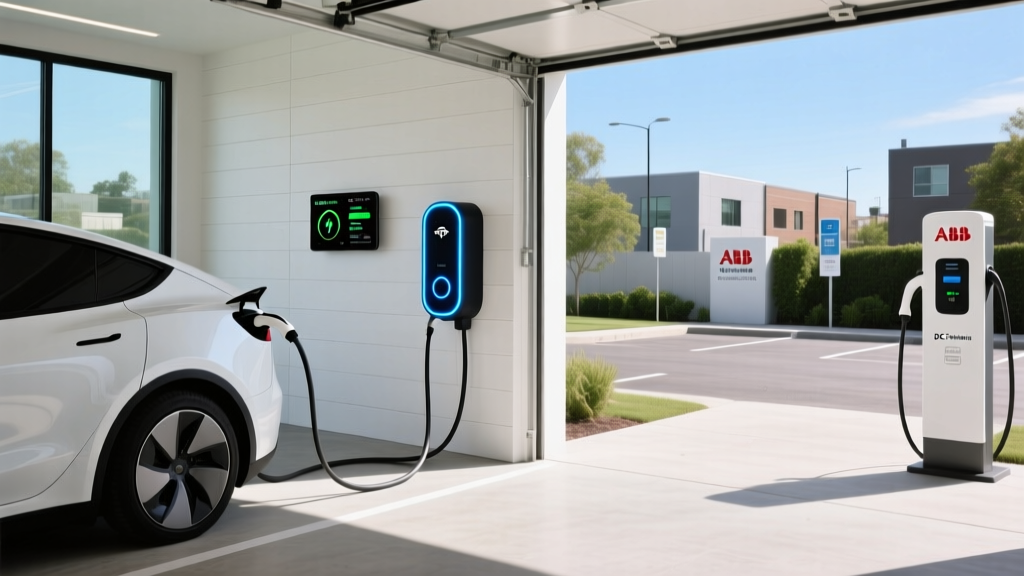
ABB's residential portfolio centers on Level 2 hardware, while its Terra and Terra HP product families serve commercial DC fast-charging deployments. Most EV owners will interact with ABB Level 2 units at home and ABB DC fast chargers at public stations operated by networks like Electrify America, EVgo, and Tesla Supercharger sites that have opened to non-Tesla vehicles via NACS.
ABB Home Level 2 Chargers: Models, Power, and Features
ABB's residential and light-commercial wallboxes are marketed under the ABB Terra AC brand. The lineup spans from compact 7.4 kW units to 22 kW three-phase models (available in markets with three-phase residential service). In the US, where most homes have single-phase 240V service, the practical maximum for a hardwired ABB Terra AC unit is 19.2 kW (80A), though most homeowners opt for 40A or 48A circuits for cost and panel-capacity reasons.
ABB Terra AC Wallbox (7.4 kW / 32A)
- Power output: 7.4 kW (240V, 32A)
- Connector: J1772 (NACS adapter required for Tesla)
- Cable length: 18 ft (5.5 m) tethered or Type 2 socket variant
- Smart features: Wi-Fi, ABB E-mobility app, load management, RFID access control
- Price: ~$650 – $750 USD
- Best for: Homes with 100A panels or limited spare breaker capacity
ABB Terra AC Wallbox (11.5 kW / 48A)
- Power output: 11.5 kW (240V, 48A)
- Connector: J1772 (NACS adapter required for Tesla)
- Cable length: 24 ft (7.3 m) tethered
- Smart features: Wi-Fi, Ethernet, OCPP 1.6 for commercial use, integrated DC fault protection, dynamic load management
- Price: ~$850 – $1,050 USD
- Best for: Most BEV owners with 200A panels; charges a 75 kWh battery 10–80% in roughly 5 hours
ABB Terra AC Wallbox (19.2 kW / 80A)
- Power output: 19.2 kW (240V, 80A)
- Connector: J1772
- Cable length: 24 ft (7.3 m) tethered
- Smart features: Full OCPP support, ABB Ability cloud, advanced load balancing for multi-charger installations
- Price: ~$1,200 – $1,500 USD
- Best for: High-capacity panels (320A+), commercial fleets, homes running two EVs simultaneously with load sharing
ABB units carry IP55 ratings for outdoor installation and integrate DC residual current detection, eliminating the need for an external Type B RCD in many jurisdictions — a cost savings on the electrical side. All models support scheduled charging to take advantage of off-peak utility rates.
Home Installation Costs: Electrical Requirements and Panel Upgrades
The single biggest variable in home charger installation is whether your existing electrical panel has enough spare capacity. A 48A Level 2 charger requires a dedicated 60A breaker (the National Electrical Code requires circuits to be rated at 125% of the continuous load). If your panel is already near capacity — common in older homes with 100A or 150A service — you may need a panel upgrade or a smart load-management device.
| Item | Typical Cost Range | Notes |
|---|---|---|
| ABB Terra AC charger (11.5 kW) | $850 – $1,050 | Equipment only |
| Electrician labor (standard install, <50 ft run) | $600 – $1,200 | Varies by region; longer wire runs cost more |
| Permit and inspection | $100 – $350 | Required in most US jurisdictions |
| Circuit breaker and wiring materials | $50 – $200 | 6 AWG copper for 60A circuit |
| Panel upgrade (if needed: 100A → 200A) | $1,500 – $3,500 | Major cost adder; required if panel lacks capacity |
| Total (no panel upgrade) | $1,600 – $2,800 | Most homeowners fall in this range |
| Total (with panel upgrade) | $3,100 – $6,300 | Older homes, high-load panels |
What Electrical Upgrades Might You Need?
Before purchasing any ABB charger, have a licensed electrician evaluate:
- Panel amperage: A 200A panel typically supports a 48A charger without issue. A 100A panel may require a load calculation per NEC Article 220.
- Available breaker spaces: You need two adjacent slots for a 240V double-pole breaker.
- Wire run distance: Runs exceeding 50 feet may require upsizing from 6 AWG to 4 AWG copper to prevent voltage drop, adding $2–$5 per foot in material cost.
- GFCI requirements: The 2020 NEC requires GFCI protection for EVSE in garages; ABB Terra AC units include integrated ground-fault protection, which may satisfy this requirement, but your local inspector has final say.
- Smart panel alternatives: Devices like the SPAN smart panel or ABB's own load-management controller can avoid a full panel upgrade by dynamically curtailing charger power when household loads spike.
Connector Compatibility: NACS, CCS1, and CHAdeMO
Connector standards have shifted dramatically. As of the 2025 model year, nearly every major automaker — Ford, GM, Rivian, Volvo, Hyundai, Kia, BMW, Mercedes-Benz — has adopted the North American Charging Standard (NACS) for new vehicles. Tesla has used NACS (formerly the Tesla connector) since 2012. The legacy CCS1 connector remains on many 2020–2024 vehicles, and CHAdeMO is limited to the Nissan Leaf and Mitsubishi Outlander PHEV.
| Connector | Used By | ABB Charger Compatibility | Adapter Needed? |
|---|---|---|---|
| NACS (Tesla-style) | Tesla (all years), Ford, GM, Rivian, Hyundai, Kia, BMW, Mercedes (2025+) | ABB Terra AC ships with J1772; ABB has announced NACS-tethered variants for 2026 | Yes — J1772-to-NACS adapter (~$100–$150) for current ABB models; native NACS ABB units expected mid-2026 |
| J1772 (Level 2 standard) | All EVs (via onboard adapter for NACS vehicles) | Native on all ABB Terra AC units | No — but NACS vehicles need the Tesla-provided J1772 adapter |
| CCS1 | 2020–2024 models from VW, Audi, Porsche, some Hyundai/Kia, Ford Mustang Mach-E (pre-2025) | ABB DC fast chargers (Terra HP) support CCS1 natively | No for DC fast; CCS1-to-NACS adapters available for home Level 2 (~$200) |
| CHAdeMO | Nissan Leaf, Mitsubishi Outlander PHEV | ABB DC fast chargers offer CHAdeMO as optional connector | No |
For home Level 2 charging, the ABB Terra AC's J1772 connector works universally: NACS-equipped EVs come with a J1772-to-NACS adapter in the trunk. For ABB DC fast chargers at public sites, you'll typically find both CCS1 and NACS cables on newer Terra HP 350 kW units, with CHAdeMO being phased out at many locations.
Real-World Charging Times: 10–80% for Common Battery Sizes
Charging time depends on your vehicle's onboard charger capacity (for Level 2) and its DC fast-charging architecture. Here's what to expect with an 11.5 kW ABB Terra AC unit:
- Hyundai Ioniq 5 (84 kWh battery, NMC): 10–80% in approximately 5 hours 15 minutes on Level 2. The Ioniq 5's 10.9 kW onboard charger means you'll use most of the ABB's 11.5 kW output.
- Tesla Model Y Long Range (~75 kWh usable, NMC): 10–80% in roughly 4 hours 45 minutes. The Model Y's 11.5 kW onboard charger matches the ABB unit exactly.
- Ford F-150 Lightning Extended Range (131 kWh battery, NMC): 10–80% in approximately 8 hours 30 minutes at 11.5 kW. The F-150's 19.2 kW onboard charger can accept more, but only if paired with a 19.2 kW ABB unit on an 80A circuit.
- Chevrolet Equinox EV (85 kWh battery, NMC): 10–80% in about 5 hours 10 minutes. The Equinox EV's 11.5 kW onboard charger is a good match.
On ABB DC fast chargers (Terra HP 180–350 kW), expect 10–80% times of 18–25 minutes for 800V-architecture vehicles like the Ioniq 5 and Kia EV6, and 30–40 minutes for 400V vehicles like the Ford Mustang Mach-E and VW ID.4. Remember that charging speed tapers significantly above 80% SoC to protect battery health — the peak kW figure is never sustained across the full session.
Cost to Charge: Home vs. Public vs. Gasoline
Electricity pricing varies enormously by utility and time of day. The national average residential rate is approximately $0.17/kWh as of early 2026 (per EIA data), but off-peak rates in many regions drop to $0.08–$0.12/kWh, while public DC fast chargers typically charge $0.35–$0.55/kWh.
| Scenario | Rate ($/kWh) | Vehicle Efficiency (kWh/mi) | Cost Per Mile | Equiv. Gas Price at 28 MPG |
|---|---|---|---|---|
| Home off-peak (Level 2) | $0.10 | 0.30 (e.g., Model Y) | $0.030 | $0.84/gal |
| Home average (Level 2) | $0.17 | 0.30 | $0.051 | $1.43/gal |
| Public Level 2 (workplace/retail) | $0.25 | 0.30 | $0.075 | $2.10/gal |
| DC fast charging (road trip) | $0.45 | 0.30 | $0.135 | $3.78/gal |
| Gasoline baseline (2026 avg) | — | 28 MPG combined | $0.118 | $3.30/gal |
Home charging on an off-peak rate with an ABB Terra AC unit delivers the lowest per-mile cost in transportation — roughly 3 cents per mile for an efficient crossover. Even at average residential rates, you're paying the equivalent of $1.43/gallon gasoline. DC fast charging on road trips narrows the gap with gasoline, which is why most EV owners do 80–90% of their charging at home.
ABB Terra AC units support scheduled charging via the ABB E-mobility app, allowing you to set charge windows that align with your utility's off-peak hours. Some utilities offer dedicated EV time-of-use plans that drop rates to $0.05–$0.08/kWh overnight — pair this with the ABB's scheduling feature and a 75 kWh battery fills for under $6.
Safety, Code Compliance, and Installation Best Practices
ABB Terra AC wallboxes are UL-listed and meet NEC Article 625 requirements for EV charging systems. Key safety and code points for your installation:
- Dedicated circuit: The charger must be on its own dedicated breaker — no shared circuits with other appliances.
- Hardwired vs. plug-in: Units above 40A (i.e., above 9.6 kW) must be hardwired per NEC; the ABB 48A and 80A models require hardwiring. The 32A model is available in NEMA 14-50 plug-in configuration.
- Outdoor rating: ABB Terra AC carries an IP55 rating, suitable for outdoor wall mounting in rain, snow, and dust. Ensure the mounting surface is structurally sound — the unit weighs approximately 11 lbs (5 kg).
- Ventilation: Indoor garage installations generally don't require additional ventilation for Level 2 EVSE, but your local code may have specific requirements.
- Grounding: Confirm your home's grounding system is intact; older homes with ungrounded outlets or panels need remediation before EVSE installation.
- Inspection: Most jurisdictions require a post-installation inspection. Your electrician should pull the permit before work begins — unpermitted installations can void homeowner's insurance claims.
Federal Tax Credit and Incentives for Home Charging
The federal Alternative Fuel Vehicle Refueling Property Credit (IRS Form 8911) covers 30% of home EV charger equipment and installation costs, up to a maximum credit of $1,000. This credit applies to the ABB Terra AC hardware and the electrician's labor. Key eligibility rules for 2026:
- The charger must be installed at your primary residence in the United States.
- The property must be in an eligible census tract (non-urban or low-income community as defined by the IRS) — this is a geographic requirement added by the Inflation Reduction Act.
- The credit is non-refundable: it can reduce your federal tax liability to zero but won't generate a refund beyond that.
- Consult a tax professional for your specific situation; eligibility depends on your tax liability, census tract, and whether you've claimed the credit in prior years.
Many utilities also offer rebates of $250–$750 for installing a smart Level 2 charger — check with your local provider. Combined with the federal credit, an ABB Terra AC 11.5 kW installation can effectively cost $1,000–$1,500 after incentives in a straightforward install scenario.
Frequently Asked Questions
How much does it cost to install an ABB home EV charger?
Expect $1,600–$2,800 for a standard installation of an ABB Terra AC 11.5 kW unit (equipment, electrician labor, permit, and materials) in a home with a 200A panel and adequate spare capacity. If your panel needs upgrading from 100A to 200A, total costs can reach $3,100–$6,300. The federal refueling property credit can offset up to $1,000 of this cost.
How fast will each ABB charging level add range?
An ABB Terra AC 7.4 kW unit adds roughly 25 miles of range per hour. The 11.5 kW model adds approximately 38–40 miles per hour for an efficient crossover like the Tesla Model Y (3.5–4 mi/kWh). The 19.2 kW model adds up to 65 miles per hour for vehicles with a matching onboard charger, like the Ford F-150 Lightning.
Which connector is compatible with my EV?
ABB Terra AC units ship with a J1772 connector, which works with every EV sold in North America. If you drive a NACS-equipped vehicle (Tesla, 2025+ Ford, GM, Rivian, Hyundai, Kia, BMW, Mercedes), use the J1772-to-NACS adapter included with your car. For legacy CCS1 vehicles (2020–2024 VW ID.4, older Mach-E), J1772 Level 2 works natively. CHAdeMO vehicles (Nissan Leaf) also charge via J1772 at Level 2.
How much does charging cost per mile vs. gas?
Home Level 2 charging on an ABB Terra AC at the national average rate of $0.17/kWh costs approximately $0.05 per mile in an efficient EV — equivalent to $1.43/gallon gasoline in a 28 MPG vehicle. Off-peak home charging drops to about $0.03/mile ($0.84/gal equivalent). Public DC fast charging at $0.45/kWh costs roughly $0.135/mile ($3.78/gal equivalent), which is close to the 2026 gasoline average of $3.30/gal.
What electrical upgrades might I need for an ABB charger?
If your home has a 200A electrical panel with at least two open breaker slots and 40–60A of spare capacity, you likely need no upgrade. Homes with 100A panels, fully loaded breaker boxes, or ungrounded wiring may require a panel upgrade ($1,500–$3,500), a smart load-management controller ($300–$600), or wiring remediation. Always have a licensed electrician perform a load calculation per NEC Article 220 before purchasing equipment.