If you've been driving a 1998 Pontiac Grand Prix GTP Supercharged — with its 3.8L L67 V6 pushing 240 hp and returning roughly 18–20 mpg combined — the jump to a modern battery-electric vehicle involves more than just trading keys. The biggest ownership shift is how you refuel. Instead of five minutes at a gas pump, you're managing kilowatt-hours, charge curves, and home electrical capacity. This guide breaks down exactly what EV charging looks like in 2026, using the GTP as a cost and convenience baseline so you know precisely what changes — and what you save.
Charging Levels Explained: Speeds, Power, and Range Per Hour
The first concept to nail down: kW (kilowatts) measures charging power — how fast energy flows into the battery. kWh (kilowatt-hours) measures battery energy capacity — the size of the tank. A 75 kWh battery charged at 11 kW (Level 2) takes roughly 7 hours from empty; that same battery at 150 kW (DC fast) can go from 10–80% in about 25 minutes. Never confuse the two.
| Level | Voltage | Power (kW) | Miles of Range Added Per Hour | Typical Use Case |
|---|---|---|---|---|
| Level 1 | 120V AC | 1.0–1.4 kW | 3–5 mi/hr | Overnight top-off, PHEVs, low-mileage drivers |
| Level 2 | 240V AC | 7.2–19.2 kW | 25–65 mi/hr | Home daily charging, workplace, destinations |
| DC Fast Charge | 400–800V DC | 50–350 kW | 150–1,200+ mi/hr (peak) | Road trips, highway corridors, quick top-ups |
For a former GTP driver accustomed to 350 miles between fill-ups, a modern EV like the 2026 Hyundai Ioniq 5 (84 kWh usable battery, EPA range 310 miles) will cover most daily needs on a single overnight Level 2 session. Real-world highway range at 75 mph drops to roughly 250–270 miles; in sub-freezing weather, expect another 15–25% reduction due to cabin heating and battery chemistry limitations.
How Much Does It Cost to Install a Home EV Charger?
This is the single biggest variable in EV ownership, and it depends entirely on your home's electrical panel. A house built in the 1970s–1990s (the era when your GTP was designed) may have a 100-amp panel that's already near capacity. Upgrading to 200 amps adds significant cost. Here's the realistic breakdown:
| Component | Simple Install (Panel Has Capacity) | Complex Install (Panel Upgrade Needed) |
|---|---|---|
| Level 2 Charger Unit (hardwired, 48A) | $400–$700 | $400–$700 |
| Electrician Labor (run 240V/60A circuit, ~30 ft) | $600–$1,200 | $800–$1,500 |
| Electrical Permit | $50–$200 | $50–$200 |
| Panel Upgrade (100A → 200A, if needed) | N/A | $1,500–$3,500 |
| Total Estimated Cost | $1,050–$2,100 | $2,750–$5,900 |
Key gotcha: A 48-amp charger requires a dedicated 60-amp circuit (the National Electrical Code mandates circuits be rated at 125% of continuous load). If your panel is maxed out, an electrician may recommend a load-management device ($200–$400) that dynamically throttles charger amperage based on household demand — a cheaper alternative to a full panel upgrade.
Some utilities offer rebates of $250–$500 for Level 2 installations, and the federal Alternative Fuel Vehicle Refueling Property Credit (IRC §30C) covers 30% of home charging equipment and installation costs up to $1,000, subject to income and census-tract eligibility. Always confirm current-year rules with a tax professional.
Which Connector and Charger Is Compatible with My EV?
The connector landscape has consolidated significantly by 2026. Here's what fits what:
| Connector | Brands Using It | Notes |
|---|---|---|
| NACS (Tesla / J3400) | Tesla, Ford, GM, Rivian, Volvo, Polestar, Hyundai/Kia (2025+), most new models | Now the dominant standard; access to Tesla Supercharger network |
| CCS1 | Legacy models (2024 and earlier from VW, BMW, Stellantis, some Hyundai/Kia) | Adapters available for Supercharger access (~$200–$250) |
| CHAdeMO | Nissan Leaf (discontinued), Mitsubishi Outlander PHEV | Effectively deprecated; limited new infrastructure |
If you're buying a 2026 EV, it almost certainly has a NACS port. If you're buying a used 2022–2024 model with CCS1, budget for a NACS adapter to access Tesla's Supercharger network — the most reliable DC fast-charging infrastructure in North America.
Charging Time Examples: What to Expect with Common Battery Sizes
Charge times are not linear. EV batteries charge fastest between roughly 10–50% State of Charge (SoC), then taper significantly above 80% to protect cell longevity. Here are real-world benchmarks:
- 60 kWh battery (e.g., base Tesla Model 3 RWD): ~18 min at 170 kW DC fast charger; ~6 hrs on 11.5 kW Level 2
- 84 kWh battery (e.g., Hyundai Ioniq 5 Long Range): ~18 min at 240 kW peak (sustained ~150 kW average); ~8 hrs on 11.5 kW Level 2
- 100 kWh battery (e.g., Ford F-150 Lightning Extended Range): ~25 min at 150 kW peak; ~10 hrs on 11.5 kW Level 2
- 115 kWh battery (e.g., GMC Sierra EV): ~30 min at 350 kW peak on 800V architecture; ~12 hrs on 11.5 kW Level 2
Note: Peak kW is not sustained kW. A charger rated at 250 kW may deliver that rate for only 5–10 minutes before tapering. Always look at 10–80% time, not peak rate.
How Much Does Charging Cost Per Mile vs. Gas?
This is where the GTP comparison becomes stark. The 1998 Grand Prix GTP Supercharged averaged roughly 19 mpg combined. At $3.40/gallon (2026 national average), that's $0.179 per mile in fuel alone. Here's how EV charging scenarios compare:
| Scenario | Rate | Cost Per Mile (at 3.5 mi/kWh) | Annual Fuel Cost (12,000 mi) |
|---|---|---|---|
| Home Level 2 — Off-Peak Utility Rate | $0.08–$0.12/kWh | $0.023–$0.034 | $276–$408 |
| Home Level 2 — Standard Rate | $0.14–$0.18/kWh | $0.040–$0.051 | $480–$612 |
| Public Level 2 (ChargePoint, EVgo) | $0.25–$0.40/kWh | $0.071–$0.114 | $852–$1,368 |
| DC Fast Charging (Electrify America, Tesla) | $0.30–$0.55/kWh | $0.086–$0.157 | $1,032–$1,884 |
| 98 Grand Prix GTP (19 mpg, $3.40/gal) | $3.40/gallon | $0.179 | $2,148 |
The takeaway: Home charging at off-peak rates saves roughly $1,700–$1,870 per year compared to fueling the GTP. Even exclusive DC fast charging can still save $250–$1,100 annually. The savings widen further if your utility offers time-of-use (TOU) plans with super off-peak rates below $0.07/kWh between midnight and 5 AM.
Efficiency matters here. A vehicle rated at 3.5 miles per kWh (like the Ioniq 5) costs significantly less per mile than a heavy electric truck at 2.0 mi/kWh. Check fueleconomy.gov for the kWh/100mi rating of any EV you're considering — lower is better, just like lower MPG numbers mean worse fuel economy.
Level 2 Home Charger Equipment Recommendations (2026)
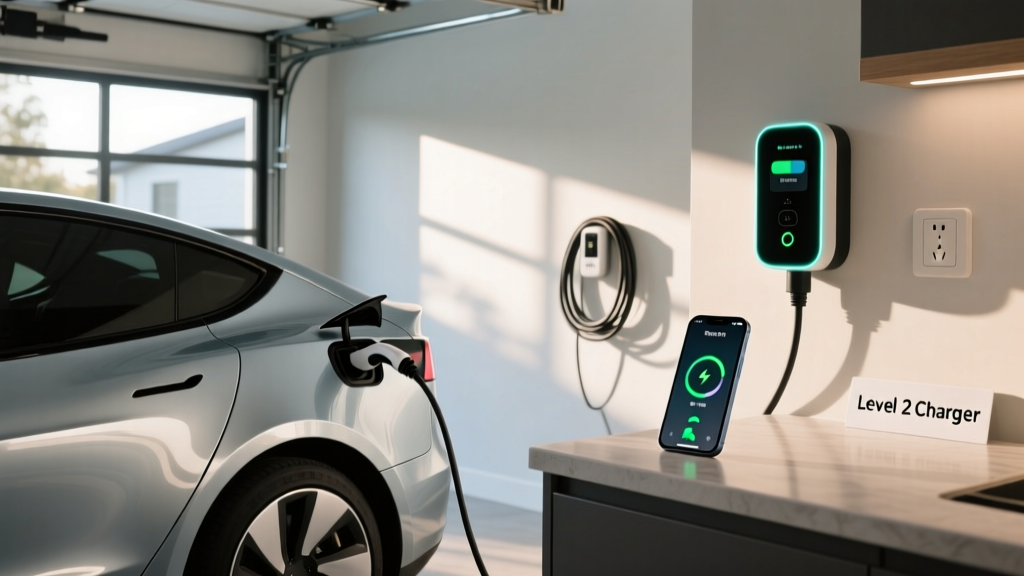
Not all Level 2 chargers are equal. Here are three proven units across price tiers, all NACS-compatible with hardwired installation (hardwired avoids the NEC GFCI breaker nuisance-tripping issues common with 240V plug-in outlets):
Budget Pick: Emporia Vue Smart Charger
- Power: 48A / 11.5 kW (hardwired) or 40A / 9.6 kW (NEMA 14-50 plug)
- Connector: NACS (J3400)
- Cable Length: 24 ft
- Smart Features: Wi-Fi, energy monitoring, TOU scheduling, solar integration
- Price: ~$399
- Best For: Budget-conscious buyers who want smart scheduling and energy tracking
Best Overall: ChargePoint Home Flex
- Power: Up to 50A / 12 kW (adjustable via DIP switches for panel capacity)
- Connector: NACS (J3400)
- Cable Length: 23 ft
- Smart Features: Wi-Fi, app scheduling, Alexa/Google integration, flexible amperage
- Price: ~$549
- Best For: Most homeowners — adjustable amperage means it works with older panels without upgrade
Premium Pick: Tesla Wall Connector
- Power: 48A / 11.5 kW (hardwired, 60A circuit)
- Connector: NACS native
- Cable Length: 24 ft
- Smart Features: Wi-Fi, OTA updates, power sharing (link multiple units on one circuit), load management
- Price: ~$475
- Best For: Tesla owners or multi-EV households needing power sharing between two chargers
Electrical Safety and Code Considerations
EV charging is a continuous, high-draw electrical load — your charger will run at full amperage for 6–10 hours straight. This is fundamentally different from a dryer or oven that cycles on and off. The NEC (National Electrical Code) treats it accordingly:
- Dedicated Circuit: Your Level 2 charger must have its own dedicated circuit — no sharing with other outlets or appliances.
- 125% Rule: A 48A charger requires a 60A breaker and 60A-rated wire (typically 6 AWG copper or 4 AWG aluminum). A 32A charger needs a 40A circuit.
- GFCI Protection: If you use a plug-in installation (NEMA 14-50 receptacle), the NEC requires a GFCI breaker. However, many EV charger manufacturers recommend hardwired installation to avoid nuisance tripping — GFCI breakers for 240V/50A circuits are expensive ($100–$150) and can trip from the charger's internal ground-fault detection conflicting with the breaker's own sensor.
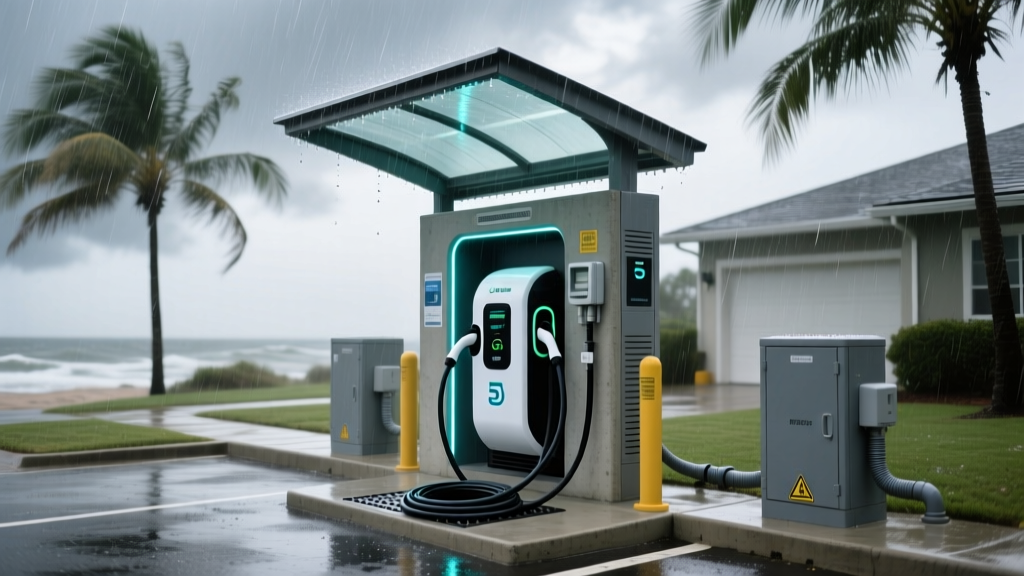
- Outdoor Rating: If your charger is installed outdoors (carport, driveway), ensure the unit is rated NEMA 4 (weatherproof). All three recommendations above carry NEMA 4 ratings.
- Permit and Inspection: Virtually every jurisdiction requires an electrical permit for a new 240V circuit. The inspection ensures wire gauge, breaker sizing, and grounding meet code. Don't skip this — unpermitted work can void home insurance and create fire risk.
Frequently Asked Questions
Can I just use a regular 120V outlet to charge my EV?
Yes, but slowly. Level 1 charging at 120V/12A delivers about 1.4 kW — roughly 4 miles of range per hour. A full charge of an 84 kWh battery from empty takes over 60 hours. Level 1 is viable only if you drive under 30 miles per day and can leave the car plugged in for 10+ hours overnight. For a former GTP driver used to quick fill-ups, Level 2 is the practical minimum.
Will charging at home raise my electric bill more than I'm saving on gas?
No. Even at the highest residential rate ($0.18/kWh), charging an efficient EV costs $0.051/mile — roughly 72% less than fueling the GTP at $0.179/mile. The annual savings range from $1,500 (standard rate) to $1,870 (off-peak rate). Your electric bill will rise by $50–$85/month, but your gas spending drops to zero.
Do I need a Tesla to use Tesla Superchargers?
No. As of 2026, most major automakers have adopted the NACS connector, and any NACS-equipped EV can access Tesla's Supercharger network. If your EV has a CCS1 port (common on 2022–2024 models), Tesla sells a CCS-to-NACS adapter for approximately $200–$250 that enables Supercharger access.
How long will my EV battery last before it needs replacement?
Modern NMC and LFP batteries are designed to retain 70–80% of original capacity after 150,000–200,000 miles. Federal law mandates a minimum battery warranty of 8 years/100,000 miles (10 years/150,000 miles in CARB states). Real-world degradation data from NHTSA-monitored fleets shows most batteries lose 1–2% capacity per year under normal use. A full battery replacement costs $8,000–$18,000 depending on the vehicle, but is rarely needed within the typical ownership period.
Is it cheaper to charge at home or use public fast chargers?
Home Level 2 charging is 3–5× cheaper per mile than public DC fast charging. DC fast chargers ($0.30–$0.55/kWh) should be treated as a road-trip necessity, not a daily charging strategy. If you lack home charging access and must rely entirely on public DC fast charging, your per-mile cost ($0.086–$0.157) is still below the GTP's $0.179/mile — but the convenience gap widens significantly.
What's the single biggest mistake new EV owners make with charging?
Charging to 100% every night. For NMC batteries, daily charging to 80% and letting the battery drop to 20% before recharging significantly extends long-term cell health. Reserve 100% charges for road trips. LFP batteries (used in base Tesla Model 3/Y, some Ford models) are an exception — manufacturers recommend periodic 100% charges for accurate state-of-charge calibration. Check your owner's manual for chemistry-specific guidance.