Why 1990s Homes Need Special Attention for EV Charging
If your house was built between 1988 and 1999, it likely has a 100-amp or 150-amp electrical panel — adequate for the appliances of that era, but potentially strained when you add a 48-amp Level 2 EV charger drawing continuously for hours. Homes from the 1990s represent a sweet spot of electrical modernization: they have grounded wiring, circuit breakers (not fuses), and typically 240V service for dryers and ranges. But that doesn't automatically mean they're EV-ready.
The core challenge: a Level 2 home charger pulling 11.5 kW (48 amps on a 60-amp dedicated circuit) can consume 30-50% of a 100-amp panel's total capacity. Run it simultaneously with an electric oven, dryer, and central A/C, and you risk tripping the main breaker. This guide walks through exactly what a 90s-home owner needs to evaluate, upgrade, and budget for — with real 2026 pricing and equipment picks.
Understanding EV Charging Levels: Speeds in kW and Miles Per Hour
Before assessing your panel, you need to understand what you're plugging in. EV charging is measured in kW (kilowatts), which is the rate of power delivery — think of it like water flow from a hose. The battery capacity is measured in kWh (kilowatt-hours), the total energy stored — like the size of the bucket. These are not interchangeable.
| Level | Voltage | Max Power (kW) | Miles of Range Added Per Hour | Typical Use |
|---|---|---|---|---|
| Level 1 | 120V AC | 1.4–1.9 kW | 3–5 mi/hr | Overnight trickle; PHEVs; emergency |
| Level 2 | 240V AC | 7.2–19.2 kW | 20–60+ mi/hr | Daily home charging; workplace |
| DC Fast | 400–800V DC | 50–350+ kW | 150–1,200+ mi/hr (peak) | Road trips; 10-80% in 18-45 min |
For a 90s home, Level 2 is the target. Most homeowners install a 48-amp charger on a 60-amp circuit (the National Electrical Code requires the circuit to be rated 125% above the continuous load). That delivers up to 11.5 kW — enough to fully replenish a 75 kWh battery (like the Tesla Model Y Long Range) in roughly 7-8 hours, or add about 35-44 miles of range per hour of charging.
Electrical Panel Assessment: Is Your 90s Home Ready?
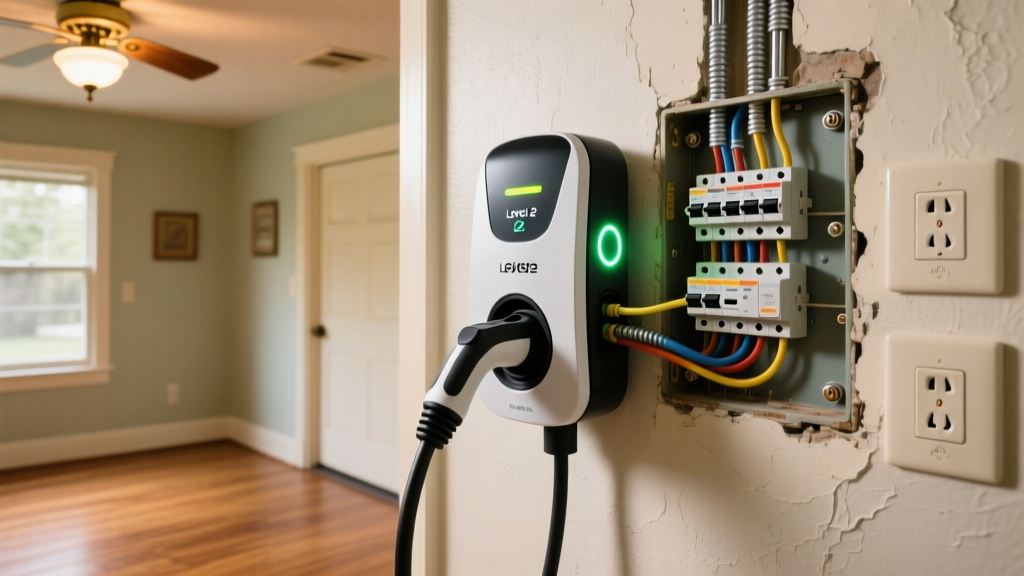
A licensed electrician will perform a load calculation per NEC Article 220 to determine if your existing panel can handle an EV charger. Here's what they evaluate:
Common 1990s Panel Configurations
- 100-amp service: Found in smaller 90s homes (under 1,800 sq ft). Marginal for a 48A EV charger if you have electric heat, A/C, dryer, and oven. A panel upgrade to 200A is often required.
- 150-amp service: Common in mid-size 90s homes. May support a 32-amp (7.7 kW) Level 2 charger without upgrade, but a 48-amp unit may push limits.
- 200-amp service: Present in larger 90s builds. Usually sufficient for a 48A Level 2 charger with room to spare.
Signs Your Panel Needs an Upgrade
- Breakers trip regularly under normal load
- The panel is a Federal Pacific, Zinsco, or Pushmatic brand (known safety hazards common in older homes — these must be replaced regardless of EV plans)
- No available double-pole breaker slots (a 240V charger requires two adjacent slots)
- The electrician's load calculation exceeds 80% of panel capacity with the charger added
If your 90s home has a 100-amp panel with electric appliances, budget for a 200-amp panel upgrade. This is the single biggest variable in your installation cost.
How Much Does It Cost to Install a Home EV Charger?
Installation costs vary enormously based on whether your panel needs upgrading and how far the charger is from the panel. Here's a realistic 2026 breakdown:
| Component | Simple Install (No Panel Upgrade) | Complex Install (Panel Upgrade + Long Run) |
|---|---|---|
| Level 2 Charger (hardware) | $400 – $750 | $400 – $750 |
| Electrical permit | $50 – $200 | $100 – $350 |
| Electrician labor (2-4 hrs simple / 8-16 hrs complex) | $300 – $800 | $1,200 – $2,800 |
| Wiring & conduit materials | $50 – $200 | $200 – $600 |
| Panel upgrade (100A → 200A, if needed) | $0 | $1,500 – $3,500 |
| Total Estimated Cost | $800 – $1,950 | $3,400 – $8,000 |
Key cost drivers for 90s homes:
- Distance from panel to garage: Many 90s floor plans place the panel in the basement or utility room far from the garage. Every foot of 6 AWG copper wire (required for 48A circuits) adds $3-$8 in materials and labor.
- Conduit requirements: If wiring runs through finished walls or externally along the house, conduit is required — adding $500-$1,500.
- Utility service entrance: Upgrading from 100A to 200A may require the utility company to replace the service drop or meter base, adding $500-$2,000 and 2-6 weeks of scheduling.
Some utilities offer rebates of $250-$1,000 for Level 2 charger installation, and certain states provide additional incentives. Check with your local utility before scheduling work.
Connector Compatibility: NACS, CCS1, and CHAdeMO
As of 2026, the North American EV charging landscape has largely consolidated around the NACS (North American Charging Standard) connector, originally developed by Tesla. Nearly every major automaker — Ford, GM, Rivian, Hyundai, Kia, BMW, and others — has adopted NACS for new vehicles starting with 2025-2026 model years.
| Connector | Brands Using It (2026) | Notes |
|---|---|---|
| NACS (Tesla) | Tesla, Ford, GM, Rivian, Hyundai, Kia, BMW, Mercedes, Volvo, Polestar | Standard on most new EVs; smaller/lighter plug |
| CCS1 | VW ID.4 (remaining stock), some Stellantis models, older 2023-2024 EVs | Being phased out; adapters available |
| CHAdeMO | Nissan Leaf (discontinued), Mitsubishi Outlander PHEV (older) | Legacy; limited DC fast-charger support |
What this means for your charger purchase: If you're buying a new 2025-2026 EV, it almost certainly uses NACS. Buy a NACS-connector Level 2 charger. If you own a 2023-2024 CCS1 vehicle (like an early Hyundai Ioniq 5 or VW ID.4), either buy a CCS1 charger or use a NACS-to-CCS1 adapter (approximately $150-$250 from Tesla or third-party suppliers).
Level 2 Charger Equipment Picks for 90s Homes
Here are four proven 2026 chargers well-suited for older-home installations, with specific reasons each might fit your situation:
Best Overall: Tesla Wall Connector (NACS)
- Power output: Up to 11.5 kW (48A) on a 60A circuit
- Connector: NACS (native); J1772 adapter included for CCS vehicles
- Cable length: 24 ft
- Smart features: Wi-Fi, load sharing (pair two units on one circuit), OTA updates, Tesla app integration
- Price: ~$475
- Why for 90s homes: Load-sharing feature lets you pair two Wall Connectors on a single 60A circuit — useful if panel space is tight
Best for Limited Panels: Emporia Level 2 Charger
- Power output: Up to 11.5 kW (48A); software-adjustable down to 16A
- Connector: NACS or J1772 (select at purchase)
- Cable length: 24 ft
- Smart features: Energy monitoring, solar integration, EV energy tracking, adjustable amperage via app
- Price: ~$400
- Why for 90s homes: Software amperage adjustment lets you dial down to 32A or 24A if your panel can't handle 48A — no hardware swap needed
Best Smart/Utility Integration: ChargePoint Home Flex
- Power output: Up to 12 kW (50A) on a 60A circuit; configurable down to 16A
- Connector: NACS or J1772 (select at purchase)
- Cable length: 23 ft
- Smart features: Scheduled charging, utility demand-response programs, Alexa integration, detailed session history
- Price: ~$550
- Why for 90s homes: Utility demand-response compatibility may earn you $50-$200/year in rebates from participating utilities
Best Budget/Simple: Lectron V-BOX Pro
- Power output: Up to 11.5 kW (48A)
- Connector: NACS or J1772
- Cable length: 20 ft
- Smart features: Basic app, no Wi-Fi required; plug-and-charge simplicity
- Price: ~$300
- Why for 90s homes: Lower price offsets panel-upgrade costs; reliable performance without smart features you may not need
Cost to Charge: Home vs. Public vs. Gas
One of the strongest arguments for home charging in any era of home is cost. Even with a panel upgrade factored in, home charging delivers fuel at roughly one-third to one-half the per-mile cost of gasoline.
| Scenario | Avg $/kWh | Cost to Add 200 Miles* | Equiv. $/Gallon |
|---|---|---|---|
| Home (off-peak utility rate) | $0.08 – $0.14 | $4.80 – $8.40 | $0.72 – $1.26 |
| Home (standard rate, no TOU) | $0.14 – $0.20 | $8.40 – $12.00 | $1.26 – $1.80 |
| Public Level 2 (workplace/retail) | $0.20 – $0.35 | $12.00 – $21.00 | $1.80 – $3.15 |
| DC Fast Charging (Electrify America, Tesla Supercharger) | $0.30 – $0.55 | $18.00 – $33.00 | $2.70 – $4.95 |
| Gasoline (25 MPG avg, $3.40/gal) | — | $27.20 | $3.40 |
*Based on an EV averaging 3.0 miles/kWh (e.g., Tesla Model Y, Hyundai Ioniq 5). Per fueleconomy.gov, most 2026 EVs range from 2.5 to 4.0 mi/kWh.
Even at standard residential rates without time-of-use optimization, home charging costs roughly $8-$12 for 200 miles of range — compared to $27+ for the same distance in a 25 MPG gas car. Over 12,000 miles per year, that's a savings of $900-$1,400 annually, which recoups a panel upgrade investment within 3-5 years.
Safety, Code, and Installation Best Practices
The National Electrical Code (NEC) and your local jurisdiction set specific requirements for EV charger installations. For 90s homes, pay particular attention to these:
Dedicated Circuit Requirement
Your Level 2 charger must be on a dedicated circuit — meaning no other outlets or appliances share that breaker. A 48-amp charger requires a 60-amp double-pole breaker. Do not share this circuit with a dryer, oven, or workshop outlet.
GFCI Protection
NEC 2023 (and most 2026 local adoptions) requires GFCI protection for outdoor receptacles. However, most hardwired Level 2 chargers have built-in ground-fault protection and do not require a separate GFCI breaker. Hardwiring (rather than using a 240V outlet like a NEMA 14-50) is generally recommended for reliability and code compliance — it eliminates the outlet as a potential failure point and avoids the GFCI breaker requirement that can cause nuisance trips with some chargers.
Outdoor and Garage Ratings
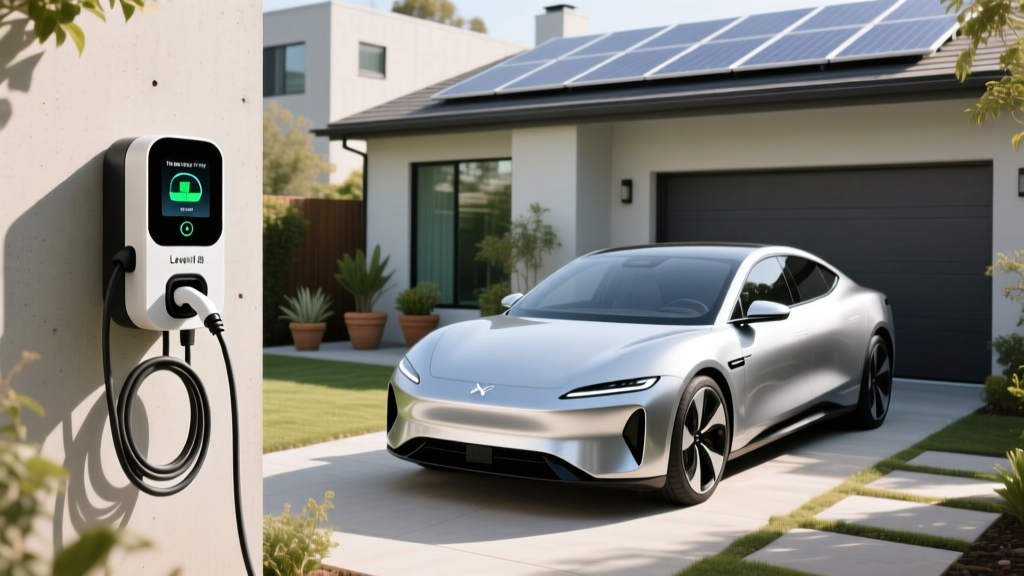
If your charger mounts on an exterior wall or in an unconditioned garage:
- Ensure the unit carries a NEMA 4 or NEMA 4X rating (weatherproof enclosure)
- All 2026 chargers from Tesla, ChargePoint, Emporia, and Lectron carry NEMA 4 ratings for outdoor use
- Cable management (retractors or hooks) prevents tripping hazards and cable degradation from ground contact
Permit and Inspection
Most jurisdictions require a permit for any new 240V circuit. The permit typically costs $50-$200, and the inspection ensures your installation meets NEC standards. Skipping the permit risks voiding your homeowner's insurance coverage for any electrical fire originating from the unpermitted work. Your electrician should pull the permit — not you.
Charging Time Examples for Common EV Battery Sizes
Here's how long a 48-amp (11.5 kW) Level 2 charger takes to charge popular 2026 EVs from 10% to 80% state of charge:
| Vehicle | Usable Battery (kWh) | 10-80% Energy Needed | Approx. Charge Time |
|---|---|---|---|
| Tesla Model Y Long Range | 75 kWh | 52.5 kWh | ~4.5 hours |
| Ford Mustang Mach-E Extended Range | 91 kWh | 63.7 kWh | ~5.5 hours |
| Hyundai Ioniq 5 Long Range | 77.4 kWh | 54.2 kWh | ~4.7 hours |
| Chevrolet Equinox EV | 85 kWh | 59.5 kWh | ~5.2 hours |
| Toyota bZ4X | 64 kWh | 44.8 kWh | ~3.9 hours |
| BMW i4 eDrive40 | 81.5 kWh | 57.1 kWh | ~5.0 hours |
All of these comfortably complete an overnight charge during typical off-peak utility windows (10 PM – 6 AM). If your 90s home's panel limits you to a 32-amp (7.7 kW) charger, add roughly 50% to these times — still manageable overnight for most daily driving needs under 60 miles.
Frequently Asked Questions
How much does it cost to install a home EV charger in a 1990s house?
For a straightforward install on an existing 200-amp panel with the charger near the electrical panel, expect $800-$1,950 all-in (charger, permit, labor, materials). If your 90s home has a 100-amp panel that needs upgrading to 200 amps, total costs range from $3,400 to $8,000 depending on wire run length and utility service entrance work. Get at least three quotes from licensed electricians — prices vary significantly by region and contractor.
How fast will each charging level add range?
Level 1 (120V standard outlet): 3-5 miles per hour. Level 2 (240V, 48A): 35-44 miles per hour for most EVs. DC Fast Charging (150-350 kW): can add 150-300+ miles in 20-30 minutes at peak rate, though the charge curve tapers significantly above 80% SoC. For daily driving, Level 2 at home is the practical standard.
Which connector and charger is compatible with my EV?
Check your vehicle's charge port. For 2025-2026 model year EVs, most use NACS (the Tesla-style connector). Earlier models (2022-2024) from Hyundai, Kia, VW, and Ford use CCS1. The Nissan Leaf uses CHAdeMO. When buying a Level 2 charger, match the connector to your vehicle — or buy a NACS charger and use an adapter for CCS1 vehicles. Tesla's Wall Connector includes a J1772 adapter in the box.
How much does charging cost per mile compared to gas?
At the US average residential electricity rate of ~$0.16/kWh (per EIA data), and an EV efficiency of 3.0 mi/kWh, home charging costs approximately $0.053 per mile. A 25 MPG gas car at $3.40/gallon costs $0.136 per mile — roughly 2.5× more. Over 12,000 miles annually, that's a savings of about $1,000/year with home charging.
What electrical upgrades might my 90s home need?
The most common upgrade is a panel replacement from 100 amps to 200 amps ($1,500-$3,500). You may also need: a new double-pole breaker slot (or a tandem breaker rearrangement), heavier-gauge service entrance wiring, an updated meter base, or a utility service drop replacement. Federal Pacific or Zinsco panels — found in some 90s builds — must be replaced entirely for safety reasons regardless of EV plans. A licensed electrician's load calculation will determine exactly what's needed.
Can I use a smart charger to avoid a panel upgrade?
Yes, in some cases. Chargers like the Emporia Level 2 and ChargePoint Home Flex allow software-based amperage adjustment. If your panel can only spare 32 amps, set the charger to 32A (7.7 kW) via the app — you'll charge slightly slower but avoid a $2,000-$3,500 panel upgrade. Additionally, smart load-management devices like the Span smart panel or Emporia's smart breaker can dynamically throttle the charger when other high-draw appliances activate, keeping total load within panel limits.