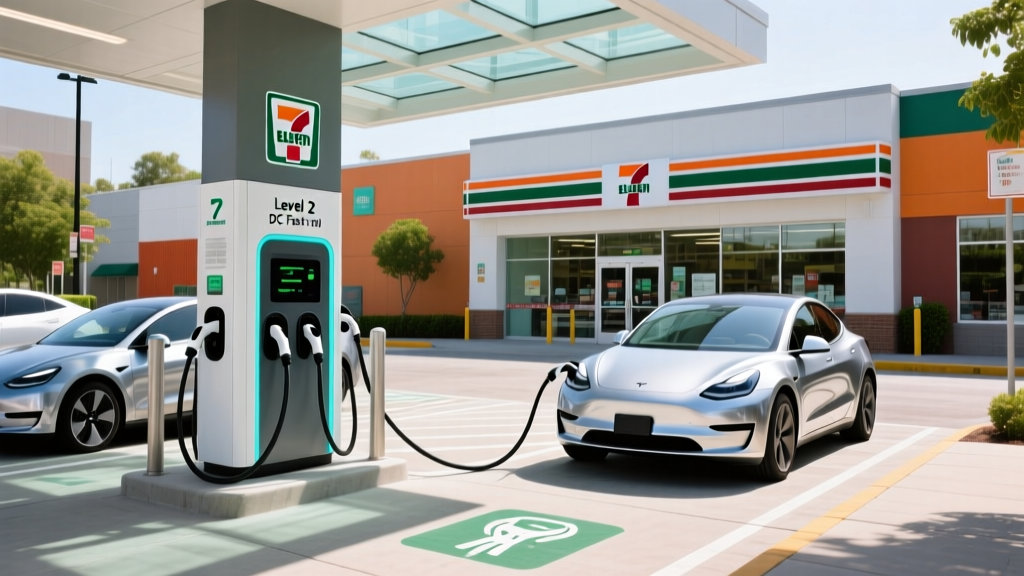
If you've pulled into a 7-Eleven for coffee and noticed a row of EV chargers out front, you're not alone. The convenience-store giant has spent the last several years quietly building one of the more interesting public charging footprints in North America — a network of DC fast chargers (and in some locations, Level 2 units) placed precisely where EV drivers already stop for snacks, fuel, and a bathroom break. But are 7-Eleven charging stations actually worth planning a route around? What speeds can you expect, which connectors are available, and how does the per-kWh pricing compare to Electrify America, EVgo, or Tesla Superchargers?
This guide breaks down the 7-Eleven charging network with real numbers: power output in kilowatts (kW), energy added in kilowatt-hours (kWh), connector compatibility, session costs, and how the experience compares to the major public networks in 2026.
What Are 7-Eleven Charging Stations?
7-Eleven entered the EV charging space through its subsidiary 7Charge, rolling out DC fast-charging stations at select convenience-store locations across the United States and Canada. The deployment accelerated following partnerships announced with charge-point operators and hardware providers. By 2026, 7-Eleven has established charging infrastructure at dozens of locations, primarily concentrated in states with strong EV adoption — California, Texas, Florida, and parts of the Northeast corridor.
The strategic logic is straightforward: EV drivers need 15–30 minutes at a DC fast charger. 7-Eleven locations are already designed for quick stops with food service, restrooms, and well-lit parking. Unlike destination chargers at hotels or malls, these are convenience-oriented fast-charge stops — closer in concept to a gas station than a shopping-center charger.
Charging Speeds: What You'll Find at 7-Eleven Locations
Most 7-Eleven charging installations feature DC fast chargers in the 50 kW to 180 kW range, though newer deployments have included units capable of up to 350 kW. The actual speed your vehicle receives depends on three factors: the charger's maximum output, your vehicle's onboard charge acceptance rate, and your battery's current state of charge (SoC).
Here's how the charging levels break down across the broader EV ecosystem, including what you'll typically encounter at 7-Eleven:
| Level | Power Output | Typical Location | Miles of Range Added Per Hour | Best For |
|---|---|---|---|---|
| Level 1 | 1.4–1.9 kW (120V) | Home (standard outlet) | 3–5 miles | Overnight trickle, PHEVs |
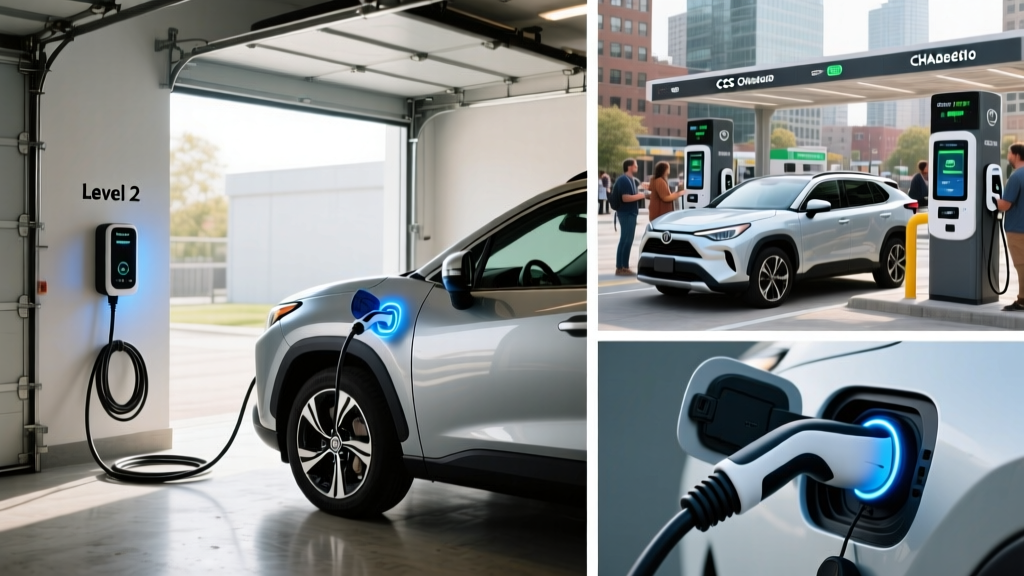
| Level 2 | 7.2–19.2 kW (240V) | Home, workplace, some retail | 20–60 miles | Daily home charging |
| DC Fast | 50–350 kW (480V+) | 7-Eleven, highway corridors | 150–1,000+ miles (peak rate) | Road trips, quick top-ups |
At a typical 7-Eleven station with a 150 kW DC fast charger, a vehicle like the Hyundai Ioniq 5 (which can accept up to 240 kW peak) will be limited to the charger's 150 kW ceiling. Expect a 10–80% charge in roughly 22–28 minutes depending on battery temperature and starting SoC. A vehicle with a lower charge acceptance rate — such as a Chevrolet Equinox EV (accepting around 115 kW peak) — won't fully utilize even a 150 kW stall.
Connector Compatibility at 7-Eleven Chargers
The North American charging landscape has shifted dramatically toward the North American Charging Standard (NACS), originally developed by Tesla and now adopted by nearly every major automaker for 2025 and 2026 model-year vehicles. Here's what connector availability looks like at 7-Eleven fast-charging stations:
| Connector Type | Vehicle Brands Using It | Available at 7-Eleven? | Adapter Needed? |
|---|---|---|---|
| NACS (Tesla standard) | Tesla, Ford, GM, Rivian, Volvo, Polestar, BMW, Hyundai/Kia (2025+) | Yes — newer 7Charge stalls | None for NACS-native vehicles |
| CCS1 (Combo) | Hyundai/Kia (pre-2025), VW, BMW (pre-2025), older Ford/GM | Yes — legacy and dual-cable stalls | CCS-to-NACS adapter if vehicle is NACS-only |
| CHAdeMO | Nissan Leaf (older), Mitsubishi Outlander PHEV | Limited — phasing out | No adapter widely available; use CCS/NACS stations with caution |
If you drive a 2026 model-year EV from Ford, GM, Rivian, or Hyundai, your vehicle almost certainly uses the NACS connector natively. 7-Eleven's newer 7Charge installations include NACS cables. Older installations may still be CCS1-heavy. Always check the specific station on a routing app like PlugShare or A Better Routeplanner (ABRP) before detouring.
For drivers with CCS1-equipped vehicles visiting a NACS-only 7-Eleven stall, a NACS-to-CCS adapter (such as the Lectron or Tesla-approved adapter, typically $150–$250) allows charging, though you may lose some peak charge speed depending on adapter quality.
How Much Does Charging at 7-Eleven Cost?
Public DC fast-charging pricing varies by location, time of day, and local electricity rates. At 7-Eleven 7Charge stations, pricing is typically structured per kWh consumed rather than per minute — which is the fairer model for EV drivers since it directly measures energy received.
| Scenario | Price per kWh | Cost to Add 200 Miles (75 kWh Battery Vehicle) | Cost Per Mile |
|---|---|---|---|
| Home Level 2 (off-peak utility rate) | $0.08–$0.14/kWh | $6.00–$10.50 | $0.03–$0.05 |
| Home Level 2 (standard rate) | $0.12–$0.20/kWh | $9.00–$15.00 | $0.05–$0.08 |
| 7-Eleven DC Fast (typical) | $0.35–$0.48/kWh | $26.25–$36.00 | $0.13–$0.18 |
| Electrify America (Guest rate) | $0.43–$0.56/kWh | $32.25–$42.00 | $0.16–$0.21 |
| Gas vehicle (28 MPG, $3.40/gal) | — | $24.29 | $0.12 |
The numbers tell a clear story: home Level 2 charging remains the cheapest option by a wide margin — often 3–5× less expensive per mile than public DC fast charging. At 7-Eleven's typical rates, a full 200-mile charge costs roughly the same as or slightly more than gasoline for an efficient 28 MPG vehicle. The value proposition of 7-Eleven charging is convenience and speed, not cost savings.
Some 7-Eleven locations participate in subscription plans through third-party networks (such as EVgo or ChargePoint roaming agreements), which can reduce per-kWh pricing by 10–25% for a monthly fee of $4–$8. Check your vehicle's built-in charging navigation or the PlugShare app to see which network operates a given 7-Eleven station.
Reliability and User Experience: What Owners Report
Public charging reliability remains a top concern for EV buyers, and 7-Eleven's 7Charge network has drawn mixed but generally improving reviews. Common praise points include well-lit locations, 24/7 access, proximity to food and restrooms, and straightforward payment via credit card tap or app. Common complaints mirror those across the public charging industry: occasional out-of-service stalls, slower-than-advertised charge speeds during peak grid hours, and app connectivity hiccups.
One advantage 7-Eleven has over standalone charging plazas: if a charger is malfunctioning, you're at a staffed convenience store rather than a remote parking lot. While the store staff can't repair a DC fast charger, the location tends to have better security, lighting, and amenities than unattended charging sites.
For the most current uptime data, consult the PlugShare community check-ins, which crowdsource real-time station status from fellow EV drivers.
How 7-Eleven Charging Compares to Major Networks
Here's how 7-Eleven's 7Charge network stacks up against the largest public DC fast-charging networks in the U.S. as of 2026:
7-Eleven 7Charge Strengths
- Convenience-store amenities (food, restrooms, 24/7 access)
- Locations along high-traffic corridors
- Credit card tap payment at most stalls
- Growing NACS connector availability
7-Eleven 7Charge Limitations
- Smaller network footprint than Tesla, EA, or EVgo
- Charger power caps at 150–180 kW at many locations
- No dedicated lounge or covered charging canopy
- Stall count per site typically 2–4 (can mean wait times)
Tesla's Supercharger network remains the gold standard for reliability and coverage, with over 6,000 stalls in the U.S. and consistent 250 kW (V3) or 350 kW (V4) speeds. Electrify America offers the broadest non-Tesla highway coverage with many 350 kW-capable stations. EVgo operates a large urban and suburban network. 7-Eleven occupies a niche: it's not a primary road-trip network, but a supplementary option that leverages existing real estate in convenient locations.
Planning a Route Around 7-Eleven Chargers
If 7-Eleven charging stations are part of your regular driving routine — or you want to include them in a road-trip plan — here's a practical approach:
- Verify connector type: Open PlugShare or your vehicle's native navigation and confirm the station has your connector (NACS or CCS1) before driving there.
- Check max kW output: A 50 kW stall will take roughly 3× longer than a 150 kW stall for the same 10–80% charge. Plan your stop duration accordingly.
- Precondition your battery: If your EV supports navigation-based battery preconditioning (Tesla, Hyundai/Kia, Ford, BMW), set the 7-Eleven as your destination 20–30 minutes before arrival. This warms the battery and enables faster charge acceptance.
- Arrive at 10–20% SoC: DC fast charging is fastest at low states of charge. Arriving at 50% SoC means you'll hit the taper curve almost immediately, wasting time and money.
- Don't charge past 80%: The charge curve slows dramatically above 80%. Unless you absolutely need the range to reach your next stop, unplug at 80% and move on — it's faster and cheaper.
For real-world range planning, remember that EPA range estimates assume a mix of city and highway driving at moderate temperatures. On a 70 MPH highway run in 40°F weather, expect your actual range to be 20–30% below the EPA sticker. A vehicle rated at 300 miles EPA may deliver only 210–240 miles in those conditions. The EPA's fueleconomy.gov site provides model-specific efficiency data to help you calculate conservatively.
Home Charging Setup: The Foundation of EV Ownership
Public chargers like 7-Eleven's are essential for road trips and occasional top-ups, but 80–90% of EV charging happens at home. If you're considering an EV purchase, understanding home charging costs and requirements is critical.
| Component | Cost Range | Notes |
|---|---|---|
| Level 2 charger (hardware) | $350–$800 | 40A–48A smart charger, 240V, NACS or J1772 |
| Electrical permit | $50–$200 | Required in most jurisdictions; varies by municipality |
| Electrician labor (standard install) | $500–$1,500 | Short run from panel to garage; no panel upgrade |
| Panel upgrade (if needed) | $1,500–$4,000 | 100A → 200A service upgrade for older homes |
| Total (no panel upgrade) | $900–$2,500 | Most homes with 200A service |
| Total (with panel upgrade) | $2,400–$6,500 | Older homes with 100A service |
A Level 2 home charger operating at 240V and 40–48 amps delivers 9.6–11.5 kW — enough to fully recharge most EVs overnight (8–10 hours for a 75–100 kWh battery). This requires a dedicated 50A or 60A circuit on your electrical panel. If your home has a 200-amp service panel with available breaker slots, installation is straightforward and relatively affordable.
Homes with older 100-amp panels or panels that are already near capacity may require a service upgrade to 200 amps before adding an EV charger circuit. This is the single biggest variable in home charging cost and one that many buyers overlook during purchase planning.
Recommended Home Level 2 Chargers (2026)
Emporia Vue Level 2 Smart Charger
- Power: 48A / 11.5 kW (240V)
- Connector: J1772 (NACS adapter included)
- Cable: 24 ft
- Smart features: Wi-Fi, scheduling, energy monitoring, solar integration
- Price: ~$399
ChargePoint Home Flex
- Power: Up to 50A / 12 kW (240V, adjustable)
- Connector: J1772 or NACS (configurable)
- Cable: 23 ft
- Smart features: Wi-Fi, Alexa, app scheduling, utility demand-response
- Price: ~$649
Tesla Wall Connector
- Power: 48A / 11.5 kW (240V)
- Connector: NACS native
- Cable: 24 ft
- Smart features: Wi-Fi updates, power sharing (multiple units), load management
- Price: ~$475
Grizzl-E Smart
- Power: 40A / 9.6 kW (240V)
- Connector: J1772 or NACS
- Cable: 24 ft
- Smart features: OCPP-compatible, rugged outdoor rating, adjustable amperage
- Price: ~$449
All chargers listed above are hardwired or NEMA 14-50 plug compatible. Hardwired installations are generally preferred for 48A+ chargers because a NEMA 14-50 outlet is rated for only 40A continuous draw (per the National Electrical Code continuous-load rule requiring circuits to be rated at 125% of continuous load). If you want a plug-in charger for portability, limit yourself to 32A (7.7 kW) on a 14-50 outlet, or have your electrician install a 14-60 or hardwired connection.
Safety and Code Requirements
EV charger installations must comply with NEC Article 625 and local electrical codes. Key requirements include:
- Dedicated circuit: Your EV charger needs its own breaker — no sharing with other appliances.
- GFCI protection: Required for outdoor installations and in many jurisdictions for garage outlets (NEC 2020+). Hardwired chargers often bypass this requirement since many have built-in ground-fault protection.
- Outdoor rating: If installing outside, ensure the charger is rated NEMA 4 (weatherproof). All chargers listed above carry outdoor ratings.
- Permit and inspection: Most municipalities require an electrical permit and a post-installation inspection. Budget $50–$200 and 1–2 weeks for this process.
Always hire a licensed electrician for EV charger installation. DIY electrical work on 240V circuits carries fire and shock risk, and an unpermitted installation may void your homeowner's insurance coverage in the event of an electrical fire.
Frequently Asked Questions
How much does it cost to install a home EV charger?
A standard Level 2 home charger installation (40A–48A, 240V) costs between $900 and $2,500 when your electrical panel has sufficient capacity. If your home requires a panel upgrade from 100A to 200A service, total costs range from $2,400 to $6,500 including equipment, labor, and permits. The charger hardware itself runs $350–$800.
How fast will each charging level add range?
Level 1 (120V household outlet) adds 3–5 miles per hour — suitable only for plug-in hybrids or emergency trickle charging. Level 2 (240V, 40A–48A) adds 20–40 miles per hour and fully recharges most EVs overnight. DC fast charging at 150 kW adds roughly 150–250 miles in a 20-minute session, though actual speed depends on your vehicle's charge acceptance rate and battery temperature.
Which connector is compatible with my EV?
For 2025 and 2026 model-year vehicles, most new EVs use the NACS connector (Tesla, Ford, GM, Rivian, Hyundai, Kia, BMW, Volvo). Pre-2025 non-Tesla EVs typically use CCS1. The Nissan Leaf uses CHAdeMO. Check your vehicle's charge port or owner's manual. If you drive a CCS1 vehicle and want to use NACS-only chargers, a CCS-to-NACS adapter ($150–$250) enables compatibility.
How much does charging cost per mile vs. gas?
Home Level 2 charging at typical utility rates costs $0.03–$0.08 per mile — roughly 60–75% less than gasoline at $3.40/gallon for a 28 MPG vehicle ($0.12/mile). Public DC fast charging at 7-Eleven or similar networks costs $0.13–$0.21 per mile, which is comparable to or slightly more expensive than gas. The economic case for EV ownership depends heavily on access to affordable home charging.
What electrical upgrades might I need?
If your home has a 200-amp electrical panel with available breaker slots, you likely need no upgrade — just a new 50A or 60A dedicated circuit. Homes with 100-amp panels, full breaker panels, or older wiring (knob-and-tube, aluminum) may require a panel upgrade ($1,500–$4,000) or a service upgrade from the utility. An electrician can assess your panel during a site visit, typically free with a quote request.
Are 7-Eleven chargers free to use?
No. 7-Eleven 7Charge stations charge per kWh consumed, typically $0.35–$0.48/kWh depending on the location and local electricity rates. Some locations may offer promotional pricing or participate in third-party subscription plans that reduce the per-kWh rate.
Can I use a 7-Eleven charger if I don't have a Tesla?
Yes. 7-Eleven 7Charge stations are open to all EV brands. Newer installations include both NACS and CCS1 connectors. If you drive a non-Tesla EV with a CCS1 port and the station only has NACS cables, you'll need a CCS-to-NACS adapter. Check the station listing on PlugShare before arriving to confirm connector availability.