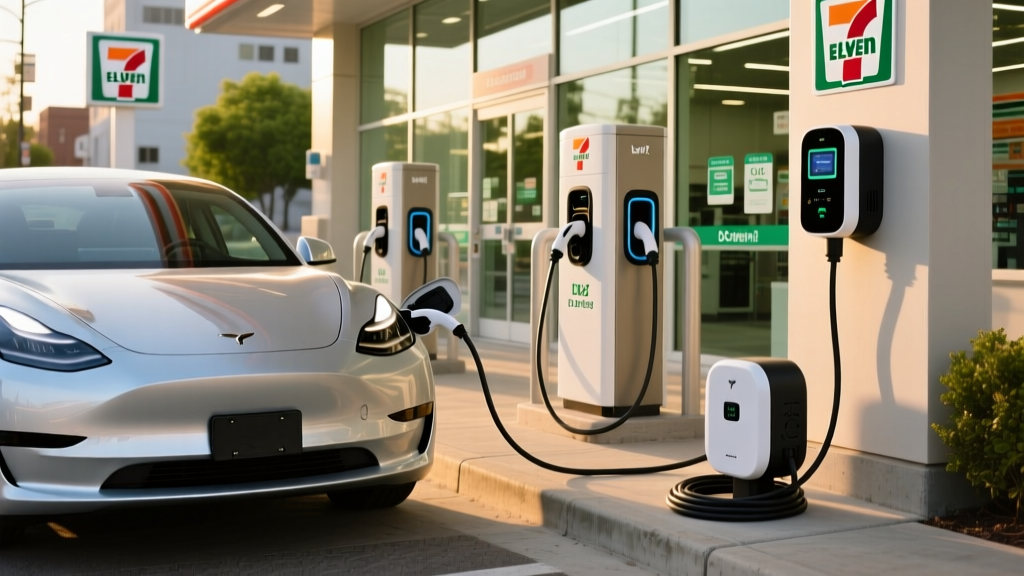
If you've pulled into a 7-Eleven for coffee and noticed EV charging stalls out front, you're not imagining things. The convenience-store chain has been rolling out DC fast chargers across select U.S. markets, partnering with networks like EVgo and ChargePoint to place 50–350 kW stations at high-traffic locations. But does 7-Eleven sell chargers you can buy and install at home? No — 7-Eleven hosts public charging infrastructure; it doesn't retail home charging equipment. If you're looking to buy a home charger, you'll need to source that separately from dedicated EV equipment brands.
This guide covers everything 7-Eleven's charging presence means for your daily driving, then walks through exactly what you need to charge at home — from electrical requirements and installation costs to equipment picks and the real cost-per-mile versus gasoline.
7-Eleven's Public EV Charging Network: What's Available
7-Eleven has partnered with major charging networks to deploy DC fast chargers at select locations, primarily in California, Texas, and Florida. These are typically 50 kW to 350 kW CCS or NACS stations operated by EVgo, ChargePoint, or Tesla Supercharger partners. You won't find Level 2 destination chargers at most 7-Elevens — the strategy is fast top-ups for drivers already stopping for convenience items.
As of 2026, availability remains regional. You can locate 7-Eleven charging stations through the EVgo, ChargePoint, or PlugShare apps by filtering for the retailer's locations. Expect to pay standard public DC fast-charging rates — typically $0.35–$0.55/kWh depending on the network and time of day.
Charging Levels Explained: Speed, Power, and Real-World Range Added
Every EV owner needs to understand the three charging tiers. The table below shows the power output (kW), typical voltage/amperage, and how many miles of range you'll add per hour of charging. These figures assume an average EV efficiency of 3–4 miles per kWh.
| Level | Power (kW) | Voltage / Amperage | Miles of Range Per Hour | Best Use Case |
|---|---|---|---|---|
| Level 1 | 1.2–1.9 kW | 120V / 12–16A | 3–5 miles | Overnight top-up, PHEVs, low daily mileage |
| Level 2 | 3.3–19.2 kW | 240V / 16–80A | 12–60 miles | Daily home charging, workplace, overnight full charge |
| DC Fast | 50–350 kW | 400–800V DC | 150–1,200+ miles (equivalent) | Road trips, rapid top-ups, 10–80% in 15–40 min |
Real-world charging time examples (10–80% SoC):
- 75 kWh battery (e.g., Tesla Model Y, Hyundai Ioniq 5) on a 150 kW DC fast charger: ~18–25 minutes, though peak rate tapers significantly above 60% SoC.
- 75 kWh battery on a 50 kW DC charger: ~55–70 minutes.
- 75 kWh battery on an 11.5 kW Level 2 home charger: ~7–8 hours for a full 0–100% charge; 10–80% in roughly 5 hours.
- 90 kWh battery (e.g., Ford F-150 Lightning extended range) on a 150 kW DC fast charger: ~28–38 minutes (10–80%).
Understand that peak kW is not sustained kW. A charger rated at 250 kW may only deliver that rate between 10–40% SoC before tapering. The charge curve matters more than the headline number — always check 10–80% times, not just peak power.
Home EV Charger Installation: Electrical Requirements and Costs
Installing a Level 2 home charger is the single biggest upgrade most EV owners make. It requires a dedicated 240V circuit — the same voltage your electric dryer or oven uses — and must be performed by a licensed electrician to meet National Electrical Code (NEC) requirements.
Electrical Requirements
- Voltage: 240V (split-phase residential service)
- Amperage: 20A to 60A dedicated circuit, depending on charger power. A 48A charger requires a 60A breaker (NEC requires circuits rated at 125% of continuous load).
- Wire gauge: 6 AWG copper for 60A circuits; 8 AWG for 40A circuits.
- Panel capacity: Your main electrical panel must have sufficient spare amperage. Most homes with 200A service can accommodate a 60A EV circuit. Homes with 100A service often need a panel upgrade.
Do You Need a Panel Upgrade?
This is the hidden cost that catches many homeowners off guard. If your home has a 100A main panel, or your existing loads (HVAC, electric range, dryer, water heater) already consume most of a 200A panel's capacity, you'll need either a panel upgrade to 200A–400A or a load-management device that throttles charger amperage when other appliances draw power. A panel upgrade adds $1,500–$4,000+ to the project. Load-management devices like the Emporia Load Management System or Tesla Wall Connector with energy management can avoid this expense by dynamically limiting charge rate.
| Cost Component | Low Estimate | High Estimate | Notes |
|---|---|---|---|
| Level 2 Charger Equipment | $250 | $700 | Hardwired or NEMA 14-50 plug; smart vs. dumb units |
| Electrician Labor (standard install) | $400 | $1,500 | Depends on panel-to-charger distance, conduit run, wall type |
| Permit & Inspection | $50 | $300 | Varies by municipality; some jurisdictions waive for EV |
| Panel Upgrade (if needed) | $1,500 | $4,500 | 100A → 200A upgrade; older homes most affected |
| Total (no panel upgrade) | $700 | $2,500 | Most homeowners land in the $1,000–$1,800 range |
| Total (with panel upgrade) | $2,200 | $7,000 | Older homes or high-load panels |
Safety and Code Considerations
- Dedicated circuit: NEC Article 625 requires EV chargers to have their own dedicated circuit — no sharing with other outlets or appliances.
- GFCI protection: NEC 2020+ requires GFCI (Ground Fault Circuit Interrupter) protection for outdoor receptacles used for EV charging. Hardwired installations may be exempt in some jurisdictions, but GFCI breakers are always a safe choice.
- Outdoor rating: If your charger mounts outdoors, it must carry a NEMA 4 or IP65+ weather rating. Most reputable chargers (ChargePoint, Emporia, Tesla) meet this standard.
- NEMA 14-50 receptacle: If you opt for a plug-in charger rather than hardwired, the 14-50 outlet must be installed with proper torque specifications. The NHTSA and CPSC have flagged improperly torqued 14-50 outlets as fire risks — hire a licensed electrician, not a handyman.
Connector Compatibility: NACS, CCS1, and CHAdeMO
The connector landscape has consolidated significantly since 2023, when Ford, GM, Rivian, Volvo, and most major automakers committed to adopting Tesla's North American Charging Standard (NACS). By 2026, NACS is the dominant connector for new EVs sold in the U.S., though CCS1 vehicles remain widespread on the road.
| Connector | Brands Using It (2026 Models) | Adapter Needed? | Public Network Access |
|---|---|---|---|
| NACS (J3400) | Tesla (all), Ford, GM, Rivian, Volvo, Polestar, Mercedes, BMW, Hyundai/Kia (2025+) | CCS1 → NACS adapter for legacy vehicles ($150–$250) | Tesla Superchargers (open network), EVgo, ChargePoint, Electrify America (NACS stalls added) |
| CCS1 | Volkswagen ID.4, older Hyundai/Kia, BMW iX (pre-2025), Stellantis | NACS → CCS1 adapter to access Superchargers ($200–$300) | Electrify America, EVgo, ChargePoint, Ionity (Europe) |
| CHAdeMO | Nissan Leaf (legacy only — discontinued in U.S.) | No reliable adapter to NACS/CCS for DC fast charging | Declining network; Electrify America removed most CHAdeMO stalls |
For home Level 2 charging: Nearly all home chargers now ship with a NACS (J1772-to-NACS adapter included) connector or offer both options. If you own a CCS1 vehicle and buy a NACS home charger, a simple J1772 adapter (usually included with the car) bridges the gap at Level 2 speeds. The connector war primarily affects DC fast charging on the road.
Cost to Charge: Home vs. Public vs. Gasoline
Charging economics depend heavily on where and when you plug in. Home charging during off-peak hours delivers the lowest per-mile cost, while public DC fast charging approaches or sometimes exceeds gasoline costs for efficient cars.
| Scenario | Rate ($/kWh) | EV Efficiency (kWh/mi) | Cost Per Mile | Equivalent Gas Price (at 30 MPG) |
|---|---|---|---|---|
| Home off-peak (utility TOU rate) | $0.08–$0.12 | 0.28 (3.5 mi/kWh) | $0.02–$0.03 | $0.60–$0.90/gal |
| Home standard rate (no TOU) | $0.14–$0.20 | 0.28 | $0.04–$0.06 | $1.20–$1.80/gal |
| Public Level 2 (workplace, mall) | $0.15–$0.30 | 0.28 | $0.04–$0.08 | $1.20–$2.40/gal |
| DC fast charging (public) | $0.35–$0.55 | 0.28 | $0.10–$0.15 | $3.00–$4.50/gal |
| Gasoline (2026 U.S. avg) | — | 30 MPG combined | $0.11–$0.13 | $3.30–$3.90/gal |
The takeaway: If you can charge at home on a time-of-use (TOU) plan, your fuel cost drops to roughly a quarter of what gasoline costs. Public DC fast charging is a road-trip convenience, not a daily strategy — it's comparable to paying $3.50+/gallon for gas. According to fueleconomy.gov, most EVs achieve 100–130 MPGe combined, translating to 3–4 miles per kWh.
Recommended Home EV Chargers for 2026
These units represent the best-performing Level 2 chargers based on power output, reliability, connector flexibility, and smart features. All are NACS-compatible or include adapters for CCS1 vehicles.
Tesla Wall Connector (Gen 4)
- Power: 11.5 kW (48A on 60A circuit)
- Connector: NACS native; J1772 adapter included
- Cable length: 24 ft
- Smart features: Wi-Fi, OTA updates, energy management, Power Share (load balancing with multiple units)
- Price: ~$475
- Best for: Tesla owners and NACS-equipped vehicles; cleanest integration with Tesla Powerwall
ChargePoint Home Flex
- Power: Up to 12 kW (50A, configurable 16–50A)
- Connector: NACS (J1772 adapter included in box)
- Cable length: 23 ft
- Smart features: Wi-Fi, ChargePoint app scheduling, Alexa integration, amperage dip-switch configurable
- Price: ~$550–$650
- Best for: Mixed-fleet households; adjustable amperage avoids panel upgrades
Emporia Vue Level 2 EV Charger
- Power: 11.5 kW (48A)
- Connector: NACS or J1772 versions available
- Cable length: 24 ft
- Smart features: Integration with Emporia Vue energy monitor, solar-aware charging, load management, scheduling
- Price: ~$350–$400
- Best for: Budget-conscious buyers; solar-home integration; panel-constrained installs with load management
Grizzl-E Smart
- Power: 10 kW (40A) or 11.5 kW (48A depending on circuit)
- Connector: NACS or J1772 options
- Cable length: 24 ft
- Smart features: Wi-Fi, OCPP compatibility, adjustable amperage, extreme cold rated (-40°C)
- Price: ~$400–$500
- Best for: Cold-climate garages; Canadian-built durability; outdoor installs in harsh weather
Federal and Local Incentives for Home Charger Installation
The federal Residential Clean Energy Credit (IRC §25C) was extended through 2025, but as of 2026, the federal EV charger tax credit (formerly §30C, offering up to $1,000 for home charging equipment) has expired unless renewed by Congress. However, many states, municipalities, and utility companies continue to offer rebates ranging from $200 to $1,500 for Level 2 charger installation. Check with your local utility — programs like PG&E's EV Rate Program, Con Edison's SmartCharge New York, and Austin Energy's Plug-In Partners offer direct rebates or reduced TOU rates.
For the vehicle itself, the IRS §30D New Clean Vehicle Credit still applies to qualifying EVs with MSRP, income, and battery-sourcing requirements — but this covers the car, not the charger.
Frequently Asked Questions
Does 7-Eleven sell EV chargers for home use?
No. 7-Eleven hosts public DC fast chargers at select locations through partnerships with EVgo, ChargePoint, and other networks. They do not sell home charging equipment. For home chargers, purchase from dedicated brands like Tesla, ChargePoint, Emporia, or Grizzl-E through their websites, Amazon, or electrical supply retailers.
How much does it cost to install a home EV charger?
A standard Level 2 installation (equipment + electrician + permit) typically costs $700–$2,500 if your electrical panel has sufficient capacity. If you need a panel upgrade from 100A to 200A, add $1,500–$4,500, bringing the total to $2,200–$7,000. Get at least three quotes from licensed electricians and confirm they have EV charger installation experience.
How fast will each charging level add range?
Level 1 (120V) adds 3–5 miles per hour — adequate for PHEVs with small batteries or drivers covering under 30 miles daily. Level 2 (240V, 48A) adds 30–40 miles per hour, fully recharging most EVs overnight in 6–9 hours. DC fast charging (150 kW) can add 150+ miles in 15–20 minutes, though charging speed tapers significantly above 80% State of Charge.
Which connector is compatible with my EV?
If your EV is a 2025+ model from Ford, GM, Rivian, Tesla, Hyundai, Kia, Volvo, or most other brands, it uses NACS (J3400). Older models from Volkswagen, BMW, and pre-2025 Hyundai/Kia use CCS1. The Nissan Leaf used CHAdeMO but is no longer sold in the U.S. For home Level 2 charging, adapters are inexpensive and widely available. For DC fast charging on the road, CCS1 owners need a NACS-to-CCS adapter ($200–$300) to access Tesla Superchargers.
How much does charging cost per mile versus gas?
Home charging on off-peak utility rates costs $0.02–$0.03 per mile — roughly equivalent to $0.75/gallon gasoline. Standard home rates bring this to $0.04–$0.06/mile. Public DC fast charging costs $0.10–$0.15/mile, comparable to $3.00–$4.50/gallon gas. The average gasoline vehicle at 30 MPG and $3.50/gallon costs about $0.12/mile. Home charging delivers 60–80% fuel savings.
What electrical upgrades might I need?
The most common upgrade is a panel capacity increase if your main service is 100A or your 200A panel is near capacity. Alternatives to a full panel upgrade include smart load-management devices (which throttle EV charging when other appliances are running) or a lower-amperage charger (32A instead of 48A) that draws less from the panel. A licensed electrician should perform a load calculation before recommending an upgrade.
Can I use a regular 120V outlet for EV charging?
Yes — this is Level 1 charging, using the portable cord that comes with most EVs. It delivers 1.2–1.9 kW and adds 3–5 miles of range per hour. For a PHEV with a 15–30 kWh battery, overnight Level 1 charging is sufficient. For a BEV with a 75+ kWh battery, Level 1 requires 40+ hours for a full charge and is only practical as an emergency backup or for very low daily mileage.
Sources: EPA fuel economy data from fueleconomy.gov; IRS tax credit guidance from irs.gov; NEC Article 625 electrical code requirements; manufacturer specifications from Tesla, ChargePoint, and Emporia product pages (2026 model year).