Understanding the True Cost of a 60kW DC Charger Per Unit of Energy
If you've ever pulled up to a public fast-charging station and watched the dollar counter spin, you've probably asked: what am I actually paying per kilowatt-hour? And more specifically, how does a mid-tier 60kW DC charger compare in per-unit charging cost against a 150 kW or 350 kW stall — or against charging at home?
The answer depends on more than just the posted rate. Electricity pricing structures, demand charges that station operators pass through, time-of-use windows, and your vehicle's actual charge acceptance rate all shape the real per-unit cost. This guide breaks down the economics of 60 kW DC fast charging — at commercial stations, at workplaces, and in the rare home or small-fleet scenario — with exact numbers you can use to calculate your own costs.
kW (kilowatt) measures power — the rate at which energy flows into your battery. Think of it as the width of the hose. kWh (kilowatt-hour) measures energy — the actual amount of electricity stored. Think of it as the volume of water in the bucket. When we discuss "per unit charging cost," we mean cost per kWh — the energy you actually receive. A 60 kW charger delivers energy at up to 60 kilowatts of power, but you pay for the kilowatt-hours accumulated.
Charging Levels Explained: Speeds, Power, and Range Added Per Hour
Before calculating cost, you need to understand what each charging level delivers. Here's how Level 1, Level 2, and DC Fast Charging compare in real-world terms:
| Level | Voltage / Amperage | Power Output | Miles of Range Per Hour | Best For |
|---|---|---|---|---|
| Level 1 (120V) | 120V / 12-16A | 1.4–1.9 kW | 3–5 miles | Overnight top-ups, PHEVs |
| Level 2 (240V) | 240V / 32-48A | 7.7–11.5 kW | 20–40 miles | Daily home charging |
| DC Fast (60 kW) | 200–500V DC | Up to 60 kW | 120–180 miles | Road trips, commercial fleets |
| DC Fast (150 kW) | 200–500V DC | Up to 150 kW | 250–400 miles | Highway corridor charging |
| DC Fast (350 kW) | 200–920V DC | Up to 350 kW | 500–800+ miles | 800V-architecture vehicles |
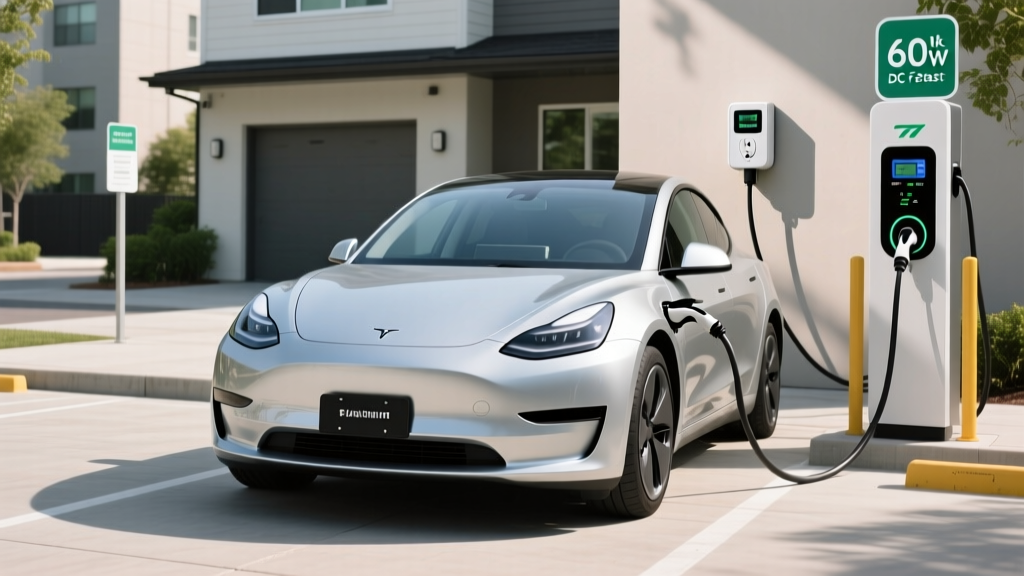
A 60 kW DC charger sits in the middle of the fast-charging spectrum. It's common at older Electrify America and EVgo stations, many workplace installations, and some apartment-complex setups. For a vehicle with a 75 kWh battery (like a Tesla Model Y Long Range or Ford Mustang Mach-E Extended Range), a 60 kW charger will add roughly 45–55 kWh in a 10–80% session — enough for about 150–190 miles of real-world range — in approximately 45–60 minutes.
That's slower than a 150 kW or 350 kW stall, but here's the counterintuitive part: the per-kWh cost at a 60 kW charger is often lower than at ultra-fast stations, because operators of higher-power equipment face steeper demand charges from utilities and pass those costs to you.
60kW DC Charger Per Unit Charging Cost: Public Station Pricing
Public DC fast-charging networks price electricity in several ways: per kWh, per minute, or a combination of both. Here's what you'll typically encounter at a 60 kW station in 2026:
| Network | Typical 60 kW Rate | Pricing Model | Idle Fee |
|---|---|---|---|
| EVgo | $0.36–$0.48/kWh | Per kWh (some per-minute legacy) | $0.25/min after 10 min grace |
| Electrify America | $0.48–$0.64/kWh | Per kWh | $0.40/min after 10 min grace |
| ChargePoint (DC) | $0.32–$0.55/kWh | Per kWh (site-dependent) | Varies by site |
| Tesla Supercharger (non-Tesla) | $0.35–$0.55/kWh | Per kWh | $0.50–$1.00/min |
Real-world cost example: Charging from 10% to 80% on a 75 kWh battery at a 60 kW station requires roughly 52 kWh. At $0.48/kWh (a typical EA rate), that session costs about $24.96. At a lower-cost EVgo station with a membership rate of $0.36/kWh, the same session runs about $18.72.
The per-unit cost at 60 kW stations tends to be $0.05–$0.15/kWh cheaper than at 150–350 kW ultra-fast stations on the same network, because the operator's demand charges (the commercial utility fee based on peak power draw) are lower. This is the central economics of the 60kW DC charger per unit charging cost question: slower DC charging is often cheaper per kWh, but costs you more in time.
A 60 kW charger delivers its peak rate only in a narrow state-of-charge (SoC) window — typically between 10% and 40%. Above 60% SoC, most vehicles will accept only 30–45 kW. Above 80%, that drops to 15–25 kW. This means your session average is closer to 40–45 kW, not the full 60 kW. The per-kWh cost doesn't change, but your effective charging speed does. Plan accordingly: if you're at a 60 kW charger, stopping at 80% rather than pushing to 90%+ saves significant time without proportionally increasing cost.
Charging at Home vs Public: The Real Cost-Per-Mile Comparison
The single biggest lever for reducing your per-unit charging cost is moving from public DC fast chargers to home Level 2 charging. Here's how the economics stack up across common scenarios, using a vehicle averaging 3.0 miles per kWh (about 112 MPGe — typical for a midsize electric SUV):
| Charging Scenario | Cost per kWh | Cost per Mile | Annual Cost (12,000 mi) |
|---|---|---|---|
| Home Level 2 (national avg $0.16/kWh) | $0.16 | $0.053 | $640 |
| Home Level 2 (off-peak TOU, $0.09/kWh) | $0.09 | $0.030 | $360 |
| Public Level 2 ($0.25/kWh avg) | $0.25 | $0.083 | $1,000 |
| Public 60 kW DC ($0.43/kWh avg) | $0.43 | $0.143 | $1,720 |
| Public 150–350 kW DC ($0.55/kWh avg) | $0.55 | $0.183 | $2,200 |
| Gasoline (28 MPG combined, $3.40/gal) | — | $0.121 | $1,457 |
The takeaway is stark: home off-peak charging at $0.09/kWh costs roughly one-quarter of what a 60 kW public DC charger costs per mile. Even at the national average residential rate of $0.16/kWh (per EIA data), home charging is cheaper per mile than gasoline at $3.40/gallon in a 28 MPG vehicle. Public DC fast charging, by contrast, frequently exceeds the per-mile cost of gasoline — which is why DC fast charging should be treated as a road-trip and convenience tool, not a daily charging strategy.
Can You Install a 60kW DC Charger at Home?
Short answer: almost certainly not in a practical sense. A 60 kW DC fast charger requires a 480V three-phase electrical supply (or a 208V commercial service with significant amperage), dedicated transformer capacity, and utility-grade infrastructure. The equipment alone costs $20,000–$40,000, and the electrical service upgrade to support it would add another $10,000–$50,000+ depending on your utility's requirements.
For residential and small-business owners, the practical fast-charging options are:
- Level 2 home charger (7.7–11.5 kW): The standard for daily charging. Runs on a 240V circuit — the same voltage as your electric dryer or oven.
- Level 2 workplace/destination charger (19.2 kW): Some commercial Level 2 units push to 80A/19.2 kW, but these require a 100A dedicated circuit and commercial electrical service.
If you're evaluating the 60kW DC charger per unit charging cost for a commercial or fleet application, the economics shift. A single 60 kW unit might serve 8–12 vehicles per day, and the per-kWh cost drops when you amortize demand charges across high utilization. But for individual EV owners, home Level 2 remains the cost champion.
Home Level 2 Charger Installation: Electrical Requirements and Costs
Since home Level 2 is the realistic alternative to public DC fast charging, understanding installation costs is essential. Here's what a typical 240V / 48A home charger installation involves:
| Component | Simple Install (panel nearby) | Complex Install (panel upgrade + long run) |
|---|---|---|
| Level 2 charger equipment | $350–$700 | $500–$750 |
| 60A dedicated circuit breaker | $30–$60 | $30–$60 |
| Electrical wiring (6 AWG copper, conduit) | $100–$300 | $500–$1,500 |
| Licensed electrician labor | $400–$800 | $1,200–$3,000 |
| Permit and inspection | $50–$200 | $100–$350 |
| Electrical panel upgrade (100A → 200A) | Not needed | $1,500–$4,000 |
| Total estimated cost | $930–$2,060 | $3,830–$9,660 |
The panel upgrade is the wild card. Homes built before 2000 often have 100-amp or 150-amp main panels that may lack capacity for a 60A EV circuit (which draws 48A continuous under NEC 80% derating rules). If your panel is already near capacity — running central AC, an electric oven, and a dryer — adding a 48A continuous load may require a panel upgrade to 200A. This is the single largest cost variable and one that many online guides gloss over. Always have a licensed electrician perform a load calculation before quoting your install.
Some utilities offer rebates of $250–$1,000 for Level 2 charger installation, and the federal §30C alternative fuel vehicle refueling property credit covers up to 30% of home charging equipment and installation costs (capped at $1,000) for eligible taxpayers in qualifying census tracts. Check irs.gov for current eligibility rules, as census tract qualification and income limits apply.
Connector Compatibility: NACS, CCS1, and CHAdeMO
Not all chargers physically connect to all vehicles. As of 2026, the North American connector landscape has consolidated significantly around NACS (the Tesla-designed standard now adopted by most automakers), but legacy connectors remain in widespread use:
| Connector | Brands Using It (2026 Models) | Adapter Needed? | Availability at 60 kW Stations |
|---|---|---|---|
| NACS | Tesla (all), Ford, GM, Rivian, Volvo, Polestar, Hyundai/Kia (2025+), Mercedes-Benz | CCS-to-NACS adapter for legacy CCS stations | Growing rapidly; Tesla Superchargers + retrofit EA/EVgo stalls |
| CCS1 | VW ID.4 (pre-2025), BMW iX/i4 (pre-2025), older Hyundai/Kia, Stellantis | NACS-to-CCS adapter for Tesla Superchargers | Most Electrify America, EVgo, ChargePoint DC stalls |
| CHAdeMO | Nissan Leaf (legacy only — discontinued in US after 2025) | No practical adapter to NACS/CCS | Declining; some EA and EVgo stalls retain one cable |
If you're buying a 2026 model-year EV, it almost certainly ships with a native NACS port. When using a 60 kW public DC charger with a CCS cable, you'll need a CCS-to-NACS adapter (typically $150–$250 from Tesla, Ford, or third-party suppliers like Lectron or A2Z). Always confirm adapter compatibility with your specific vehicle's charge controller — not all adapters support the full communication protocol needed for DC fast charging.
Level 2 Home Charger Recommendations
Since a 60 kW DC charger isn't practical for home use, here are the best Level 2 home chargers to minimize your per-unit charging cost. All units below support 240V operation with a NEMA 14-50 plug or hardwired installation:
Tesla Wall Connector
Power: Up to 11.5 kW (48A)
Connector: NACS native
Cable length: 24 ft
Smart features: Wi-Fi, OTA updates, load sharing, power sharing between units
Price: $475
Best for: Tesla owners and NACS-native vehicles. Excellent build quality and the longest cable in its class.
ChargePoint Home Flex
Power: Up to 12 kW (50A, hardwired) or 9.6 kW (40A, plug-in)
Connector: NACS or J1772 (configurable)
Cable length: 23 ft
Smart features: Wi-Fi, app scheduling, Alexa integration, utility TOU integration
Price: $549–$649
Best for: Multi-EV households, CCS-to-NACS flexibility, utility demand-response programs.
Emporia Vue Level 2
Power: Up to 11.5 kW (48A)
Connector: NACS (J1772 adapter included)
Cable length: 24 ft
Smart features: Wi-Fi, solar integration, energy monitoring, TOU scheduling
Price: $399
Best for: Budget-conscious buyers who want smart features. Best value in the smart-charger category.
Grizzl-E Smart
Power: Up to 10 kW (40A)
Connector: NACS or J1772
Cable length: 24 ft
Smart features: Wi-Fi, OCPP support, adjustable amperage
Price: $449
Best for: Cold climates and outdoor installs. IP67 rated, built in Canada, extremely rugged housing.
Safety, Code, and Electrical Considerations
Any Level 2 charger installation must comply with the National Electrical Code (NEC) Article 625 and local amendments. Key requirements include:
- Dedicated circuit: EV chargers must be on a dedicated circuit — not shared with other appliances. A 48A continuous charger requires a 60A breaker (NEC 125% rule for continuous loads).
- GFCI protection: The 2023 NEC update (and 2026 adoptions by most jurisdictions) requires GFCI protection for all EV charging outlets rated 150V to ground or less and 60A or less. Hardwired installations may have different GFCI requirements depending on local code.
- Outdoor rating: If your charger is installed outdoors (carport, driveway pedestal, or exterior wall), both the charger and any receptacle must carry a NEMA 3R or 4 (weatherproof) rating. All chargers recommended above meet this standard.
- Cable management: NEC requires that the charging cable not create a tripping hazard. Wall-mounted cord reels or J-hooks are recommended for installations where the cable crosses a walkway.
- Utility notification: Some utilities require notification before adding a Level 2 charger, particularly if your home is on a transformer nearing capacity. Check with your local utility — some offer free or discounted panel inspections.
Always hire a licensed electrician for EV charger installation. While the equipment is plug-and-play for a NEMA 14-50 outlet, the circuit wiring, breaker sizing, and code compliance require professional expertise. A permitted and inspected installation also protects your homeowner's insurance coverage in the event of an electrical fire.
10–80% Charging Times by Battery Size at 60 kW
To help you plan road-trip stops at 60 kW stations, here are approximate 10–80% charging times for common EV battery sizes. These assume the vehicle can accept the full 60 kW (most modern EVs can) and account for charge-curve taper above 60% SoC:
| Vehicle / Battery Size | Usable kWh | 10–80% Energy (kWh) | Est. Time at 60 kW | Est. Session Cost ($0.43/kWh) |
|---|---|---|---|---|
| Chevrolet Equinox EV (85 kWh) | 81 kWh | ~57 kWh | ~62 min | $24.51 |
| Tesla Model Y LR (75 kWh) | 72 kWh | ~50 kWh | ~55 min | $21.50 |
| Hyundai Ioniq 5 (77.4 kWh) | 74 kWh | ~52 kWh | ~57 min | $22.36 |
| Ford F-150 Lightning (131 kWh) | 123 kWh | ~86 kWh | ~105 min | $36.98 |
| BMW i4 eDrive40 (83.9 kWh) | 81 kWh | ~57 kWh | ~62 min | $24.51 |
Note that large-battery vehicles like the F-150 Lightning Extended Range suffer the most at 60 kW stations — over 100 minutes for a 10–80% session. These vehicles benefit enormously from 150–350 kW chargers, where the same session could take 25–40 minutes.
Frequently Asked Questions
How much does it cost to install a home EV charger?
A standard Level 2 home charger installation costs $930–$2,060 for a straightforward setup where the electrical panel is near the garage. If you need a panel upgrade from 100A to 200A, a long wire run, or trenching, costs can reach $3,830–$9,660. The charger equipment itself ranges from $350–$700. Always get a load calculation from a licensed electrician before committing.
How fast will each charging level add range?
Level 1 (120V) adds 3–5 miles of range per hour. Level 2 (240V, 48A) adds 25–40 miles per hour depending on vehicle efficiency. A 60 kW DC fast charger adds approximately 120–180 miles per hour at peak, but this rate tapers significantly above 60% state of charge. A 350 kW charger can add 500+ miles per hour for compatible 800V-architecture vehicles like the Hyundai Ioniq 5 or Porsche Taycan.
Which connector/charger is compatible with my EV?
For 2026 model-year vehicles: Tesla, Ford, GM, Rivian, Volvo, Hyundai, and Kia now use the NACS connector natively. Older VW, BMW, and Stellantis EVs may still use CCS1. The Nissan Leaf used CHAdeMO but has been discontinued in the US. Check your vehicle's charge port — if it's NACS, you can use Tesla Superchargers directly and will need a CCS-to-NACS adapter for legacy Electrify America or EVgo stations.
How much does charging cost per mile vs gas?
At the national average residential electricity rate of $0.16/kWh and a vehicle efficiency of 3.0 miles/kWh, home charging costs about $0.053 per mile. Gasoline at $3.40/gallon in a 28 MPG vehicle costs about $0.121 per mile — more than double. However, public 60 kW DC fast charging at $0.43/kWh costs about $0.143 per mile, which exceeds gasoline. The cost advantage of EVs is maximized with home charging and minimized with exclusive reliance on public DC fast chargers.
What electrical upgrades might I need?
The most common upgrade is an electrical panel replacement from 100A or 150A to 200A service, which costs $1,500–$4,000. You may also need a new 60A breaker, 6 AWG copper wiring, conduit, and a NEMA 14-50 receptacle (or hardwired connection). Homes with older knob-and-tube or aluminum wiring may require a full rewire of the circuit path. A licensed electrician can perform a load calculation to determine exactly what your home needs.
Is a 60 kW DC charger worth it for a small business or fleet?
For commercial applications, a 60 kW DC charger can be cost-effective if you have high vehicle utilization (8+ vehicles per day). The per-unit charging cost drops with volume, and the equipment cost ($20,000–$40,000 per unit) can be offset by the §30C commercial refueling property credit (up to 30%, capped at $100,000 per item of property). However, demand charges from your utility — which can add $5–$20 per kW per month based on your peak draw — are the hidden cost that makes or breaks the economics. Model your expected utilization carefully before investing.