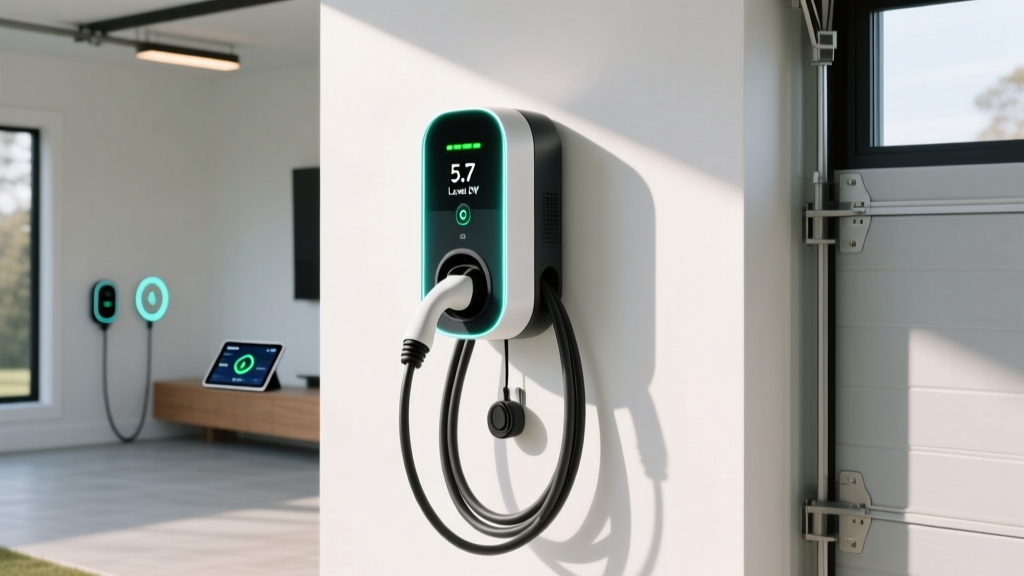
If you've searched for a home EV charger and encountered the term "5.7 charger" or a 5.7 kW charging rate, you're looking at one specific slice of the Level 2 charging spectrum — and it's more common than you might think. A 5.7 kW charge rate is what you get when a Level 2 charger operates on a 240-volt circuit at 24 amps (240V × 24A = 5,760 watts, or ~5.7 kW). This is the typical output of many plug-in Level 2 units connected to a NEMA 14-50 outlet configured for continuous 80% load, or a hardwired unit on a 30-amp breaker.
For many EV owners — particularly those with smaller battery packs, older electrical panels, or budget constraints — a 5.7 kW charger represents a practical sweet spot between the glacial pace of Level 1 (1.4 kW from a standard wall outlet) and the higher cost of a full 48-amp / 11.5 kW hardwired installation. In this guide, we'll explain exactly what 5.7 kW gets you in real-world charging time, what it costs to install, which equipment delivers it, and when you might want more power.
Understanding Charging Levels: Where 5.7 kW Fits
Before we get into installation specifics, let's clarify the three EV charging tiers. kW (kilowatts) measures power — the rate at which energy flows into your battery. kWh (kilowatt-hours) measures energy — the total capacity of your battery. Think of kW as the width of the hose and kWh as the size of the bucket. A 5.7 kW charger fills a 75 kWh battery in roughly 13 hours from empty; a 150 kW DC fast charger could do it in under 40 minutes.
| Level | Voltage | Power (kW) | Miles of Range Added per Hour | Typical Use Case |
|---|---|---|---|---|
| Level 1 | 120V AC | 1.2 – 1.4 kW | 3 – 5 mi/hr | Overnight top-up; PHEVs; emergency |
| Level 2 (5.7 kW example) | 240V AC | 5.7 kW | 18 – 24 mi/hr | Home daily charging; budget installs |
| Level 2 (full 11.5 kW) | 240V AC | 7.2 – 11.5 kW | 25 – 44 mi/hr | Home fast charging; larger batteries |
| DC Fast Charge | 400–800V DC | 50 – 350 kW | 150 – 1,000+ mi/hr | Road trips; public stations |
A 5.7 kW Level 2 charger adds roughly 18–24 miles of range per hour depending on your vehicle's efficiency (measured in kWh/100mi or MPGe). A highly efficient sedan like the Hyundai IONIQ 6 (which achieves roughly 27 kWh/100mi combined per fueleconomy.gov) will squeeze more miles per kW than a heavier SUV like the Ford F-150 Lightning. Over a typical 10-hour overnight session, 5.7 kW delivers about 57 kWh — enough to fully recharge most EV batteries or add 180–240 miles of range.
How Fast Will a 5.7 kW Charger Fill Common EV Batteries?
Here's where the rubber meets the road. Most EV owners charge between 10% and 80% State of Charge (SoC) to preserve battery longevity and avoid the slow taper that occurs above 80%. Below are estimated 10–80% charging times for popular 2025–2026 EV models on a 5.7 kW Level 2 circuit:
| Vehicle (2025–2026) | Battery (kWh usable) | Energy Needed (10–80%) | Time at 5.7 kW |
|---|---|---|---|
| Chevrolet Equinox EV | 85 kWh | ~59.5 kWh | ~10.4 hours |
| Tesla Model Y (Long Range) | 75 kWh | ~52.5 kWh | ~9.2 hours |
| Hyundai IONIQ 5 (Std Range) | 58 kWh | ~40.6 kWh | ~7.1 hours |
| BMW i4 eDrive40 | 81.5 kWh | ~57 kWh | ~10.0 hours |
| Toyota RAV4 Prime (PHEV) | 18.1 kWh | ~12.7 kWh | ~2.2 hours |
For plug-in hybrid owners, a 5.7 kW charger is more than adequate — most PHEV batteries recharge fully in under 3 hours. For BEV owners with batteries above 80 kWh, a 5.7 kW unit will require a full overnight session (8–11 hours) for a 10–80% fill. That's fine for daily commuting if you charge every night, but if you frequently arrive home with a near-depleted battery and need a full charge by morning, you may want a 40-amp or 48-amp Level 2 unit (9.6–11.5 kW) instead.
Electrical Requirements and Installation Costs
Installing a 5.7 kW home charger requires a dedicated 240-volt circuit — the same voltage your electric dryer or oven uses. The specific electrical requirements depend on whether you go with a plug-in or hardwired unit:
- Plug-in (NEMA 14-50 outlet): Requires a 30-amp breaker (for continuous 24A draw at 80% load). The outlet must be on a dedicated circuit with appropriate wire gauge (typically 10 AWG copper for runs under 50 feet).
- Hardwired: A hardwired 5.7 kW unit also draws 24A continuous and requires a 30-amp breaker. Hardwired installations eliminate the outlet as a failure point and are often preferred for outdoor mounts or garages where the charger stays permanently.
How Much Does It Cost to Install a Home EV Charger?
Installation costs vary dramatically based on your home's electrical panel capacity, the distance from panel to charger location, and local permit fees. Here's a realistic breakdown for a 5.7 kW / 24-amp installation:
| Component | Low Estimate | High Estimate | Notes |
|---|---|---|---|
| Level 2 charger unit (24–32A) | $300 | $600 | Plug-in or hardwired; smart vs. basic |
| Electrician labor (2–4 hrs) | $300 | $800 | Depends on panel proximity and conduit run |
| Materials (wire, conduit, breaker) | $100 | $400 | Longer runs = more copper and conduit |
| Electrical permit | $50 | $200 | Varies by municipality |
| Panel upgrade (if needed) | $1,500 | $3,500 | Only if existing panel lacks capacity |
| Total (no panel upgrade) | $750 | $2,000 | Most common scenario for modern homes |
| Total (with panel upgrade) | $2,250 | $5,500 | Older homes with 100A service |
What Electrical Upgrades Might I Need?
The single biggest variable is your home's electrical panel. Most homes built after 2000 have a 200-amp panel, which can typically support a 30-amp EV circuit without issue. However, if you have a 100-amp panel (common in homes built before the 1990s), adding a 24A continuous load may exceed your panel's capacity — especially if you already run electric heat, an electric dryer, and an electric range simultaneously.
A licensed electrician will perform a load calculation (per NEC Article 220) to determine whether your panel can handle the additional circuit. If it can't, you have options:
- Panel upgrade to 200A: $1,500–$3,500 — the most definitive solution.
- Load-management device: Products like the Emporia Load Management or ChargePoint load-sharing module can dynamically reduce charger amperage when other appliances draw heavy current. This avoids a panel upgrade and typically costs $200–$500 additional.
- Downsize the circuit: A 20-amp breaker with a 16A charger (3.8 kW) is slower but may fit within your existing panel. This sacrifices roughly 6 miles/hr of charging speed.
Always hire a licensed electrician and pull a permit. Unpermitted EV charger work can void homeowner's insurance claims and create fire hazards. The National Electrical Code (NEC) requires GFCI protection for 240V outlets in garages (NEC 2020, Section 210.8), and outdoor installations require weatherproof enclosures rated NEMA 3R or 4.
Connector Compatibility: Will a 5.7 kW Charger Work with My EV?
As of 2025–2026, the EV connector landscape has consolidated significantly, but you still need to match your charger's plug to your vehicle's inlet. Here's the current state of play:
| Connector | Brands Using It | Notes |
|---|---|---|
| NACS (Tesla / SAE J3400) | Tesla, Ford, GM, Rivian, Volvo, Polestar, Mercedes, Nissan (2025+), Honda (2025+), Fisker | Now the dominant North American standard. Most non-Tesla automakers switched for 2025+ models. |
| CCS1 (Combo) | Hyundai, Kia, BMW, Volkswagen, Stellantis (Jeep/Chrysler), some legacy 2023–2024 models | Still common on vehicles sold before 2025. Adapters available. |
| CHAdeMO | Nissan Leaf (pre-2025), Mitsubishi Outlander PHEV (older) | Effectively discontinued for new vehicles. |
If you drive a 2025+ Ford, GM, Rivian, or Volvo with a native NACS port, you'll want a Level 2 charger with a NACS connector (or use the J1772-to-NACS adapter that most automakers include). If your EV still has a CCS1 port (common on 2023–2024 Hyundai and Kia models), buy a charger with a CCS1/J1772 connector — since J1772 is the AC charging subset of CCS1, any J1772 charger will work with any CCS1 vehicle for Level 2 charging.
Cost to Charge: Home vs. Public vs. Gas
One of the strongest arguments for home Level 2 charging — whether at 5.7 kW or 11.5 kW — is the cost advantage over both public charging and gasoline. Here's how the numbers stack up:
| Scenario | Avg. $/kWh | Cost per Mile (efficient EV ~3.5 mi/kWh) | Cost per Mile (SUV EV ~2.8 mi/kWh) |
|---|---|---|---|
| Home (national avg. electricity, 2025) | $0.16 | $0.046 | $0.057 |
| Home (off-peak TOU rate) | $0.08 | $0.023 | $0.029 |
| Public Level 2 (ChargePoint, EVgo) | $0.25 – $0.40 | $0.071 – $0.114 | $0.089 – $0.143 |
| DC Fast Charging (EA, Tesla Supercharger) | $0.32 – $0.55 | $0.091 – $0.157 | $0.114 – $0.196 |
| Gasoline (28 MPG avg., $3.30/gal) | — | $0.118 | $0.165 (at 20 MPG) |
At home on a standard rate, a 5.7 kW charger delivers fuel at roughly $0.05 per mile — less than half the cost of gasoline. If your utility offers a time-of-use (TOU) plan with off-peak rates below $0.10/kWh (common in California, Texas, and the Pacific Northwest), you can cut that to under $0.03 per mile. Over 15,000 annual miles, the savings versus gas range from $1,000 to $1,800 per year, meaning a $1,200 charger installation pays for itself within 12 months.
According to the U.S. Energy Information Administration, the national average residential electricity price in late 2025 is approximately $0.16/kWh, though this varies from $0.10/kWh in Louisiana to $0.30+/kWh in Hawaii and parts of California.
Recommended 5.7 kW–Class Chargers for 2026
Below are three well-regarded Level 2 chargers that operate in the 5.7–7.7 kW range on a 24–32 amp circuit — ideal for homes with 30-amp breakers or electrical panels with limited headroom:
Emporia Level 2 EV Charger
- Power: Up to 48A configurable (set to 24A for 5.7 kW on a 30A breaker)
- Connector: J1772 (NACS adapter available)
- Cable length: 24 ft
- Smart features: Wi-Fi, Emporia app scheduling, energy monitoring, solar integration, load management capable
- Price: ~$399
- Best for: Budget-conscious buyers who want smart scheduling and energy tracking without paying premium prices
ChargePoint Home Flex (NACS or J1772)
- Power: Up to 50A configurable (set to 24A–32A for 5.7–7.7 kW)
- Connector: Available in NACS or J1772
- Cable length: 23 ft
- Smart features: Wi-Fi, ChargePoint app, Alexa integration, flexible amperage via DIP switch, load sharing with second unit
- Price: ~$649
- Best for: Owners who want a proven brand with NACS native option and flexible amperage
Tesla Wall Connector (Gen 3)
- Power: Up to 48A / 11.5 kW (can be configured lower via app)
- Connector: NACS native
- Cable length: 24 ft
- Smart features: Wi-Fi, over-the-air updates, power sharing between multiple units, Tesla app integration
- Price: ~$475
- Best for: Tesla owners or households planning to buy a NACS-equipped vehicle; excellent value at this price point
All three units can be hardwired or plugged into a NEMA 14-50 outlet (with the appropriate plug configuration). The Emporia and ChargePoint offer the most flexibility for non-Tesla EVs, while the Tesla Wall Connector is the most affordable NACS-native option. If you're currently driving a CCS1 vehicle but plan to switch to a NACS vehicle in the next few years, buying a NACS charger now with a J1772 adapter for your current car is the more future-proof choice.
Safety and Code Considerations
A 5.7 kW charger is a significant continuous electrical load. The National Electrical Code (NEC) defines continuous loads as those operating for 3 hours or more — which describes most EV charging sessions. Here's what you must get right:
- Dedicated circuit: Your EV charger must have its own breaker — no sharing with other outlets or appliances.
- 80% rule: A 30-amp breaker supports a maximum continuous load of 24 amps (30A × 0.80 = 24A). Never configure a charger to draw more than 80% of the breaker rating.
- GFCI protection: NEC 2020 and 2023 require GFCI protection for 240V receptacles in garages. Some EV chargers have built-in GFCI; if yours doesn't, your electrician must install a GFCI breaker (adds ~$50–$100).
- Outdoor rating: If mounting outside, the charger must be rated NEMA 3R (rain-resistant) or NEMA 4 (watertight). All three units recommended above carry outdoor ratings.
- Wire gauge: 10 AWG copper is standard for a 30A circuit with runs under 50 feet. Longer runs may require 8 AWG to prevent voltage drop.
- Permit and inspection: Most jurisdictions require an electrical permit for new 240V circuits. The inspection ensures your installation meets code and protects your insurance coverage.
Do not attempt a DIY installation unless you are a licensed electrician. A miswired 240V circuit carries serious shock and fire risk. According to the National Fire Protection Association, improperly installed high-amperage circuits are a leading cause of residential electrical fires.
Is 5.7 kW Enough — or Should You Install More?
A 5.7 kW charger is a practical choice if:
- Your electrical panel has limited spare capacity (a 30-amp circuit draws less from the panel than a 60-amp circuit).
- You drive fewer than 60 miles per day and charge overnight every night.
- You own a PHEV with a small battery (under 20 kWh).
- You want to minimize installation cost by using an existing NEMA 14-50 outlet or a shorter wire run.
- You're in an apartment or condo where the building's electrical capacity is shared.
Consider stepping up to a 40-amp or 48-amp circuit (9.6–11.5 kW) if:
- Your EV has a battery larger than 80 kWh and you frequently need full overnight charges.
- You drive 100+ miles daily and arrive home with significant depletion.
- You plan to add a second EV and want faster turnaround between vehicles.
- Your panel has ample capacity (200A+ with significant headroom) — in which case, running a larger circuit now avoids a second installation later.
The incremental cost difference between a 30-amp and 60-amp installation is often only $200–$500 (mainly thicker wire and a larger breaker), so if your panel supports it, going bigger provides future-proofing for minimal extra cost.
Frequently Asked Questions
Can I use a 5.7 kW charger with any EV?
Yes — every EV sold in North America accepts Level 2 AC charging at 5.7 kW or higher. The only variable is the physical connector (NACS vs. J1772/CCS1), which you can match with the correct plug or adapter. Your vehicle's onboard charger determines the maximum AC charge rate, but it will always accept a lower rate like 5.7 kW without issue.
Will a 5.7 kW charger damage my EV battery?
No. Level 2 AC charging at any amperage is gentle on lithium-ion batteries compared to DC fast charging. The battery management system (BMS) in your EV controls exactly how much current the battery accepts. Charging at 5.7 kW generates minimal heat and is actually beneficial for long-term battery health compared to frequent DC fast charging.
Do I qualify for a tax credit on my home charger installation?
The federal Alternative Fuel Vehicle Refueling Property Credit (IRS Form 8911) covers 30% of home EV charger equipment and installation costs, up to $1,000. However, as of 2025–2026, this credit is restricted to taxpayers in eligible census tracts (typically rural or low-income areas per IRS guidelines). Check your census tract eligibility before counting on this credit. Some utilities also offer rebates of $250–$500 for Level 2 charger installations.
How do I know if my electrical panel can handle a 30-amp EV circuit?
Check your panel's main breaker rating (100A, 150A, or 200A) and count the existing breaker amperages. A licensed electrician will perform a formal NEC Article 220 load calculation. As a rough guideline: a 200A panel with gas appliances (not electric heat/dryer/range) almost always has room. A 100A panel with all-electric appliances almost always needs an upgrade or load-management device.
Is it better to plug in or hardwire a 5.7 kW charger?
Hardwiring eliminates the outlet as a potential failure point (NEMA 14-50 outlets can loosen over time with repeated plug/unplug cycles) and avoids the NEC GFCI breaker requirement for garage receptacles, saving $50–$100. However, a plug-in unit is portable — you can take it when you move or swap it easily. For a permanent garage installation, hardwiring is generally preferred. For renters or those who may relocate, plug-in is the better choice.
What's the real-world cost to fully charge a 75 kWh battery at home?
At the national average of $0.16/kWh, a full 0–100% charge of a 75 kWh battery costs approximately $12.00. On an off-peak TOU rate of $0.08/kWh, that drops to $6.00. That same 75 kWh typically delivers 230–280 miles of real-world range depending on the vehicle — equivalent to filling a gas car with 8–10 gallons at $3.30/gallon ($26–$33).