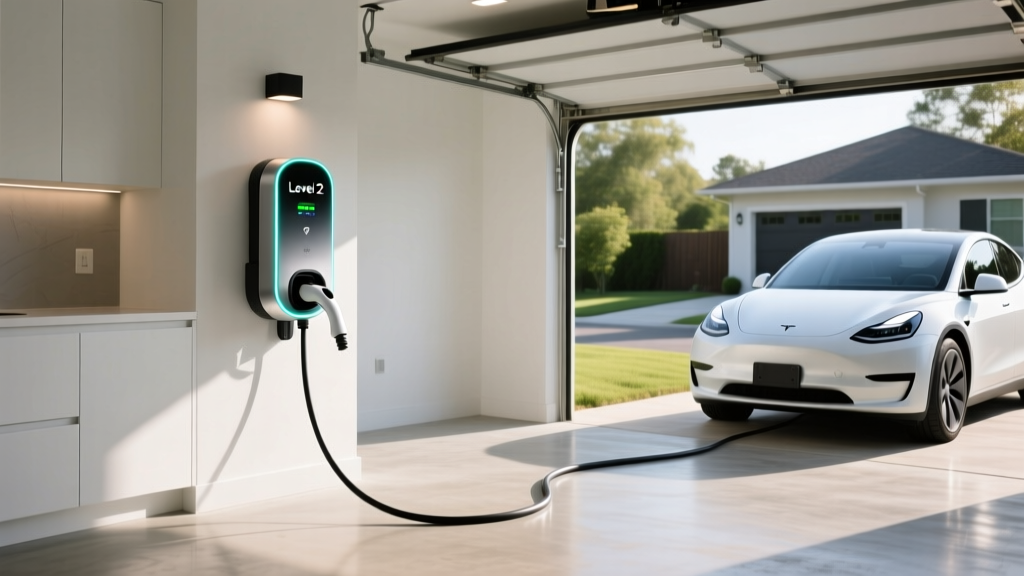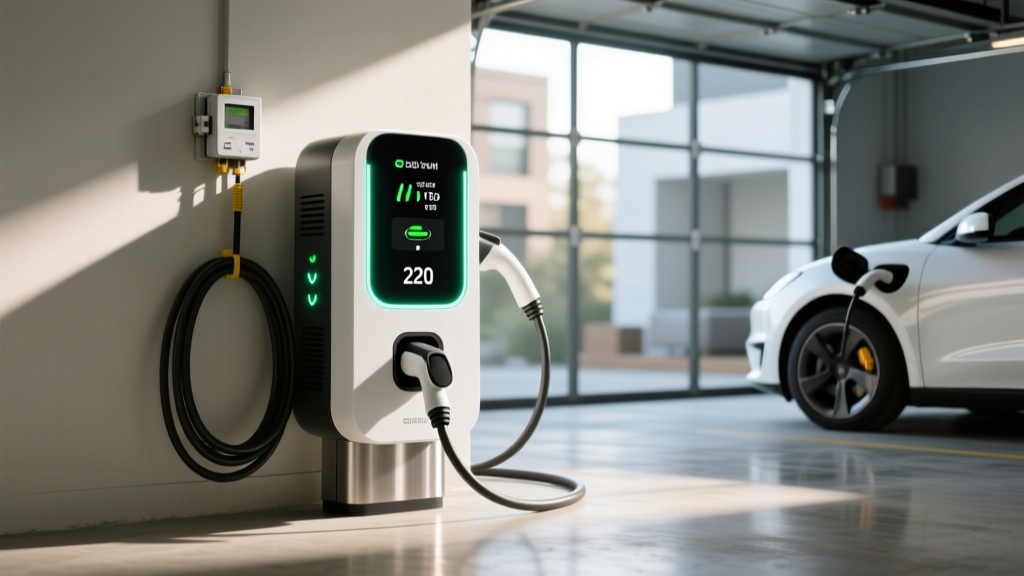
If you've ordered an electric vehicle or are seriously shopping for one, you've probably hit the same wall every new EV owner faces: a standard 120V household outlet adds roughly 3-5 miles of range per hour. For a 75 kWh battery, that's over 20 hours from empty to full. A 220 volt EV charger — technically a 240V Level 2 home charging station — cuts that to 6-10 hours, making overnight charging practical and turning EV ownership from a compromise into a convenience.
This guide breaks down exactly what's required to install a 220V (240V) charger at home, what it costs, how fast each setup charges, which connectors your vehicle needs, and which specific equipment delivers the best value in 2026. We'll be precise with numbers because vague promises don't help you budget an electrical project.
How Fast Does Each Charging Level Add Range?
EV charging happens at three distinct levels, each defined by voltage and maximum power delivery. Here's what each actually delivers to your battery in real-world conditions:
| Level | Voltage | Max Power (kW) | Miles of Range Added Per Hour | Typical Use Case |
|---|---|---|---|---|
| Level 1 | 120V AC | 1.4–1.9 kW | 3–5 miles | Overnight trickle; PHEVs with small batteries |
| Level 2 (220V/240V) | 240V AC | 3.3–19.2 kW | 12–75 miles | Home daily charging; workplace; public destinations |
| DC Fast Charging | 400–900V DC | 50–350 kW | 150–1,200+ miles per hour (theoretical) | Road trips; rapid top-ups; 10–80% in 15–35 min |
For most EV owners, a 220 volt EV charger at Level 2 is the workhorse. A typical 48-amp, 11.5 kW Level 2 unit adds roughly 35–45 miles of range per hour for a mid-size sedan like the Tesla Model 3 or Hyundai IONIQ 6. For larger vehicles with lower efficiency — say a Ford F-150 Lightning at ~2.0 mi/kWh — that same charger adds closer to 23 miles per hour.
DC fast charging is essential for road trips but isn't practical or necessary for daily home use. Most EV batteries charge fastest between 10–80% state of charge, then taper significantly. A vehicle advertising "250 kW peak charging" may only sustain that rate for 5–10 minutes before dropping to 100 kW or less as the battery fills and thermal management limits increase.
What Does It Cost to Install a 220 Volt EV Charger at Home?
Home Level 2 charger installation costs vary dramatically based on your electrical panel's capacity, the distance from panel to charger location, and local permit fees. Here's a realistic breakdown based on 2026 electrician rates and equipment pricing:
| Cost Component | Simple Install (Panel Adjacent) | Moderate Install (50–80 ft Run) | Complex Install (Panel Upgrade + Long Run) |
|---|---|---|---|
| Level 2 Charger Equipment | $350–$700 | $350–$700 | $350–$700 |
| Electrician Labor (2–8 hrs @ $75–$150/hr) | $200–$400 | $500–$1,000 | $800–$1,500 |
| Materials (conduit, wire, junction box) | $50–$150 | $200–$500 | $300–$600 |
| Permit Fee | $50–$200 | $50–$200 | $50–$200 |
| Electrical Panel Upgrade (if needed) | $0 | $0 | $1,500–$3,500 |
| Total Estimated Cost | $650–$1,450 | $1,100–$2,400 | $3,000–$6,500 |
The single biggest cost variable is whether your electrical panel can handle the additional load. A 48-amp Level 2 charger requires a dedicated 60-amp circuit (National Electrical Code requires circuits to be rated at 125% of continuous load: 48A × 1.25 = 60A). If your home has a 100-amp panel that's already near capacity with HVAC, electric range, and dryer loads, you may need a panel upgrade to 200 amps — adding $1,500–$3,500 to the project.
A qualified electrician will perform a load calculation before recommending a circuit size. Some homes can accommodate a 32-amp charger on a 40-amp circuit without any panel work, delivering 7.7 kW — enough for most daily driving needs of 30–50 miles.
Utility Rebates and the Federal §30D Alternative Fuel Refueling Credit
Before writing the check, check two incentive sources. Many utilities offer rebates of $200–$500 for Level 2 charger installation, sometimes bundled with time-of-use rate plans. Separately, the federal Alternative Fuel Vehicle Refueling Property Credit (IRS Form 8911) may cover up to 30% of home charging equipment and installation costs, capped at $1,000, for eligible taxpayers in qualifying census tracts. Eligibility depends on income limits, whether your residence is in a non-urban census tract, and prevailing wage requirements for the installation. Consult a tax professional before claiming — these rules have tightened significantly since the Inflation Reduction Act.
What Electrical Upgrades Might Your Home Need?
Not every home is ready for a 220 volt EV charger. Here are the scenarios to anticipate when an electrician evaluates your property:
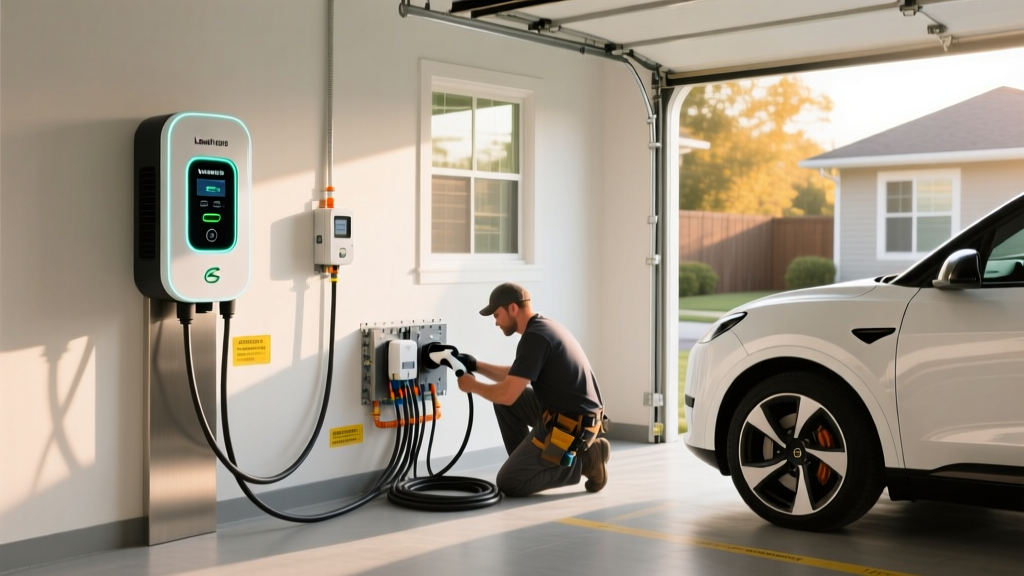
Best case — sufficient panel capacity: Your 200-amp panel has spare capacity. The electrician runs a new 60-amp double-pole breaker, pulls 6 AWG copper wire through conduit to your garage or exterior wall, mounts a NEMA 14-50 receptacle or hardwires the charger directly, and pulls a permit. Total disruption: a half-day.
Common case — panel at or near capacity: Your 100-amp or 150-amp panel is already loaded. Options include upgrading to a 200-amp panel ($1,500–$3,500), installing a smaller 32-amp charger that fits within existing capacity, or using an automatic load-management device (like the Emporia Smart Load Center or Tesla Wall Connector with load-sharing) that dynamically reduces charger amperage when other circuits draw heavy current.
Worst case — older home with knob-and-tube or Federal Pacific panel: Homes built before 1980 may have outdated wiring, insufficient grounding, or panels known to be fire hazards (Federal Pacific Stab-Lok panels are uninsurable in many states). A full panel replacement and partial rewire may be required before any EV charger installation. Budget $3,000–$6,000+ for this scenario.
Which Connector Is Compatible with Your EV?
The connector landscape in 2026 has largely consolidated around the North American Charging Standard (NACS), originally developed by Tesla and now adopted by most major automakers. Here's where each brand stands:
| Connector Type | Brands Using It (New Vehicles) | Adapter Needed for Other Networks? |
|---|---|---|
| NACS (Tesla-style) | Tesla, Ford, GM, Rivian, Volvo, Polestar, Mercedes-Benz, BMW, Hyundai, Kia, Lucid | CCS adapter needed for some older public stations; NACS-to-CCS adapters available from ~$150–$250 |
| CCS1 (Combined Charging System) | Legacy VW ID.4 (pre-2025), some Stellantis models, remaining older inventory | NACS adapter included or available for Tesla Supercharger access |
| CHAdeMO | Nissan Leaf (legacy only; discontinued for new sales in US) | Limited network; no practical adapter to NACS for DC fast charging |
For a home Level 2 charger, the connector matters less than you'd think. All Level 2 chargers use the J1772 plug for non-Tesla vehicles, and Tesla provides a J1772 adapter with every vehicle. If you buy a NACS-equipped charger (like the Tesla Wall Connector), it includes a J1772 adapter in the box for non-Tesla EVs. The practical result: almost any quality Level 2 charger will work with any EV you buy today or in the near future.
For DC fast charging on road trips, NACS is now the dominant standard. Tesla's Supercharger network — the most reliable in North America — is open to NACS-equipped vehicles from Ford, GM, Rivian, and others, either natively or via adapter. CCS-only vehicles are increasingly limited to Electrify America, EVgo, and ChargePoint DC stations.
How Much Does Charging Cost Per Mile vs. Gas?
The economics of EV charging depend entirely on where and when you charge. Here's a realistic comparison using 2026 national averages:
| Charging Scenario | Average Cost per kWh | Cost per Mile (4 mi/kWh EV) | Annual Cost (12,000 mi) |
|---|---|---|---|
| Home Level 2 — Off-Peak TOU Rate | $0.08–$0.14 | $0.02–$0.035 | $240–$420 |
| Home Level 2 — Standard Residential Rate | $0.14–$0.20 | $0.035–$0.05 | $420–$600 |
| Public Level 2 (ChargePoint, EVgo) | $0.25–$0.49 | $0.06–$0.12 | $720–$1,440 |
| DC Fast Charging (Electrify America, Tesla) | $0.30–$0.55 | $0.075–$0.14 | $900–$1,680 |
| Gasoline Vehicle (25 MPG combined @ $3.40/gal) | — | $0.136 | $1,632 |
The math is clear: home charging on an off-peak rate plan delivers fuel costs roughly 75–85% lower than an equivalent gasoline vehicle. Even at standard residential rates, most EV owners spend $400–$600 annually on electricity for 12,000 miles of driving — compared to $1,600+ for gas. The savings erode if you rely exclusively on public DC fast charging, which is why a home 220 volt EV charger is the single most impactful ownership decision you can make.
Many utilities now offer time-of-use (TOU) plans specifically designed for EV owners, with rates as low as $0.06–$0.09/kWh during overnight hours (typically 12 AM – 6 AM). If your utility offers a TOU plan, pairing it with a smart charger that schedules charging during off-peak windows maximizes savings.
Charging Time Examples: How Long to Charge Common EV Batteries
Here's how long popular 2026 EV models take to charge from 10% to 80% on various Level 2 setups. We use 10–80% because charging above 80% slows dramatically — the battery management system reduces current to protect cell longevity, sometimes cutting the charge rate to under 2 kW for the final 20%.
| Vehicle (2026) | Battery (Usable kWh) | 32A / 7.7 kW Charger | 48A / 11.5 kW Charger | 80A / 19.2 kW Charger* |
|---|---|---|---|---|
| Tesla Model 3 Long Range | 75 kWh | ~6.8 hours | ~4.5 hours | ~2.8 hours |
| Hyundai IONIQ 5 (Long Range) | 77.4 kWh | ~7.0 hours | ~4.7 hours | ~3.0 hours |
| Ford F-150 Lightning (Extended) | 131 kWh | ~11.9 hours | ~8.0 hours | ~4.8 hours |
| Chevrolet Equinox EV | 85 kWh | ~7.7 hours | ~5.2 hours | ~3.2 hours |
| Toyota bZ4X | 64 kWh | ~5.8 hours | ~3.9 hours | ~2.5 hours |
*80A / 19.2 kW charging requires a 100-amp dedicated circuit and is supported only by vehicles with dual onboard chargers (certain Tesla models, some Ford configurations). Most EVs max out at 11.5 kW onboard, meaning an 80A charger provides no speed benefit for those vehicles.
For context, the average American drives 37 miles per day, according to FHWA data. That's roughly 10 kWh of energy for an efficient sedan. Even a modest 32-amp Level 2 charger replenishes that in under 90 minutes — well within any overnight window.
Best 220 Volt EV Chargers: Equipment Picks for 2026
After evaluating current models on power output, build quality, smart features, cable length, connector flexibility, and price, here are the Level 2 chargers we recommend for home installation:
Tesla Wall Connector (Gen 4)
- Power: Up to 48A / 11.5 kW (on 60A circuit)
- Connector: NACS native; J1772 adapter included
- Cable: 24 feet
- Smart features: Wi-Fi, OTA updates, load sharing with other Wall Connectors, scheduling via Tesla app
- Price: ~$475
- Best for: Tesla owners; multi-EV households with NACS vehicles
ChargePoint Home Flex (2nd Gen)
- Power: Adjustable 16A–50A / up to 12 kW (on 60A circuit)
- Connector: J1772 native; NACS adapter available
- Cable: 23 feet
- Smart features: Wi-Fi, Alexa integration, detailed energy tracking, flexible amperage to match panel capacity
- Price: ~$550–$650
- Best for: Homes with limited panel capacity (can dial down to 32A or 24A); non-Tesla EVs
Emporia Level 2 EV Charger
- Power: Up to 48A / 11.5 kW (on 60A circuit)
- Connector: J1772 native; NACS version available
- Cable: 24 feet
- Smart features: Wi-Fi, solar integration with Emporia Vue energy monitor, TOU scheduling, load management
- Price: ~$350–$400
- Best for: Budget-conscious buyers; homes with solar panels; energy monitoring enthusiasts
For hardwired installations (no NEMA 14-50 plug), all three units support direct wiring, which eliminates the need for a GFCI breaker — a $100–$200 component required by NEC 2020 for receptacle-based EV charging circuits in many jurisdictions. Hardwiring also avoids the occasional plug-connection fault that some NEMA 14-50 installations experience under sustained high-amperage loads.
Safety and Code Considerations You Can't Ignore
A 240V circuit delivers enough current to be lethal and enough sustained power to start a fire if improperly installed. Here are the non-negotiable safety requirements for a 220 volt EV charger installation:
- Dedicated circuit: Your Level 2 charger must be on its own dedicated double-pole breaker. No sharing with dryers, ranges, or HVAC. This is NEC Article 625.
- Circuit sizing at 125%: A 48-amp charger requires a 60-amp breaker and 6 AWG copper wire (or 4 AWG aluminum). A 32-amp charger requires a 40-amp breaker and 8 AWG copper.
- GFCI protection: NEC 2020 and later requires GFCI protection for receptacle-based EV charging outlets in garages. Hardwired chargers are exempt from this requirement in most jurisdictions. A 60-amp GFCI breaker costs $100–$200 and can cause nuisance trips if not properly matched — another reason many electricians recommend hardwiring.
- Outdoor rating: If mounting outdoors, the charger must carry a NEMA 4 or NEMA 4X rating for weather resistance. All three chargers recommended above carry outdoor ratings, but the connection point (receptacle or junction box) must also be weatherproof.
- Grounding: A proper equipment grounding conductor is mandatory. Older homes with ungrounded 240V circuits (like pre-1960s dryer outlets) cannot safely be repurposed for EV charging without adding a ground wire.
- Permit and inspection: Required in virtually all US jurisdictions for new 240V circuits. The inspection verifies wire gauge, breaker sizing, grounding, and GFCI compliance. Per the National Electrical Code (NFPA 70), your installation must meet current local amendments.
Frequently Asked Questions
Can I use my existing dryer outlet for EV charging?
Technically, a NEMA 14-50 dryer outlet provides 240V at up to 50 amps, which is compatible with many Level 2 chargers. However, NEC code requires EV chargers to be on a dedicated circuit — you cannot share a dryer outlet. Some EV owners use a smart splitter device (like the NeoCharge Smart Splitter) that allows one 240V outlet to serve two devices, but only one at a time, with automatic switching. This avoids a new circuit installation but limits convenience. Consult your electrician and local code authority before using this approach.
Is a 220 volt EV charger the same as a 240V charger?
Yes. In the United States, residential "220V," "220 volt," "240V," and "Level 2" all refer to the same thing: a split-phase 240-volt AC circuit. The "220V" terminology is a legacy holdover — modern US residential service delivers 240V nominal, though actual voltage at the outlet may measure 232–246V. Equipment rated for 240V is fully compatible with any standard US residential 240V circuit.
How long does installation take?
A straightforward installation — panel with spare capacity, charger within 20 feet, no conduit complications — typically takes 2–4 hours. Complex runs through finished walls, attic crawls, or long conduit paths can extend to a full day. If a panel upgrade is required, add another 4–8 hours plus a utility coordination visit for the meter swap.
Will a Level 2 charger damage my battery over time?
No. Level 2 AC charging at 7.7–11.5 kW is well within the safe charge rate for modern lithium-ion and LFP battery packs. Battery degradation is driven primarily by sustained high state of charge (sitting at 100%), extreme temperatures, and frequent DC fast charging. For daily use, setting your charge limit to 80% (or 100% for LFP batteries, per manufacturer guidance) and using a scheduled Level 2 charge overnight is the optimal longevity strategy. Per fueleconomy.gov, most modern EV batteries retain 85–90% capacity after 100,000 miles under normal charging patterns.
Do I need a smart charger, or will a basic unit work?
A basic, non-smart Level 2 charger will charge your EV just as fast as a smart one. Smart features — Wi-Fi connectivity, scheduling, energy monitoring, load management — add convenience and cost savings but aren't required for the charger to function. If your utility offers time-of-use rates, a smart charger that schedules charging during off-peak hours will pay for its price premium within months. If you have solar panels, a charger with solar-integration features (like the Emporia) can prioritize charging from excess solar production.
What if I live in an apartment or don't have a garage?
Multi-unit dwellings and street-parking situations are the hardest EV charging scenarios. Some municipalities now require EV-ready wiring in new construction, and aftermarket solutions like curbside Level 2 chargers from companies such as FLO and ChargePoint are expanding. Check with your HOA or landlord — many states (California, Colorado, New York, Florida) have "right to charge" laws that prevent landlords and HOAs from unreasonably blocking Level 2 charger installations in assigned parking spaces.