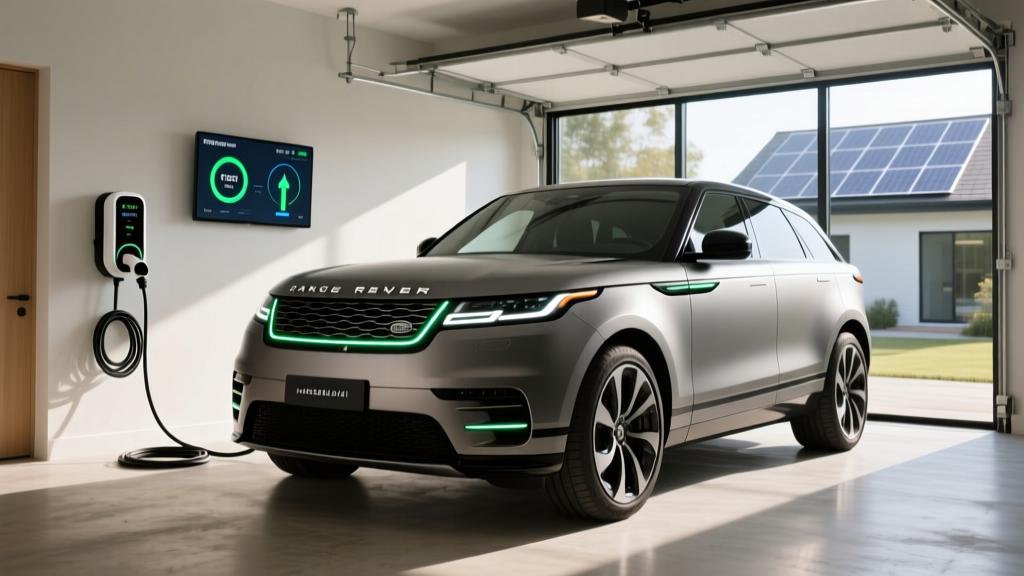
Land Rover's first all-electric Range Rover is slated to arrive as a 2027 model, riding the new MLA-Flex (Modular Longitudinal Architecture) platform with an estimated battery pack north of 110 kWh. If you are on the reservation list — or simply planning ahead — the single most impactful ownership decision you will make happens before the SUV ever enters your driveway: installing a properly sized home charger.
A luxury EV with a massive battery and 800-volt-class architecture demands more electrical capacity than the average household outlet can deliver. This guide breaks down the charging levels, home installation costs, connector standards, and equipment you need to evaluate now, so you are ready the day the 2027 Range Rover EV rolls into your garage.
Charging Levels Explained: What Speeds Mean for a 117 kWh Battery
Before selecting equipment, you need a clear picture of the three charging tiers. The critical distinction: kW (kilowatts) measures power — how fast energy flows into the car at any given moment. kWh (kilowatt-hours) measures energy — the total capacity of the battery, like gallons in a fuel tank. A 117 kWh battery charged at 11 kW takes far longer than one charged at 150 kW. Here is how each level translates into real range added per hour for a large luxury SUV like the Range Rover EV, assuming roughly 2.5 miles per kWh efficiency (a reasonable estimate for a heavy, aerodynamic luxury vehicle).
| Level | Voltage / Current | Power (kW) | Miles of Range Added per Hour | 0–80% Time (est. 117 kWh) |
|---|---|---|---|---|
| Level 1 (standard outlet) | 120V / 12A | ~1.4 kW | ~3–4 mi/hr | ~67 hours |
| Level 2 (home / destination) | 240V / 40–48A | 9.6–11.5 kW | ~24–29 mi/hr | ~8–10 hours |
| DC Fast Charging | 400–800V DC | 50–350 kW (peak) | ~150–500+ mi/hr (at peak) | ~20–30 min (10–80%) |
Level 1 is essentially useless for a vehicle of this size — you would need nearly three full days to fill the battery from empty. Level 2 is the home standard and the focus of this guide. DC fast charging is for road trips and is accessed via public networks; you do not install DC equipment at home.
JLR has indicated the MLA-Flex platform supports 800-volt architecture, which should enable DC fast-charge peaks in the range of 200–350 kW at compatible stations. Expect the real-world charge curve to taper significantly above 80% state of charge (SoC) — this is normal lithium-ion behavior designed to protect cell longevity. A 10–80% session at a 350 kW Electrify America or Tesla Supercharger V4 station could take roughly 20–25 minutes, but that last 20% may add another 25–35 minutes.
Home Electrical Requirements: Will Your Panel Handle It?
A Level 2 charger delivering 11.5 kW draws 48 amps continuously. Per the National Electrical Code (NEC), continuous loads must not exceed 80% of the circuit breaker rating, meaning you need a dedicated 60-amp, 240-volt circuit. This is a significant draw — roughly equivalent to running an electric range and a dryer simultaneously.
Here is where many homeowners encounter a surprise: electrical panel capacity. Most homes built before 2010 have a 100-amp or 150-amp main service panel. Adding a 60-amp EV circuit to an already-loaded panel (HVAC, electric water heater, dryer, range, etc.) may exceed safe capacity. A licensed electrician will perform a load calculation per NEC Article 220 to determine whether your panel can accommodate the circuit or needs an upgrade.
For the 2027 Range Rover EV specifically, consider that its large battery means you will want the fastest practical Level 2 charge rate. A 40-amp circuit (delivering 32 amps continuous, or ~7.7 kW) will add roughly 19 miles of range per hour and take about 12 hours for a 10–80% session — workable if you park overnight, but a 48-amp/60-amp circuit is meaningfully better for a pack this size.
How Much Does It Cost to Install a Home EV Charger?
Installation costs vary enormously based on your home's electrical infrastructure, the distance from the panel to the charging location, and local labor rates. Below is a realistic breakdown based on national averages and electrician-reported data as of 2026:
| Component | Simple Install (panel nearby) | Moderate Install (50–80 ft run) | Complex Install (panel upgrade needed) |
|---|---|---|---|
| Level 2 charger unit (hardwired, 48A) | $500–$750 | $500–$750 | $500–$750 |
| Electrical labor (licensed electrician) | $400–$800 | $800–$1,800 | $1,500–$3,000 |
| Materials (wire, conduit, breaker) | $100–$200 | $200–$500 | $300–$600 |
| Permit & inspection | $50–$200 | $50–$200 | $100–$300 |
| Panel upgrade (if needed) | $0 | $0 | $1,500–$3,500 |
| Total Estimated Cost | $1,050–$1,950 | $1,550–$3,250 | $3,900–$8,150 |
Many utilities and some state programs offer rebates of $250–$1,000 for Level 2 charger installation, which can meaningfully offset costs. Check your local utility's EV program page and your state energy office for current incentives. Note: the federal Residential Clean Energy Credit (30% up to $1,000 for EV charging equipment under IRC §30C) applies in eligible census tracts — verify your address at the IRS site, as eligibility is location-specific.
Connector Compatibility: NACS, CCS, and What the Range Rover EV Will Use
The North American EV connector landscape has shifted dramatically. As of 2026, nearly every major automaker — Ford, GM, Rivian, Volvo, Hyundai/Kia, BMW, Mercedes-Benz, and others — has committed to adopting the NACS (North American Charging Standard) connector pioneered by Tesla. Jaguar Land Rover has not yet publicly confirmed the connector for the 2027 Range Rover EV, but given the industry-wide migration and JLR's partnership ecosystem, NACS is the most probable outcome.
Here is what each connector standard means and where adapters come into play:
| Connector | AC Level 2 | DC Fast | Adopting Brands (2026) | Adapter Needed? |
|---|---|---|---|---|
| NACS (Tesla) | Yes | Yes | Tesla, Ford, GM, Rivian, Volvo, Polestar, BMW, Mercedes, Hyundai (2025+), and most others | CCS→NACS adapter if vehicle has CCS inlet |
| CCS1 (Combined Charging System) | Yes (via J1772 upper) | Yes | Legacy models; phasing out for new vehicles | NACS→CCS adapter for Tesla Superchargers |
| CHAdeMO | No (separate J1772) | Yes | Nissan Leaf (legacy); effectively discontinued | Rare adapters available; network declining |
For home Level 2 charging, the AC portion of NACS and CCS both derive from the SAE J1772 signaling standard, meaning any J1772-compatible Level 2 charger will work with either connector type using the appropriate physical adapter. If you purchase a NACS-equipped charger now and the Range Rover EV arrives with a CCS inlet (or vice versa), a simple adapter (typically $100–$200) resolves it.
Cost to Charge: Home vs. Public vs. Gasoline Comparison
The 2027 Range Rover EV will likely compete with the gasoline Range Rover P400 (starting around $108,000, EPA combined ~19 MPG) and the Range Rover P530 V8 (~16 MPG combined). Charging costs depend heavily on where and when you charge. Here is a realistic comparison assuming the EV achieves approximately 2.5 mi/kWh (~120 MPGe) and premium gasoline costs $4.50/gallon:
| Scenario | Rate | Cost per Mile | Annual Cost (12,000 mi) |
|---|---|---|---|
| Home Level 2 (off-peak utility rate) | $0.09/kWh | $0.036 | $432 |
| Home Level 2 (standard residential rate) | $0.16/kWh | $0.064 | $768 |
| Public Level 2 (network pricing) | $0.25/kWh | $0.10 | $1,200 |
| DC Fast Charging (public) | $0.40/kWh | $0.16 | $1,920 |
| Gas Range Rover P400 (19 MPG combined) | $4.50/gallon | $0.237 | $2,842 |
| Gas Range Rover P530 V8 (16 MPG combined) | $4.50/gallon | $0.281 | $3,375 |
Even at the highest public DC fast-charging rates, the Range Rover EV will cost meaningfully less per mile than its gasoline siblings. At home off-peak rates, the savings are dramatic — roughly $2,400 per year compared to the P400 and nearly $3,000 per year versus the V8. Over a typical 5-year ownership period, that is $12,000–$15,000 in fuel savings alone, partially offsetting the EV's likely premium pricing.
To maximize savings, enroll in your utility's time-of-use (TOU) or EV-specific rate plan. Many utilities offer rates as low as $0.06–$0.10/kWh during overnight hours (typically 11 PM – 6 AM), which is when you should schedule charging via your charger's app or the vehicle's built-in scheduler.
Recommended Level 2 Chargers for a Large-Battery Luxury EV
For a vehicle with a ~117 kWh battery, you want a charger that delivers the maximum practical Level 2 speed (48 amps / 11.5 kW), offers a cable long enough to reach the charge port regardless of parking orientation, and includes smart scheduling features to exploit off-peak electricity rates. Here are four strong options as of 2026:
ChargePoint Home Flex
- Power: Up to 11.5 kW (48A) on a 60A circuit; configurable down to 16A
- Connector: J1772 (NACS adapter included in newer revisions)
- Cable length: 23 feet
- Smart features: Wi-Fi, app scheduling, Alexa integration, energy reports
- Price: ~$650–$750
- Best for: Flexibility — adjustable amperage lets you match your circuit capacity
Tesla Wall Connector (Universal)
- Power: Up to 11.5 kW (48A) on a 60A circuit
- Connector: NACS with integrated J1772 adapter
- Cable length: 24 feet
- Smart features: Wi-Fi, OTA updates, load sharing between multiple units, Powerwall integration
- Price: ~$600
- Best for: NACS-equipped vehicles; excellent value and build quality
Grizzl-E Smart
- Power: Up to 10 kW (40A) on a 50A circuit
- Connector: J1772 (NACS version available)
- Cable length: 24 feet
- Smart features: OCPP-compatible, app control, works with utility demand-response programs
- Price: ~$500–$600
- Best for: Budget-conscious buyers; Canadian-built, extreme cold-rated (-40°F)
Emporia Level 2 EV Charger
- Power: Up to 11.5 kW (48A) on a 60A circuit
- Connector: J1772
- Cable length: 24 feet
- Smart features: Integrates with Emporia Vue energy monitor for whole-home load tracking, solar-aware charging
- Price: ~$400–$500
- Best for: Solar panel owners and energy-monitoring enthusiasts
All four units are hardwired models. Hardwired chargers avoid the NEC requirement for GFCI protection on 240V receptacles (NEMA 14-50), which has been a source of nuisance tripping with plug-in units. If you prefer a plug-in charger for portability, specify a NEMA 14-50 or 6-50 receptacle and ensure your electrician installs an industrial-grade GFCI breaker rated for continuous EV loads.
Safety, Code, and Installation Best Practices
EV charging is a high-draw, continuous electrical load running for 8–12 hours at a time. Proper installation is not optional — it protects your home and your vehicle. Key requirements and best practices:
- Dedicated circuit: Your Level 2 charger must have its own dedicated breaker. Do not share the circuit with other appliances.
- Wire gauge: A 60-amp circuit requires 6 AWG copper wire (or 4 AWG aluminum) per NEC Table 310.16. Your electrician will size accordingly.
- GFCI protection: Required for receptacle-based (plug-in) installations per NEC 2020/2023. Hardwired installations are exempt and generally preferred for reliability.
- Outdoor rating: If your charger is installed outdoors or in an unconditioned garage, ensure the unit carries a NEMA 4 (weatherproof) rating. All four chargers recommended above meet this standard.
- Permit and inspection: Most jurisdictions require an electrical permit for new 240V circuits. The inspection ensures code compliance and protects your home insurance coverage. Do not skip this step — unpermitted work can void claims in the event of an electrical fire.
- Cable management: Use a wall-mounted holster or cable organizer to prevent the charging cable from lying on the garage floor where it can be driven over or exposed to moisture and chemicals.
Frequently Asked Questions
How much does it cost to install a home EV charger for the 2027 Range Rover EV?
For a straightforward installation with a nearby 200-amp electrical panel, expect $1,050–$1,950 including the charger unit, electrician labor, materials, and permit. If your panel needs an upgrade to 200A service, total costs can reach $3,900–$8,150. Utility rebates and the federal §30C credit (30%, up to $1,000, in eligible census tracts) can reduce your out-of-pocket cost. See the IRS Residential Clean Energy Credit page for current eligibility rules.
How fast will each charging level add range to the Range Rover EV?
Level 1 (120V) adds roughly 3–4 miles per hour — impractical for a 117 kWh battery. Level 2 at 48 amps / 11.5 kW adds approximately 24–29 miles per hour, fully replenishing the battery overnight in 10–12 hours. DC fast charging at 200–350 kW can add 150–500+ miles per hour at peak, achieving a 10–80% charge in an estimated 20–30 minutes.
Which connector will the 2027 Range Rover EV use?
JLR has not officially confirmed the connector as of mid-2026, but NACS is the most likely standard given the industry-wide migration. For home Level 2 charging, any J1772-compatible charger will work with either NACS or CCS vehicles using the appropriate adapter (typically included or available for $100–$200).
How much does charging cost per mile compared to a gas Range Rover?
At a typical residential rate of $0.16/kWh, the Range Rover EV costs approximately $0.064 per mile. The gasoline Range Rover P400 at 19 MPG and $4.50/gallon costs $0.237 per mile — nearly four times more. Over 12,000 miles per year, that is a savings of roughly $2,074 annually with home charging.
What electrical upgrades might I need before installing a Level 2 charger?
The most common upgrade is a panel capacity increase. If your home has a 100-amp or 150-amp main panel and already runs electric HVAC, a dryer, range, and water heater, a 60-amp EV circuit may push you over safe capacity. A licensed electrician will perform a NEC Article 220 load calculation. Panel upgrades to 200A typically cost $1,500–$3,500. In rare cases, older homes may also need service-drop upgrades from the utility or new conduit runs.
Can I use a Tesla Supercharger with the 2027 Range Rover EV?
If the Range Rover EV ships with a NACS connector (likely), it will have direct access to Tesla's Supercharger network, which now exceeds 30,000 stalls in North America. If it ships with CCS, a NACS adapter will enable Supercharger access, though at potentially reduced peak charge rates depending on adapter specifications.
Is it worth getting a smart charger with Wi-Fi and app control?
Yes, particularly for a large-battery vehicle. Smart chargers allow you to schedule charging during off-peak utility hours (saving $0.05–$0.10/kWh), monitor energy consumption, receive firmware updates, and integrate with solar panels or home batteries. The $50–$150 premium over a "dumb" charger pays for itself quickly through off-peak savings alone.