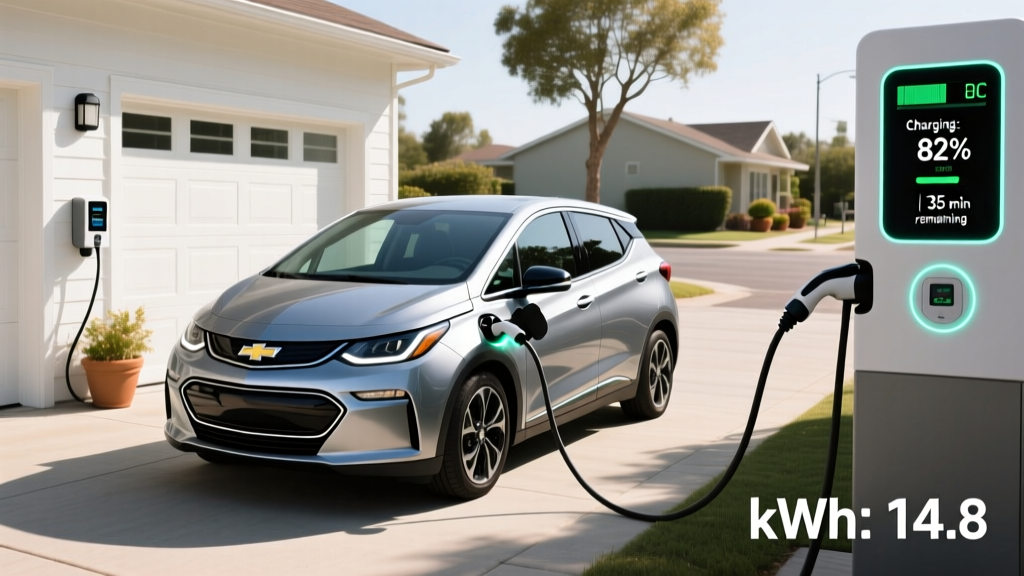
The next-generation Chevrolet Bolt EV returns on GM's Ultium platform with a larger battery and faster charging architecture. For buyers researching the 2027 Chevy Bolt driving range, understanding how that range translates into real-world miles — and what it takes to keep the battery full at home or on the road — is the difference between confident EV ownership and frustrating compromises. This guide covers the Bolt's expected range and efficiency, breaks down every charging level in exact kilowatt figures, details home installation costs down to the permit fee, and compares the cost per mile against a gasoline baseline.
2027 Chevy Bolt: Expected Range, Battery, and Efficiency
Chevrolet has confirmed the next-generation Bolt will ride on the Ultium platform with an updated battery pack. While final EPA certification numbers are pending at the time of this writing, here is what we know based on GM's announced specifications and platform data:
| Specification | 2027 Chevy Bolt (Preliminary) | 2023 Chevy Bolt EV (Prior Gen) |
|---|---|---|
| Battery Chemistry | NMC (Ultium) | NMC (LG) |
| Battery Capacity (usable, est.) | ~65 kWh | 65 kWh |
| EPA Range (est.) | ~260–290 miles | 259 miles |
| Efficiency (est.) | ~27–29 kWh/100 mi | 28 kWh/100 mi (120 MPGe) |
| Max DC Fast Charge Rate | ~150 kW (CCS1/NACS via adapter) | 55 kW (CCS1) |
| 10–80% DC Fast Charge (est.) | ~28–32 minutes | ~60 minutes |
| Level 2 Onboard Charger | 11.5 kW (48A) | 11.5 kW (48A) |
| Base MSRP (est.) | ~$28,000–$30,000 | $26,500 |
Real-World Range Reality: The EPA sticker is a laboratory estimate. On highway trips at 70+ mph, expect roughly 10–15% less range than the EPA figure — so a Bolt rated at 280 miles EPA may deliver 240–250 miles in sustained highway driving. In cold weather (below 30°F), range can drop an additional 15–25% due to cabin heating demands and reduced battery efficiency. Plan for ~200–215 miles of usable range on a cold winter highway trip.
The previous-generation Bolt's 55 kW DC fast-charging cap was its most criticized limitation. The Ultium-based 2027 model addresses this directly, with an expected peak rate near 150 kW — roughly a 3× improvement. However, as with all EVs, peak charge rate is not sustained across the entire session. The Bolt will likely hit 150 kW only between 10–40% State of Charge (SoC), then taper progressively. This is why the 10–80% time (~30 minutes) is a more honest metric than the peak kW number alone.
Charging Levels Explained: Speeds, Power, and Range Added
Understanding the difference between kW (kilowatts) and kWh (kilowatt-hours) is essential. kW measures power — the rate at which energy flows into your battery, like water pressure from a hose. kWh measures energy — the total capacity of your battery, like the size of the tank. A 65 kWh battery charged at 11.5 kW takes roughly 5.6 hours from empty to full (minus losses). The same battery charged at 150 kW on DC fast charge fills much faster, but only while the battery can accept that rate.
| Charging Level | Voltage / Current | Max Power (kW) | Miles of Range Added per Hour | Typical Use Case |
|---|---|---|---|---|
| Level 1 (Standard Outlet) | 120V / 12A | 1.4 kW | ~3–5 miles/hr | Overnight top-up, low-mileage drivers |
| Level 2 (Home/Public AC) | 240V / 32–48A | 7.7–11.5 kW | ~25–40 miles/hr | Daily home charging, workplace, shopping |
| DC Fast Charge (Level 3) | 400V+ / variable DC | 50–350 kW | ~150–400+ miles/hr (peak) | Road trips, rapid top-ups |
For a 2027 Bolt with a ~65 kWh battery and ~280 miles of range:
- Level 1 (1.4 kW): A full 0–100% charge takes approximately 46 hours. Practical only for overnight replenishment of 30–50 miles after a short commute.
- Level 2 (11.5 kW): A full charge takes roughly 6 hours. A typical overnight session (8–10 hours) easily covers any daily driving. This is the standard home-charging setup most Bolt owners should target.
- DC Fast Charge (~150 kW peak): 10–80% in approximately 28–32 minutes, adding roughly 190 miles of range in that window. The charge curve tapers significantly above 80% SoC to protect battery health.
Home Charger Installation: Electrical Requirements and Cost Breakdown
Installing a Level 2 home charger is the single most impactful upgrade for EV ownership. Here is what the installation involves and what it costs.
Electrical Requirements
A Level 2 charger delivering 11.5 kW requires a 240-volt, 50-amp dedicated circuit (the charger draws 48A continuous; the National Electrical Code requires the breaker to be rated at 125% of continuous load, hence 60A breaker with a 50A circuit). For a lower-powered 7.7 kW charger, a 240V/40A circuit (breaker rated at 50A) suffices.
Panel Upgrade Considerations
If your home has a 100-amp electrical service panel — common in homes built before the 1990s — adding a 50A EV circuit may exceed your panel's capacity, especially if you already run electric HVAC, a dryer, and an electric range. A panel upgrade to 200A typically costs $1,500–$3,000. Some utilities offer rebates for panel upgrades tied to EV adoption. Homes with 200A service rarely need an upgrade for a single Level 2 charger.
| Cost Component | Basic Install (Short Run, 200A Panel) | Complex Install (Long Run or Panel Upgrade) |
|---|---|---|
| Level 2 Charger Equipment | $350–$700 | $350–$700 |
| Electrician Labor (2–6 hours) | $300–$600 | $800–$1,500 |
| Electrical Permit | $50–$150 | $50–$200 |
| Conduit, Wiring, and Materials | $100–$300 | $300–$800 |
| Panel Upgrade (if needed) | $0 | $1,500–$3,000 |
| Total Estimated Cost | $800–$1,750 | $3,000–$6,200 |
Always hire a licensed electrician and pull a permit. Unpermitted electrical work can void your homeowner's insurance and create fire hazards. The National Electrical Code (NEC) Article 625 governs EV charging equipment installation, and your local inspector will verify compliance.
Safety and Code Requirements
- Dedicated circuit: Your EV charger must be on its own circuit — not shared with other appliances.
- GFCI protection: NEC 2020 and later require GFCI (Ground Fault Circuit Interrupter) protection for all EV charging outlets, including hardwired units in some jurisdictions.
- Outdoor rating: If your charger is installed outdoors (garage-less homes), the unit must carry a NEMA 4 or IP65 weather-resistance rating. Most quality Level 2 chargers meet this standard.
- Cable management: Ensure the charging cable doesn't create a trip hazard. Wall-mounted retractors or J-hooks are inexpensive solutions.
Connector Compatibility: NACS, CCS1, and Adapters
The connector landscape has shifted significantly. GM announced in 2023 that all new Ultium-based EVs — including the 2027 Bolt — would adopt the NACS (North American Charging Standard) port, the connector pioneered by Tesla. This means the 2027 Bolt will natively plug into Tesla Superchargers without an adapter, while CCS1 chargers (the previous GM standard) will require a CCS-to-NACS adapter.
| Connector Type | 2027 Chevy Bolt Compatibility | Network Examples |
|---|---|---|
| NACS (Tesla-style) | Native port — no adapter needed | Tesla Supercharger, Electrify America (new stalls), Rivian Adventure Network |
| CCS1 | Requires CCS-to-NACS adapter (~$200–$250) | Electrify America (legacy), EVgo, ChargePoint, non-Tesla DC stations |
| CHAdeMO | Not supported — adapter not commercially available for NACS | Nissan Leaf network (legacy, declining) |
| J1772 (Level 2 AC) | Requires NACS-to-J1772 adapter for public Level 2 | ChargePoint, Blink, workplace chargers |
GM has stated it will provide or subsidize a CCS-to-NACS adapter for early NACS-equipped vehicles. Check with your dealer at purchase. For home Level 2 charging, most NACS-equipped wall connectors (like the Tesla Wall Connector) will plug directly into the Bolt's port.
Charging Cost per Mile: EV vs Gasoline
One of the strongest economic arguments for the Bolt is the cost to "fuel" it. Let's compare charging costs against a gasoline equivalent using the Bolt's estimated efficiency of 28 kWh/100 miles.
| Charging Scenario | Rate ($/kWh) | Cost per 100 Miles | Cost per Mile | Equivalent MPG at $3.50/gal |
|---|---|---|---|---|
| Home (off-peak utility rate) | $0.09 | $2.52 | $0.025 | ~140 MPG |
| Home (standard residential avg) | $0.16 | $4.48 | $0.045 | ~78 MPG |
| Public Level 2 (network average) | $0.25 | $7.00 | $0.07 | ~50 MPG |
| DC Fast Charge (EA/EVgo average) | $0.40 | $11.20 | $0.112 | ~31 MPG |
| Gasoline (30 MPG car at $3.50/gal) | — | $11.67 | $0.117 | 30 MPG |
The numbers are clear: home charging on an off-peak or standard residential rate delivers fueling costs at roughly one-quarter to one-half the price of gasoline. Even DC fast charging on the road is competitive with gas for a 30 MPG vehicle. The Bolt's efficiency — approximately 28 kWh per 100 miles — is among the best in its class, making every dollar of electricity go further.
Source: National average electricity rates from the U.S. Energy Information Administration; efficiency estimates based on fueleconomy.gov data for the prior-generation Bolt EV.
Recommended Home Level 2 Chargers for the 2027 Bolt
With a NACS port and an 11.5 kW onboard charger, the 2027 Bolt can take full advantage of 48-amp Level 2 chargers. Here are three well-regarded options across different price points:
1. Tesla Wall Connector (NACS)
- Power Output: Up to 11.5 kW (48A at 240V)
- Connector: NACS — native fit for the 2027 Bolt
- Cable Length: 24 feet
- Smart Features: Wi-Fi enabled, OTA firmware updates, power sharing between multiple units, load management
- Price: ~$425
- Best For: Bolt owners who want a reliable, high-output NACS charger with no adapter hassle
2. ChargePoint Home Flex (NACS variant)
- Power Output: Up to 12 kW (50A at 240V) — adjustable via DIP switches
- Connector: Available in NACS or J1772 (choose NACS for the Bolt)
- Cable Length: 23 feet
- Smart Features: App-based scheduling, energy tracking, Alexa/Google Home integration, flexible amperage settings to match your circuit
- Price: ~$650
- Best For: Owners who want granular app control and the ability to dial amperage down if their panel is tight on capacity
3. Emporia Vue Level 2 Charger
- Power Output: Up to 11.5 kW (48A at 240V)
- Connector: J1772 (NACS adapter may be needed depending on Bolt port) — check current model availability
- Cable Length: 24 feet
- Smart Features: Integrates with Emporia Vue home energy monitor, solar-aware scheduling, utility rate optimization
- Price: ~$400
- Best For: Budget-conscious buyers with solar panels or time-of-use utility plans who want energy-aware charging
Regardless of which charger you choose, ensure it is UL-listed (not just "tested to UL standards" — look for the actual UL mark). Hardwired installations are preferred for 48A+ chargers, as NEMA 14-50 outlets can overheat under sustained high-current loads if not installed with commercial-grade receptacles.
Federal Tax Credit and Incentives for Home Charging
Under current IRS rules, the Alternative Fuel Vehicle Refueling Property Credit (IRC §30C) provides a tax credit of up to 30% of the cost of home EV charging equipment and installation, capped at $1,000. This credit applies to both the charger hardware and the electrician's labor.
Important caveats from IRS §30C guidelines:
- The credit is non-refundable — it can reduce your tax liability to zero but won't generate a refund beyond that.
- Eligibility depends on the equipment being installed at your primary residence in the United States.
- The credit is subject to prevailing wage and census-tract requirements for commercial installations, though residential installations have fewer restrictions.
- Always consult a tax professional to confirm your eligibility based on your specific tax situation.
Additionally, many utilities offer rebates for Level 2 charger purchases and time-of-use rate plans that make off-peak charging significantly cheaper. Check with your local utility before purchasing equipment.
Frequently Asked Questions
How much does it cost to install a home EV charger for the 2027 Chevy Bolt?
A straightforward Level 2 installation (short wiring run, 200A panel, no upgrades) typically costs $800–$1,750 including equipment, electrician labor, permit, and materials. If your home needs a panel upgrade from 100A to 200A, total costs can reach $3,000–$6,200. Always get at least two quotes from licensed electricians.
How fast will each charging level add range to the 2027 Bolt?
Level 1 (120V standard outlet) adds roughly 3–5 miles per hour. Level 2 (240V, 48A) adds approximately 35–40 miles per hour. DC fast charging at ~150 kW peak can add roughly 190 miles in a 10–80% session lasting about 30 minutes.
Which connector and charger is compatible with the 2027 Chevy Bolt?
The 2027 Bolt is expected to use a native NACS (Tesla-style) port. This means it will plug directly into Tesla Superchargers and NACS-equipped home chargers. For legacy CCS1 public chargers, you'll need a CCS-to-NACS adapter. For J1772 public Level 2 chargers, a NACS-to-J1772 adapter is required.
How much does charging the 2027 Bolt cost per mile versus gas?
At the national average residential electricity rate of ~$0.16/kWh, charging the Bolt costs roughly $0.045 per mile — equivalent to driving a 78 MPG gasoline car. Off-peak home rates (~$0.09/kWh) bring that down to $0.025/mile, equivalent to ~140 MPG. A comparable 30 MPG gas car costs about $0.117/mile at $3.50/gallon.
What electrical upgrades might I need for a home Level 2 charger?
You need a dedicated 240V circuit (50A for 48A chargers, 40A for 32A chargers). If your home has a 100A service panel, you may need a panel upgrade to 200A, costing $1,500–$3,000. Homes with 200A panels rarely need upgrades. A licensed electrician can assess your panel's available capacity during a pre-installation consultation.
Does the 2027 Chevy Bolt qualify for the $7,500 federal EV tax credit?
The IRS §30D credit has strict eligibility requirements including buyer income caps, vehicle MSRP caps (under $55,000 for sedans/hatchbacks), and battery critical-mineral and component sourcing rules. The Bolt's estimated MSRP of ~$28,000–$30,000 falls well under the cap, but income limits ($150,000 single / $300,000 joint for modified AGI) and battery sourcing compliance will determine final eligibility. The credit may also be transferred to the dealer as a point-of-sale discount. Always verify current-year rules with a tax professional.