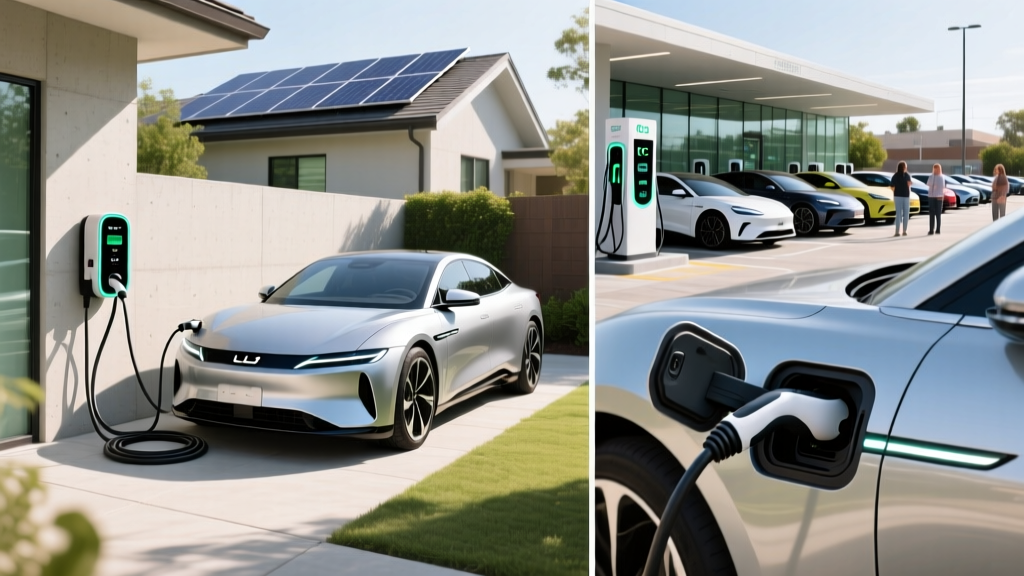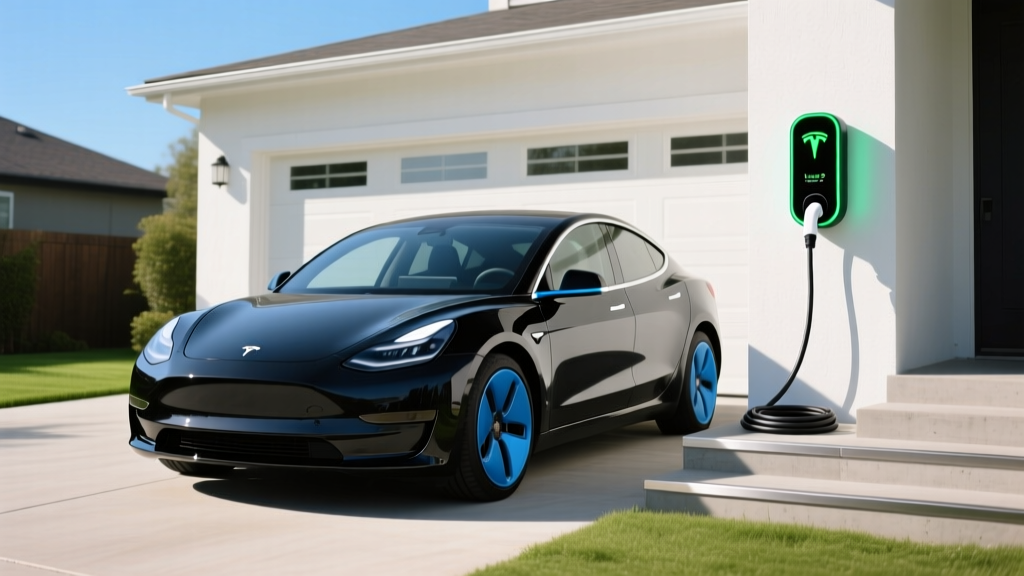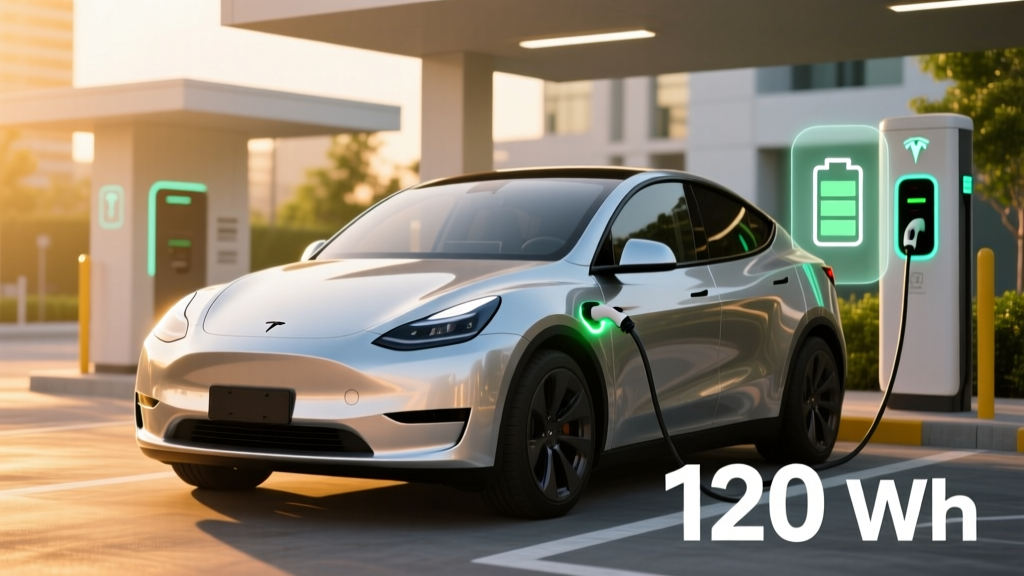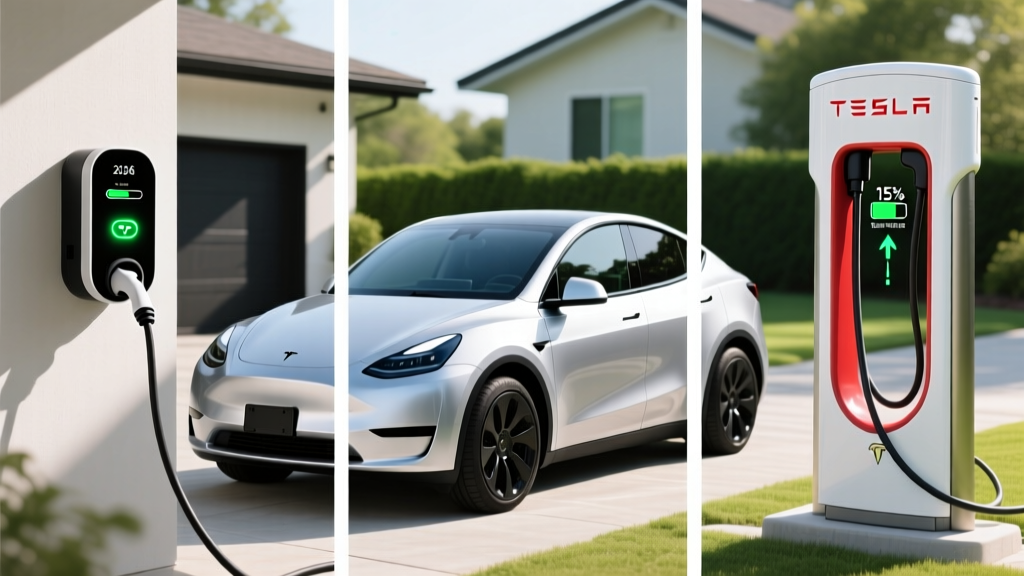
The 2026 Tesla Model Y Long Range RWD pairs an EPA-estimated 320 miles of range with one of the most efficient charging ecosystems in the industry. But range on a sticker doesn't tell you how long a road-trip stop takes, whether your garage outlet can handle overnight top-ups, or what you'll actually pay per mile. This guide breaks down every charging scenario for the Model Y Long Range RWD — from a standard 120V wall outlet to a 250 kW Supercharger — with the exact numbers, install costs, and equipment you need to plan confidently.
- EPA Range: 320 miles
- Real-World Expectation: ~270–290 mi highway (70–80 mph); ~240–260 mi in freezing weather
- Battery Capacity: ~75 kWh usable (LFP chemistry, CATL-sourced)
- Efficiency: 122 MPGe combined / 27 kWh per 100 mi
- Max DC Fast Charge Rate: 250 kW peak (NACS connector)
- Level 2 Max Acceptance: 11.5 kW (48A)
- 10–80% DC Fast Charge: ~25 minutes (preconditioned)
- Base MSRP: $44,990 (before incentives)
Sources: fueleconomy.gov, Tesla specifications.
Charging Levels Explained: How Fast Will Each Add Range?
Before plugging in, it helps to separate kW (kilowatts — the rate of power flow, like water pressure) from kWh (kilowatt-hours — the total energy stored, like gallons in a tank). A 75 kWh battery charged at 7.5 kW takes roughly 10 hours from empty. The same battery at 250 kW DC fast charging can recover most of its capacity in under 30 minutes — but only while the charge curve allows peak rates.
| Level | Voltage / Amps | Power (kW) | Miles of Range per Hour | Typical Use Case |
|---|---|---|---|---|
| Level 1 | 120V / 12A | ~1.4 kW | ~3–4 mi/hr | Overnight trickle; emergency backup |
| Level 2 (basic) | 240V / 32A | ~7.7 kW | ~25–28 mi/hr | Portable chargers, older home installs |
| Level 2 (optimal) | 240V / 48A | ~11.5 kW | ~37–44 mi/hr | Hardwired home Wall Connector |
| DC Fast (Supercharger V3) | 400V+ architecture | Up to 250 kW | ~1,000+ mi/hr (peak) | Road trips; 10–80% in ~25 min |
At Level 1, the Model Y Long Range RWD gains roughly 3–4 miles per hour. That's about 36 miles over a 10-hour night — enough for a short commute, but inadequate for replenishing a depleted battery. Level 2 at 48A (the vehicle's maximum onboard charger acceptance) adds a full charge in roughly 7–8 hours, making it the practical home standard.
DC fast charging at a V3 Supercharger peaks at 250 kW but does not sustain that rate. The charge curve is steepest below 40% State of Charge (SoC) and tapers progressively above 60%. Expect roughly 170 miles of range in the first 15 minutes from a low SoC, then slower gains as the battery management system protects cell health. Plan road-trip stops around 10–80% rather than full charges — the last 20% can take as long as the first 60%.
Home Charger Installation: Requirements, Costs & Panel Upgrades
Installing a Level 2 home charger for the Model Y Long Range RWD involves more than buying a wall unit. Your home's electrical panel, available amperage, and the distance from panel to garage all affect total cost.
Electrical Requirements
The Tesla Wall Connector at its maximum output requires a 240V / 60A dedicated circuit (delivering 48A continuous to the vehicle, per the National Electrical Code 80% rule for continuous loads). If your panel lacks capacity, a 240V / 40A circuit (32A continuous, ~7.7 kW) is a common fallback that still provides ~25–28 miles of range per hour.
Panel Upgrade Considerations
Homes with 100A service or older panels may need a panel upgrade to 200A before adding a 60A EV circuit — particularly if you also run electric HVAC, a dryer, and an electric range. A licensed electrician will perform a load calculation per NEC Article 220 to determine if your panel can accommodate the new circuit. Skipping this step risks tripped breakers or, worse, overheated wiring.
| Item | Low Estimate | High Estimate | Notes |
|---|---|---|---|
| Level 2 Charger (Equipment) | $400 | $650 | Tesla Wall Connector, ChargePoint Home Flex, Emporia |
| Electrician Labor (standard run) | $500 | $1,200 | Depends on distance from panel to outlet/location |
| Electrical Permit | $50 | $200 | Varies by municipality |
| Panel Upgrade (if needed) | $1,500 | $3,500 | 100A → 200A service upgrade |
| Conduit / Trenching (outdoor runs) | $200 | $1,000 | Long garage-to-panel distances or buried runs |
| Total (no panel upgrade) | $950 | $2,050 | Most homes with 200A service |
| Total (with panel upgrade) | $2,450 | $5,550 | Older homes with 100A service |
Many utility companies offer rebates of $200–$500 for Level 2 charger installation — check with your local provider. Some states also offer additional point-of-sale or tax incentives for home charging equipment. The IRS Residential Clean Energy Credit (25C) may cover up to 30% of charger equipment and installation costs (capped at $1,000) through 2032 — consult a tax professional for eligibility.
Connector Compatibility: NACS, Adapters & the Public Network
The 2026 Tesla Model Y Long Range RWD uses the North American Charging Standard (NACS) connector natively — the same plug used across the entire Tesla Supercharger network, which now exceeds 25,000 stalls in North America. Since late 2024, most major automakers have adopted NACS, making it the de facto standard.
| Connector | Native on Model Y? | Network Availability | Adapter Needed? |
|---|---|---|---|
| NACS (Tesla) | Yes — native | Tesla Superchargers, many new Electrify America / EVgo stalls | None |
| CCS1 | No | Electrify America, EVgo, ChargePoint (legacy stalls) | Tesla CCS Adapter (~$175, included with some trims) |
| CHAdeMO | No | Limited — mostly older Nissan Leaf infrastructure | Third-party adapter (rare, not recommended) |
| J1772 (Level 2) | No (NACS inlet) | Public Level 2 stations everywhere | Tesla J1772 Adapter (included with vehicle) |
For the vast majority of Model Y Long Range RWD owners, the native NACS connector and Tesla Supercharger network cover daily and road-trip needs without adapters. The included J1772 adapter handles public Level 2 stations at airports, malls, and workplaces. The CCS adapter is worth carrying for road trips through areas where Supercharger coverage is sparse — particularly in parts of the rural Midwest and Mountain West.
Cost to Charge: Home vs. Public vs. Gas
Charging costs vary dramatically depending on where and when you plug in. The Model Y Long Range RWD's ~75 kWh usable battery and 27 kWh/100 mi efficiency make it one of the more cost-efficient EVs to fuel — but the rate per kWh determines your actual savings.
| Scenario | Rate ($/kWh) | Cost for Full 75 kWh Charge | Cost per Mile (at 27 kWh/100 mi) |
|---|---|---|---|
| Home — Off-Peak Utility Rate | $0.08 | $6.00 | $0.022 |
| Home — Average US Residential | $0.17 | $12.75 | $0.046 |
| Public Level 2 (ChargePoint, etc.) | $0.25 | $18.75 | $0.068 |
| Tesla Supercharger (average 2026) | $0.32 | $24.00 | $0.086 |
| Gas Car (28 MPG combined, $3.40/gal) | — | $9.11 per gallon-equiv. | $0.121 |
At home off-peak rates, the Model Y Long Range RWD costs roughly 2.2 cents per mile — about one-fifth the cost of a comparable gas-powered crossover at current fuel prices. Even at Supercharger rates, you're paying roughly $0.086 per mile, still a meaningful savings. Over 15,000 annual miles, home charging at the national average saves roughly $1,125 per year compared to a 28 MPG gas vehicle at $3.40/gallon.
The key to maximizing savings is time-of-use (TOU) scheduling. Most utilities offer rates 40–60% lower during overnight hours (typically 10 PM – 6 AM). Set your Model Y's scheduled charging in the Tesla app to take advantage of these windows. Some utilities also offer dedicated EV rate plans with even deeper discounts.
Recommended Home Charging Equipment for the Model Y
The Model Y Long Range RWD accepts up to 11.5 kW on Level 2 (48A). To take full advantage, you need a charger rated for at least 48A on a 60A circuit. Here are three proven options:
Tesla Wall Connector (Gen 4)
- Power Output: Up to 11.5 kW (48A)
- Connector: NACS (native fit)
- Cable Length: 24 ft
- Smart Features: Wi-Fi, OTA updates, Power Sharing (link multiple units), Tesla app integration
- Price: ~$475
- Best For: Seamless Tesla ecosystem integration, cleanest aesthetic, load-sharing in multi-EV garages
ChargePoint Home Flex
- Power Output: Configurable up to 12 kW (50A)
- Connector: NACS (2025+ model) or J1772 (use Tesla adapter)
- Cable Length: 23 ft
- Smart Features: Wi-Fi, ChargePoint app, Alexa, scheduling, energy tracking
- Price: ~$599
- Best For: Multi-vehicle households (NACS + J1772 flexibility), robust app features
Emporia Vue EV Charger
- Power Output: Up to 11.5 kW (48A)
- Connector: J1772 (NACS adapter included with some bundles)
- Cable Length: 24 ft
- Smart Features: Wi-Fi, energy monitoring integration with Emporia Vue panel monitor, scheduling
- Price: ~$399
- Best For: Budget-conscious buyers who want whole-home energy monitoring
For Model Y Long Range RWD owners, the Tesla Wall Connector is the path of least resistance — native NACS plug, Power Sharing for two-EV garages, and no adapter clutter. Choose the ChargePoint Home Flex if a non-Tesla EV may join your household within a few years.
Safety, Code & Installation Best Practices
EV charging is a high-draw, continuous electrical load. Cutting corners on installation creates fire risk and may void your homeowner's insurance in the event of a claim.
- Dedicated Circuit: Your Level 2 charger must be on its own dedicated breaker — never shared with other appliances. A 60A breaker for a 48A continuous load follows NEC 80% derating rules.
- GFCI Protection: The 2023 NEC (Article 625.54) requires GFCI protection for all EV receptacles rated 150V to ground or less and up to 60A. Hardwired units (like the Tesla Wall Connector) typically have built-in ground-fault protection and may not require an external GFCI breaker — your electrician will confirm local code interpretation.
- Outdoor Rating: If your charger is mounted outdoors (driveway, carport), ensure it carries a NEMA 4 or equivalent weather-resistance rating. The Tesla Wall Connector is rated for indoor and outdoor use.
- Wire Gauge: A 60A circuit typically requires 6 AWG copper wire (THHN in conduit) or 4 AWG aluminum. Longer runs may need upsized wire to reduce voltage drop — your electrician will calculate this.
- Permits & Inspections: Most jurisdictions require an electrical permit and post-installation inspection. Skipping this can cause problems at home sale or insurance claim time. Budget $50–$200 for the permit.
- Surge Protection: Consider a whole-panel surge protector ($200–$400 installed) to guard against voltage spikes, particularly in areas with frequent lightning or utility switching events.
Charging Time Examples: What to Expect in Practice
Here's how long common charging scenarios take for the Model Y Long Range RWD's ~75 kWh battery:
| Scenario | Starting SoC | Target SoC | Energy Needed | Estimated Time |
|---|---|---|---|---|
| Level 1 (120V, 1.4 kW) | 20% | 80% | 45 kWh | ~32 hours |
| Level 2 (240V, 32A / 7.7 kW) | 20% | 80% | 45 kWh | ~6 hours |
| Level 2 (240V, 48A / 11.5 kW) | 20% | 80% | 45 kWh | ~4 hours |
| Level 2 (240V, 48A / 11.5 kW) | 10% | 100% | 67.5 kWh | ~6 hours |
| DC Fast (250 kW Supercharger) | 10% | 80% | 52.5 kWh | ~25 minutes |
| DC Fast (150 kW older stall) | 10% | 80% | 52.5 kWh | ~35 minutes |
A critical nuance: preconditioning matters. When you navigate to a Supercharger using the Tesla navigation system, the vehicle automatically warms the battery to optimal charging temperature. Arriving at a Supercharger without preconditioning (for example, at a third-party CCS station using the adapter) can add 5–10 minutes to your session in cold weather because the battery must heat before accepting peak charge rates.
The LFP battery chemistry in the Model Y Long Range RWD also has a unique charging recommendation: Tesla advises charging to 100% at least once per week to maintain accurate state-of-charge calibration. Unlike NMC batteries, which benefit from staying below 80% daily, LFP cells tolerate full charges well and need periodic full charges for the battery management system to recalibrate cell voltages.
Federal Tax Credits & Incentives for Charging
Beyond the vehicle itself, several incentives can offset your charging setup costs:
- IRS §30D New Clean Vehicle Credit: The 2026 Tesla Model Y Long Range RWD may qualify for up to $7,500 in federal tax credits, subject to MSRP caps ($80,000 for SUVs), buyer income limits ($300,000 joint / $150,000 single), and critical mineral and battery component sourcing requirements. Point-of-sale transfer is available, reducing the purchase price at the dealer. Always verify current eligibility at IRS.gov before purchasing.
- IRS §25C Residential Clean Energy Credit: Home EV charger equipment and installation may qualify for a credit of up to 30% (capped at $1,000 annually). This applies to the charger hardware and electrical labor — not the panel upgrade itself.
- Utility Rebates: Many utilities offer $200–$500 rebates for Level 2 charger installation, and some offer free or discounted TOU rate enrollment. Check your local utility's EV programs page.
- State/Local Incentives: Several states offer additional charger rebates or tax credits. These vary widely — consult the Alternative Fuels Data Center for your jurisdiction.
Frequently Asked Questions
How much does it cost to install a home EV charger for the Model Y Long Range RWD?
Between $950 and $2,050 for most homes with adequate 200A electrical service, including the Tesla Wall Connector ($475), electrician labor ($500–$1,200), and permit fees ($50–$200). Homes needing a panel upgrade from 100A to 200A should budget an additional $1,500–$3,500.
How fast will each charging level add range to the Model Y?
Level 1 (120V) adds ~3–4 miles per hour. Level 2 at 48A (240V) adds ~37–44 miles per hour — enough for a full overnight charge. DC fast charging at a 250 kW Supercharger adds up to 170 miles in 15 minutes from a low state of charge, with 10–80% taking approximately 25 minutes.
Which connector does the 2026 Model Y Long Range RWD use?
The vehicle uses the NACS (North American Charging Standard) connector natively — the same plug used by all Tesla Superchargers. A J1772 adapter (included) handles public Level 2 stations. A CCS adapter (~$175) enables access to legacy Electrify America and EVgo DC fast chargers.
How much does charging cost per mile vs. gas?
At the national average residential electricity rate ($0.17/kWh), the Model Y Long Range RWD costs about $0.046 per mile to charge at home. A comparable 28 MPG gas crossover at $3.40/gallon costs $0.121 per mile — roughly 2.6× more. Off-peak home charging drops the cost to ~$0.022 per mile.
What electrical upgrades might I need?
If your home has 200A electrical service and available breaker slots, you likely need only a new 60A dedicated circuit — no panel work required. Homes with 100A service, older wiring, or panels near capacity may need a full panel upgrade ($1,500–$3,500). A licensed electrician's load calculation will determine this before any work begins.
Should I charge the LFP battery to 100% daily?
Tesla recommends charging LFP batteries to 100% at least once per week for accurate SoC calibration. Daily charging to 100% is acceptable with LFP chemistry — unlike NMC batteries, which degrade faster when held at high SoC. Set your daily charge limit to 100% and use scheduled departure to minimize time spent at full charge.