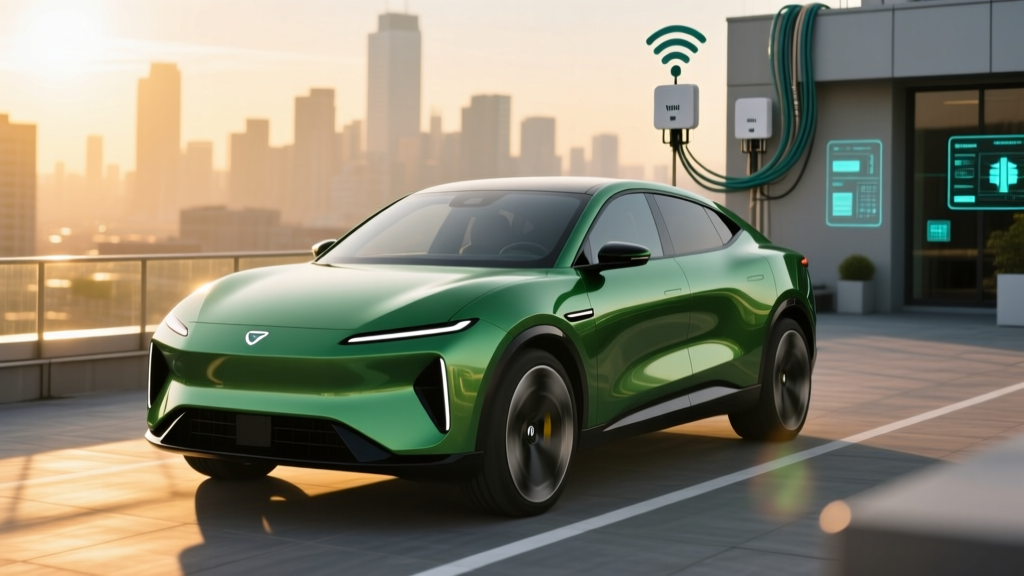
The 2026 Tesla Model Y Long Range Launch Series arrives with a refreshed battery pack, a NACS-native charge port, and an EPA-estimated range hovering around 320 miles. But range is only half the ownership equation — how you replenish those electrons, how fast, and at what cost determines whether EV ownership feels effortless or frustrating. This guide breaks down every charging scenario for the 2026 Model Y Long Range, from overnight Level 2 top-ups in your garage to 250 kW Supercharger road-trip stops, with real numbers for installation, electricity costs, and equipment.
Understanding Charging Levels: Level 1, Level 2, and DC Fast Charging
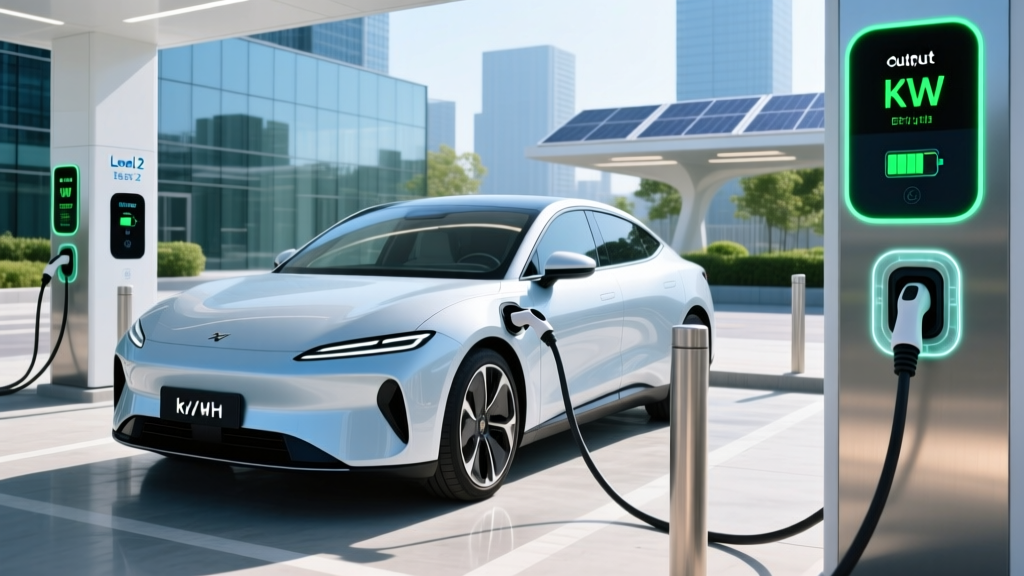
Before plugging in the Model Y, it is essential to understand the three charging tiers and what they mean in practical terms. The distinction between kW (kilowatts — the rate of power delivery, like water pressure from a hose) and kWh (kilowatt-hours — the total energy stored, like gallons in a tank) is the single most important piece of EV literacy. Your battery capacity is measured in kWh; your charger's speed is measured in kW.
The 2026 Model Y Long Range Launch Series carries an estimated 78 kWh usable battery pack (NMC chemistry). Here is how each charging level interacts with that pack:
| Charging Level | Voltage / Amperage | Max Power (kW) | Miles of Range Added per Hour | Typical Use Case |
|---|---|---|---|---|
| Level 1 (120V AC) | 120V / 12A | ~1.4 kW | ~4–5 mi/hr | Emergency trickle, overnight top-up for short commutes |
| Level 2 (240V AC) | 240V / 32–48A | 7.7–11.5 kW | ~25–44 mi/hr | Daily home and workplace charging |
| DC Fast Charging | DC direct to battery | Up to 250 kW (peak) | ~1,000+ mi/hr (at peak) | Road trips, Tesla Supercharger network |
Home Charging Installation: Electrical Requirements and Costs
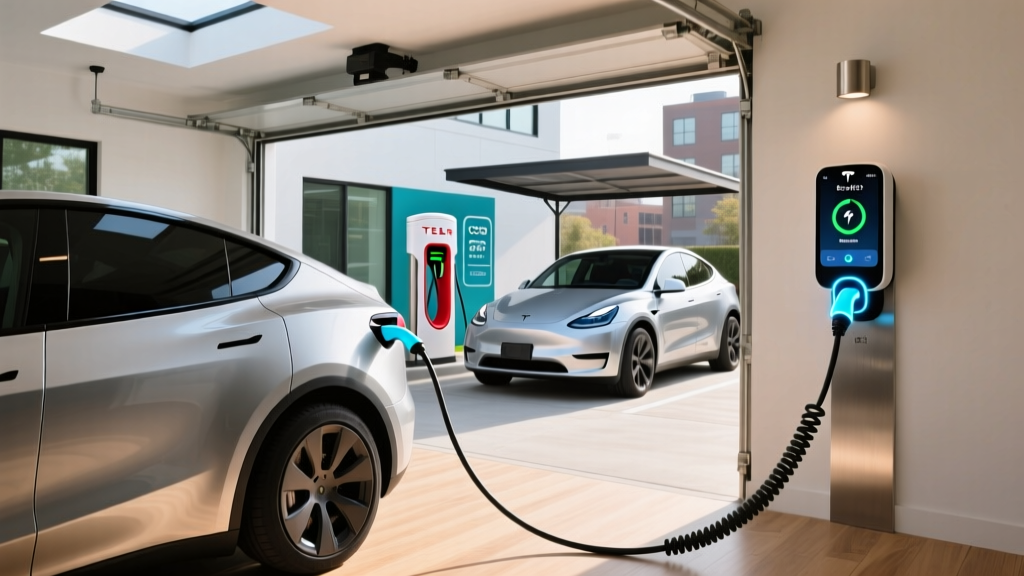
For the 2026 Model Y Long Range, a Level 2 home charger is the cornerstone of convenient ownership. Tesla's onboard charger accepts up to 11.5 kW (48A on a 60A dedicated circuit). To get that full rate, your electrical setup must support it.
Electrical Requirements
Here is what a proper Level 2 installation demands:
- Circuit: Dedicated 60A breaker (for 48A continuous charging) or 50A breaker (for 40A continuous / 9.6 kW). The National Electrical Code requires continuous loads to use no more than 80% of the circuit rating.
- Wiring: 6 AWG copper (for 50A) or 4 AWG copper (for 60A), run in conduit where required.
- Outlet vs. hardwired: A NEMA 14-50 receptacle (50A) offers portability — you can unplug the charger and take it when you move. Hardwired installations (common for 60A circuits) eliminate the receptacle but may require a GFCI breaker depending on local code.
- Panel capacity: Your main electrical panel must have enough spare capacity to accommodate the new breaker. A typical home with a 200A panel and modest loads can usually handle a 50–60A EV circuit. Older homes with 100A service may need a panel upgrade.
How Much Does It Cost to Install a Home EV Charger?
Installation costs vary enormously based on your panel's proximity to the charge location, whether conduit runs are needed, and local labor rates. Here is a realistic breakdown for a 2026 installation:
| Cost Component | Low Estimate | High Estimate | Notes |
|---|---|---|---|
| Level 2 Charger Equipment | $350 | $600 | Tesla Wall Connector, ChargePoint, Emporia, etc. |
| Electrician Labor (standard install) | $500 | $1,500 | Depends on run length, conduit, drywall work |
| Permit & Inspection | $50 | $300 | Varies by municipality; some jurisdictions waive for EV |
| Panel Upgrade (if needed) | $1,500 | $4,000+ | 100A → 200A service upgrade; not always required |
| Total (without panel upgrade) | $900 | $2,400 | Most homeowners fall in the $1,200–$1,800 range |
| Total (with panel upgrade) | $2,400 | $6,400+ | Older homes with 100A service are most affected |
Connector Compatibility: NACS, CCS1, and Adapters
The 2026 Tesla Model Y Long Range uses the NACS (North American Charging Standard) connector natively. This is the same physical plug used on all Tesla vehicles and, as of 2025–2026, adopted by Ford, GM, Rivian, Hyundai, and most other major automakers for their North American models.
| Connector Standard | Native on Model Y? | Where You Will Find It | Adapter Needed? |
|---|---|---|---|
| NACS (Tesla) | Yes — native | Tesla Superchargers, Tesla Destination Chargers, many new public stations (Electrify America, EVgo adding NACS) | None |
| CCS1 | No | Legacy public DC fast chargers (some Electrify America, ChargePoint, independent networks) | Tesla CCS Adapter (~$175 from Tesla) |
| CHAdeMO | No | Rare in 2026; some older Nissan Leaf-era stations | No practical adapter available; avoid relying on this |
| J1772 (Level 2 AC public) | No | Public Level 2 stations at malls, hotels, workplaces | Tesla J1772 Adapter (included with vehicle or ~$95) |
For 2026 Model Y owners, the NACS ecosystem is a major advantage. The Tesla Supercharger network remains the most reliable and widely deployed DC fast-charging network in North America, with over 25,000 stalls in the U.S. alone. The CCS adapter is worth carrying for redundancy on longer road trips through regions where non-Tesla networks fill coverage gaps.
Charging Cost: Per Mile vs. Gasoline
One of the strongest arguments for the Model Y Long Range is the cost-per-mile advantage over internal combustion vehicles. Electricity pricing varies by region, time of day, and charging location, so let us model three realistic scenarios:
| Charging Scenario | Cost per kWh | Cost to Charge 78 kWh (full pack) | Cost per Mile (at 3.5 mi/kWh) |
|---|---|---|---|
| Home — off-peak utility rate | $0.12 | $9.36 | $0.034 |
| Home — average blended rate | $0.17 | $13.26 | $0.049 |
| Public Level 2 (workplace, shopping) | $0.25–$0.35 | $19.50–$27.30 | $0.071–$0.10 |
| Tesla Supercharger (DC fast) | $0.28–$0.40 | $21.84–$31.20 | $0.080–$0.114 |
| Gasoline equivalent (30 MPG at $3.50/gal) | — | — | $0.117 |
The 2026 Model Y Long Range achieves roughly 3.5 miles per kWh (approximately 117 MPGe combined, per fueleconomy.gov estimates for recent Model Y configurations). At home off-peak rates, you are paying roughly 3.4 cents per mile — about a third of the gasoline cost. Even at Supercharger rates, the Model Y is competitive with or cheaper than a 30 MPG gas crossover.
Over 15,000 miles of annual driving, home-charging exclusively at $0.12/kWh costs approximately $514 per year. The equivalent gas cost at 30 MPG and $3.50/gallon is $1,750. That is over $1,200 in annual fuel savings — and the gap widens further in states with higher gas prices or lower electricity rates.
Equipment Recommendations: Best Chargers for the Model Y
Not all Level 2 chargers are equal. Below are four units well-suited to the 2026 Model Y Long Range, each selected for NACS compatibility, build quality, and smart features:
Tesla Wall Connector
- Power: Up to 11.5 kW (48A)
- Connector: NACS native
- Cable: 24 ft
- Smart Features: Wi-Fi, OTA updates, power-sharing with second unit, Tesla app integration
- Price: ~$475
- Best for: Tesla-only households wanting seamless integration
Emporia Vue Level 2 Charger
- Power: Up to 11.5 kW (48A)
- Connector: NACS native (2025+ models)
- Cable: 24 ft
- Smart Features: Automatic load management (avoids panel upgrade), energy monitoring, scheduling, solar integration
- Price: ~$399
- Best for: Homes needing load management or solar-aware charging
ChargePoint Home Flex
- Power: Up to 12 kW (50A, configurable)
- Connector: NACS native (2025+ revision)
- Cable: 23 ft
- Smart Features: ChargePoint app scheduling, Alexa integration, detailed session data
- Price: ~$550
- Best for: Mixed-EV households (also sells J1772 version)
Grizzl-E Smart
- Power: Up to 10 kW (40A)
- Connector: NACS available
- Cable: 24 ft
- Smart Features: OCPP-compatible, works with multiple apps, ruggedized for extreme cold (-40°C rated)
- Price: ~$449
- Best for: Cold-climate garages and outdoor installs
Safety, Electrical Code, and Permitting
EV charging involves sustained high-current draw — often for 6–10 hours straight. This is fundamentally different from typical household appliance loads. Proper installation is not optional; it is a fire-safety requirement.
- Dedicated circuit: Your Level 2 charger must be on its own breaker — never shared with other outlets or appliances. A shared circuit risks tripping and creates a fire hazard under continuous load.
- GFCI protection: The 2020 and 2023 NEC require GFCI (Ground Fault Circuit Interrupter) protection for receptacles in garages. If you install a NEMA 14-50 outlet, your electrician will likely need a GFCI breaker ($50–$100 more than a standard breaker). Hardwired installations may be exempt depending on jurisdiction — ask your local inspector.
- Outdoor rating: If your charger is mounted outside, both the unit and the connector must carry an outdoor/wet-location rating (NEMA 4 or IP65). All chargers listed above meet this standard.
- UL listing: Only purchase chargers with UL (Underwriters Laboratories) or ETL certification. Uncertified chargers from overseas marketplaces may lack critical safety components and can void your homeowner's insurance coverage in the event of a fire.
- Permit: Most jurisdictions require an electrical permit for a new 240V circuit. The permit fee is typically $50–$300, and the inspection ensures your installation meets code. Skipping the permit risks insurance denial and complications during a home sale.
Charging Time Examples: What to Expect
Charging speed depends on the starting state of charge, battery temperature, and charger capability. Here are practical time estimates for the 2026 Model Y Long Range's ~78 kWh pack:
| Scenario | Charger Type | Starting SoC | Ending SoC | Approximate Time |
|---|---|---|---|---|
| Overnight home charge | Level 2, 11.5 kW (48A) | 20% | 90% | ~5–6 hours |
| Overnight home charge | Level 2, 7.7 kW (32A) | 20% | 90% | ~7.5–9 hours |
| Road-trip Supercharger stop | DC fast, 250 kW peak | 10% | 80% | ~25–28 minutes |
| Cold-weather Supercharger | DC fast, 250 kW peak (no preconditioning) | 10% | 80% | ~35–45 minutes |
| Trickle recovery | Level 1, 1.4 kW (120V) | 50% | 80% | ~16–20 hours |
Frequently Asked Questions
How much does it cost to install a home EV charger for the 2026 Model Y?
Expect $1,200–$2,400 for a standard installation (equipment + electrician + permit) if your electrical panel has adequate capacity. If a panel upgrade from 100A to 200A is needed, add $1,500–$4,000. Always get multiple quotes from licensed electricians and verify the quote includes permitting.
How fast will each charging level add range to the Model Y Long Range?
Level 1 (120V) adds roughly 4–5 miles per hour. Level 2 (240V at 48A) adds about 37–44 miles per hour. DC fast charging at a V3 Supercharger can add up to ~200 miles in 15 minutes at peak rate, but sustained speed depends on state of charge and battery temperature.
Which connector is compatible with the 2026 Tesla Model Y Long Range?
The Model Y uses NACS natively for both AC and DC charging. For CCS1 public chargers, you will need the Tesla CCS Adapter (~$175). For J1772 Level 2 public stations, the Tesla J1772 adapter is included with the vehicle or available separately for ~$95.
How much does charging the Model Y cost per mile compared to gasoline?
At home off-peak rates ($0.12/kWh), the Model Y costs approximately $0.034 per mile. At Supercharger rates ($0.28–$0.40/kWh), it costs $0.08–$0.11 per mile. A comparable 30 MPG gas crossover at $3.50/gallon costs $0.117 per mile. Home charging saves $1,000–$1,200+ annually over gasoline for 15,000 miles of driving.
What electrical upgrades might I need for a Level 2 charger?
You need a dedicated 50A or 60A breaker with appropriate wiring (6 AWG or 4 AWG copper). If your panel lacks spare capacity, a load-management device (like Emporia's automatic balancing) can sometimes avoid a full panel upgrade. Homes with 100A service, aluminum wiring, or panels at capacity may need a service upgrade to 200A, costing $1,500–$4,000. A licensed electrician's load calculation per NEC Article 220 will determine your exact requirements.
Can I charge the Model Y Long Range using solar panels?
Yes. Chargers like the Emporia Vue integrate directly with solar inverters to charge only when excess solar production is available, effectively reducing your per-mile cost to near zero. The Tesla Wall Connector also supports scheduled charging during peak solar hours, though it lacks direct inverter communication without a third-party integration.
Is it safe to leave the Model Y plugged in overnight every night?
Yes — this is the intended use case. Tesla recommends keeping the vehicle plugged in whenever possible. The battery management system monitors cell temperature, voltage, and state of charge continuously. For NMC batteries like the Model Y Long Range's, Tesla recommends setting the daily charge limit to 80% and only charging to 100% for road trips to maximize long-term battery health.
Sources: EPA Fuel Economy, Tesla Model Y Specifications, IRS §30D EV Tax Credit Rules. Pricing and availability current as of 2026 model year. Consult a licensed electrician for installation specifics and a tax professional for credit eligibility.