Why Charging Setup Matters for the 2026 Tesla Model S Long Range
The 2026 Tesla Model S Long Range pairs a ~100 kWh usable battery pack (NMC chemistry) with an EPA-estimated 402 miles of range and a peak DC fast-charge rate of 250 kW on V3 Superchargers. That hardware is capable — but only if your charging infrastructure keeps up. A 402-mile sedan that charges at 3 kW overnight from a standard outlet gains roughly 9 miles per hour. That's not a charging strategy; it's a liability.
This guide walks through every charging scenario a Model S Long Range owner will face: Level 1 trickle, Level 2 home installation (with real cost breakdowns), DC fast charging on the Supercharger and third-party networks, connector compatibility as NACS becomes the North American standard, and the per-mile economics versus gasoline. We'll use the 2026 Model S Long Range as our reference vehicle throughout, with its specific battery capacity, charge acceptance, and efficiency figures.
Battery: ~100 kWh usable (NMC)
EPA Range: 402 miles
Efficiency: 124 MPGe combined (~3.0 miles/kWh)
Max DC Fast Charge: 250 kW (V3 Supercharger)
Max Level 2 AC Charge: 11.5 kW (48A on 60A circuit)
Connector: NACS (native Tesla)
Base MSRP: ~$79,990 (Long Range AWD)
Charging Levels Explained: Speeds, Power, and Range Added
EV charging breaks into three tiers. The critical distinction: kW (kilowatts) measures power — how fast energy flows into the battery. kWh (kilowatt-hours) measures energy — the total capacity stored. Think of kW as the flow rate of a hose and kWh as the size of the tank. The 2026 Model S Long Range has roughly a 100 kWh tank; how fast you fill it depends on the kW rate of your charger.
| Level | Voltage / Amperage | Max Power (kW) | Miles of Range Added per Hour | Typical Use Case |
|---|---|---|---|---|
| Level 1 | 120V / 12–16A | 1.4–1.9 kW | 4–6 mi/hr | Emergency / overnight trickle |
| Level 2 | 240V / 32–48A | 7.7–11.5 kW | 23–35 mi/hr | Home daily charging, workplace |
| DC Fast (V3 Supercharger) | 400V+ DC | Up to 250 kW | ~1,000+ mi/hr (peak) | Road trips, rapid top-ups |
At Level 1 (a standard 120V household outlet using Tesla's Mobile Connector), the Model S Long Range gains only about 4–6 miles of range per hour. Fully replenishing a depleted 100 kWh pack would take roughly 55–70 hours. Level 1 is viable only as a backup or for plug-in hybrids with small batteries — not a 402-mile sedan.
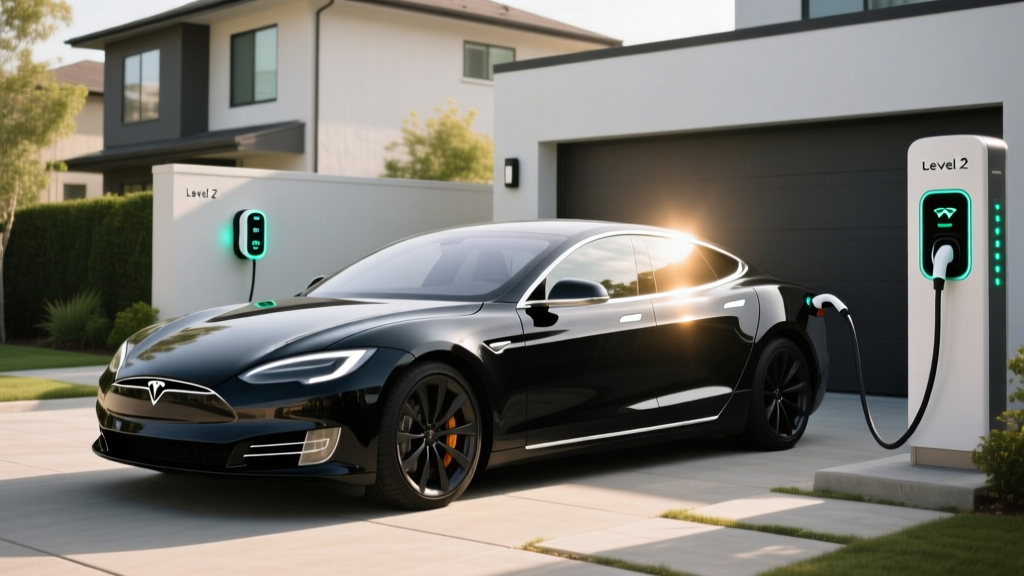
Level 2 at 240V is the home-charging standard. The Model S Long Range's onboard charger accepts up to 11.5 kW (48 amps on a dedicated 60-amp circuit). At that rate, you add roughly 35 miles of range per hour, and a 10–80% charge completes in approximately 6–7 hours — ideal for overnight replenishment.
DC fast charging bypasses the onboard charger entirely, feeding DC current straight to the battery. On a V3 Supercharger, the Model S peaks at 250 kW and can add up to 200 miles in about 15 minutes under ideal conditions. However, charge speed tapers significantly above 80% state of charge (SoC) to protect battery health — a 10–90% session will take considerably longer than the 10–80% benchmark.
Home Level 2 Installation: Electrical Requirements and Cost Breakdown
Installing a Level 2 home charger is the single most impactful upgrade for daily EV ownership. For the 2026 Model S Long Range, the goal is a 240V circuit delivering 48 amps continuously, which requires a dedicated 60-amp breaker (the National Electrical Code requires circuits to be rated at 125% of continuous load).
Electrical Requirements
- Circuit: Dedicated 60-amp, 240V breaker (for 48A continuous charging)
- Wire gauge: 6 AWG copper (or 4 AWG aluminum) for runs up to ~50 feet; thicker for longer runs to minimize voltage drop
- Panel capacity: Your main service panel must have spare capacity. A 200-amp panel is standard for modern homes; older 100-amp panels often require an upgrade
- Permit: Most jurisdictions require an electrical permit for new 240V circuits — budget $50–$200
- GFCI protection: NEC 2020+ requires GFCI protection for EV outlets in garages; hardwired chargers may have internal GFCI compliance
Installation Cost Breakdown
| Cost Component | Simple Install (Panel Nearby) | Complex Install (Panel Upgrade / Long Run) |
|---|---|---|
| Level 2 Charger Equipment | $400–$700 | $400–$700 |
| Electrician Labor (2–6 hrs @ $75–$150/hr) | $300–$600 | $800–$2,000 |
| Electrical Materials (wire, conduit, breaker) | $100–$300 | $300–$800 |
| Permit Fee | $50–$150 | $100–$250 |
| Panel Upgrade (if needed: 100A → 200A) | $0 | $1,500–$3,500 |
| Total Estimated Cost | $850–$1,750 | $3,100–$7,250 |
The wide cost range is real. If your electrical panel is in the garage next to where you'll park, and it has spare slots and adequate amperage, you're looking at a straightforward $850–$1,750 job. If you need a panel upgrade, a 60-foot wire run through finished walls, or trenching to a detached garage, costs climb quickly. Get at least two quotes from licensed electricians and confirm they include permit costs.
Connector Compatibility: NACS, CCS, and the 2026 Charging Landscape
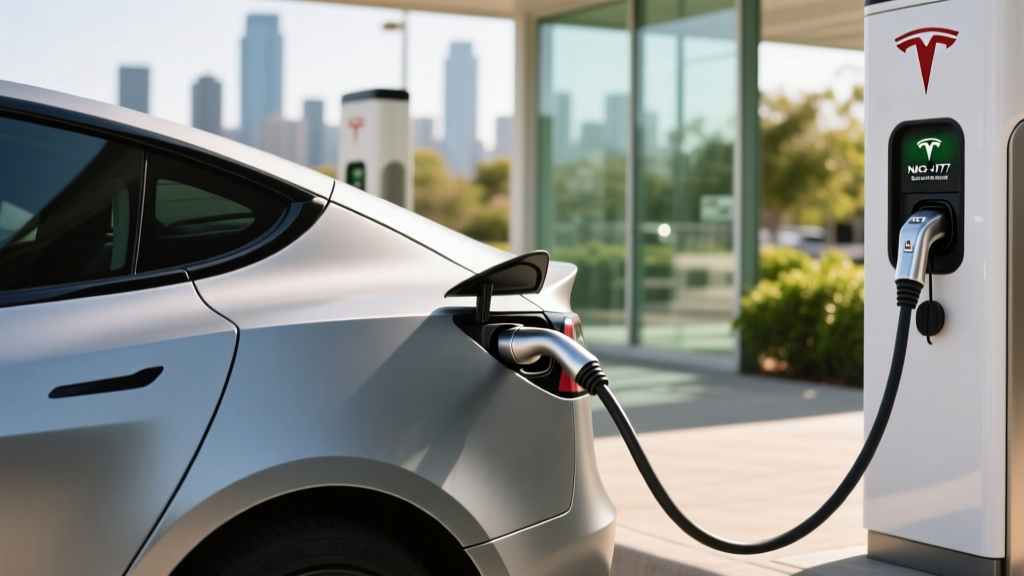
The 2026 Tesla Model S Long Range ships with the NACS (North American Charging Standard) connector — Tesla's proprietary design, now formally adopted as the North American standard by SAE. This means native compatibility with the entire Tesla Supercharger network (over 25,000 stalls in North America as of 2026) without any adapter.
The broader charging landscape has shifted dramatically. Ford, GM, Rivian, Volvo, and most major automakers have transitioned to NACS for their 2025–2026 models. CCS1-equipped vehicles (older Ford Mustang Mach-E, Hyundai Ioniq 5, VW ID.4) now require a CCS-to-NACS adapter to access Superchargers. CHAdeMO is effectively obsolete for new vehicles in North America, with only the Nissan Leaf still carrying the connector.
| Connector Type | Native Support? | Adapter Needed? | Network Access |
|---|---|---|---|
| NACS (Tesla) | Yes — native | None | Tesla Superchargers, Destination Chargers, most new public stations |
| CCS1 | With adapter | Tesla CCS Adapter (~$250) or third-party | Electrify America, EVgo, ChargePoint DC stations |
| CHAdeMO | No | Not available | Legacy network — avoid relying on this |
| J1772 (Level 2 AC) | With adapter | Tesla J1772 Adapter (included with vehicle) | Public Level 2 stations, non-Tesla workplace chargers |
For Model S owners, the included J1772 adapter covers virtually all public Level 2 stations. The optional Tesla CCS adapter opens access to Electrify America and other CCS networks — useful as a backup on road trips through areas with sparse Supercharger coverage. We recommend keeping both adapters in the frunk.
Charging Times: 10–80% Benchmarks for the Model S Long Range
Charging speed is not linear. Lithium-ion batteries accept charge fastest at low states of charge and taper as they fill — a phenomenon called the charge curve. The 250 kW peak rate on a V3 Supercharger is sustained only roughly between 10–30% SoC; above 50%, the rate drops substantially. This is why the industry standard benchmark is 10–80%, not 0–100%.
Level 1 (120V, 1.4 kW): 10–80% in ~50 hours (not practical for full recharge)
Level 2 (240V, 11.5 kW / 48A): 10–80% in ~6.5 hours
Level 2 (240V, 7.7 kW / 32A): 10–80% in ~9.5 hours
DC Fast — V3 Supercharger (250 kW peak): 10–80% in ~27–32 minutes
DC Fast — Electrify America (150 kW peak, with CCS adapter): 10–80% in ~40–45 minutes
The 27–32 minute DC fast-charge window assumes ideal conditions: battery preconditioned (the Model S does this automatically when you navigate to a Supercharger), ambient temperature above 50°F, and a V3 stall not sharing power with adjacent vehicles. In cold weather (below 32°F), expect 10–80% times to stretch to 35–45 minutes even with preconditioning, as the battery management system limits charge rate to protect the cells.
For daily home charging, the math is simpler. If you drive 40 miles per day (well above the US average of ~37 miles per fueleconomy.gov data), you've consumed roughly 13 kWh. At 11.5 kW, that replenishes in just over an hour. Most owners plug in nightly and wake to a full charge — the "gas station" becomes your garage.
Cost to Charge: Per-Mile Economics vs. Gasoline
The cost advantage of electricity over gasoline is one of the strongest ownership arguments for the Model S Long Range, but the savings vary enormously depending on where and when you charge.
| Scenario | Rate ($/kWh) | Cost for 10–80% (~70 kWh) | Cost per Mile (≈280 mi added) |
|---|---|---|---|
| Home — Off-Peak (Time-of-Use) | $0.08–$0.12 | $5.60–$8.40 | $0.02–$0.03/mi |
| Home — Standard Rate (US avg) | $0.16–$0.18 | $11.20–$12.60 | $0.04–$0.045/mi |
| Tesla Supercharger (avg 2026) | $0.28–$0.36 | $19.60–$25.20 | $0.07–$0.09/mi |
| Electrify America / Third-Party DC | $0.32–$0.48 | $22.40–$33.60 | $0.08–$0.12/mi |
For comparison, a gasoline sedan averaging 28 MPG combined on $3.50/gallon fuel costs about $0.125 per mile. The Model S Long Range charged at home on off-peak rates costs roughly $0.025 per mile — an 80% reduction. Even on Superchargers, the per-mile cost is 30–50% below gasoline.
Annual savings depend on mileage and charging mix. A driver covering 12,000 miles per year, charging 80% at home (off-peak) and 20% on Superchargers, would spend roughly $420/year on electricity versus $1,500 on gasoline — saving over $1,000 annually. Over five years, that's $5,000+ in fuel savings, partially offsetting the Model S's premium purchase price.
Check whether your utility offers a dedicated EV rate or time-of-use plan. Many utilities (PG&E, SCE, ConEdison, Xcel Energy) offer off-peak rates as low as $0.06–$0.10/kWh for overnight charging, dramatically reducing operating costs.
Recommended Home Charging Equipment for the Model S Long Range
The 2026 Model S Long Range accepts up to 11.5 kW on Level 2 AC, which means you want a charger capable of delivering at least 48 amps to maximize charge speed. Here are three proven options spanning Tesla's own hardware and top third-party units.
Power Output: 11.5 kW (48A)
Connector: NACS (native)
Cable Length: 24 ft
Smart Features: Wi-Fi, OTA updates, load sharing with multiple units, Power Sharing
Price: ~$475
Verdict: Best default choice for Tesla owners. Seamless integration, fastest Level 2 speed the Model S can accept, and clean aesthetics.
Power Output: Up to 12 kW (50A, configurable down to 16A)
Connector: NACS (2025+ models) or J1772 with adapter
Cable Length: 23 ft
Smart Features: Wi-Fi, app scheduling, energy tracking, Alexa integration
Price: ~$550–$650
Verdict: Best if you own or plan to own a non-Tesla EV alongside the Model S. Flexible amperage lets you match your circuit capacity.
Power Output: Up to 11.5 kW (48A)
Connector: NACS or J1772
Cable Length: 24 ft
Smart Features: Wi-Fi, solar integration, real-time energy monitoring, load management
Price: ~$400–$500
Verdict: Best value pick with excellent app features and solar-aware charging for homes with rooftop panels.
For any of these units, we recommend hardwiring rather than using a NEMA 14-50 plug. Hardwired installations eliminate a potential failure point (loose outlet connections are a known cause of charger-related fires), avoid the NEC GFCI breaker requirement for receptacles, and allow the full 48A output. A NEMA 14-50 outlet limits you to 40A continuous (9.6 kW) and requires a $60–$100 GFCI breaker.
Safety, Code, and Best Practices
EV charging involves sustained high-current draw — far more demanding than typical household appliances. Cutting corners on installation creates fire risk. Key safety considerations:
- Dedicated circuit: Your Level 2 charger must have its own dedicated breaker. Never share a circuit with other high-draw appliances (dryer, range, HVAC).
- GFCI protection: Required for receptacle-based (plug-in) chargers per NEC 2020 and later. Hardwired units with internal ground-fault protection may satisfy this requirement — confirm with your electrician and local inspector.
- Outdoor rating: If your charger is installed outdoors (driveway, carport), ensure it carries a NEMA 4 or IP65 weather rating. All three units recommended above are outdoor-rated.
- Cable management: Use a wall-mounted holster or cable organizer to prevent tripping hazards and protect the cable from abrasion and UV degradation.
- Surge protection: A whole-home surge protector ($150–$300 installed) safeguards the charger's electronics from lightning and grid transients — particularly important in storm-prone regions.
- Inspection: After installation, your local electrical inspector should verify the work before you energize the circuit. Most permits require this, and skipping it can void homeowner's insurance coverage for electrical fires.
Frequently Asked Questions
How much does it cost to install a home EV charger for the 2026 Tesla Model S?
A straightforward installation (panel nearby, adequate capacity) costs $850–$1,750 including the Tesla Wall Connector, electrician labor, materials, and permit. Complex installations requiring a panel upgrade, long wire runs, or trenching can reach $3,100–$7,250. Always get multiple quotes from licensed electricians.
How fast will each charging level add range to the Model S Long Range?
Level 1 (120V): approximately 4–6 miles per hour. Level 2 (240V, 48A): approximately 35 miles per hour. DC fast charging on a V3 Supercharger: up to 200 miles in 15 minutes at peak rate, tapering as the battery fills. For context, the Model S Long Range achieves roughly 3.0 miles per kWh, which determines these conversions.
Which connector and charger is compatible with my 2026 Model S Long Range?
The 2026 Model S Long Range uses the NACS connector natively. It is directly compatible with the entire Tesla Supercharger and Destination Charger network. For CCS-based public DC chargers (Electrify America, EVgo), you'll need the optional Tesla CCS adapter. For J1772 Level 2 public stations, the included J1772 adapter works seamlessly.
How much does charging cost per mile compared to gasoline?
At home on off-peak electricity ($0.10/kWh), the Model S Long Range costs roughly $0.03 per mile. On Superchargers ($0.32/kWh average), it's about $0.08 per mile. A comparable gasoline sedan at 28 MPG on $3.50/gallon costs $0.125 per mile. Home charging delivers the largest savings — up to 75–80% less per mile than gasoline. For more on EV efficiency ratings, see the EPA's fuel economy technology guide.
What electrical upgrades might I need for a Level 2 charger?
The most common upgrade is a panel capacity increase from 100A to 200A service, which costs $1,500–$3,500 and is necessary if your existing panel is near its load limit. Other potential upgrades include: replacing a Federal Pacific or Zinsco panel (known safety hazards, $2,000–$4,000 to replace), adding a sub-panel in a detached garage ($500–$1,500), or upgrading the meter socket if your utility requires it for higher amperage service. A licensed electrician's load calculation will determine exactly what's needed.
Does the 2026 Model S Long Range qualify for the federal EV tax credit?
The 2026 Tesla Model S Long Range is subject to the IRS §30D clean vehicle credit rules, which include buyer income caps ($150,000 single / $300,000 joint), an MSRP cap of $55,000 for sedans (the Model S exceeds this at ~$79,990), and battery component/critical mineral sourcing requirements. As of 2026, the Model S does not qualify for the $7,500 federal credit due to the sedan MSRP cap. Always verify current eligibility on the IRS qualified vehicles page, as rules are subject to change.
Should I precondition the battery before DC fast charging?
Yes — and the Model S handles this automatically. When you set a Supercharger as your navigation destination, the vehicle's thermal management system begins warming (or cooling) the battery to its optimal charging temperature, typically 20–30 minutes before arrival. This can shave 5–10 minutes off a 10–80% session, especially in cold weather. Never skip navigation-based preconditioning if fast-charging speed matters to you.