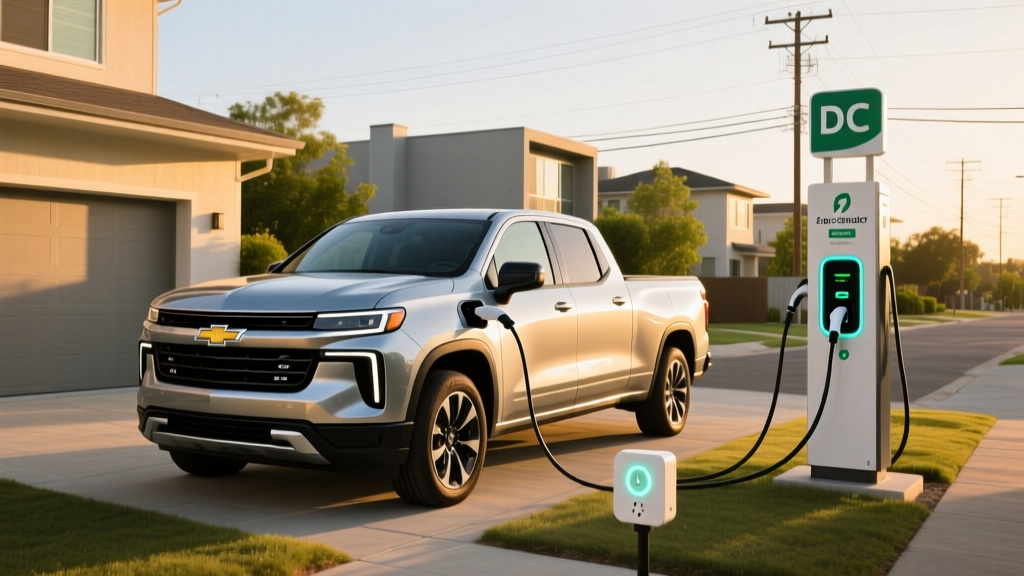
The 2026 Chevrolet Silverado EV e4WD Crew Cab with the Max Range battery is one of the largest and most capable electric pickups on the market — but keeping its massive battery pack full requires a deliberate charging strategy. With an EPA-estimated 440 miles of range and a usable battery capacity exceeding 200 kWh (GM's Ultium platform uses NMC chemistry), this truck demands robust Level 2 infrastructure at home and benefits enormously from DC fast-charging capability on the road. Whether you're a first-time EV buyer or adding the Silverado EV to an existing electric fleet, this guide covers exactly what you need to charge it efficiently, safely, and cost-effectively.
Understanding Charging Levels: Level 1, Level 2, and DC Fast Charging
Electric vehicle charging happens at three distinct levels, each defined by power output — measured in kilowatts (kW). This is fundamentally different from kilowatt-hours (kWh), which measures the total energy stored in the battery. Think of kW as the speed of water flowing through a hose, and kWh as the total volume of the bucket. The Silverado EV's Max Range pack holds roughly 200+ kWh of usable energy, so the charge rate in kW determines how long filling that bucket takes.
| Level | Voltage / Amperage | Max Power (kW) | Miles of Range Added per Hour | Best Use Case |
|---|---|---|---|---|
| Level 1 (120V) | 120V / 12A | ~1.4 kW | ~3–4 miles/hr | Emergency overnight trickle |
| Level 2 (240V) | 240V / 48A | ~11.5 kW | ~30–34 miles/hr | Daily home charging |
| Level 2 (240V High) | 240V / 80A | ~19.2 kW | ~50–55 miles/hr | Fast home / fleet depot |
| DC Fast Charge | 400V+ architecture | Up to ~350 kW (peak) | ~700+ miles/hr (at peak) | Road trips, rapid top-ups |
At Level 1 (a standard household outlet), you'd add roughly 30–40 miles overnight — barely enough to offset a short commute in a truck this heavy. Level 2 at home is essential for daily usability. On DC fast charging, the Silverado EV's Ultium platform supports peak rates up to approximately 350 kW on compatible chargers, though sustained rates taper significantly above 80% state of charge (SoC). Expect a 10–80% charge in roughly 30–40 minutes at a 350 kW-capable station, assuming optimal battery preconditioning.
Home Charger Installation: Electrical Requirements and Costs
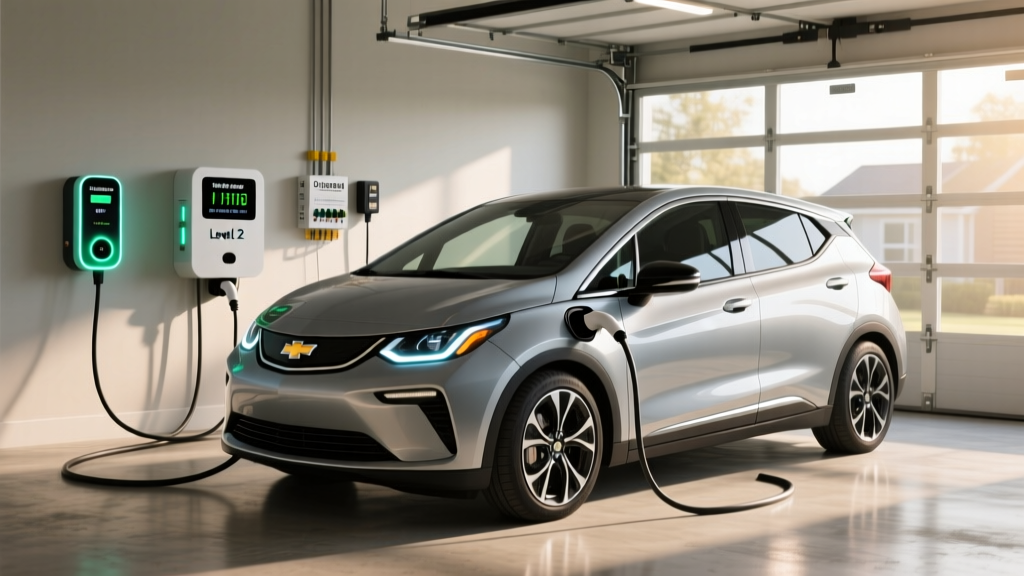
The Silverado EV's onboard charger accepts up to 19.2 kW on Level 2 (80 amps at 240 volts). To take full advantage, you'll need a dedicated 100-amp circuit with a hardwired EVSE (Electric Vehicle Supply Equipment) unit. Most homes, however, install a 60-amp circuit supporting 48 amps of continuous charge — delivering 11.5 kW, which adds roughly 30–34 miles per hour and fully replenishes the Max Range battery in about 18–20 hours from empty.
Electrical Panel and Circuit Requirements
Before installation, a licensed electrician will assess:
- Panel capacity: Most modern homes have 200-amp service panels. Adding a 60A EV circuit may require a panel upgrade to 300–400 amps if your existing panel is near capacity — common in older homes or those with electric heating, dryers, and ranges.
- Dedicated circuit: The EVSE requires its own breaker — never shared with other appliances.
- Wire gauge: A 60A circuit typically requires 4 AWG copper wire; an 80A circuit requires 2 AWG or larger.
- GFCI protection: The National Electrical Code (NEC) requires Ground Fault Circuit Interrupter protection for EV outlets, particularly outdoors. Hardwired units often include built-in GFCI.
- Permit: Nearly all jurisdictions require an electrical permit for EVSE installation, typically $50–$200 depending on your municipality.
| Component | Simple Install (Near Panel) | Complex Install (Panel Upgrade + Long Run) |
|---|---|---|
| EVSE Equipment (Level 2, 48A–80A) | $500–$800 | $600–$1,200 |
| Electrician Labor | $400–$800 | $1,500–$3,500 |
| Electrical Permit | $50–$100 | $100–$250 |
| Panel Upgrade (if needed) | $0 | $2,000–$5,000 |
| Conduit, Wire, Misc. | $100–$300 | $400–$1,000 |
| Total Estimated Range | $1,050–$2,000 | $4,600–$10,950 |
For a simple garage install where the panel is nearby and has spare capacity, expect to pay roughly $1,200–$2,000 total. For homes needing a panel upgrade, a long wire run through walls or underground, or an outdoor-rated pedestal mount, costs can climb to $5,000–$11,000. Always get at least three quotes from licensed electricians and confirm they include permit costs. Some utilities offer rebates of $250–$1,000 for Level 2 installations — check with your local provider.
Connector Compatibility: NACS, CCS, and Adapter Options
For 2026, Chevrolet has transitioned the Silverado EV to the North American Charging Standard (NACS) connector — the same connector Tesla uses. This is a significant advantage, as it grants native access to the Tesla Supercharger network, which remains the most reliable and extensive DC fast-charging network in the United States with over 25,000 stalls nationwide.
| Connector Standard | Native Support? | Adapter Needed? | Networks Accessible |
|---|---|---|---|
| NACS (Tesla) | Yes — native | None | Tesla Supercharger, Electrify America (NACS stalls), Rivian Adventure Network |
| CCS1 | No (as of 2026) | NACS-to-CCS adapter (~$200–$300) | Electrify America (CCS stalls), EVgo, ChargePoint DC |
| CHAdeMO | No | Rare; not recommended | Limited legacy stations — largely deprecated |
| J1772 (Level 2 public) | No — NACS port | J1772-to-NACS adapter (often included) | Public Level 2 stations (ChargePoint, Blink, etc.) |
Chevrolet typically includes a J1772-to-NACS adapter with the vehicle for public Level 2 compatibility. For CCS1 DC fast chargers still in the field, a third-party NACS-to-CCS adapter from an authorized supplier is recommended. Always verify adapter UL certification before purchasing. According to Chevrolet's EV portal, the Silverado EV is designed for full Supercharger network compatibility without adapters starting with the 2025 model year, continuing into 2026.
Charging Cost Per Mile: EV vs. Gas Truck Comparison
The economic case for the Silverado EV hinges on electricity costs versus gasoline. Here's how the numbers break down across common charging scenarios, based on national averages in early 2026:
| Scenario | Cost per kWh / Gallon | Cost per Mile | Annual Cost (15,000 mi) |
|---|---|---|---|
| Home charging (off-peak utility rate) | $0.12/kWh | ~$0.04 | ~$600 |
| Home charging (average US rate) | $0.17/kWh | ~$0.057 | ~$855 |
| Public Level 2 (network pricing) | $0.30/kWh | ~$0.10 | ~$1,500 |
| DC Fast Charging ( Electrify America / EVgo) | $0.48/kWh | ~$0.16 | ~$2,400 |
| Gas Silverado 1500 4WD (19 MPG combined) | $3.40/gal | ~$0.18 | ~$2,700 |
The Silverado EV's efficiency is approximately 3.0–3.4 kWh per mile (roughly 100–113 MPGe combined, per fueleconomy.gov). At home off-peak rates, you'll pay roughly 4 cents per mile — a quarter of what a comparable gas Silverado costs. Even relying heavily on public DC fast charging, the EV can still undercut gasoline. However, if you exclusively use expensive public chargers without any home charging access, the savings narrow considerably. Home charging is where the economics truly work.
Recommended Home Charging Equipment for the Silverado EV
Given the Silverado EV's large battery, we recommend Level 2 chargers that deliver at least 48 amps (11.5 kW) and ideally up to 80 amps (19.2 kW) to minimize overnight charge times. Here are top picks for 2026:
ChargePoint Home Flex (NACS)
- Power: Up to 19.2 kW (80A) on a 100A circuit; configurable down to 16A
- Connector: NACS native (2025+ models)
- Cable Length: 23 feet
- Smart Features: Wi-Fi, app scheduling, Alexa integration, energy tracking
- Price: ~$650–$750
- UL Listed: Yes
Tesla Wall Connector (NACS)
- Power: Up to 19.2 kW (80A) on a 100A circuit
- Connector: NACS native
- Cable Length: 24 feet
- Smart Features: Wi-Fi, OTA updates, power-sharing with second unit, load management
- Price: ~$450–$550
- UL Listed: Yes
Emporia Vue Level 2 Charger
- Power: Up to 11.5 kW (48A) on a 60A circuit
- Connector: NACS (2025+ models) or J1772 with adapter
- Cable Length: 24 feet
- Smart Features: Whole-home energy monitoring integration, solar-aware scheduling, app control
- Price: ~$400–$500
- UL Listed: Yes
For the Silverado EV's large battery, the ChargePoint Home Flex or Tesla Wall Connector at 80 amps is ideal — both can add roughly 50–55 miles of range per hour, replenishing the Max Range pack from 20% to 80% in about 10–12 hours overnight. The Emporia is a strong budget pick for homes with 60-amp circuits, though charging the full pack will take closer to 18–20 hours.
Safety, Electrical Code, and Installation Best Practices
EV charging involves sustained high-current draw — often for 8–12 hours continuously. This places demands on your electrical system that differ from typical household loads. Key safety and code requirements include:
- Dedicated circuit: NEC Article 625 requires EVSE to be on its own dedicated branch circuit. Never share a circuit with other loads.
- Continuous load derating: EV charging is classified as a continuous load, meaning the circuit must be rated for 125% of the charger's maximum draw. A 48A charger requires a 60A breaker; an 80A charger requires a 100A breaker.
- GFCI protection: Required for all receptacle-based EVSE installations. Hardwired units with integrated ground-fault protection may not require an additional GFCI breaker, but local codes vary — confirm with your inspector.
- Outdoor rating: If installing outdoors, the EVSE must carry a NEMA 4 or NEMA 4X rating for weather resistance. All outdoor receptacles require weatherproof covers.
- Cable management: Avoid running charging cables across driveways or walkways. Use cable retractors, hooks, or conduit runs to prevent trip hazards and cable damage.
- Ventilation: While the Silverado EV's battery is sealed, indoor charging areas should have adequate airflow, particularly in enclosed garages.
Always hire a licensed electrician familiar with NEC Article 625 and EVSE installations. Pull a permit — unpermitted work can void insurance coverage and create resale issues. Many states also offer tax credits or rebates for EV charger installation; check IRS.gov for the §30D residential energy credit and your state energy office for local programs.
DC Fast Charging on the Road: Networks and Charge Curve Reality
The Silverado EV's Ultium battery architecture supports DC fast charging at peak rates up to approximately 350 kW. However, peak rate is not sustained rate — understanding the charge curve is critical for road-trip planning.
At a 350 kW-capable station (like Electrify America's latest Hyperchargers or Tesla V4 Superchargers), the Silverado EV will:
- Ramp quickly to peak power between 10–30% SoC
- Sustain roughly 250–300 kW from 30–50% SoC
- Begin tapering above 55–60% SoC, dropping to ~150 kW by 70%
- Slow further to ~50–75 kW above 80% SoC
This means a 10–80% charge takes approximately 30–40 minutes under ideal conditions, but charging from 80–100% can add another 40+ minutes. For road trips, plan to charge from 10–80% and drive on — the last 20% is painfully slow due to lithium-ion charge-curve physics. Battery preconditioning (the truck automatically warming the pack when you navigate to a charger) is essential for achieving peak rates, particularly in cold weather.
The NACS connector gives the Silverado EV native access to Tesla's Supercharger network — widely regarded as the most reliable public charging network with uptime exceeding 95%. Combined with Electrify America's expanding NACS deployment and EVgo's urban coverage, Silverado EV owners have one of the broadest DC fast-charging access profiles of any non-Tesla EV.
Frequently Asked Questions
How much does it cost to install a home EV charger for the Silverado EV?
For a straightforward garage install near your electrical panel with spare capacity, expect $1,200–$2,000 total (equipment, labor, and permit). If your home needs a panel upgrade, a long wire run, or outdoor mounting, costs range from $4,600–$11,000. Get multiple quotes and check for utility rebates that can offset $250–$1,000.
How fast will each charging level add range to the Silverado EV Max Range?
Level 1 (120V) adds roughly 3–4 miles per hour — impractical for daily use. Level 2 at 48 amps (11.5 kW) adds 30–34 miles per hour, replenishing the battery overnight. Level 2 at 80 amps (19.2 kW) adds 50–55 miles per hour. DC fast charging at peak rates can add 200+ miles in 15–20 minutes, though rates taper significantly above 80% SoC.
Which connector does the 2026 Silverado EV use?
The 2026 Silverado EV uses the NACS (North American Charging Standard) connector natively, providing direct access to Tesla Superchargers and an expanding number of NACS-equipped public stations. For older CCS1 chargers, a NACS-to-CCS adapter is needed. A J1772-to-NACS adapter is typically included for public Level 2 stations.
How much does charging the Silverado EV cost per mile compared to gas?
At home off-peak rates ($0.12/kWh), the Silverado EV costs roughly $0.04 per mile — about 75% less than a gas Silverado 1500 at $3.40/gallon and 19 MPG combined ($0.18/mile). Even at public DC fast-charging rates ($0.48/kWh), the EV costs roughly $0.16/mile — still cheaper than gasoline. Home charging is essential to maximize savings.
What electrical upgrades might my home need for a Level 2 charger?
The most common upgrade is a panel capacity increase from 200A to 300–400A, costing $2,000–$5,000. You may also need a new dedicated circuit with appropriate wire gauge (4 AWG for 60A, 2 AWG for 100A), a new breaker, and possibly conduit runs. Older homes with knob-and-tube wiring or Federal Pacific panels will require more extensive upgrades. A licensed electrician can assess your specific needs during a site visit.
Does the 2026 Silverado EV qualify for the federal tax credit?
Federal §30D tax credit eligibility depends on MSRP caps ($80,000 for trucks/vans/SUVs), buyer income limits ($150,000 single / $300,000 joint AGI), and battery component and critical mineral sourcing requirements that tighten annually. The credit can be applied as a point-of-sale rebate at the dealer. Because sourcing rules change yearly, verify current eligibility on IRS.gov and consult a tax professional before finalizing your purchase.