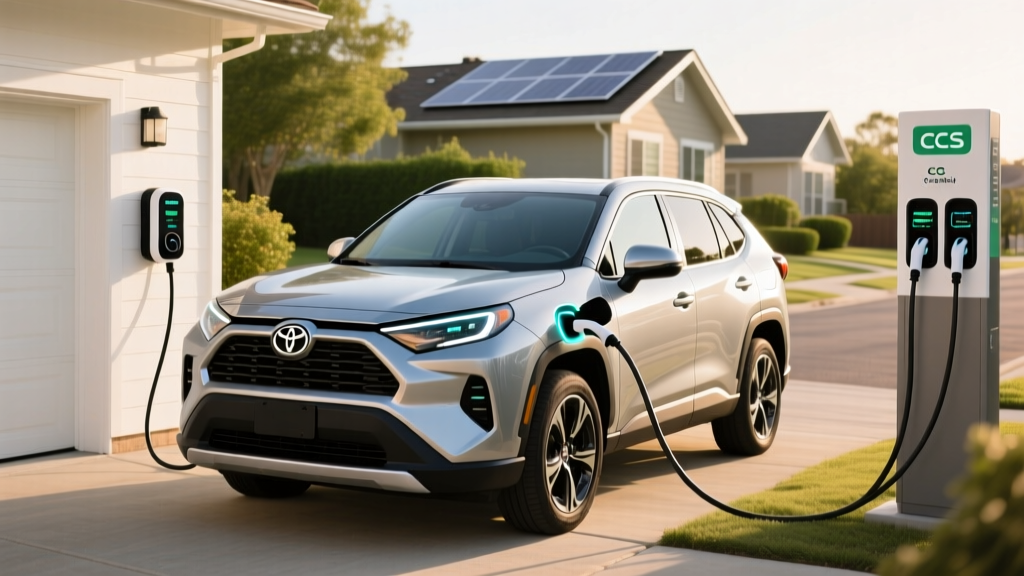
The 2026 Toyota RAV4 Plug-In Hybrid (formerly Prime) pairs a 18.1 kWh lithium-ion battery with a 2.5-liter hybrid powertrain, delivering an EPA-estimated 42 miles of electric-only range and 302 combined horsepower. But that impressive 2026 RAV4 plug-in hybrid range is only useful if you can reliably recharge it. A standard 120V wall outlet adds roughly 3 miles of range per hour — meaning a full recharge takes overnight and then some. A properly installed 240V Level 2 station cuts that to about 2.5 hours, making daily electric-only commuting practical.
This guide walks through exactly what you need to charge a RAV4 PHEV at home and on the road, with real numbers for install costs, charging speeds, and per-mile electricity costs compared to gasoline.
Understanding the RAV4 PHEV Battery and Charging Limits
Before selecting equipment, you need to know the vehicle's constraints. The 2026 RAV4 PHEV uses an 18.1 kWh battery pack (approximately 14.4 kWh usable to preserve longevity buffers). The onboard charger maxes out at 6.6 kW on Level 2 AC power. This means even if you install a 48-amp, 11.5 kW home charger, the RAV4 will only draw 6.6 kW. You won't damage anything — the car simply limits the draw — but you won't gain speed from oversizing the station beyond 32 amps.
Battery: 18.1 kWh total / ~14.4 kWh usable
Onboard charger: 6.6 kW max (AC Level 2)
EV-only range: 42 miles (EPA); expect 35–38 mi highway, 30–34 mi in freezing weather
Charge port: J1772 (AC); no DC fast charging capability
Combined MPGe: 94 MPGe (electric + gas); 38 MPG combined (gas only)
A critical point often missed: the RAV4 PHEV cannot DC fast charge. There is no CCS or CHAdeMO inlet. All charging happens via AC — Level 1 (120V) or Level 2 (240V). This is typical for PHEVs with smaller batteries; DC fast infrastructure is reserved for full battery-electric vehicles with packs above 50 kWh.
Charging Levels Explained: Speeds, kW, and Miles Per Hour
EV charging is categorized into three levels. Here's how each applies to the RAV4 PHEV specifically:
| Level | Voltage / Amps | Power (kW) | Miles of Range Added/Hour | 0–100% Time (RAV4 PHEV) |
|---|---|---|---|---|
| Level 1 | 120V / 12A | ~1.4 kW | ~3 mi/hr | ~12–14 hours |
| Level 2 | 240V / 32A | 6.6 kW (car-limited) | ~16 mi/hr | ~2.5 hours |
| DC Fast | N/A | N/A | N/A | Not supported |
kW vs. kWh — the essential distinction: kW (kilowatts) measures power — the rate of energy flow, like water pressure from a hose. kWh (kilowatt-hours) measures energy — the total amount stored or delivered, like gallons in a bucket. The RAV4 PHEV has an 18.1 kWh battery. Charging at 6.6 kW means you add 6.6 kWh of energy per hour (minus ~10% efficiency losses). A Level 1 outlet at 1.4 kW adds only 1.4 kWh per hour.
For RAV4 PHEV owners, Level 2 at home is the practical minimum for daily electric-only driving. If your round-trip commute is 30 miles, Level 1 technically works (10 hours of charging adds ~30 miles), but only if you plug in the moment you arrive home and don't need the car again until morning. Level 2 gives you margin for detours, preconditioning, and cold-weather range loss.
Home Charger Installation: Electrical Requirements and Costs
Installing a Level 2 home charger involves three cost components: the charging equipment, electrical labor, and permits. The total varies dramatically based on your home's electrical panel and the distance from panel to parking spot.
Electrical Requirements for the RAV4 PHEV
Since the RAV4 caps at 6.6 kW, you need a 240V circuit rated for at least 32 amps (EVs require circuits rated 125% above continuous draw, so a 32A charge rate needs a 40A breaker). A NEMA 14-50 outlet or hardwired connection both work. If you want future-proofing for a battery-electric vehicle down the road, installing a 48A-capable circuit (60A breaker) adds modest cost now and saves a rewire later.
Panel capacity check: Most modern homes have 200A electrical panels. Adding a 40A EV circuit consumes 20% of total panel capacity — usually fine if you don't already have electric heat, a hot tub, and a double oven running simultaneously. Older homes with 100A or 150A panels may need a panel upgrade, which is the single largest variable in installation cost.
| Component | Simple Install (panel nearby, no upgrade) | Complex Install (long run, panel upgrade) |
|---|---|---|
| Level 2 charger (32–48A) | $350–$700 | $350–$700 |
| Electrician labor (240V circuit) | $400–$800 | $1,200–$2,500 |
| Permit & inspection | $50–$200 | $100–$300 |
| Panel upgrade (if needed) | $0 | $1,500–$3,500 |
| Total | $800–$1,700 | $3,150–$7,000 |
The wide range reflects real-world variation. A homeowner with a 200A panel and a garage outlet 15 feet from the panel might spend $1,000 total. Someone with a 100A panel in a 1960s home, needing a 200A upgrade and a 60-foot conduit run to a detached carport, could see $5,000+. Always get at least two quotes from licensed electricians and confirm they pull permits — unpermitted work can void home insurance claims.
Safety and Code Requirements
The National Electrical Code (NEC) requires:
- Dedicated circuit: Your EV charger must have its own breaker — no sharing with other appliances.
- GFCI protection: 2023 NEC update requires ground-fault circuit interrupter protection for all EV supply equipment, including hardwired units (previously only required for plug-in receptacles).
- Outdoor rating: If your charger mounts outside, it must carry a NEMA 4 or NEMA 4X rating for weather resistance.
- Cable management: NEC 625 requires the cord not drape across walkways; a retractable reel or wall hook satisfies this.
Connector Compatibility: What Plugs Into a RAV4 PHEV
The 2026 RAV4 PHEV uses the J1772 connector for AC charging — the universal North American standard for Level 1 and Level 2. This is the round, five-pin connector that every non-Tesla EV and PHEV has used for over a decade.
| Connector | Type | RAV4 PHEV Compatible? | Notes |
|---|---|---|---|
| J1772 | AC (L1/L2) | ✅ Native | Standard on all RAV4 PHEV trims |
| NACS (Tesla) | AC/DC | ❌ No adapter needed for AC; no DC capability | RAV4 has no DC inlet; Tesla Destination Chargers with J1772 cables work |
| CCS1 | DC Fast | ❌ Not supported | No DC fast charging on PHEV |
| CHAdeMO | DC Fast | ❌ Not supported | No DC fast charging on PHEV |
Because the RAV4 PHEV only charges on AC, the ongoing NACS-vs-CCS connector war doesn't affect you. Any Level 2 station with a J1772 plug works. Most public Level 2 chargers (ChargePoint, Blink, EVgo L2 stations) still provide J1772 connectors. If you buy a Tesla Wall Connector for home — which uses the NACS plug natively — you'd need a Tesla-to-J1772 adapter (~$50–$100) to charge the RAV4. The simpler path: buy a J1772-native charger.
Level 2 Charger Recommendations for the RAV4 PHEV
Since the RAV4 caps at 6.6 kW (32 amps), any quality 32A charger fully saturates its onboard charger. Going to 40A or 48A costs more but future-proofs for a BEV. Here are three proven options across price points:
Emporia Vue Link (Budget Pick)
- Power: 48A / 11.5 kW max (RAV4 draws 6.6 kW)
- Connector: J1772
- Cable: 24 ft
- Smart features: Wi-Fi, app scheduling, energy monitoring, solar integration
- Price: ~$399
- Install type: Hardwire or NEMA 14-50 plug
Best value on the market. The energy monitoring pairs with the Emporia home panel monitor for whole-home visibility.
ChargePoint Home Flex (Best Overall)
- Power: Up to 50A / 12 kW (configurable via DIP switches)
- Connector: J1772
- Cable: 23 ft
- Smart features: Wi-Fi, Alexa/Google, scheduled charging, utility TOU integration
- Price: ~$699
- Install type: NEMA 14-50 or hardwire
Reliable, well-supported app, adjustable amperage lets you match your circuit exactly. UL-listed and Energy Star certified.
Tesla Wall Connector (Future-Proof Pick)
- Power: 48A / 11.5 kW max
- Connector: NACS (requires J1772 adapter for RAV4)
- Cable: 24 ft
- Smart features: Wi-Fi, power sharing (link up to 6 units), OTA updates
- Price: ~$475 + adapter
- Install type: Hardwire only
Excellent hardware, but the NACS connector means an adapter for the RAV4. Choose this if you plan to add a Tesla or other NACS-equipped BEV later.
Cost to Charge: Electricity vs. Gasoline Per Mile
The economic case for a PHEV hinges on how cheaply you charge at home versus what you'd spend on gas. Here's the math for the RAV4 PHEV's 42-mile electric range:
| Scenario | Rate | Cost for 42 mi (EV mode) | Cost Per Mile |
|---|---|---|---|
| Home off-peak (utility TOU) | $0.09/kWh | $1.30 | $0.031/mi |
| Home standard rate | $0.16/kWh | $2.31 | $0.055/mi |
| Public Level 2 (ChargePoint, etc.) | $0.30/kWh | $4.33 | $0.103/mi |
| Gas only (38 MPG, $3.50/gal) | $3.50/gallon | $3.87 | $0.092/mi |
The takeaway: Home charging on off-peak rates costs about one-third of gasoline per mile. Even at standard residential rates, electricity undercuts gas. But public Level 2 charging at $0.30/kWh actually costs more per mile than gas in the RAV4's efficient hybrid mode. This is why home charging is essential to PHEV economics — relying on public charging erases the fuel-cost advantage.
Over a year of 12,000 miles with 70% electric driving (plugging in nightly), a RAV4 PHEV owner spending $0.12/kWh at home and $3.50/gal for the remaining 30% on gas would spend roughly $900 on energy. A comparable gas-only RAV4 at 30 MPG combined would spend about $1,400. That's $500/year in fuel savings, with the gap widening as gas prices rise.
Public Charging: When and Where to Plug In a PHEV
The RAV4 PHEV's lack of DC fast charging means public charging is a Level 2 affair — useful for topping up while parked at work, a shopping center, or a hotel, but not for quick roadside stops. At a typical 7.2 kW public Level 2 station, expect to add roughly 18 miles of range per hour parked.
Practical public-charging strategy for PHEV owners:
- Workplace charging is the highest-value public option — 8 hours parked at 6.6 kW fully recharges the battery for the drive home.
- Destination charging (hotels, malls) provides modest top-ups; don't plan trips around it.
- Avoid DC fast chargers — you physically can't plug in, and even if an adapter existed, the RAV4's small battery doesn't benefit from 150+ kW speeds.
- Apps to use: PlugShare and ChargePoint show real-time availability, pricing, and connector types for Level 2 stations near you.
Federal Tax Credit and Incentives for Home Charger Installation
The Alternative Fuel Vehicle Refueling Property Credit (IRS Form 8911) covers 30% of home EV charger equipment and installation costs, up to $1,000. This applies to the 2026 tax year, but with a significant caveat: the credit is only available in census tracts classified as "low-income" or "non-urban" under current IRS guidance. Many suburban and urban tracts are excluded.
Frequently Asked Questions
How much does it cost to install a home EV charger for the RAV4 PHEV?
A straightforward installation — 200A panel, short conduit run, no upgrade — costs $800–$1,700 including a quality Level 2 charger, electrician labor, and permit. If your home needs a panel upgrade from 100A to 200A, expect $3,150–$7,000 total. Get multiple quotes and always require a permit.
How fast will each charging level add range to my RAV4 PHEV?
Level 1 (120V) adds about 3 miles per hour. Level 2 (240V at 32A) adds about 16 miles per hour, fully recharging the 42-mile battery in roughly 2.5 hours. The RAV4 PHEV does not support DC fast charging.
Which connector and charger are compatible with my RAV4 PHEV?
Any J1772 Level 2 charger works natively. This includes ChargePoint Home Flex, Emporia Vue Link, Grizzl-E, and most other mainstream home stations. If you choose a Tesla Wall Connector (NACS plug), you'll need a Tesla-to-J1772 adapter.
How much does charging cost per mile vs. gas?
At home on off-peak electricity ($0.09/kWh), the RAV4 PHEV costs about $0.03/mile in EV mode — roughly one-third the cost of gasoline at $3.50/gallon ($0.09/mile at 38 MPG). At standard residential rates ($0.16/kWh), EV mode costs $0.055/mile. Public Level 2 charging at $0.30/kWh is actually more expensive per mile than gas.
What electrical upgrades might I need?
If your home has a 200A panel with available capacity, you likely only need a new 40A breaker and a conduit run — no upgrade. Homes with 100A or 150A panels, or panels already near capacity (electric heat, hot tub, workshop), may need a panel upgrade to 200A or 400A, adding $1,500–$3,500. An electrician's load calculation determines this before any work begins.
Can I use the included Level 1 charging cord instead of installing Level 2?
Technically yes, but practically it's limiting. The Toyota-supplied Level 1 cord delivers ~1.4 kW, requiring 12–14 hours for a full charge. If you drive 30+ miles daily and can't guarantee 12 hours plugged in, you'll frequently start the day with an incomplete charge — meaning the engine kicks in and you burn gas for miles that could have been electric. Level 2 is a near-requirement for anyone serious about maximizing the RAV4 PHEV's electric range.