The 2026 Ford Mustang Mach-E arrives with revised battery options and a confirmed switch to the NACS charge port, eliminating the adapter dependency that frustrated early CCS owners. But whether you're charging the Standard Range or Extended Range battery at home or on the road, understanding how charging speed, connector type, and electrical infrastructure interact is what separates a seamless EV ownership experience from a frustrating one. This guide maps the exact 2026 Ford Mustang Mach-E range figures to the charging hardware and home electrical upgrades you'll need to keep it fueled.
2026 Mustang Mach-E Range & Battery Specs by Trim
Before sizing a charger, you need to know what you're filling. The 2026 Mach-E lineup uses two lithium-ion battery packs (NMC chemistry) with the following EPA-estimated range and usable capacity:
| Trim / Config | Battery (Usable kWh) | EPA Range | Real-World Highway | 0-60 mph | Base MSRP |
|---|---|---|---|---|---|
| Select RWD (SR) | 72 kWh | 250 mi | ~215-230 mi | 6.3 sec | $39,995 |
| Select AWD (SR) | 72 kWh | 230 mi | ~195-210 mi | 5.8 sec | $42,995 |
| Premium RWD (ER) | 91 kWh | 320 mi | ~270-290 mi | 5.9 sec | $46,995 |
| Premium AWD (ER) | 91 kWh | 295 mi | ~250-270 mi | 5.1 sec | $49,995 |
| GT (ER AWD) | 91 kWh | 280 mi | ~235-255 mi | 3.5 sec | $56,995 |
Charging Levels Explained: kW, Speed & Miles Per Hour
The single most important distinction in EV charging is between kW (kilowatts — the rate of power delivery, like water pressure from a hose) and kWh (kilowatt-hours — the total energy stored in the battery, like the size of the tank). A 72 kWh battery charged at 11.5 kW takes roughly 6.3 hours from 0-100%. Here's how each level performs on the 2026 Mach-E:
| Charging Level | Voltage / Amperage | Max Power (kW) | Miles of Range Added Per Hour | Best Use Case |
|---|---|---|---|---|
| Level 1 (120V Outlet) | 120V / 12A | ~1.4 kW | 3-5 mi/hr | Overnight top-off, emergencies |
| Level 2 (240V Home) | 240V / 40-48A | 9.6-11.5 kW | 25-35 mi/hr | Daily home charging |
| DC Fast Charging | 400V+ DC | 150 kW (peak) | ~150-200 mi in 20 min | Road trips, rapid top-ups |
On Level 1, fully recharging the Extended Range 91 kWh battery from empty would take roughly 65 hours — impractical for daily use. Level 2 is the realistic home standard. The Mach-E's onboard charger accepts up to 11.5 kW on Level 2 (48A), meaning a full charge of the 91 kWh pack takes approximately 8 hours — ideal for overnight replenishment.
For DC fast charging, the 2026 Mach-E peaks at approximately 150 kW on the Extended Range battery and around 115 kW on the Standard Range pack. Ford quotes a 10-80% charge time of roughly 30 minutes for the ER and 34 minutes for the SR at a capable station. Note that charge speed tapers significantly above 80% SoC — the last 20% can take as long as the first 60% due to battery protection protocols.
Home Charger Installation: Electrical Requirements & Costs
Installing a Level 2 home charger is the single highest-impact upgrade for Mach-E ownership. Here's what's involved electrically:
Circuit & Panel Requirements
A 48A charger requires a dedicated 60A circuit (the National Electrical Code requires circuits to be rated at 125% of continuous load). A 40A charger needs a 50A circuit. Most modern homes with 200A electrical panels have sufficient capacity, but older homes with 100A service may require a panel upgrade — a significant added cost.
| Cost Component | Low Estimate | High Estimate | Notes |
|---|---|---|---|
| Level 2 Charger (Equipment) | $350 | $700 | Smart Wi-Fi charger, 40-48A |
| Electrician Labor | $500 | $1,500 | Varies by run length, conduit, wall type |
| Permit & Inspection | $50 | $300 | Required in most jurisdictions |
| Panel Upgrade (if needed) | $1,500 | $3,500 | 100A → 200A service upgrade |
| Total (no panel upgrade) | $900 | $2,500 | Typical install for modern homes |
| Total (with panel upgrade) | $2,400 | $6,000 | Older homes with 100A service |
Get a quote from a licensed electrician before purchasing equipment. They will assess your panel's available amperage, the distance from the panel to your desired charger location (longer wire runs increase cost), and whether your existing wiring can support a 60A breaker. Some utilities offer rebates of $250-$500 for Level 2 installations — check with your local provider. Federal tax credit rules under IRS §30D apply to the vehicle, not the charger; however, the Alternative Fuel Vehicle Refueling Property Credit (IRC §30C) may cover up to $1,000 of home charging equipment for eligible taxpayers in qualifying census tracts. Consult a tax professional (irs.gov).
Safety & Code Considerations
- Dedicated circuit: Your Level 2 charger must be on its own breaker — never share with other appliances.
- GFCI protection: NEC 2023+ requires GFCI protection for EV receptacles; hardwired units may not require a separate GFCI breaker depending on jurisdiction.
- Outdoor rating: If installing in a driveway or carport, use a NEMA 4-rated (weatherproof) charger enclosure.
- Hardwired vs. plug: Hardwired installations (no NEMA 14-50 receptacle) eliminate a potential failure point and may be required for 48A+ circuits in some areas.
Connector Compatibility: NACS, CCS & the 2026 Transition
The 2026 Mustang Mach-E ships with a native NACS (North American Charging Standard) charge port — the same connector used by Tesla vehicles. This is a significant shift from the 2021-2025 models, which used CCS1 and required a Tesla adapter for Supercharger access.
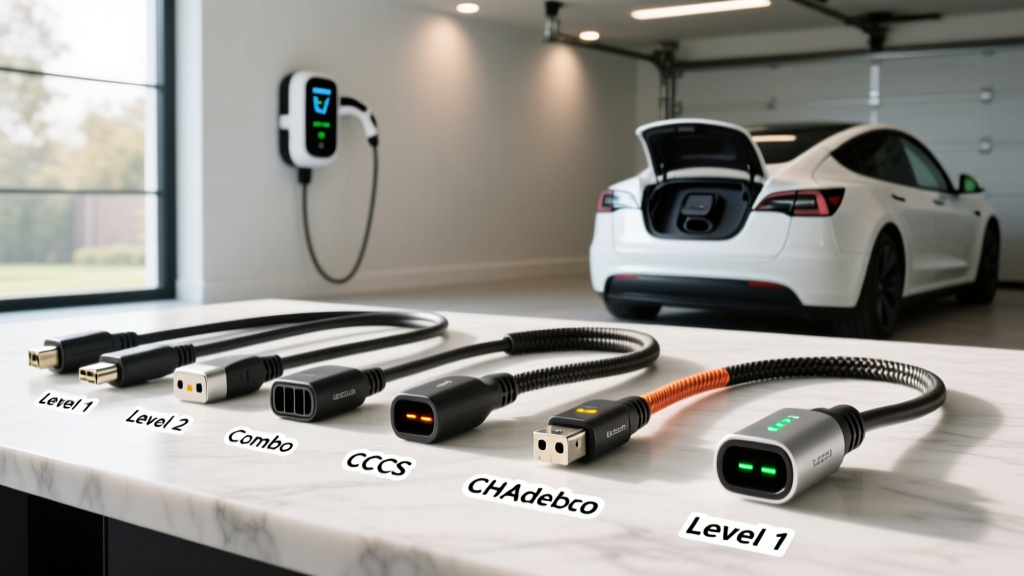
| Connector Type | Used By | 2026 Mach-E Compatible? | Adapter Needed? |
|---|---|---|---|
| NACS (Tesla) | Tesla, Ford (2025+), GM (2025+), Rivian, Volvo | Yes — native port | No |
| CCS1 | Legacy EVs, Electrify America stations | Yes — via NACS-to-CCS adapter | Yes (~$200-250) |
| CHAdeMO | Nissan Leaf (legacy) | No | N/A — network is declining |
With a native NACS port, the 2026 Mach-E gains direct access to Tesla's Supercharger network — over 25,000 stalls in North America — without any adapter. For Electrify America and other CCS-based networks, Ford provides or sells a NACS-to-CCS adapter. When purchasing a home Level 2 charger, choose one with a NACS connector (or a J1772 connector with a J1772-to-NACS adapter, as J1772 remains the Level 2 standard on many chargers).
Cost to Charge: Home vs. Public vs. Gas Comparison
Charging economics depend heavily on where and when you plug in. Here's a realistic cost breakdown for a 2026 Mach-E Premium ER (91 kWh battery, 320 EPA miles):
| Charging Scenario | Rate ($/kWh) | Full Charge Cost (91 kWh) | Cost Per Mile |
|---|---|---|---|
| Home (off-peak utility rate) | $0.08-$0.13 | $7.28-$11.83 | $0.023-$0.037 |
| Home (average US rate) | $0.16 | $14.56 | $0.046 |
| Public Level 2 (ChargePoint, etc.) | $0.25-$0.40 | $22.75-$36.40 | $0.071-$0.114 |
| DC Fast (Tesla Supercharger) | $0.28-$0.42 | $25.48-$38.22 (10-80%) | $0.08-$0.12 |
| Gas equivalent (25 MPG, $3.40/gal) | — | $43.52 (320 mi) | $0.136 |
Home charging at off-peak rates delivers fuel costs roughly 70-80% lower than a comparable gas vehicle. Even at average residential rates, the Mach-E costs about $0.046 per mile versus $0.136 for a 25 MPG gas car — a savings of roughly $1,350 per year at 15,000 miles driven. Public DC fast charging narrows the gap, which is why home Level 2 installation pays for itself quickly.
Many utilities offer time-of-use (TOU) plans that drop rates to $0.06-$0.10/kWh between 10 PM and 6 AM. Setting your Mach-E's scheduled charging feature or your smart charger's timer to charge during these windows maximizes savings.
Best Home Chargers for the 2026 Mach-E
These Level 2 chargers pair well with the Mach-E's 11.5 kW onboard charger capability and native NACS port:
Tesla Wall Connector (Gen 4)
- Power: Up to 11.5 kW (48A)
- Connector: Native NACS
- Cable: 24 ft
- Smart features: Wi-Fi, OTA updates, power sharing
- Price: ~$475
- Verdict: Best native NACS option; compact and reliable
ChargePoint Home Flex
- Power: Up to 12 kW (50A, configurable)
- Connector: J1772 (use J1772-to-NACS adapter) or NACS pigtail
- Cable: 23 ft
- Smart features: Wi-Fi, app scheduling, Alexa
- Price: ~$550-$650
- Verdict: Most versatile; adjustable amperage fits any circuit
Emporia Level 2 Smart Charger
- Power: Up to 11.5 kW (48A)
- Connector: J1772 (adapter needed for NACS)
- Cable: 24 ft
- Smart features: Wi-Fi, energy monitoring, solar integration
- Price: ~$350-$400
- Verdict: Best budget smart charger with energy tracking
For the cleanest experience with the 2026 Mach-E's NACS port, the Tesla Wall Connector eliminates the need for any adapter. If you anticipate charging a non-Tesla/non-NACS EV in the future, the ChargePoint Home Flex with its J1772 connector (and included or separately purchased adapter) offers broader compatibility.
DC Fast Charging on the Road: Network Access & Charge Curves
The 2026 Mach-E's native NACS port unlocks Tesla Supercharger V3 and V4 stalls directly. On a V3 Supercharger (250 kW capable), the Mach-E ER will peak around 150 kW and charge from 10-80% in approximately 30 minutes. The charge curve is not linear:
- 10-50% SoC: Near-peak speed (~130-150 kW) — fastest portion of the curve
- 50-80% SoC: Gradual taper (~100-120 kW)
- 80-100% SoC: Sharp taper (~30-50 kW) — avoid unless necessary for trip planning
For road trips, plan to charge from 10-80% and drive on. Charging past 80% at a DC fast station adds minimal range but significant time. Use the Mach-E's built-in navigation with Ford's Intelligent Range feature, which factors in terrain, temperature, and driving style to route you through charging stops with preconditioning enabled — warming the battery before arrival to maximize charge speed.
On Electrify America and other CCS networks, use the Ford-provided NACS-to-CCS adapter. Peak speeds on 150 kW EA stalls will be similar, though station reliability varies. Check PlugShare or the EA app for real-time station status before routing to a CCS-only location.
Frequently Asked Questions
How much does it cost to install a home EV charger for the Mach-E?
Expect $900-$2,500 for a standard installation (equipment, electrician labor, and permit) in a home with a 200A electrical panel. If your home has a 100A panel and needs a service upgrade, add $1,500-$3,500. Always get a site assessment from a licensed electrician before purchasing equipment.
How fast will each charging level add range to my 2026 Mach-E?
Level 1 (120V) adds roughly 3-5 miles per hour. Level 2 (240V, 48A) adds approximately 25-35 miles per hour — enough to fully replenish the Extended Range battery overnight. DC fast charging at 150 kW adds roughly 150-200 miles in 20-30 minutes (10-80%).
Which connector does the 2026 Mach-E use?
The 2026 model uses a native NACS (Tesla-style) charge port. It plugs directly into Tesla Superchargers and any NACS-equipped public station. For CCS-based networks like Electrify America, a NACS-to-CCS adapter is required. Home Level 2 chargers with a NACS connector (like the Tesla Wall Connector) plug in without an adapter.
How much does charging the Mach-E cost per mile versus a gas car?
At average US residential electricity rates ($0.16/kWh), the Mach-E costs roughly $0.046 per mile. A comparable 25 MPG gas vehicle at $3.40/gallon costs about $0.136 per mile. That's a difference of approximately $0.09 per mile, or $1,350 per year at 15,000 miles. Off-peak home charging can drop the Mach-E to under $0.03 per mile.
What electrical upgrades might I need for a Level 2 charger?
A 48A Level 2 charger requires a dedicated 60A, 240V circuit. If your electrical panel lacks sufficient spare amperage (common in homes with 100A service), you may need a panel upgrade to 200A — typically $1,500-$3,500. An electrician will assess your panel's capacity, the wire run distance, and whether conduit is needed. Some homes can support a lower-amperage 32A or 40A charger on an existing circuit without an upgrade.
Does the 2026 Mach-E qualify for the federal EV tax credit?
Eligibility for the IRS §30D clean vehicle credit (up to $7,500) depends on the buyer's modified adjusted gross income, the vehicle's MSRP (must be under $80,000 for SUVs — all Mach-E trims qualify), battery component and critical mineral sourcing requirements, and whether the credit is claimed at point of sale or on your tax return. Rules change frequently; verify current eligibility at IRS.gov and consult a tax professional.
Bottom Line: Optimizing Your Mach-E Charging Setup
The 2026 Ford Mustang Mach-E's switch to NACS, combined with its 91 kWh Extended Range battery and 150 kW DC fast-charge capability, makes it one of the most practical electric SUVs for both daily commuting and road trips — provided your home charging infrastructure is properly sized. Budget $1,000-$2,500 for a quality Level 2 installation with a 48A smart charger, prioritize off-peak utility rates, and you'll fuel the Mach-E for roughly $0.03-$0.05 per mile — a fraction of gasoline costs. Confirm your panel capacity with a licensed electrician, choose a NACS-native charger like the Tesla Wall Connector for the simplest plug-in experience, and leverage the Supercharger network for road trips without adapter hassle.