Why Your 2026 Tesla Model Y Long Range RWD Demands a Smart Charging Strategy
The 2026 Tesla Model Y Long Range Rear-Wheel Drive pairs an EPA-estimated 320 miles of range with a 75 kWh (usable) LFP battery pack and a peak DC fast-charge rate of 250 kW on the NACS connector. That combination rewards owners who charge at home with minimal cost and maximum convenience — but punishes those who rely solely on public infrastructure with higher per-mile expenses and unpredictable availability.
This guide walks through every charging scenario Model Y Long Range RWD owners will encounter: Level 1 trickle charging, Level 2 home installation, and DC fast charging on road trips. We break down exact electrical requirements, real installation costs, equipment picks, and the per-mile math versus gasoline — all calibrated to the 2026 Model Y's specific powertrain.
Battery: 75 kWh usable (LFP chemistry) | EPA Range: 320 mi | NACS connector standard
Peak DC Fast Charge: 250 kW | 10–80% DCFC: ~25 min | Max Level 2 AC: 11.5 kW (48A)
Onboard Charger: 11.5 kW max | Real-world highway range: ~260–285 mi
Charging Levels Explained: Speeds, Power, and Range Added Per Hour
Before evaluating equipment, you need clarity on the three charging tiers and how they apply to the Model Y Long Range RWD's 75 kWh battery. The critical distinction: kW (kilowatts) measures the rate of power delivery — how fast energy flows into the battery. kWh (kilowatt-hours) measures total energy capacity — the size of the "tank." Think of kW as gallons-per-minute from a hose, and kWh as the total gallons the tank holds.
| Level | Voltage / Amperage | Max Power (kW) | Miles of Range Added Per Hour | 0–100% Full Charge Time | Best Use Case |
|---|---|---|---|---|---|
| Level 1 (120V) | 120V / 12A | ~1.4 kW | ~3–4 mi/hr | ~54+ hours | Emergency / overnight trickle |
| Level 2 (240V) | 240V / 48A | 11.5 kW | ~37–44 mi/hr | ~7–8 hours | Daily home charging |
| DC Fast Charge | 400V+ DC | 250 kW peak | ~1,000+ mi/hr (peak) | 10–80% in ~25 min | Road trips, rapid top-ups |
A few real-world caveats: Level 1 charging on a standard 120V outlet will fully replenish the Model Y's 75 kWh battery in over two days — functional for occasional use but impractical as a primary strategy. Level 2 at 48A/11.5 kW is the sweet spot: plug in after your evening commute and wake up with a full battery every morning. DC fast charging peaks at 250 kW only when the battery is preconditioned and at a low state of charge (roughly 10–30%); above 80%, the charge curve tapers sharply to protect the LFP cells, dropping to under 50 kW. This is why manufacturers quote 10–80% times rather than full charges.
Home Level 2 Installation: Electrical Requirements, Panel Upgrades, and Costs
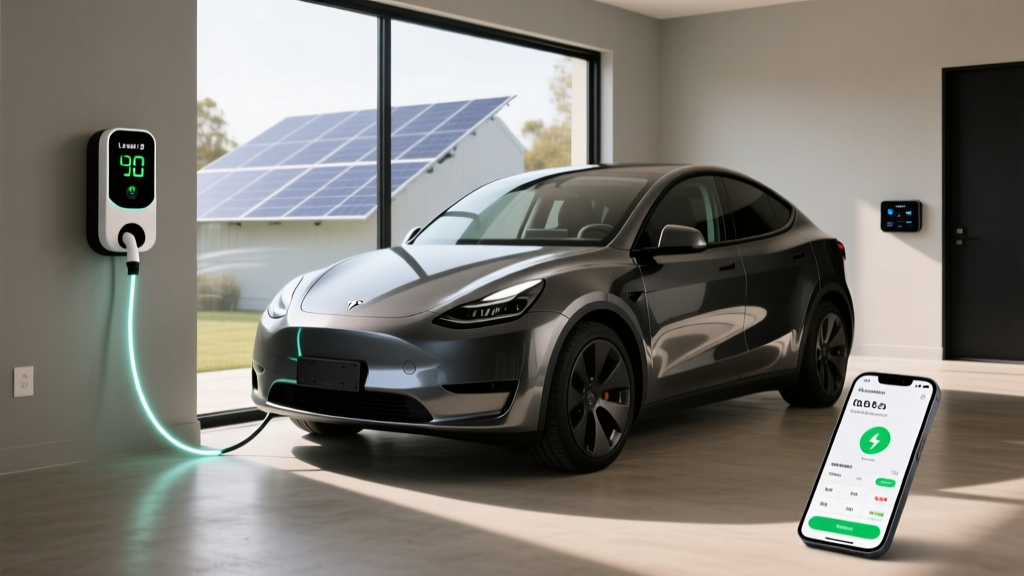
Installing a Level 2 home charger for your 2026 Model Y Long Range RWD requires a dedicated 240V circuit — the same voltage your electric dryer or oven uses. The Model Y's onboard charger accepts up to 48 amps, which means you need a circuit rated for at least 60 amps (electrical code requires circuits to be sized at 125% of the continuous load: 48A × 1.25 = 60A).
Electrical Requirements for Full-Speed Level 2 Charging
- Circuit: Dedicated 60A, 240V breaker
- Wire gauge: 6 AWG copper (for runs under 50 ft); 4 AWG for longer runs
- Connector: NACS (native Tesla) or hardwired — no adapter needed
- Outlet option: NEMA 14-50 (50A circuit, delivers up to 40A / 9.6 kW to the car) if you prefer a plug-in charger
- Panel capacity: Minimum 100A service; 200A strongly recommended for modern homes with EV + electric appliances
If you opt for a NEMA 14-50 outlet instead of hardwiring, the circuit is rated at 50A, delivering a maximum of 40A continuous to the vehicle — yielding roughly 9.6 kW and approximately 30–35 miles of range per hour. That's still excellent for overnight charging but leaves about 15% of the Model Y's onboard charger capacity unused.
Homes built before 1990 often have 100A or even 60A electrical panels. Adding a 60A EV circuit to a fully loaded 100A panel can exceed safe capacity — especially if you also run electric heat, a dryer, and an electric oven simultaneously. A panel upgrade to 200A typically costs $1,500–$3,500 before the charger install. Always have a licensed electrician perform a load calculation before committing to a circuit size. Some utilities offer rebates for panel upgrades tied to EV adoption.
How Much Does It Cost to Install a Home EV Charger?
Installation costs vary widely based on your home's electrical infrastructure, the distance from panel to charger location, and local permit fees. Here's a realistic breakdown for a 2026 Model Y Long Range RWD setup:
| Cost Component | Simple Install (panel nearby, no upgrade) | Complex Install (long wire run, panel upgrade) |
|---|---|---|
| Level 2 Charger Equipment (48A, NACS) | $400–$650 | $400–$650 |
| Electrical Permit | $50–$200 | $50–$200 |
| Electrician Labor (60A circuit, hardwired) | $500–$1,200 | $1,500–$3,000 |
| Wire & Conduit Materials | $100–$300 | $400–$900 |
| Panel Upgrade (if needed) | $0 | $1,500–$3,500 |
| Total Estimated Cost | $1,050–$2,350 | $3,850–$8,250 |
For most homeowners with a 200A panel and a garage adjacent to the electrical service, expect to spend between $1,200 and $2,000 all-in for a hardwired 48A NACS charger. The federal Residential Clean Energy Credit does not cover EV chargers as of 2026 (the alternative fuel vehicle refueling property credit under §30C has specific census-tract eligibility requirements and a $1,000 cap — consult a tax professional and check irs.gov for current rules).
Connector Compatibility: NACS, CCS, and Adapter Requirements
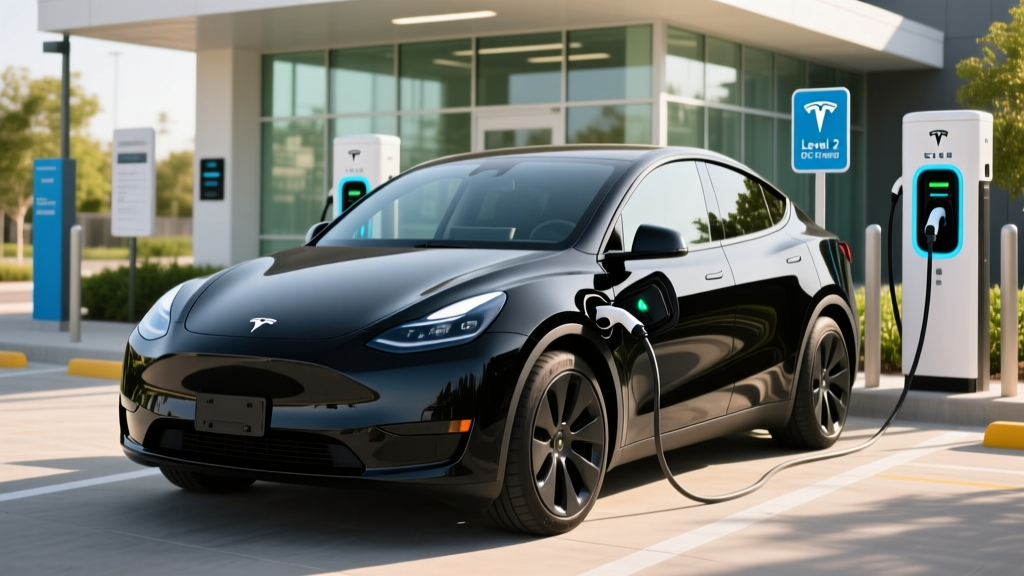
The 2026 Tesla Model Y Long Range RWD ships with the North American Charging Standard (NACS) connector built in. Tesla's Supercharger network — now exceeding 30,000 stalls globally — uses NACS natively, meaning zero adapters are required for the largest DC fast-charging network in North America.
For non-Tesla public chargers, here's what you need to know:
| Connector Type | Network Examples | Compatible with Model Y? | Adapter Needed? |
|---|---|---|---|
| NACS (Tesla) | Tesla Superchargers, Tesla Destination | Yes — native | None |
| CCS1 (Combined Charging System) | Electrify America, EVgo, ChargePoint (some) | Yes — with adapter | Tesla CCS Adapter (included with vehicle or ~$175) |
| CHAdeMO | Legacy Nissan Leaf stations | No — not supported | N/A |
| J1772 (Level 2 public) | Public Level 2 stations, workplaces | Yes — with adapter | Tesla J1772 Adapter (included with vehicle) |
The Tesla CCS adapter is essential for road trips outside the Supercharger network. It enables DC fast charging at up to 170 kW on Electrify America and similar CCS stations — slower than the 250 kW Supercharger peak, but still capable of a 10–80% charge in roughly 30–35 minutes. Always carry both the CCS adapter and the J1772 adapter in the frunk.
Cost to Charge: Home vs. Public vs. Gasoline — The Per-Mile Math
One of the strongest ownership arguments for the 2026 Model Y Long Range RWD is the fuel-cost advantage. Here's how the numbers break down across charging scenarios, using the Model Y's EPA-rated efficiency of approximately 26 kWh per 100 miles (roughly 130 MPGe combined per fueleconomy.gov):
| Scenario | Price per kWh | Cost per 100 Miles | Cost per Mile | Cost for Full 75 kWh Charge |
|---|---|---|---|---|
| Home (national avg. residential, off-peak TOU) | $0.13/kWh | $3.38 | $0.034 | $9.75 |
| Home (California avg. residential) | $0.27/kWh | $7.02 | $0.070 | $20.25 |
| Tesla Supercharger (avg. 2026) | $0.35/kWh | $9.10 | $0.091 | $26.25 |
| Electrify America (avg.) | $0.43/kWh | $11.18 | $0.112 | $32.25 |
| Gasoline equivalent (25 MPG, $3.40/gal) | — | $13.60 | $0.136 | — |
At the national average residential electricity rate, home charging costs roughly $0.034 per mile — a 75% savings versus a comparable 25 MPG gasoline crossover at $3.40/gallon. Even on California's higher rates, home charging undercuts gasoline by nearly half. Public DC fast charging narrows the gap but still saves 15–30% versus gas in most markets.
Time-of-use (TOU) rate plans offered by many utilities can push off-peak home charging costs even lower — some as cheap as $0.05–$0.08/kWh overnight, reducing the per-mile cost to under two cents. Schedule your Model Y to charge between midnight and 5 AM via the Tesla app to capture these rates.
Recommended Level 2 Chargers for the Model Y Long Range RWD
The 2026 Model Y's 11.5 kW onboard charger means you should target a Level 2 unit that delivers at least 48 amps to maximize charging speed. Below are three proven options, all with native NACS connectors (no adapter required):
Power: 11.5 kW (48A) | Connector: NACS native
Cable: 24 ft | Wi-Fi: Yes (OTA updates, scheduling)
Price: ~$475 | Hardwired, 60A circuit required
Best for: Seamless Tesla integration, load sharing with second unit, Powerwall integration
Power: Up to 12 kW (50A adjustable) | Connector: NACS
Cable: 23 ft | Wi-Fi: Yes (app scheduling, energy tracking)
Price: ~$599 | Hardwired or NEMA 14-50 plug
Best for: Flexible amperage settings, detailed energy reporting, non-Tesla household compatibility
Power: 11.5 kW (48A) | Connector: NACS
Cable: 24 ft | Wi-Fi: Yes (real-time energy monitoring)
Price: ~$399 | Hardwired, 60A circuit required
Best for: Budget-conscious buyers, whole-home energy monitoring integration
All three chargers deliver the full 48A the Model Y can accept. The Tesla Wall Connector remains the default pick for single-EV Tesla households due to native integration, automatic firmware updates, and the ability to pair with a second Wall Connector for load-balanced dual charging. The ChargePoint Home Flex is the better choice if your household includes a non-Tesla EV (it's available in J1772 or NACS) or if you want plug-in flexibility with a NEMA 14-50 outlet.
Safety, Code Compliance, and Installation Best Practices
EV charging draws sustained high current for hours — a fundamentally different load profile than most household appliances. Cutting corners on installation creates fire risk. Here's what a proper install requires:
- Dedicated circuit: Your Level 2 charger must have its own breaker — never share a circuit with other appliances. A 60A breaker for a 48A continuous load is code-mandated (NEC Article 625).
- GFCI protection: The 2020 NEC and later require GFCI protection for outdoor EV outlets. Hardwired indoor installations may be exempt in some jurisdictions, but outdoor receptacles must be GFCI-protected. Note: some EVSE units have built-in ground-fault protection that satisfies this requirement.
- Outdoor rating: If mounting outside, the charger must carry a NEMA 4 or NEMA 4X rating for weather resistance. The Tesla Wall Connector and ChargePoint Home Flex both carry NEMA 4 ratings.
- Permit and inspection: Virtually all jurisdictions require an electrical permit for a new 240V circuit. The inspection ensures wire gauge, breaker sizing, and grounding meet code. Factor $50–$200 for the permit into your budget.
- Cable management: A 24-foot cable is sufficient for most garage installations. If your parking spot is farther from the wall, verify cable reach before mounting — stretching a cable creates wear and potential hazard.
Always hire a licensed electrician experienced with EVSE installations. Ask for a load calculation on your panel before work begins, and request photos of the completed wiring behind the panel for your records.
Real-World Charging Times: What to Expect With the 75 kWh LFP Battery
The 2026 Model Y Long Range RWD's LFP (lithium iron phosphate) battery chemistry offers excellent cycle life and can be charged to 100% regularly without the degradation concerns associated with NMC batteries. Tesla recommends setting the charge limit to 100% at least once per week for LFP packs to maintain accurate state-of-charge calibration.
Here are realistic charge times for common scenarios:
- 20% to 80% on Level 2 (11.5 kW): ~4 hours — add roughly 220 miles of range
- 10% to 80% on DC Supercharger (250 kW peak): ~25 minutes — preconditioned battery, warm weather
- 10% to 80% on Electrify America CCS (170 kW via adapter): ~30–35 minutes
- Overnight top-up (60% to 100%) on Level 2: ~3.5 hours — typical daily use pattern
- Cold-weather DC fast charge (below 32°F): Add 5–10 minutes to 10–80% times; preconditioning via navigation to a Supercharger is essential to warm the battery
The LFP chemistry's tolerance for 100% daily charging is a practical advantage for the Long Range RWD: you get full access to the 320-mile EPA range every morning without babying the battery. Real-world highway range at 75 mph will be closer to 260–285 miles in moderate temperatures and 230–255 miles in sub-freezing conditions — plan road-trip charging stops accordingly.
Frequently Asked Questions
How much does it cost to install a home EV charger for the 2026 Model Y?
A straightforward Level 2 installation (60A hardwired circuit, panel adjacent to garage) costs $1,050–$2,350 including equipment, labor, wire, and permit. If your home needs a panel upgrade from 100A to 200A, total costs can reach $3,850–$8,250. Most 2026 homes with 200A service fall in the lower range.
How fast will each charging level add range to the Model Y Long Range RWD?
Level 1 (120V) adds roughly 3–4 miles per hour — too slow for daily use. Level 2 (240V, 48A) adds 37–44 miles per hour, fully replenishing the 75 kWh battery overnight in about 7–8 hours. DC fast charging at a Supercharger adds over 1,000 miles per hour at peak (250 kW), delivering a 10–80% charge in approximately 25 minutes.
Which connector is compatible with my 2026 Tesla Model Y Long Range RWD?
Your Model Y uses the NACS connector natively — no adapter needed for Tesla Superchargers or Destination chargers. For CCS stations (Electrify America, EVgo), use the Tesla CCS adapter (typically included or available for ~$175). For public Level 2 J1772 stations, use the included Tesla J1772 adapter. CHAdeMO is not supported.
How much does charging cost per mile compared to gasoline?
At the national average residential electricity rate ($0.13/kWh), home charging costs approximately $0.034 per mile — a 75% savings versus a 25 MPG gasoline vehicle at $3.40/gallon ($0.136/mile). Even on public DC fast chargers at $0.35–$0.43/kWh, the Model Y costs $0.09–$0.11 per mile, still 15–30% cheaper than gas.
What electrical upgrades might I need for a Level 2 charger?
You need a dedicated 60A, 240V circuit with 6 AWG copper wire for full 48A charging. If your home has a 100A electrical panel (common in pre-1990 construction), you may need a panel upgrade to 200A — costing $1,500–$3,500 — to safely accommodate the EV load alongside existing appliances. A licensed electrician should perform a load calculation before installation.