The 2026 Kia EV9 Range Reality: EPA vs. Real World
If you're researching the 2026 Kia EV9 range and charging logistics before pulling the trigger on this three-row electric SUV, you're asking the right questions. The EV9 is one of the few mainstream BEVs offering seven-passenger seating, but its size, 100.0 kWh (usable) battery, and 210 kW peak DC charge rate create a specific ownership profile that differs meaningfully from smaller crossovers.
Let's ground the discussion in exact figures before moving to the home-charging and public-charging infrastructure you'll need to support it.
| Spec | Light Long Range (RWD) | Land (AWD) | GT-Line (AWD) |
|---|---|---|---|
| EPA Range | 304 mi | 280 mi | 270 mi |
| Battery (usable) | 100.0 kWh, NMC lithium-ion | ||
| MPGe (combined) | 88 MPGe | 83 MPGe | 82 MPGe |
| Peak DC Charge Rate | 210 kW (800V architecture) | ||
| 10–80% DC Fast | ~24 minutes (optimal conditions) | ||
| Level 2 Onboard Charger | 10.9 kW | ||
| Horsepower | 215 hp | 379 hp | 379 hp |
| 0–60 mph | 7.7 sec | 4.5 sec | 4.5 sec |
| Base MSRP | $56,395 | $61,395 | $73,995 |
| Battery/Powertrain Warranty | 10 years / 100,000 miles | ||
Real-World Range Expectations
EPA 304 mi (Light Long Range RWD) — expect roughly 250–270 mi on sustained 70–80 mph highway runs in moderate weather. In cold conditions (below 30°F), plan for a 15–25% reduction, landing around 230–255 mi. The AWD Land and GT-Line trims sacrifice 24–34 EPA miles due to the second motor and wider tires; real-world highway range on those trims typically sits between 225–250 mi in fair weather.
The EV9's 800V electrical architecture is the standout engineering detail here. It enables the 210 kW peak charge rate — but as with any BEV, that peak is not sustained across the entire session. Expect the charge curve to taper noticeably past 60% SoC, and to drop sharply past 80%. Charging from 10–80% in roughly 24 minutes is realistic at a 350 kW Electrify America or Ionity station with a functioning CCS1 or NACS connector; at a 150 kW station, plan on 32–36 minutes for the same window.
Charging Levels Explained: How Fast Will Each Add Range?
The single most common point of confusion for new EV owners is the difference between kW (power — the rate of energy flow) and kWh (energy — the total capacity of the battery). Think of kW as the width of the pipe and kWh as the size of the tank. A 100 kWh battery charged at 10 kW takes about 10 hours; charged at 200 kW (theoretically), it would take 30 minutes. Real charge curves make it more nuanced, but the principle holds.
| Level | Power (kW) | Voltage/Amps | Miles Added per Hour | 0–100% Time (approx.) |
|---|---|---|---|---|
| Level 1 (120V outlet) | 1.4 kW | 120V / 12A | ~3–4 mi/hr | ~60+ hours |
| Level 2 (240V home/public) | 7.7–10.9 kW | 240V / 32–48A | ~22–31 mi/hr | ~9–12 hours |
| DC Fast Charging | 50–210 kW | 400–800V DC | ~150–400+ mi/hr* | 10–80% in ~24 min (at 210 kW peak) |
*Miles-per-hour figures for DC fast charging are an average over the 10–80% window; peak rates are higher in the 10–40% range and taper sharply above 80%.
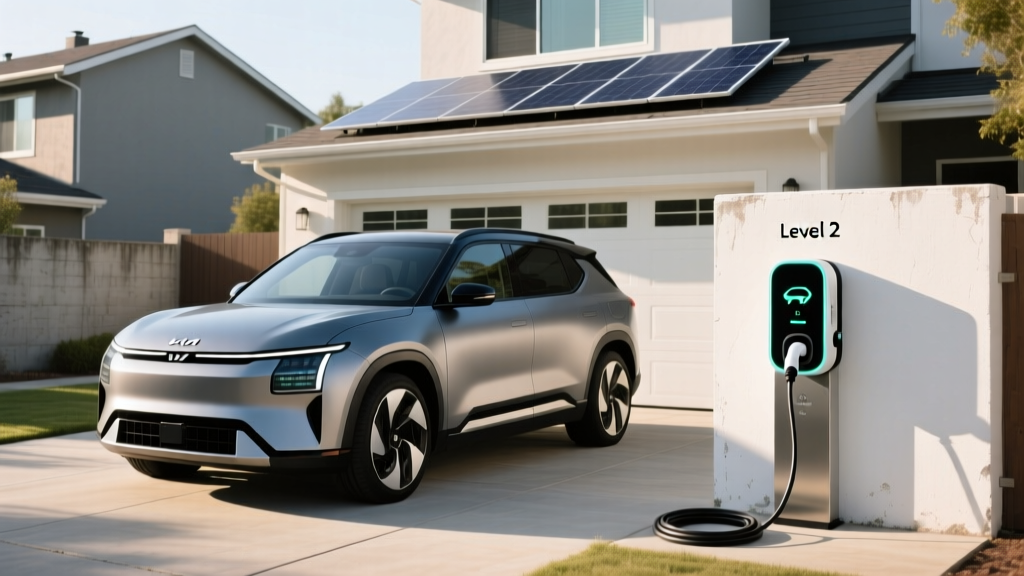
For the EV9 specifically, Level 1 is a non-starter as a primary charging strategy — it would take well over two days to refill a depleted battery. Level 2 at home on a 48A circuit (delivering up to 10.9 kW to match the EV9's onboard charger) is the sweet spot for overnight replenishment. DC fast charging is for road trips and mid-day top-ups, not daily use, as frequent high-power charging can accelerate long-term battery degradation.
Home Charger Installation: Electrical Requirements & Costs
How much does it cost to install a home EV charger? The honest answer for a 2026 EV9 owner: between $600 and $2,800 total depending on your home's electrical panel, the distance from panel to garage or driveway, and local permit fees. Here's the breakdown:
| Component | Low End | High End | Notes |
|---|---|---|---|
| Level 2 Charger (hardware) | $350 | $750 | 40A–48A Wi-Fi-enabled unit |
| Electrician labor | $300 | $1,200 | Varies with run length and conduit |
| Electrical permit | $50 | $250 | Required in most US jurisdictions |
| Panel upgrade (if needed) | $1,500 | $3,500 | 100A → 200A service upgrade |
| Total (no panel upgrade) | $700 | $2,200 | Most newer homes with 200A service |
| Total (with panel upgrade) | $2,200 | $5,700 | Older homes with 100A or 150A panels |
Electrical Requirements for the EV9
The EV9's 10.9 kW onboard charger can accept up to 48A on a 240V circuit. Per the National Electrical Code (NEC), continuous loads like EV charging can only use 80% of a circuit's rated capacity, so you need a 60A breaker to deliver a full 48A to the car. A 50A breaker (delivering 40A / 9.6 kW) is the next common size down and still fills the EV9 overnight in roughly 10.5 hours — acceptable for most owners.
What Electrical Upgrades Might I Need?
If your home has a 200A electrical panel with available breaker slots and sufficient load headroom, a 60A dedicated circuit is usually straightforward. If you have a 100A or 150A panel — common in homes built before 1990 — adding a 60A EV circuit may overload the panel. A licensed electrician will perform a NEC Article 220 load calculation to determine if an upgrade is required. In some cases, a smart panel load-management device (like the Emporia Smart Panel or Span Drive) can avoid a full panel upgrade by dynamically throttling the charger when other large loads are active.
Which Connector Is Compatible with the 2026 EV9?
For the 2026 model year, Kia has transitioned the EV9 to the NACS (North American Charging Standard) connector in the US market — the same port used by Tesla, Ford, GM, Rivian, and an expanding list of OEMs. This is a significant shift from the CCS1 connector used on 2024–2025 EV9s.
| Connector | Used By | EV9 Native? | Adapter Needed? |
|---|---|---|---|
| NACS (J3400) | Tesla, Ford, GM, Rivian, 2026+ Kia/Hyundai, Volvo, Polestar | Yes (native) | None for NACS stations; CCS1→NACS adapter for legacy CCS1 chargers |
| CCS1 | Legacy VW, BMW, older Kia/Hyundai, Electrify America stations | No (native NACS) | NACS→CCS1 adapter ($150–$250) |
| CHAdeMO | Nissan Leaf, Mitsubishi (legacy) | No | Not practical; adapters are rare and expensive |
| Tesla Supercharger (NACS) | Tesla network (17,000+ US stalls) | Yes (native) | None — direct plug-in |
The practical implication: the 2026 EV9 plugs directly into Tesla Superchargers without an adapter, unlocking the largest DC fast-charging network in North America. For Electrify America or other CCS1-only stations, you'll want to carry a NACS-to-CCS1 adapter in the frunk. Kia may include one with the vehicle; if not, aftermarket adapters from Lectron or A2Z cost $150–$250.
Recommended Level 2 Home Chargers for the EV9
Given the EV9's 10.9 kW onboard charger and NACS connector, here are three purpose-built home chargers that match its capabilities:
ChargePoint Home Flex (NACS)
- Power: Up to 11.5 kW (48A) on a 60A circuit
- Connector: Native NACS (2025+ models)
- Cable Length: 23 feet
- Smart Features: Wi-Fi, app scheduling, Alexa, utility TOU integration
- Price: ~$599
- Verdict: Best overall for smart scheduling and utility rate optimization
Tesla Wall Connector (NACS)
- Power: Up to 11.5 kW (48A) on a 60A circuit
- Connector: Native NACS
- Cable Length: 24 feet
- Smart Features: Wi-Fi, OTA updates, Powerwall integration, load sharing (pair up to 6 units on one circuit)
- Price: ~$450
- Verdict: Best value and simplest for NACS-native EVs; limited non-Tesla app ecosystem
Emporia Vue Level 2 Charger
- Power: Up to 11.5 kW (48A) on a 60A circuit
- Connector: NACS (adapter included for J1772)
- Cable Length: 24 feet
- Smart Features: Wi-Fi, whole-home energy monitoring integration, solar-aware charging
- Price: ~$399
- Verdict: Best budget pick; ideal if you already use Emporia's energy monitor
For the EV9's 100 kWh battery, a 48A / 11.5 kW charger fills it from 10% to 100% in roughly 8.5 hours — easily within a single overnight window. A 40A / 9.6 kW setup takes about 9.5 hours, still practical for most schedules.
Charging Cost Per Mile: EV9 vs. Gas SUV
How much does charging cost per mile vs. gas? Let's model three scenarios against a comparable three-row gas SUV averaging 22 MPG combined (e.g., Kia Telluride, Hyundai Palisade).
| Scenario | Rate | EV9 Cost/Mile | Gas SUV Cost/Mile ($3.50/gal) | Annual Savings (12,000 mi) |
|---|---|---|---|---|
| Home off-peak (utility TOU) | $0.10/kWh | $0.031 | $0.159 | $1,536 |
| Home average (national residential) | $0.17/kWh | $0.053 | $0.159 | $1,272 |
| Public DC fast (average) | $0.42/kWh | $0.131 | $0.159 | $336 |
EV9 efficiency assumed at 3.2 kWh/mi (derived from EPA 88 MPGe / 33.7 kWh-per-gallon equivalent for the Light Long Range RWD trim). Actual efficiency varies with driving style, temperature, and terrain.
The takeaway is stark: home charging is dramatically cheaper than gas, saving $1,200–$1,500 annually for a typical driver. But if you rely exclusively on public DC fast charging at current rates ($0.35–$0.55/kWh at Electrify America or EVgo), the per-mile cost approaches that of a fuel-efficient gas car. The EV9's economics are optimized for owners who can charge at home overnight on off-peak utility rates.
Check fueleconomy.gov for the EPA's official efficiency figures for each EV9 trim, and consult your local utility for time-of-use (TOU) rate plans that can push your home charging cost toward the $0.08–$0.12/kWh range.
Safety, Code, and Practical Considerations
A few non-negotiable items for any Level 2 installation:
- Dedicated circuit: NEC requires EV chargers to be on a dedicated breaker — no sharing with laundry, HVAC, or other appliances.
- GFCI protection: 2020 NEC and later requires GFCI protection for outdoor receptacles. Hardwired chargers (which most 48A+ units are) typically have GFCI built in; plug-in units on a NEMA 14-50 outlet need a GFCI breaker.
- Outdoor rating: If you're installing outside or in an unenclosed carport, choose a charger rated NEMA 4 (weatherproof). All three units above carry outdoor-rated enclosures.
- Permit and inspection: Skipping the permit to save $100–$250 is false economy. An unpermitted install can void homeowner's insurance claims related to electrical fire and may need to be ripped out during a home sale.
- Load management: For homes with 100–150A service that can't accommodate a panel upgrade, devices like the Emporia Smart Panel or Wallbox Power Meter enable safe 48A charging by throttling the charger when the home's total load approaches the panel's limit.
For detailed installation guidance, reference NFPA's NEC resources and always hire a licensed electrician familiar with EV-specific installations.
Federal Tax Credit & Incentives for Home Charging
The §30C Alternative Fuel Vehicle Refueling Property Credit covers 30% of home charger hardware and installation costs, up to $1,000. This is separate from the §30D new-vehicle credit (up to $7,500 for the EV9, subject to MSRP caps, buyer income limits, and battery-sourcing requirements under current IRS rules).
§30C Home Charger Credit Requirements
- Credit: 30% of equipment + installation, capped at $1,000
- Must be installed at your primary residence
- Equipment must be new and UL-listed
- Available through 2032 under current law
- Cannot be claimed for employer-reimbursed installations
On a $1,800 total install (charger + electrician + permit), the §30C credit returns $540 — bringing your net cost to roughly $1,260. Combined with the utility-rate savings outlined above, most EV9 owners recoup their home-charging investment within 12–18 months.
Frequently Asked Questions
How much does it cost to install a home EV charger for the 2026 Kia EV9?
Between $700 and $2,200 for homes with a 200A panel (charger + electrician + permit). If your home needs a panel upgrade from 100A to 200A, add $1,500–$3,500. The §30C tax credit can offset 30% of the cost, up to $1,000.
How fast will each charging level add range to the EV9?
Level 1 (120V): ~3–4 miles per hour — impractical for a 100 kWh battery. Level 2 (240V, 48A): ~28–31 miles per hour, filling the battery overnight. DC fast charging (210 kW peak): 10–80% in ~24 minutes at a capable station, adding roughly 170 usable miles.
Which connector does the 2026 EV9 use, and will it fit Tesla Superchargers?
The 2026 EV9 uses the NACS connector natively, so it plugs directly into Tesla Superchargers without an adapter. For legacy CCS1 stations (common at Electrify America), you'll need a NACS-to-CCS1 adapter (~$150–$250).
How much does charging cost per mile compared to a gas SUV?
At home on average US electricity rates ($0.17/kWh), the EV9 costs roughly $0.05/mile — about a third of a 22 MPG gas SUV at $3.50/gallon ($0.16/mile). Annual savings for 12,000 miles of driving: ~$1,200–$1,500.
What electrical upgrades might I need before installing a Level 2 charger?
Homes with 200A service usually need only a new 60A dedicated breaker and a wire run. Homes with 100A or 150A panels may require a full panel upgrade ($1,500–$3,500) or a smart load-management device to avoid one. A licensed electrician can perform a NEC load calculation to determine your situation.
Does frequent DC fast charging damage the EV9's battery?
Occasional DC fast charging on road trips is fine. Daily reliance on 200+ kW charging can accelerate long-term battery degradation compared to Level 2 charging. Kia's battery management system and 800V thermal management mitigate this, but the 10-year/100,000-mile battery warranty (covering degradation below 70% capacity) assumes reasonable use. Plan to do the majority of your charging at Level 2 for optimal battery longevity.