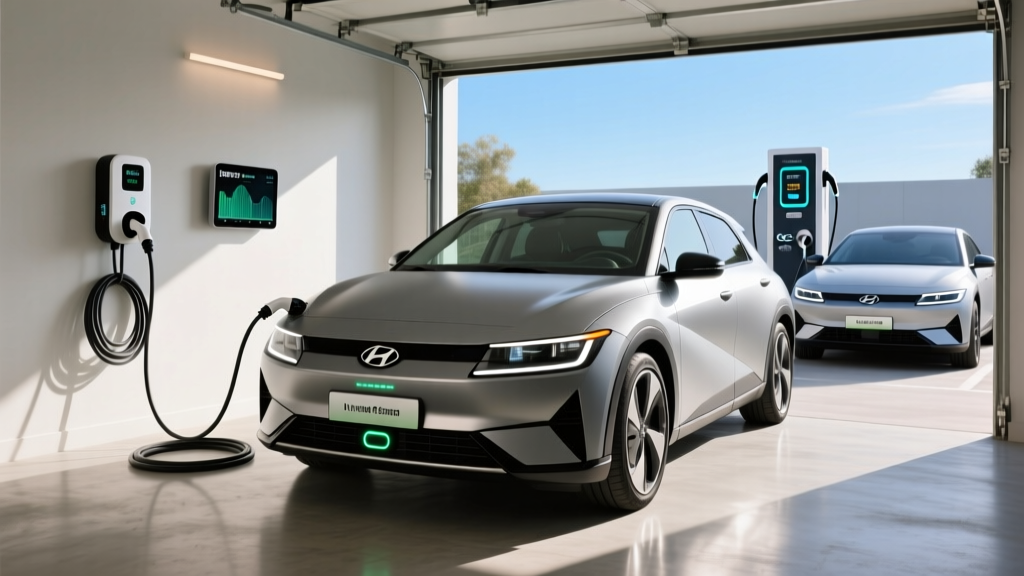
The 2026 Hyundai Ioniq 5 SE Standard Range is one of the most efficient electric crossovers on the market, pairing a 58 kWh (usable) battery with an EPA-estimated 245 miles of range and a peak DC fast-charge rate of 180 kW. But owning an EV is only half the equation — how you charge it at home and on the road determines your daily experience, your wallet, and whether that 245-mile EPA figure holds up in the real world. This guide breaks down every charging option available to Ioniq 5 SE Standard Range owners in 2026, from a basic 120V outlet to a full Level 2 home install and public DC fast-charging networks.
Battery: 58 kWh usable, NMC chemistry
EPA Range: 245 miles (RWD) | Real-world highway: ~200–220 mi; cold weather: ~170–190 mi
Peak DC Fast Charge: 180 kW | 10–80% in ~18 min (preconditioned)
Level 2 AC Charge: 10.9 kW onboard charger
0–60 mph: 7.2 seconds | 168 HP
Base MSRP: ~$42,600 (before incentives)
Federal §30D Credit: Eligible for up to $7,500 (subject to MSRP caps, income limits, and battery-sourcing rules — verify at IRS.gov)
Charging Levels Explained: How Fast Will Each Add Range?
EV charging is measured in kW (kilowatts), which is the rate of power delivery — think of it as how wide the hose is. Your battery capacity is measured in kWh (kilowatt-hours), which is the total energy stored — the size of the tank. The 2026 Ioniq 5 SE Standard Range's 58 kWh battery needs to be filled at varying speeds depending on your equipment.
| Level | Voltage / Amps | Power (kW) | Miles of Range per Hour | Full Charge Time (0–100%) |
|---|---|---|---|---|
| Level 1 (120V household) | 120V / 12A | ~1.4 kW | ~3–4 mi/hr | ~55–65 hours |
| Level 2 (240V home/public) | 240V / 48A | 10.9 kW (onboard max) | ~30–35 mi/hr | ~5.5–6 hours |
| DC Fast Charging | 400V+ / up to 450A | Up to 180 kW peak | ~600+ mi/hr (at peak) | 10–80% in ~18 min |
Real-world charging note: The 180 kW peak only applies when the battery is preconditioned (warmed to optimal temperature) and at a low state of charge (below ~30%). Above 80% SoC, the charge rate tapers significantly — expect 50 kW or less as the battery management system protects cell health. On a road trip, plan your stops around 10–80% windows for the fastest experience.
Home Charger Installation: Electrical Requirements and Costs
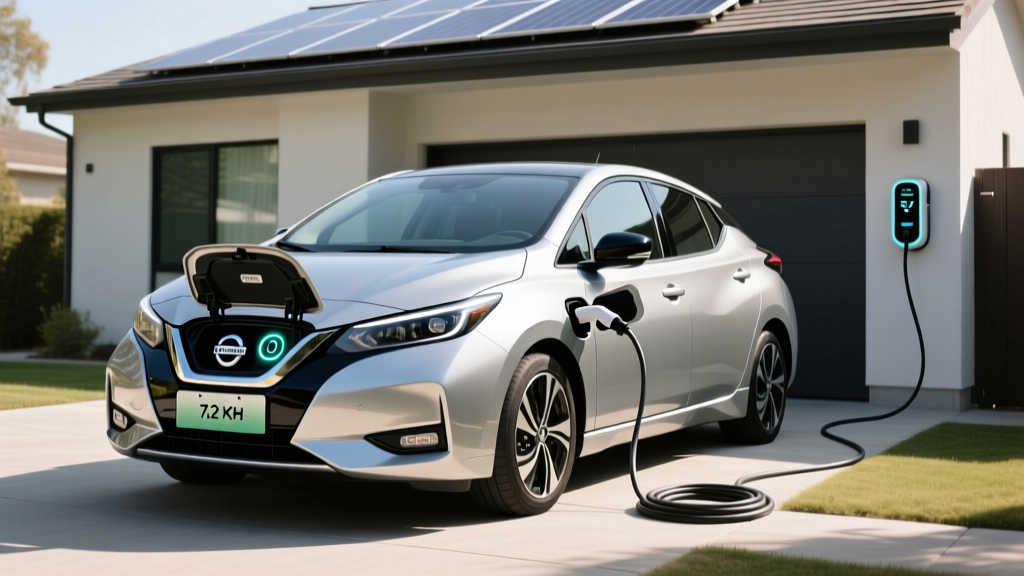
For daily ownership, a Level 2 home charger is the single best upgrade you can make. The Ioniq 5 SE Standard Range's 10.9 kW onboard charger means you'll want a 240V circuit rated for at least 48 amps to capture the full AC charging speed. Here's what that involves:
Electrical Requirements
- Circuit: Dedicated 60-amp breaker (NEC requires circuits to be rated 125% above continuous load — a 48A charger needs a 60A circuit)
- Wire: 6 AWG copper (THHN in conduit or NM-B depending on run)
- Outlet or hardwired: NEMA 14-50 receptacle (allows portability) or hardwired connection (often preferred for 48A+ chargers and avoids GFCI nuisance trips)
- Panel capacity: Your main panel must have enough spare amperage. A 200A panel is typically sufficient; a 100A panel may require a service upgrade ($1,500–$3,500)
- Permit: Most jurisdictions require an electrical permit ($50–$200) and a post-install inspection
Installation Cost Breakdown
| Component | Low End | High End | Notes |
|---|---|---|---|
| Level 2 Charger (Equipment) | $350 | $700 | 40A–48A smart charger |
| Electrician Labor | $300 | $1,200 | Depends on panel distance & wall type |
| Materials (wire, conduit, breaker) | $100 | $400 | Longer runs = more copper cost |
| Permit & Inspection | $50 | $200 | Varies by municipality |
| Panel Upgrade (if needed) | $1,500 | $3,500 | Only if upgrading from 100A to 200A |
| TOTAL (no panel upgrade) | $800 | $2,500 | Most homes with 200A panel |
| TOTAL (with panel upgrade) | $2,300 | $6,000 | Older homes with 100A service |
Pro tip: The Residential Clean Energy Credit (IRS §25D) offers a 30% federal tax credit on EV charger equipment and installation costs, up to $1,000. This applies to your primary residence and can significantly offset the install bill. Always consult a tax professional for your specific eligibility.
Connector Compatibility: NACS, CCS, and What the 2026 Ioniq 5 Uses
Hyundai transitioned the Ioniq 5 lineup to the NACS (North American Charging Standard) connector — the Tesla-designed plug now adopted industry-wide — starting with the 2025 model year. The 2026 Ioniq 5 SE Standard Range ships with a native NACS charge port, giving you direct access to Tesla Supercharger stations (now open to non-Tesla EVs) without an adapter.
| Connector | Type | 2026 Ioniq 5 SE Status | Network Access |
|---|---|---|---|
| NACS (J3400) | AC + DC native | ✅ Built-in | Tesla Superchargers, Electrify America (new stations), EVgo, ChargePoint |
| CCS1 | DC | ⚠️ Requires NACS-to-CCS adapter | Older Electrify America, some ChargePoint and EVgo stations |
| J1772 | AC Level 2 | ⚠️ Requires NACS-to-J1772 adapter | Older public Level 2 stations, some workplace chargers |
| CHAdeMO | DC | ❌ Not supported | Legacy Nissan/Mitsubishi network — being phased out |
Adapter note: Hyundai includes a basic J1772-to-NACS adapter in some trims, but verify with your dealer. For CCS legacy stations, a third-party NACS-to-CCS adapter (such as the Lectron or A2Z adapter, ~$150–$200) ensures backward compatibility at older public chargers. CHAdeMO is effectively dead for new EVs and not worth investing in.
Cost to Charge: Home vs. Public vs. Gas Comparison
The Ioniq 5 SE Standard Range achieves an EPA-rated 132 MPGe combined (approximately 3.8 miles per kWh). That efficiency figure makes it one of the cheapest EVs to fuel. Here's what you'll actually pay per mile in different scenarios:
| Scenario | Rate | Cost per kWh | Cost per Mile | Full 58 kWh Fill Cost |
|---|---|---|---|---|
| Home (off-peak utility rate) | $0.09/kWh | $0.09 | $0.024 | $5.22 |
| Home (national avg. residential) | $0.16/kWh | $0.16 | $0.042 | $9.28 |
| Public Level 2 (ChargePoint/EVgo) | $0.25–$0.39/kWh | $0.32 avg | $0.084 | $18.56 |
| DC Fast (Electrify America/Supercharger) | $0.35–$0.55/kWh | $0.45 avg | $0.118 | $26.10 |
| Gas equivalent (25 MPG compact SUV, $3.40/gal) | $3.40/gallon | N/A | $0.136 | N/A |
The bottom line: Charging at home on off-peak rates costs roughly 80% less per mile than fueling a comparable gas SUV. Even at public DC fast-charging rates, the Ioniq 5 SE Standard Range is typically cheaper per mile than gasoline. A 2026 Hyundai Tucson AWD (gas, 28 MPG combined) at $3.40/gal costs $0.121/mile — the Ioniq 5 undercuts it in every charging scenario except the most expensive DC fast chargers.
Recommended Home Chargers for the Ioniq 5 SE Standard Range
Since the Ioniq 5 SE Standard Range has a 10.9 kW onboard charger, any Level 2 unit delivering 40A–48A (9.6–11.5 kW) on 240V will maximize your AC charge speed. Here are three proven options across price tiers:
Emporia Level 2 Smart Charger
- Power: 48A / 11.5 kW (240V)
- Connector: NACS native
- Cable length: 24 ft
- Smart features: Wi-Fi, app scheduling, energy monitoring, solar integration
- Price: ~$399
- Best for: Budget-conscious buyers who want smart scheduling and energy tracking
ChargePoint Home Flex (2026 NACS)
- Power: 50A / 12 kW (240V, adjustable down)
- Connector: NACS native
- Cable length: 24 ft
- Smart features: Wi-Fi, Alexa, scheduled charging, ChargePoint network integration, load sharing
- Price: ~$599
- Best for: Owners who want a reliable ecosystem with public-charger network tie-in
Tesla Wall Connector (Universal)
- Power: 48A / 11.5 kW (240V)
- Connector: NACS native (J1772 adapter included)
- Cable length: 24 ft
- Smart features: Wi-Fi, power sharing (up to 6 units on one circuit), OTA updates
- Price: ~$475
- Best for: Multi-EV households or Tesla-ecosystem users
Our pick for Ioniq 5 owners: The ChargePoint Home Flex at 48A fully utilizes the 10.9 kW onboard charger, and its load-sharing feature is valuable if you plan to add a second EV. The Emporia is the best value if you're on a budget — it delivers the same 48A for $200 less.
Safety, Code, and Installation Best Practices
EV charging involves sustained high-current draw for hours — far more demanding than a dryer or oven cycle. Cutting corners here creates fire risk. Follow these non-negotiable requirements:
- Dedicated circuit: Your Level 2 charger must have its own breaker — never share a circuit with other appliances
- Hardwired vs. receptacle: For 48A chargers, hardwiring is preferred. NEMA 14-50 receptacles on 50A circuits are limited to 40A continuous draw (NEC 80% rule). Hardwiring also eliminates GFCI breaker nuisance trips that plague some receptacle installations
- Outdoor rating: If installing outdoors, ensure the charger carries a NEMA 4 or IP65 rating. All three chargers listed above are outdoor-rated
- GFCI protection: NEC 2023/2026 requires GFCI protection for outdoor receptacles. Hardwired chargers are exempt from this requirement in most jurisdictions — another reason to hardwire
- Permit and inspection: Skipping the permit to save $100 can void your homeowner's insurance in the event of an electrical fire. Always pull the permit and pass inspection
- Load calculation: A licensed electrician should perform an NEC Article 220 load calculation to confirm your panel can handle the additional 48A draw without overloading
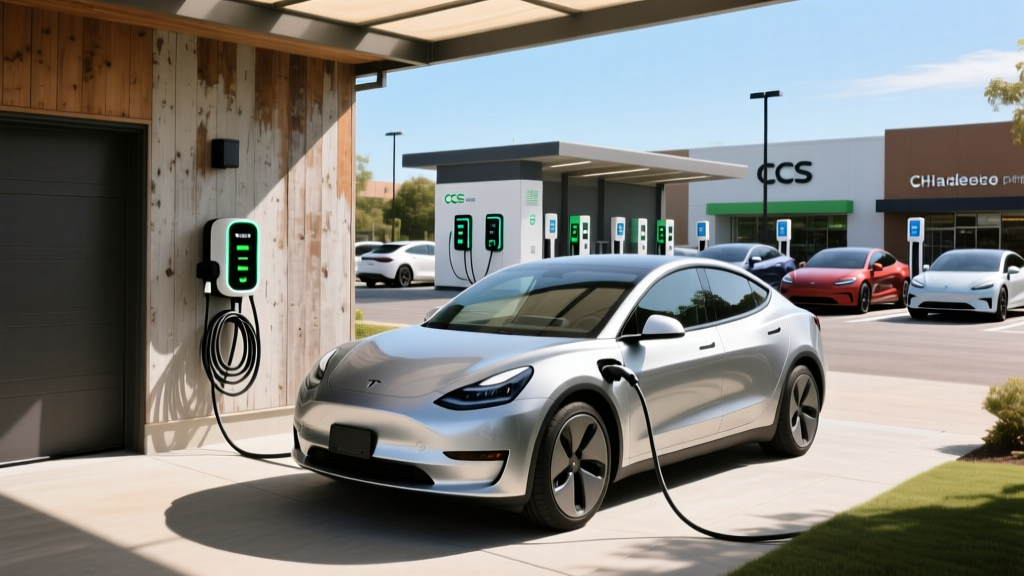
DC Fast Charging on the Road: What to Expect
The 2026 Ioniq 5 SE Standard Range supports up to 180 kW peak DC fast charging on its 400V architecture. Hyundai's battery preconditioning feature — activated automatically when you set a DC fast charger as your navigation destination — warms the battery to optimal temperature for maximum charge acceptance.
Real-world 10–80% charge times:
- 350 kW station (preconditioned): ~18 minutes (peak 180 kW, tapering above 55% SoC)
- 150 kW station (preconditioned): ~22 minutes
- 50 kW station: ~55 minutes (no taper advantage — flat rate)
- Cold battery (no preconditioning, below 40°F): Add 5–10 minutes; peak rate may drop to 120–140 kW
Charge curve reality: The Ioniq 5 holds near-peak power (160–180 kW) from roughly 10% to 55% SoC, then tapers to ~80 kW through 70%, and drops below 40 kW past 80%. This is why road-trip strategy focuses on the 10–80% window — charging from 80–100% at a DC fast charger can take as long as the 10–80% session itself.
Frequently Asked Questions
How much does it cost to install a home EV charger for the Ioniq 5?
Most homeowners with a 200A electrical panel will spend $800–$2,500 total (equipment + electrician + permit). Homes needing a panel upgrade from 100A to 200A should budget $2,300–$6,000. The IRS §25D credit covers 30% of equipment and installation, up to $1,000.
Can I charge the 2026 Ioniq 5 on a regular 120V outlet?
Yes, but Level 1 (120V) delivers only ~1.4 kW, adding about 3–4 miles of range per hour. A full charge of the 58 kWh battery takes 55–65 hours. Level 1 is viable only if you drive under 20 miles daily and can leave the car plugged in overnight. For most owners, it's an emergency backup, not a primary strategy.
Does the 2026 Ioniq 5 use NACS or CCS?
The 2026 Ioniq 5 SE Standard Range comes with a native NACS (J3400) charge port. This gives direct access to Tesla Superchargers and the growing NACS-equipped public network. For legacy CCS1 stations, you'll need a NACS-to-CCS adapter (~$150–$200).
How much does charging the Ioniq 5 cost per mile vs. gas?
At the national average residential electricity rate ($0.16/kWh), the Ioniq 5 SE Standard Range costs roughly $0.042 per mile. A comparable gas SUV at 25 MPG and $3.40/gallon costs $0.136 per mile — over three times more. Even public DC fast charging at $0.45/kWh ($0.118/mile) undercuts gasoline.
What electrical upgrades might my home need?
If your home has a 200A panel with spare capacity, you likely need only a new 60A breaker and a wire run to your garage or parking spot. Homes with 100A panels — common in pre-1990 construction — will likely need a panel upgrade to 200A, adding $1,500–$3,500 to the project. Some utility companies offer rebates for panel upgrades tied to EV adoption.
Does the Ioniq 5 SE Standard Range qualify for the $7,500 federal tax credit?
The 2026 Ioniq 5 SE Standard Range is eligible for up to $7,500 under IRS §30D, provided you meet income caps ($150K single / $300K joint), the vehicle MSRP is under $80,000 (it is), and the battery meets critical-mineral and component-sourcing thresholds. The credit can be transferred to the dealer as a point-of-sale discount. Rules are subject to change — always verify current eligibility at IRS.gov or with a tax professional before purchasing.
Sources: EPA range and efficiency data via fueleconomy.gov; Hyundai Ioniq 5 specifications via Hyundai USA; Federal tax credit rules via IRS.gov §30D Clean Vehicle Credit.