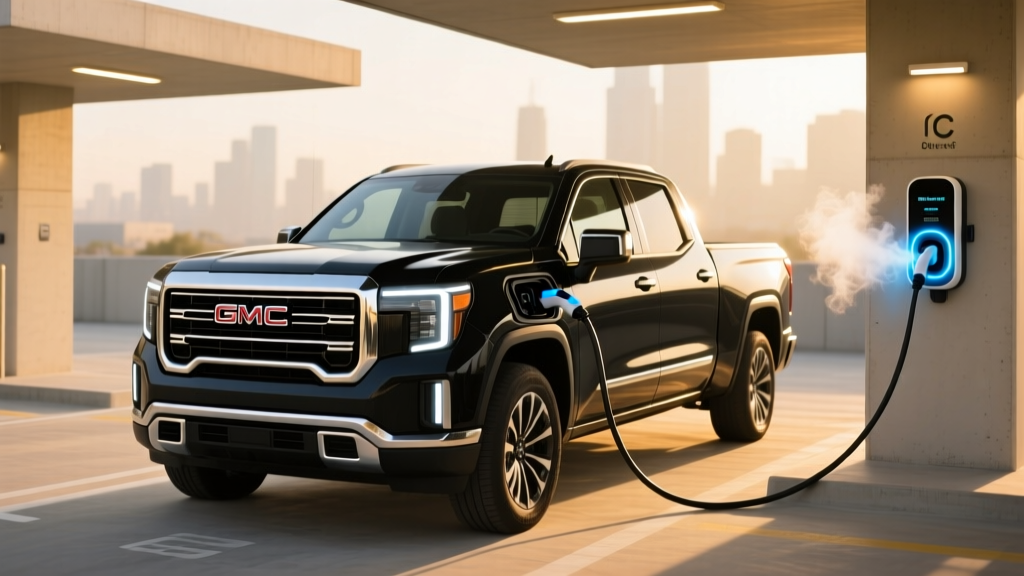
The 2026 GMC Sierra EV Elevation with the Standard Range battery brings full-size electric truck capability to a more accessible price point. But owning an EV truck means understanding how to keep its large battery full — whether you're plugging in at home overnight or topping up on a highway road trip. This guide breaks down exactly how to charge the Sierra EV Elevation Standard Range, what equipment you need, what it costs, and the electrical upgrades your home might require.
2026 GMC Sierra EV Elevation Standard Range: Key Charging Specs
Before we get into chargers and installation, here are the numbers that define the Sierra EV Elevation Standard Range's charging profile. These specs drive every recommendation below.
| Spec | Value |
|---|---|
| Battery Capacity (usable) | ~100 kWh (estimated, Ultium NMC chemistry) |
| EPA Range | ~280 miles (estimated; GM has not published final EPA cert for Standard Range as of early 2026) |
| Real-World Highway Range | ~220–250 miles (70+ mph, moderate temps); ~180–210 miles in sub-30°F cold |
| Max DC Fast Charge Rate | Up to ~200 kW (peak) |
| 10–80% DC Fast Charge Time | ~35–40 minutes (estimated based on Ultium platform curve) |
| Onboard AC Charger (Level 2) | 19.2 kW (max, with optional Dual-Level Charge Cord upgrade); 11.5 kW standard |
| Charge Port / Connector | NACS (Tesla-compatible, native) |
| Efficiency | ~2.0–2.3 kWh/mile (estimated, varies with payload/towing) |
| Base MSRP | ~$57,000 (Elevation trim, Standard Range, before incentives) |
| Battery Warranty | 8 years / 100,000 miles (capacity retention threshold: ~60–70% per GM) |
Charging Levels Explained: Level 1, Level 2, and DC Fast Charging
There are three ways to charge the Sierra EV Elevation, each with dramatically different speeds. Understanding the difference between kW (kilowatts — the rate of power flow, like water pressure from a hose) and kWh (kilowatt-hours — the total energy stored, like gallons in a tank) is critical. Your battery holds roughly 100 kWh of energy. A charger delivering 10 kW would theoretically take 10 hours to fill it from empty. Here's how each level performs:
| Level | Voltage | Max Power (kW) | Miles of Range Added Per Hour | Full 10–80% Time (approx.) |
|---|---|---|---|---|
| Level 1 (Standard 120V Outlet) | 120V | 1.4 kW | ~3–4 miles/hr | 50+ hours (impractical for full charge) |
| Level 2 (240V Home Charger) | 240V | 11.5 kW (standard onboard) 19.2 kW (with upgrade) | ~25–30 miles/hr (11.5 kW) ~42–48 miles/hr (19.2 kW) | ~6 hours (11.5 kW) ~3.5 hours (19.2 kW) |
| DC Fast Charging (Public) | 400V+ DC | Up to ~200 kW (peak) | ~150–200+ miles in 10 min (peak) | ~35–40 minutes (10–80%) |
Key takeaway: Level 1 is an emergency trickle — useful only if you drive less than 30 miles per day and have 12+ hours between drives. Level 2 at home is where 90%+ of Sierra EV charging will happen. DC fast charging is for road trips and quick top-ups when away from home.
Home Level 2 Charger Installation: Requirements, Costs, and Panel Upgrades
Installing a Level 2 home charger for the Sierra EV Elevation Standard Range means adding a dedicated 240-volt circuit to your electrical panel. Here's what's involved and what it costs.
Electrical Requirements
- Standard 11.5 kW onboard charger: Requires a 240V / 60-amp dedicated circuit (48A continuous draw — NEC code requires the breaker to be rated 125% above continuous load).
- Optional 19.2 kW onboard charger: Requires a 240V / 100-amp dedicated circuit (80A continuous draw). This is a significant electrical upgrade — many homes don't have spare capacity for this.
- Wire gauge: 6 AWG copper for 60A circuits; 2 AWG or larger for 100A circuits.
- Outlet vs. hardwired: Hardwired installations are preferred for high-amperage chargers (more reliable, no plug overheating risk). A NEMA 14-50 outlet works for 40–50A chargers with a plug.
Panel Upgrade Considerations
This is the hidden cost many EV buyers overlook. If your home has a 100-amp main electrical panel (common in homes built before 2000), adding a 60A EV charger circuit will likely require a panel upgrade to 200 amps. Even some 200A panels are already near capacity with HVAC, electric range, and dryer loads. Your electrician will perform a load calculation per NEC Article 220 to determine if your panel can handle the additional draw.
Installation Cost Breakdown
| Component | Low End | High End | Notes |
|---|---|---|---|
| Level 2 Charger Equipment | $400 | $1,200 | 40A–48A smart charger (see recommendations below) |
| Electrician Labor (standard install) | $600 | $1,800 | Depends on run length from panel to garage/driveway |
| Permit & Inspection | $50 | $300 | Required by most jurisdictions; varies by municipality |
| Panel Upgrade (if needed) | $1,500 | $4,500 | 100A → 200A service upgrade; not needed in most newer homes |
| Conduit, Wiring, Misc. Materials | $100 | $500 | Longer wire runs cost more |
| Total (no panel upgrade) | $1,150 | $3,800 | Typical scenario for homes with 200A panel |
| Total (with panel upgrade) | $2,650 | $8,300 | Older homes needing service upgrade |
The IRS §30D tax credit does not cover home charger installation directly (that was the §30C credit, which has modified eligibility for 2026). Check current IRS rules or consult a tax professional for your specific situation. Some utilities offer rebates of $250–$1,000 for Level 2 charger installation — contact your local provider.
Connector Compatibility: NACS, CCS, and Adapter Needs
The 2026 GMC Sierra EV Elevation uses the NACS (North American Charging Standard) connector natively. This is a major advantage — it means direct access to the Tesla Supercharger network (the largest and most reliable DC fast-charging network in North America) without any adapter.
| Connector Type | Native Support? | Adapter Needed? | Network Access |
|---|---|---|---|
| NACS (Tesla-style) | Yes — native port | No | Tesla Superchargers, Electrify America (NACS stalls), Rivian Adventure Network, many others |
| CCS1 | No | Yes — NACS-to-CCS adapter (available from Tesla, Lectron, others; ~$150–$250) | Legacy Electrify America CCS stalls, ChargePoint DC, EVgo (some locations) |
| CHAdeMO | No | Yes — NACS-to-CHAdeMO adapter (limited availability, ~$200–$400) | Largely legacy; Nissan Leaf network, some older stations |
| J1772 (Level 2 AC) | No (NACS port) | Yes — J1772-to-NACS adapter (typically included with vehicle or ~$100) | Public Level 2 stations (ChargePoint, Blink, etc.) |
Practical recommendation: Carry a NACS-to-CCS adapter in the truck at all times. While NACS is rapidly becoming the dominant standard, many existing public chargers — especially at shopping centers and workplaces — still use CCS1 or J1772 connectors. The adapter ensures you're never stranded.
Cost to Charge: Home vs. Public vs. Gas Comparison
One of the strongest arguments for the Sierra EV Elevation is fuel cost savings — especially if you can charge at home on off-peak electricity rates. Here's a realistic breakdown.
| Scenario | Cost per kWh | Cost to Add 200 Miles | Cost per Mile |
|---|---|---|---|
| Home Level 2 (off-peak utility rate) | $0.10–$0.14/kWh | $20–$28 | $0.10–$0.14/mile |
| Home Level 2 (standard residential rate) | $0.15–$0.20/kWh | $30–$40 | $0.15–$0.20/mile |
| Public Level 2 (network pricing) | $0.25–$0.49/kWh | $50–$98 | $0.25–$0.49/mile |
| DC Fast Charging (Tesla Supercharger) | $0.28–$0.42/kWh | $56–$84 | $0.28–$0.42/mile |
| DC Fast Charging (Electrify America / EVgo) | $0.35–$0.55/kWh | $70–$110 | $0.35–$0.55/mile |
| Gasoline Truck (comparable Sierra 1500, 19 MPG combined, $3.40/gal) | — | $35.79 (10.5 gal) | $0.18/mile |
Bottom line: If you charge primarily at home on off-peak rates, the Sierra EV Elevation Standard Range costs roughly 40–50% less per mile to "fuel" than a comparable gas Sierra 1500. If you rely entirely on public DC fast charging, costs can equal or exceed gasoline. Home charging access is the single biggest variable in EV ownership economics.
Assuming 15,000 miles/year with 80% home charging at $0.13/kWh and 20% DC fast charging at $0.35/kWh, annual fuel cost is approximately $2,670. A gas Sierra 1500 at 19 MPG and $3.40/gallon would cost roughly $2,684 — and that's before accounting for the EV's reduced maintenance (no oil changes, less brake wear from regen). The savings compound significantly if your utility offers cheaper time-of-use rates or if gas prices rise.
Recommended Home Level 2 Chargers for the Sierra EV Elevation
Since the Sierra EV Elevation uses a NACS port natively, you'll want a NACS-equipped Level 2 charger (or a J1772 charger with an adapter). Here are top picks that balance power output, reliability, smart features, and price.
Tesla Wall Connector (NACS)
- Power Output: Up to 11.5 kW (48A on 60A circuit)
- Connector: NACS native — no adapter needed
- Cable Length: 24 feet
- Smart Features: Wi-Fi, OTA updates, power sharing between units, load management
- Price: ~$475
- Best For: Sierra EV owners who want the simplest NACS-native experience
ChargePoint Home Flex (NACS version)
- Power Output: Up to 12 kW (50A on 60A circuit); adjustable down to 16A
- Connector: Available in NACS or J1772 (choose NACS for Sierra EV)
- Cable Length: 24 feet
- Smart Features: App scheduling, Alexa integration, detailed energy tracking
- Price: ~$550–$650
- Best For: Owners who want granular app control and flexible amperage settings
Grizzl-E Smart (NACS)
- Power Output: Up to 10 kW (40A on 50A circuit)
- Connector: Available in NACS
- Cable Length: 24 feet
- Smart Features: OCPP-compatible, works with multiple energy management platforms
- Price: ~$450–$550
- Best For: Budget-conscious buyers; extremely durable outdoor-rated build
Note on 19.2 kW charging: To take advantage of the Sierra EV's optional 19.2 kW onboard AC charger, you'd need a charger capable of 80A output on a 100A circuit. Very few residential chargers support this today, and the electrical infrastructure cost is substantial. For most owners, a 48A (11.5 kW) charger on a 60A circuit provides the best balance of overnight charging speed and installation cost.
DC Fast Charging on the Road: What to Expect
The Sierra EV Elevation Standard Range's estimated 200 kW peak DC fast-charge capability means meaningful road-trip stops. But peak rate isn't sustained rate — here's the reality of the charging curve.
- 10–30% SoC: The battery accepts close to peak power (~180–200 kW). You'll add roughly 80–100 miles of range in the first 10 minutes.
- 30–60% SoC: Charge rate tapers to roughly 120–150 kW as battery management protects cell health.
- 60–80% SoC: Further taper to ~80–100 kW. This is why the "10–80%" metric is standard — charging above 80% slows dramatically.
- 80–100% SoC: Trickle charging at 20–40 kW. Avoid charging past 80% on road trips unless you're at your final destination.
Cold-weather charging note: In temperatures below 40°F, the battery must warm itself before accepting peak charge rates. Use the truck's navigation-based battery preconditioning (route to a charger via the infotainment system) to minimize this delay. Without preconditioning, expect 10–15 minutes of reduced charge rates at the start of a cold-weather session.
Safety, Code, and Best Practices
Home EV charger installation is electrical work that must comply with the National Electrical Code (NEC) and your local jurisdiction's requirements. Non-negotiable items:
- Dedicated circuit: Your Level 2 charger must be on its own dedicated breaker — never shared with other appliances.
- GFCI protection: NEC 2020 and later require GFCI (Ground Fault Circuit Interrupter) protection for outdoor receptacles. Hardwired chargers may not require a GFCI breaker in all jurisdictions — your electrician will advise.
- Outdoor rating: If your charger is installed outside (driveway or exterior wall), it must carry a NEMA 4 or IP65 weather-resistance rating. All chargers listed above meet this standard.
- Permit and inspection: Most municipalities require an electrical permit for EV charger installation. The inspection ensures the work meets code — don't skip this step, as unpermitted work can cause insurance issues.
- Cable management: Use a holster or cable organizer to keep the cord off the ground and prevent trip hazards and connector damage.
Always hire a licensed electrician — ideally one with EV charger installation experience. Get at least two quotes, as pricing varies significantly based on wire run length and local labor rates.
Frequently Asked Questions
How much does it cost to install a home EV charger for the Sierra EV Elevation?
Expect $1,150–$3,800 for a typical installation (charger + electrician + permit) if your home already has a 200-amp electrical panel. If a panel upgrade from 100A to 200A is needed, add $1,500–$4,500. Total range: $1,150–$8,300 depending on your home's electrical infrastructure.
How fast will each charging level add range to the Sierra EV Elevation Standard Range?
Level 1 (120V) adds roughly 3–4 miles per hour — essentially overnight trickle charging. Level 2 (240V at 48A/11.5 kW) adds approximately 25–30 miles per hour, enough to fully replenish daily driving in 2–3 hours. DC fast charging at peak rate can add 80–100 miles in about 10 minutes.
Which connector does the 2026 GMC Sierra EV Elevation use?
The Sierra EV Elevation uses a native NACS (Tesla-style) charge port. This gives direct access to Tesla Superchargers and the growing NACS public charging network without adapters. For legacy CCS1 or J1772 public chargers, you'll need a NACS-to-CCS or J1772-to-NACS adapter.
How much does charging the Sierra EV cost per mile compared to gas?
Home charging on off-peak rates costs roughly $0.10–$0.14 per mile. A comparable gas Sierra 1500 at 19 MPG and $3.40/gallon costs about $0.18 per mile. Public DC fast charging ranges from $0.28–$0.55 per mile. The biggest savings come from maximizing home charging.
What electrical upgrades might my home need for a Level 2 charger?
A 48A Level 2 charger requires a dedicated 60A, 240V circuit. If your home has a 100-amp main panel (common in pre-2000 homes), you'll likely need a panel upgrade to 200 amps ($1,500–$4,500). Even some 200A panels may be near capacity — your electrician will perform a NEC Article 220 load calculation to determine if spare capacity exists.
Does the Sierra EV Elevation Standard Range qualify for the federal EV tax credit?
The IRS §30D clean vehicle credit offers up to $7,500 for eligible new EVs, but eligibility depends on MSRP caps (trucks: $80,000), buyer income limits ($300K joint / $150K single), battery component sourcing, and critical mineral requirements. The Sierra EV Elevation Standard Range is expected to fall under the MSRP cap, but battery sourcing rules are complex and subject to change. Verify current eligibility on the IRS website or with a tax professional before purchasing. The credit can be transferred to the dealer as a point-of-sale discount for 2026.
Can I use a Tesla Supercharger with the GMC Sierra EV?
Yes. The 2026 Sierra EV Elevation has a native NACS port, which is the same connector used by Tesla Superchargers. You can pull up, plug in, and charge — no adapter needed. Use the Tesla app or the in-vehicle navigation to locate Supercharger stalls. Note that some older Supercharger stalls (V2, 150 kW) will charge the truck slower than newer V3/V4 stalls (250 kW+), though the Sierra EV's peak acceptance rate of ~200 kW means V3 stalls are sufficient for maximum speed.
Should I charge to 100% every night?
No. GM's Ultium batteries use NMC chemistry, which degrades faster when held at 100% state of charge for extended periods. Set your daily charge limit to 80–90% for routine driving. Reserve 100% charges for road trips or days when you need maximum range. The truck's battery management system includes a buffer (some unusable capacity above and below the displayed 0–100%), but limiting your upper SoC is still the single best practice for long-term battery health.