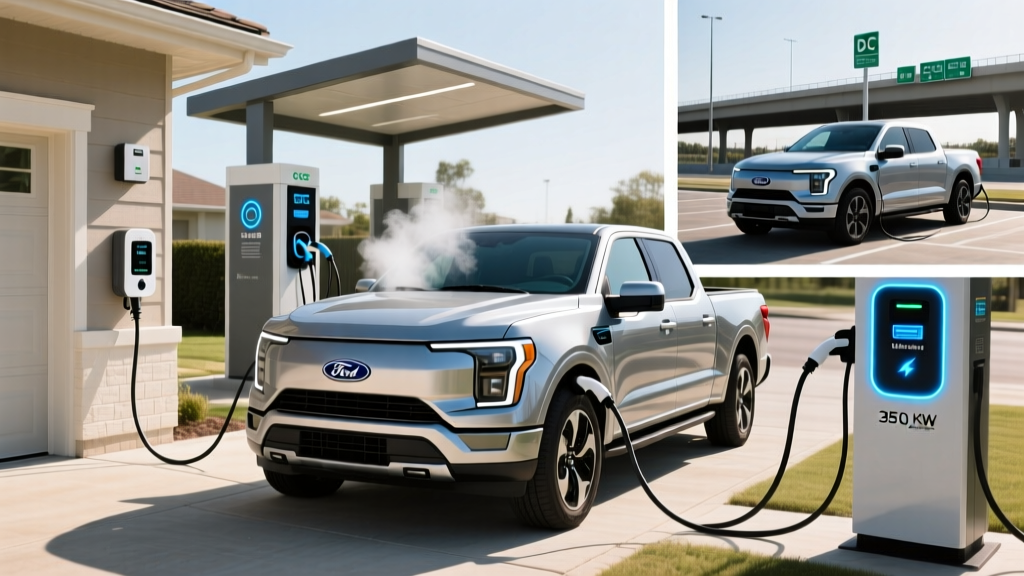
The 2026 Ford F-150 Lightning is one of the most capable electric trucks on the market, but its usefulness hinges on one question: how do you keep its massive battery fed? Whether you're spec'ing the standard-range 98 kWh pack or the extended-range 131 kWh pack, charging logistics — at home, on the road, and at the job site — define the ownership experience. This guide breaks down every 2026 Ford F-150 Lightning charging scenario with exact kW rates, real-world times, connector details, and installed costs so you can plan before you buy.
2026 F-150 Lightning Battery and Charging Specs at a Glance
Before we get into charging infrastructure, here are the hard numbers for the 2026 model year. Ford continues to offer two battery sizes built on NMC (nickel manganese cobalt) lithium-ion chemistry, which prioritizes energy density over the cycle-life advantages of LFP. Both packs support DC fast charging, but the larger pack takes significantly longer to fill from low states of charge.
| Spec | Standard Range | Extended Range |
|---|---|---|
| Battery capacity (usable) | 98 kWh | 131 kWh |
| EPA range | ~240 miles | ~320 miles |
| Max DC fast charge rate | 150 kW | 150 kW |
| 10–80% DC fast charge time | ~41 minutes | ~45 minutes |
| Level 2 onboard charger | 10.5 kW (single) / 19.2 kW (dual) | 19.2 kW (dual, standard) |
| Connector (2026 model year) | NACS (native Tesla-style) | |
| Battery warranty | 8 years / 100,000 miles (≥70% capacity retention) | |
Charging Levels Explained: How Fast Does Each Add Range?
Understanding the three charging tiers is essential for F-150 Lightning owners. Here's a critical distinction that trips up many new EV buyers: kW (kilowatts) measures power — how fast energy flows into the battery. kWh (kilowatt-hours) measures energy — how much the battery holds total. Think of kW as the width of the hose and kWh as the size of the bucket.
| Charging Level | Power (kW) | Voltage / Amps | Miles of Range per Hour | Best Use Case |
|---|---|---|---|---|
| Level 1 (standard outlet) | 1.4 kW | 120V / 12A | ~3–4 miles | Emergency trickle; overnight top-off |
| Level 2 (single onboard charger) | 10.5 kW | 240V / 48A | ~27–30 miles | Daily home charging (standard-range models) |
| Level 2 (dual onboard chargers) | 19.2 kW | 240V / 80A | ~50–55 miles | Fastest home option; extended-range models |
| DC Fast Charging | Up to 150 kW | 400V+ / variable | ~200–400 miles (peak rate) | Road trips; rapid replenishment |
Why the DC fast charge "miles per hour" looks so high: That figure reflects the peak charge rate near 10–20% state of charge (SoC). As the battery fills past ~80%, the charge rate tapers sharply to protect cell health. A session from 10–80% averages roughly 100–110 kW for the extended-range pack, not the full 150 kW peak. This charge-curve taper is why we report 10–80% times rather than "full charge" times.
Home Level 2 Installation: Electrical Requirements, Costs, and Gotchas
Home charging is where the F-150 Lightning ownership equation really pays off — but installation is not trivial. Here's what your electrician needs to know and what you should budget.
Electrical Requirements
To unlock the Lightning's dual onboard charger capability (19.2 kW), you need a 240V / 100A dedicated circuit with a hardwired wall connector. Most homes have a 200A main electrical panel, and dedicating 100A to a single circuit may push you close to — or over — your panel's capacity, especially if you're also running electric HVAC, a dryer, and an oven. This is where a panel upgrade to 400A or a secondary subpanel may be required.
For the single onboard charger (10.5 kW), a 240V / 60A circuit is sufficient, which is far more compatible with existing 200A panels.
Installation Cost Breakdown
| Component | Basic Install (10.5 kW) | High-Power Install (19.2 kW) |
|---|---|---|
| Level 2 charger equipment | $400–$700 | $600–$1,200 |
| Electrician labor (3–6 hours) | $600–$1,500 | $800–$2,500 |
| Electrical permit | $50–$200 | $50–$300 |
| Panel upgrade (if needed) | N/A (usually not needed) | $1,500–$4,000 |
| Conduit/wiring (long runs >50 ft) | $200–$600 | $400–$1,200 |
| Total estimated range | $1,250–$3,000 | $2,350–$9,200 |
Connector Compatibility: NACS, CCS, and What You Need to Know
For 2026, the F-150 Lightning ships with a native NACS (North American Charging Standard) port — the Tesla-style connector now adopted across most of the industry. This is a significant shift from the CCS1 port on 2022–2024 models. Here's how that affects your charging options:
| Network / Connector | Compatibility | Notes |
|---|---|---|
| Tesla Supercharger (NACS) | ✅ Native — no adapter needed | Access to 21,000+ Supercharger stalls; V3 stalls deliver up to 150 kW |
| Electrify America (CCS1) | ⚠️ NACS-to-CCS adapter required | Adapter available from Ford and third parties; verify kW compatibility |
| EVgo / ChargePoint (NACS stalls) | ✅ Native at NACS-equipped stalls | Many networks adding NACS connectors through 2025–2026 |
| Legacy CHAdeMO stations | ❌ Not compatible | CHAdeMO is effectively deprecated for new vehicles |
| Home Level 2 (J1772/NACS) | ✅ NACS home chargers widely available | Tesla Wall Connector, Ford Pro, and others offer NACS plugs |
If you own a 2022–2024 Lightning with a CCS1 port: Ford offers a CCS-to-NACS adapter for accessing Tesla Superchargers. Confirm adapter availability and firmware compatibility with your dealer. The charging speed will still be limited by your truck's onboard CCS1 charge controller.
Level 2 Home Charger Recommendations for the F-150 Lightning
Not all Level 2 chargers are created equal. Below are units we recommend based on power output, connector availability, cable management, and smart features that matter for truck owners.
Tesla Wall Connector (NACS)
- Max output: 11.5 kW (48A) on 60A circuit
- Connector: NACS native
- Cable length: 24 ft
- Smart features: Wi-Fi, OTA updates, load sharing between two units
- Outdoor rated: Yes (NEMA 4)
- Price: ~$475
- Best for: Standard-range Lightning owners; budget-conscious installs
Ford Charge Station Pro (19.2 kW)
- Max output: 19.2 kW (80A) on 100A circuit
- Connector: NACS native
- Cable length: 25 ft
- Smart features: FordPass integration, Intelligent Backup Power (V2H capable with Home Integration System)
- Outdoor rated: Yes
- Price: ~$1,300
- Best for: Extended-range Lightning; V2H home backup power
Grizzl-E Smart (NACS)
- Max output: 11.5 kW (48A), adjustable down to 16A
- Connector: NACS or J1772 available
- Cable length: 24 ft
- Smart features: EV Energy app, energy tracking, OCPP compatibility
- Outdoor rated: Yes (IP67)
- Price: ~$550
- Best for: Flexible amperage for older panels; rugged outdoor use
Why we don't recommend a 40A/9.6 kW charger for the Lightning: With a 131 kWh extended-range pack, a 9.6 kW charger adds roughly 25 miles per hour. To go from 20% to 100% would take over 11 hours — feasible but tight if you drive heavily during the day. A 48A or 80A charger cuts that time dramatically and future-proofs your installation.
DC Fast Charging on the Road: Networks, Speeds, and the Charge Curve
The F-150 Lightning's 150 kW peak DC fast charge rate is competitive for a full-size truck but trails the 250+ kW rates of some passenger EVs. Here's what that means in practice at public fast chargers:
Typical 10–80% session times:
- 150 kW charger (e.g., Tesla V3 Supercharger, EA 150 kW): ~41 min (standard range) / ~45 min (extended range)
- 350 kW charger (e.g., EA 350 kW stall): Same times — the Lightning cannot accept more than 150 kW, so the extra capacity is unused
- 50 kW legacy DC charger: ~95 min (standard) / ~130 min (extended) — avoid these for road trips
Supercharger access: With the native NACS port, the 2026 Lightning accesses Tesla Superchargers directly. Tesla's V3 stalls deliver up to 250 kW, but the Lightning is capped at 150 kW. V4 Supercharger stalls with CCS/NACS cables are rolling out through 2026 and may offer improved cable reach for the Lightning's charge port location (driver-side front fender).
Cost to Charge the F-150 Lightning: Home vs. Public vs. Gas
This is where the Lightning's economics become compelling — or not, depending on your local electricity rates and driving patterns. Below is a cost-per-mile breakdown using national averages and real-world scenarios.
| Scenario | Cost per kWh | Cost for Full Charge (131 kWh) | Cost per Mile (320 mi range) |
|---|---|---|---|
| Home charging (national avg. residential) | $0.17/kWh | $22.27 | $0.07/mi |
| Home charging (off-peak time-of-use rate) | $0.09/kWh | $11.79 | $0.04/mi |
| Public Level 2 (ChargePoint, EVgo L2) | $0.30/kWh | $39.30 | $0.12/mi |
| DC fast charging (Electrify America) | $0.48/kWh | $62.88 | $0.20/mi |
| Tesla Supercharger (avg. 2026) | $0.32/kWh | $41.92 | $0.13/mi |
| Gas F-150 (18 MPG combined, $3.40/gal) | N/A | N/A | $0.19/mi |
The bottom line: Home charging at off-peak rates makes the Lightning roughly 4–5× cheaper per mile than a comparable gas F-150. Even public DC fast charging at Electrify America rates is competitive with gas. But if you rely exclusively on expensive public DC chargers, your cost per mile can actually exceed a gas truck. This is why home charging access is the single most important factor in EV ownership economics.
For annual cost projections: a driver covering 15,000 miles/year with 80% home charging (off-peak) and 20% public DC fast charging would spend roughly $1,050/year on electricity vs. $2,830/year on gasoline for the equivalent gas F-150 — a savings of ~$1,780 annually. Over a 5-year ownership period, that's nearly $8,900 in fuel savings, partially offsetting the Lightning's higher purchase price.
Safety, Permits, and Code Considerations
A 19.2 kW charger pulling 80A is a serious electrical load. Here's what the National Electrical Code (NEC) and best practices require:
- Dedicated circuit: Your EV charger must be on its own dedicated breaker — no sharing with other appliances. A 19.2 kW charger requires a 100A breaker; a 10.5 kW charger requires a 60A breaker.
- GFCI protection: NEC 2020 and later require GFCI protection for all EV charging outlets. Hardwired units (recommended for 80A circuits) may have GFCI built into the charger itself. Confirm with your electrician and local inspector.
- Outdoor rating: If your charger is mounted outdoors or in an unenclosed carport, it must carry at minimum a NEMA 4 rating (weather-resistant). NEMA 3R is insufficient for wind-driven rain.
- Wire gauge: A 100A circuit typically requires 1/0 AWG copper or 3/0 AWG aluminum conductors. Long wire runs (>100 ft) may require upsizing to prevent voltage drop.
- Permit and inspection: Virtually all jurisdictions require an electrical permit for EV charger installation. The inspection ensures your wiring, breaker sizing, and grounding meet code. Skipping the permit can void homeowner's insurance coverage for electrical fires.
- Load management: Some chargers (including the Ford Charge Station Pro) support load management — a feature that monitors your home's total electrical draw and throttles the charger if you approach your panel's capacity. This can avoid a costly panel upgrade.
Frequently Asked Questions: 2026 F-150 Lightning Charging
How much does it cost to install a home EV charger for the F-150 Lightning?
Expect to spend $1,250–$3,000 for a basic 10.5 kW (48A) installation in a home with a modern 200A panel and short wiring runs. For a full 19.2 kW (80A) installation, budget $2,350–$9,200, with the wide range driven by whether you need a panel upgrade ($1,500–$4,000) and the length of conduit runs. Always get a load calculation from a licensed electrician before committing to equipment.
How fast will each charging level add range to the Lightning?
Level 1 (120V standard outlet) adds about 3–4 miles per hour — essentially useless for daily driving but fine for maintaining charge on a parked truck. Level 2 at 10.5 kW adds ~28 miles per hour, enough to replenish a full day's driving overnight. Level 2 at 19.2 kW (dual charger) adds ~50 miles per hour, fully recharging the extended-range pack in about 7 hours. DC fast charging at 150 kW can add ~130 miles in 15 minutes at peak rate.
Which connector and charger are compatible with my 2026 Lightning?
The 2026 F-150 Lightning uses a native NACS connector. This means direct compatibility with Tesla Superchargers, Tesla Wall Connectors, and an expanding network of NACS-equipped public chargers from EVgo, ChargePoint, and others. For CCS1-equipped chargers (some Electrify America and older stations), you'll need a NACS-to-CCS adapter. For home charging, any NACS-equipped Level 2 charger will work — the Tesla Wall Connector ($475), Ford Charge Station Pro ($1,300), and Grizzl-E Smart NACS ($550) are top picks.
How much does charging cost per mile vs. gas?
At home with off-peak electricity rates (~$0.09/kWh), the extended-range Lightning costs about $0.04 per mile. At national average residential rates ($0.17/kWh), it's $0.07 per mile. A comparable gas F-150 at 18 MPG combined and $3.40/gallon costs $0.19 per mile. Home charging delivers 3–5× savings. However, public DC fast charging at $0.48/kWh pushes cost to $0.20 per mile — slightly more than gas — underscoring why home charging access is critical to the value proposition.
What electrical upgrades might I need for a 19.2 kW charger?
The most common upgrade is a main panel replacement from 100A or 150A to 200A or 400A, costing $1,500–$4,000. Homes with 200A panels may still need a load calculation to confirm 100A can be dedicated to the charger without exceeding 80% of panel capacity (the NEC continuous-load rule). If your panel is maxed out, alternatives include a panel upgrade, a subpanel, or choosing a load-managing charger that dynamically adjusts power draw. Long wire runs from the panel to the garage or driveway can add $400–$1,200 in conduit and wire costs.
Can I use the F-150 Lightning to power my home during an outage?
Yes — but only with the Ford Charge Station Pro paired with the Ford Home Integration System (a separate transfer switch and inverter setup, ~$3,900 installed). This vehicle-to-home (V2H) system allows the Lightning's extended-range 131 kWh battery to power an average home for up to 3 days during an outage. Standard Level 2 chargers and the truck's Pro Power Onboard bed outlets do not provide whole-home backup without this system.
Does the Lightning qualify for federal tax credits that offset charging costs?
The IRC §30C Alternative Fuel Vehicle Refueling Property Credit covers 30% of home EV charger equipment and installation costs, up to $1,000, but only for installations in eligible census tracts (typically low-income or non-urban areas). The truck itself may qualify for the §30D Clean Vehicle Credit up to $7,500, subject to MSRP caps ($80,000 for trucks), buyer income limits, and battery-sourcing requirements. Eligibility changes frequently — consult irs.gov and a tax professional before relying on credit amounts in your purchase decision.