Why 2-Door EV Owners Need a Tailored Charging Strategy
Owning a 2-door electric vehicle — whether it's a Ford Mustang Mach-E (technically a crossover-coupe), a BMW i4 M50, a Tesla Model 3, or a Porsche Taycan — comes with a charging reality that differs subtly from the broader EV market. Lower rooflines, shorter wheelbases, and sportier packaging often mean smaller battery packs (60–90 kWh usable), tighter garage clearances, and charge ports positioned low or on the driver's side. When you're shopping for a home Level 2 charger in 2026, these details matter: cable length, connector orientation, and amperage all affect how smoothly your daily charging routine works.
This guide covers everything you need to select, install, and operate a 2-door EV charger at home and on the road — from electrical requirements and connector compatibility to real-world charging costs and equipment picks. Every number here is grounded in EPA data, manufacturer specs, and current 2026 pricing.
Understanding EV Charging Levels: kW, kWh, and Miles Per Hour
Before choosing equipment, the most critical distinction to internalize: kW (kilowatts) measures power — how fast energy flows into your battery. kWh (kilowatt-hours) measures energy — the total capacity of your battery. Think of kW as the width of a hose and kWh as the size of the bucket. A 48-amp Level 2 charger delivers up to 11.5 kW of power; an 80 kWh battery holds 80 kWh of energy.
Here's how each charging level performs with real numbers:
| Level | Voltage | Max Power (kW) | Miles of Range Added Per Hour | Typical Use Case |
|---|---|---|---|---|
| Level 1 | 120V AC | 1.4–1.9 kW | 3–5 mi/hr | Overnight trickle; PHEVs with small batteries |
| Level 2 (Home/Public AC) | 240V AC | 3.3–19.2 kW | 12–75 mi/hr | Daily home charging; workplace; destination |
| DC Fast Charging | 200–800V DC | 50–350 kW | 150–1,200+ mi/hr (peak) | Road trips; 10–80% in 15–40 min |
For most 2-door EV owners, a Level 2 home charger rated at 40–48 amps (9.6–11.5 kW on a 240V circuit) is the sweet spot. A BMW i4 with an 80.7 kWh usable battery, for example, will recharge from 10% to 80% in roughly 7–8 hours at 11.5 kW — ideal for overnight charging. A Porsche Taycan with its 83.7 kWh pack takes about the same time at that rate.
Home Charger Installation: Electrical Requirements and Costs
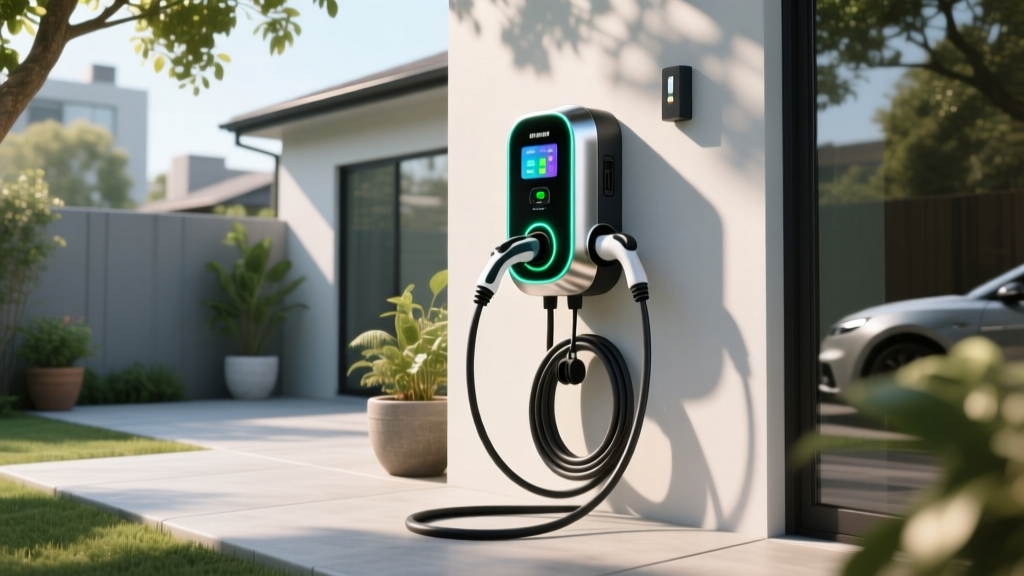
Installing a 2-door EV charger at home starts with understanding your electrical panel's capacity. Most homes built after 2000 have a 200-amp main panel, which can typically support a dedicated 50-amp circuit (for a 40-amp charger) or a 60-amp circuit (for a 48-amp charger). Older homes with 100-amp or 150-amp service may need a panel upgrade — a significant added cost.
Here's a realistic cost breakdown based on 2026 national averages:
| Component | Low-End Cost | High-End Cost | Notes |
|---|---|---|---|
| Level 2 Charger (Equipment) | $300 | $750 | 40–48A, hardwired or NEMA 14-50 plug |
| Electrician Labor | $500 | $2,000 | Depends on run length from panel to garage |
| Electrical Permit | $50 | $300 | Varies by municipality |
| Panel Upgrade (if needed) | $1,500 | $4,000 | 200A upgrade from 100A/150A service |
| Total (No Panel Upgrade) | $850 | $3,050 | Most common scenario |
| Total (With Panel Upgrade) | $2,350 | $7,050 | Older homes or high-load panels |
Key installation requirements per the National Electrical Code (NEC):
- Dedicated circuit: Your EV charger must be on its own breaker — not shared with other appliances.
- GFCI protection: Required for outdoor installations and recommended for garages (NEC 2023 and later editions).
- NEMA 14-50 receptacle vs. hardwired: A NEMA 14-50 outlet gives you portability (take the charger when you move), but hardwired units avoid the NEC's GFCI requirement for receptacles and are often more reliable long-term.
- Wire gauge: 6 AWG copper for 50A circuits; 4 AWG for 60A circuits. Your electrician will size this correctly.
- Outdoor rating: If your 2-door EV parks in a carport or driveway, choose a charger rated NEMA 4 (weatherproof).
Connector Compatibility: NACS, CCS1, and CHAdeMO in 2026
The connector landscape has consolidated dramatically by 2026. Tesla's North American Charging Standard (NACS) has become the dominant connector for new EVs, with most major automakers — Ford, GM, Rivian, Volvo, BMW, Hyundai, and others — adopting it for their 2025+ models. Here's where each connector stands:
| Connector | Brands Using It (2026) | Adapter Needed? |
|---|---|---|
| NACS (Tesla / SAE J3400) | Tesla, Ford, GM, Rivian, Volvo, Polestar, BMW, Hyundai, Kia, Mercedes-Benz (new models) | CCS-to-NACS adapter for older CCS vehicles accessing Superchargers |
| CCS1 (Combined Charging System) | Older VW ID.4, older Hyundai Ioniq 5/6 (pre-2025), legacy models | NACS-to-CCS adapter for Supercharger access |
| CHAdeMO | Nissan Leaf (legacy only — discontinued after 2025) | Very limited public network; no adapter to NACS/CCS for DC |
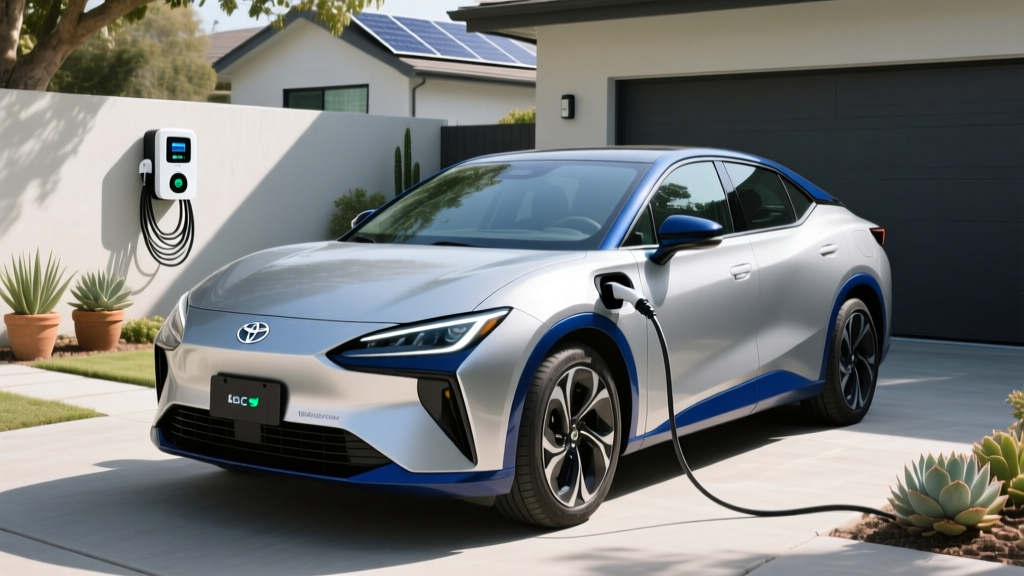
For your home Level 2 charger, the connector choice is simpler: most Level 2 units now ship with a NACS (J3400) connector as standard, with CCS1 available as an option or via adapter. If you own a 2-door EV with a CCS1 port (e.g., a 2024 BMW i4), you can either buy a charger with a CCS1 plug or use a NACS-to-CCS adapter from a reputable supplier like Lectron or A2Z.
For DC fast charging on the road, Tesla Superchargers now welcome non-Tesla NACS vehicles, and networks like Electrify America and EVgo are adding NACS cables alongside existing CCS1 connectors. According to the U.S. Department of Energy's AFDC database, over 70% of new DC fast-charging installations in 2025–2026 include NACS connectors.
Cost to Charge: Home vs. Public vs. Gas Comparison
One of the strongest ownership arguments for a 2-door EV is per-mile fuel cost. Here's how electricity and gas compare across common scenarios, using a representative 2-door EV consuming 30 kWh/100 miles (typical for a BMW i4 or Tesla Model 3 Performance) and a comparable gas coupe at 28 MPG combined:
| Scenario | Rate | Cost Per Mile (30 kWh/100mi EV) | Cost Per Mile (28 MPG Gas @ $3.40/gal) |
|---|---|---|---|
| Home Level 2 — Off-Peak TOU Rate | $0.09/kWh | $0.027 | $0.121 |
| Home Level 2 — Standard Residential | $0.16/kWh | $0.048 | $0.121 |
| Public Level 2 (ChargePoint, etc.) | $0.25/kWh | $0.075 | $0.121 |
| DC Fast Charging (Electrify America, EVgo) | $0.40/kWh | $0.120 | $0.121 |
| DC Fast Charging (Tesla Supercharger) | $0.28/kWh | $0.084 | $0.121 |
The takeaway: charging at home on a time-of-use (TOU) plan makes EV fueling roughly 75–80% cheaper per mile than gasoline. Even DC fast charging at premium networks is approaching gas parity, and Tesla Supercharger pricing typically undercuts gas by 30%. For a 2-door EV owner driving 12,000 miles/year, home charging at $0.12/kWh saves approximately $900–$1,100 annually versus a 28 MPG gas coupe.
To maximize savings, check with your utility about EV-specific TOU rates. Many utilities in 2026 offer off-peak rates between $0.06–$0.10/kWh for charging between 10 PM and 6 AM — check fueleconomy.gov for your vehicle's exact kWh/100mi efficiency rating to calculate personalized costs.
Charging Time Examples for Common 2-Door EV Battery Sizes
Here's how long typical 2-door EVs take to charge across different scenarios:
| Vehicle | Usable Battery (kWh) | Level 2 @ 11.5 kW (48A) | DC Fast (Peak kW) | DC Fast 10–80% Time |
|---|---|---|---|---|
| Tesla Model 3 Performance (2026) | 75 kWh (LFP option) / 82 kWh (NMC) | ~5.5–6 hours | 250 kW (NMC) | ~25–28 min |
| BMW i4 M50 (2026) | 80.7 kWh (NMC) | ~6 hours | 205 kW | ~31 min |
| Porsche Taycan 4S (2026) | 83.7 kWh (NMC, 800V) | ~6.5 hours (11.5 kW onboard limit) | 270 kW (325 kW peak on Turbo) | ~20–23 min |
| Ford Mustang Mach-E GT (2026) | 91 kWh usable (NMC) | ~7 hours | 150 kW | ~38–42 min |
| Hyundai Ioniq 6 (2026, NACS) | 77.4 kWh (NMC, 800V) | ~5.5 hours | 240 kW | ~18–22 min |
Note that AC Level 2 charging speed is limited by your vehicle's onboard charger, not just the wall unit. The Porsche Taycan, despite its 800V architecture enabling blistering DC speeds, accepts only 11 kW on AC — so a 48A/11.5 kW home charger is already its maximum. The Mach-E's onboard charger accepts up to 10.5 kW, meaning a 48A charger slightly exceeds its capacity.
Best Level 2 Chargers for 2-Door EVs in 2026
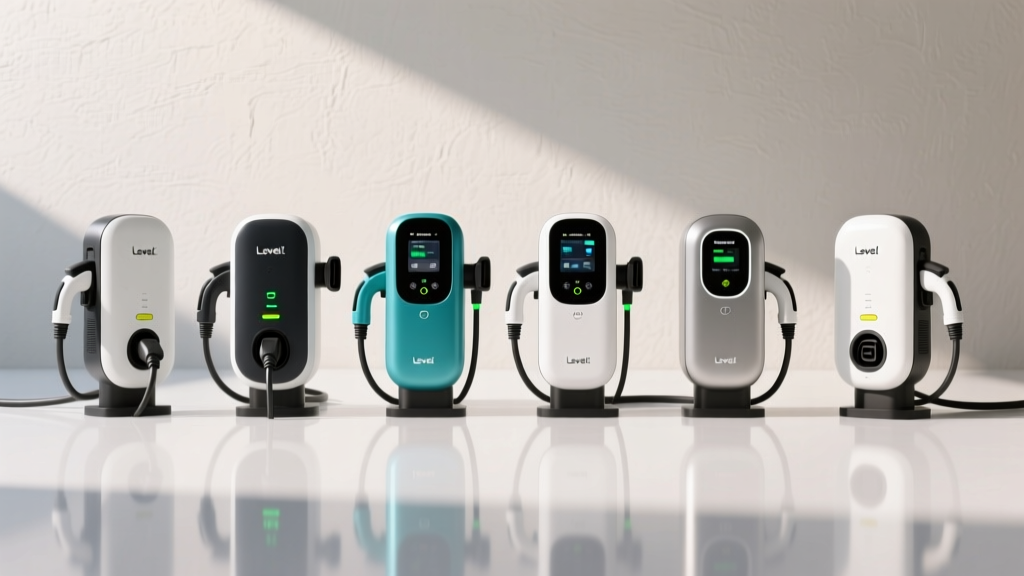
Based on reliability, smart features, cable management, and connector flexibility, here are the top Level 2 chargers for 2-door EV owners in 2026:
Emporia Vue EV Charger
Power: 48A / 11.5 kW (240V)
Connector: NACS (J3400) standard; CCS1 adapter available
Cable Length: 24 ft
Smart Features: Wi-Fi, app scheduling, solar integration, load management
Price: ~$399
Best For: Solar-equipped homes; budget-conscious buyers wanting full smart features
ChargePoint Home Flex
Power: Up to 50A / 12 kW (240V, configurable)
Connector: NACS or CCS1 (configurable at purchase)
Cable Length: 23 ft
Smart Features: Wi-Fi, Alexa, app scheduling, flexible amperage settings
Price: ~$649
Best For: Owners wanting adjustable amperage to match panel capacity
Tesla Wall Connector
Power: 48A / 11.5 kW (240V)
Connector: NACS (native)
Cable Length: 24 ft
Smart Features: Wi-Fi, OTA updates, Power Sharing (daisy-chain up to 6 units), load management
Price: ~$475
Best For: Tesla owners and NACS-adopting EVs; multi-EV garages
Grizzl-E Smart
Power: 40A / 9.6 kW (240V)
Connector: NACS or J1772 (CCS adapter compatible)
Cable Length: 24 ft
Smart Features: Wi-Fi, OCPP-compatible, extreme cold rating (-40°F)
Price: ~$449
Best For: Cold-climate garages; unheated outdoor installations
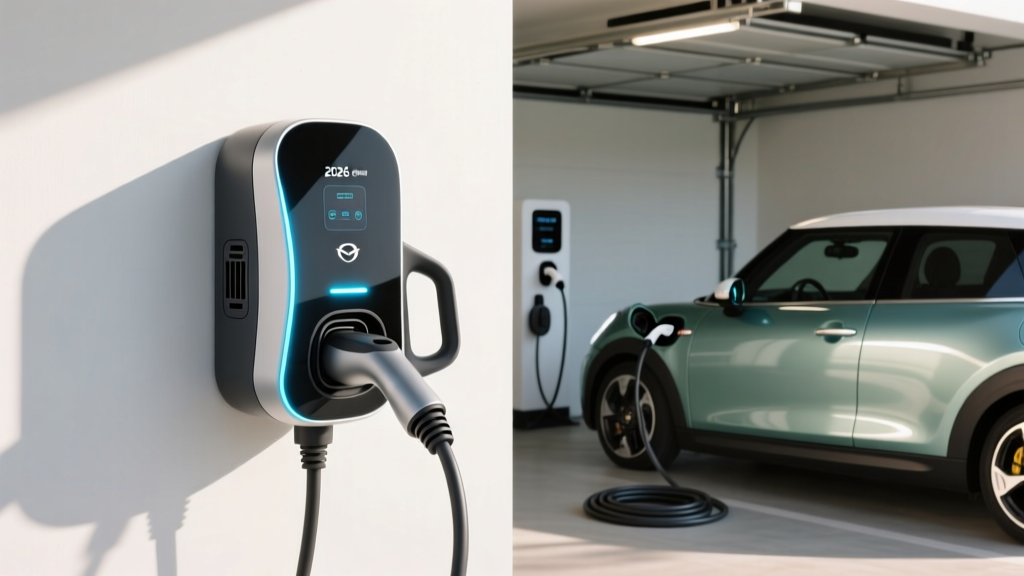
For 2-door EV owners parking in tight garages, pay attention to cable length and holster placement. A 24-foot cable provides enough slack to reach a charge port on either side of a coupe, even if the unit is mounted on the far wall. The Tesla Wall Connector's slim, integrated holster design works well in narrow spaces where a bulkier unit might interfere with door swing.
Frequently Asked Questions
How much does it cost to install a home EV charger?
A typical Level 2 home charger installation costs between $850 and $3,050 in 2026, including the charger unit ($300–$750), electrician labor ($500–$2,000), and permit fees ($50–$300). If your home's electrical panel needs an upgrade from 100A to 200A service, add $1,500–$4,000. The IRS §30D tax credit applies to new EV purchases, not charger installation; however, some utilities offer rebates of $250–$500 for installing a smart Level 2 charger — check your local utility's EV program page. The IRS clean vehicle credit rules detail current eligibility requirements for vehicle incentives.
How fast will each charging level add range?
Level 1 (120V) adds 3–5 miles of range per hour — sufficient for PHEVs with 25–40 miles of electric range but impractical for a full BEV. Level 2 (240V) at 48 amps adds approximately 35–45 miles per hour for a typical 2-door EV, fully replenishing most coupe-sized batteries overnight. DC fast charging adds 150–1,200+ miles per hour at peak, but actual session speeds depend on the charge curve taper above 80% SoC.
Which connector/charger is compatible with my EV?
Check your vehicle's charge port. If it's a 2025+ model from Ford, GM, BMW, Hyundai, Kia, Volvo, Rivian, or Tesla, it almost certainly uses NACS (J3400). Pre-2025 non-Tesla EVs typically use CCS1. The Nissan Leaf uses CHAdeMO but has been discontinued. For home charging, buy a Level 2 charger matching your car's native connector, or use a quality adapter (Lectron, A2Z, or Tesla's official CCS adapter) rated for the full amperage of your circuit.
How much does charging cost per mile vs gas?
Home charging on a standard residential rate ($0.16/kWh) costs roughly $0.04–$0.05 per mile for a typical 2-door EV — about 60–70% less than a 28 MPG gas coupe at $3.40/gallon. Off-peak TOU rates can push this below $0.03/mile. Public DC fast charging at $0.35–$0.45/kWh narrows the gap to near parity with gas, so home charging is where the real savings live.
What electrical upgrades might I need?
The most common upgrade is a dedicated 50A or 60A breaker and circuit run from your panel to the garage. If your panel lacks spare breaker slots or is already near its rated load capacity, you may need a panel upgrade (100A → 200A, costing $1,500–$4,000) or a smart load-management system that dynamically reduces charger amperage when other appliances draw heavy current. An electrician's load calculation (per NEC Article 220) will determine this before any work begins.