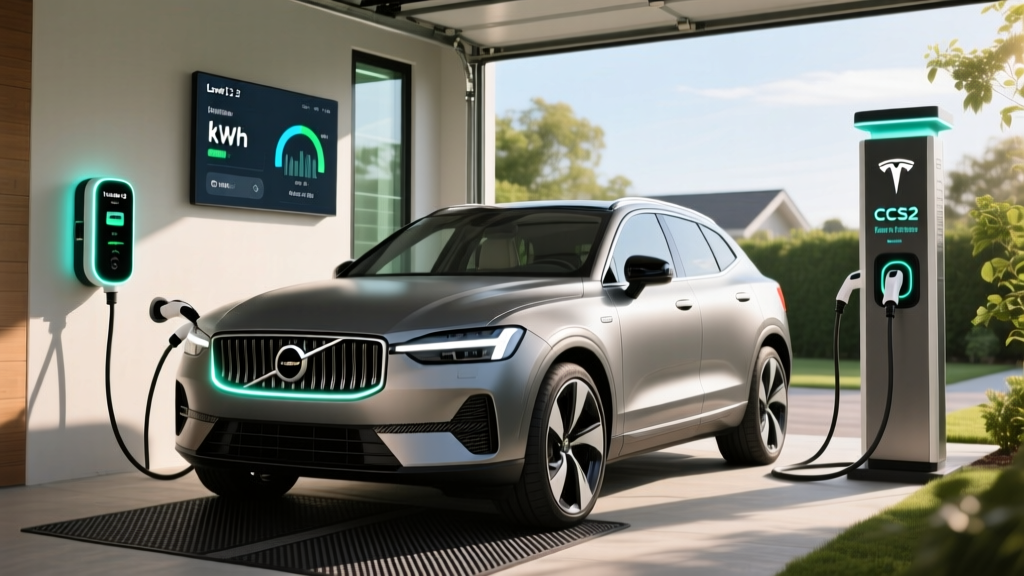
The 2025 Volvo EX90 is the brand's flagship electric SUV, built on the same SPA2 platform as the Polestar 3 and sharing architecture with the upcoming EX60. But for buyers, the most critical questions center on daily usability: How far can it really go? How fast does it charge at home and on the road? And what will it take to wire your garage for Level 2 charging? This guide breaks down every 2025 Volvo EX90 range and charging spec with real-world context, then walks through the home installation process, public charging networks, and what you'll actually spend per mile.
2025 Volvo EX90 Battery, Range, and Efficiency
The 2025 EX90 uses a 111 kWh gross (approximately 107 kWh usable) lithium-ion battery pack with NMC (nickel-manganese-cobalt) chemistry. Volvo offers two powertrain configurations:
| Spec | EX90 Twin Motor | EX90 Twin Motor Performance |
|---|---|---|
| Battery (usable) | ~107 kWh (NMC) | ~107 kWh (NMC) |
| EPA Range | 310 miles | 300 miles |
| Real-World Range (highway, 70 mph) | ~260–280 miles | ~250–270 miles |
| Cold-Weather Range (32°F / 0°C) | ~220–250 miles | ~210–240 miles |
| MPGe (combined) | 79 MPGe | 76 MPGe |
| Efficiency | ~34 kWh/100 mi | ~35 kWh/100 mi |
| Horsepower | 408 hp | 496 hp |
| 0–60 mph | 5.7 sec | 4.7 sec |
| Base MSRP | $77,990 | $84,490 |
Charging Levels Explained: How Fast Does the EX90 Charge?
Before detailing EX90-specific speeds, here's how each charging level works. Power is measured in kilowatts (kW — the rate of energy delivery), while battery capacity is measured in kilowatt-hours (kWh — the total energy stored). Think of kW as the width of a hose and kWh as the size of the bucket.
| Charging Level | Power Output | Miles Added per Hour | Typical Use Case |
|---|---|---|---|
| Level 1 (120V outlet) | 1.0–1.4 kW | 3–4 miles/hr | Emergency/overnight trickle |
| Level 2 (240V home/public) | 7.2–19.2 kW | 22–58 miles/hr | Daily home charging |
| DC Fast Charging | 50–350 kW | 150–800+ miles/hr (peak) | Road trips, highway corridors |
2025 EX90 Charging Times by Level
The EX90's onboard charger accepts up to 11 kW on Level 2 AC and up to 250 kW on DC fast charging via its CCS1 connector (pre-North American Charging Standard adoption). Here's what that means in practice with the ~107 kWh usable battery:
| Charging Scenario | Time (10–80%) | Notes |
|---|---|---|
| Level 1 (120V / 12A) | ~74 hours (not practical) | ~3 mi/hr; only for emergencies |
| Level 2 (240V / 48A, 11.5 kW) | ~7.5 hours | Full overnight charge on a hardwired home unit |
| Level 2 (240V / 32A, 7.7 kW) | ~11 hours | Typical plug-in home charger |
| DC Fast Charge (250 kW peak) | ~30 minutes | Peak rate tapers above 80% SoC |
| DC Fast Charge (150 kW station) | ~42 minutes | Common Electrify America/EVgo speed |
Home Charger Installation: Costs, Electrical Requirements, and Gotchas
Most EX90 owners will want a Level 2 home charger — it's the only practical way to refill a 107 kWh battery overnight. Here's what installation actually involves.
Electrical Requirements for the EX90
To maximize the EX90's 11 kW onboard charger, you need a 240V circuit rated for at least 48 amps (a 60-amp breaker, since NEC code requires circuits be loaded to only 80% of their rated capacity). A 40-amp circuit (32A continuous) will still deliver 7.7 kW, which is adequate for most overnight charging of the EX90.
Installation Cost Breakdown
| Component | Cost Range | Notes |
|---|---|---|
| Level 2 Charger (hardware) | $400–$750 | Smart Wi-Fi chargers; dumb units from $250 |
| Electrician labor (standard install) | $500–$1,500 | Short run from panel to garage; conduit, wiring |
| Electrical permit | $50–$200 | Required in most jurisdictions |
| Panel upgrade (if needed) | $1,500–$4,000 | 100A → 200A service; older homes often need this |
| Total (no panel upgrade) | $950–$2,450 | Most homes with 200A service |
| Total (with panel upgrade) | $2,450–$6,450 | Homes with 100A or maxed-out panels |
Will you need a panel upgrade? If your home has a 200-amp electrical panel with available breaker slots and capacity headroom, you're likely fine. If you have a 100-amp service (common in homes built before the 1990s) or your panel is near capacity with existing loads (electric dryer, HVAC, oven), adding a 60-amp EV circuit may require an upgrade. A licensed electrician can perform a load calculation — always get this assessment before purchasing equipment.
Safety and Code Considerations
- Dedicated circuit: Your EV charger must be on its own dedicated breaker — never share with other appliances.
- GFCI protection: NEC 2020 and later require GFCI protection for outdoor receptacles; hardwired chargers may be exempt in some jurisdictions but are safer.
- Outdoor rating: If mounting outside, ensure the charger carries a NEMA 4 or IP65 rating for weather resistance.
- Hardwired vs. plug: Hardwired installations support higher amperage (48A+) and eliminate the failure point of a 14-50 receptacle. For 48A charging, hardwired is strongly recommended.
Connector Compatibility: CCS1, NACS, and Adapter Options
The 2025 Volvo EX90 ships with a CCS1 (Combined Charging System) connector for DC fast charging and a J1772 inlet for Level 2 AC. Volvo has announced that future model years will transition to the North American Charging Standard (NACS), but the 2025 EX90 remains CCS1-equipped.
| Connector Type | Use | EX90 Compatibility |
|---|---|---|
| J1772 | Level 1 & Level 2 AC charging | Native (built-in inlet) |
| CCS1 | DC fast charging | Native (built-in inlet) |
| NACS (Tesla) | DC fast & Level 2 AC (Tesla Superchargers) | Requires CCS-to-NACS adapter |
| CHAdeMO | Legacy DC fast charging (Nissan Leaf, etc.) | Not compatible; network is declining |
Tesla Supercharger access: As of 2025, Volvo owners can access Tesla's Supercharger network using a CCS-to-NACS adapter (available from Tesla and third-party manufacturers like Lectron and A2Z for $150–$250). This dramatically expands the EX90's road-trip charging options, as Tesla operates over 6,000 Supercharger stalls in North America. Verify adapter compatibility with Volvo's official guidance before purchasing.
Cost to Charge: EX90 Per-Mile Cost vs. Gas
One of the strongest arguments for the EX90 is fuel cost savings — but the exact number depends on where and when you charge. Here's a realistic breakdown using the EX90's efficiency of approximately 34 kWh per 100 miles (combined).
| Charging Scenario | Rate ($/kWh) | Cost per 100 Miles | Cost per Mile |
|---|---|---|---|
| Home (off-peak utility rate) | $0.08–$0.12 | $2.72–$4.08 | $0.027–$0.041 |
| Home (average US rate) | $0.16 | $5.44 | $0.054 |
| Public Level 2 (ChargePoint, etc.) | $0.25–$0.40 | $8.50–$13.60 | $0.085–$0.136 |
| DC Fast Charging (Electrify America) | $0.35–$0.55 | $11.90–$18.70 | $0.119–$0.187 |
| Tesla Supercharger (via adapter) | $0.25–$0.35 | $8.50–$11.90 | $0.085–$0.119 |
Gas comparison: A comparable gas SUV like the Volvo XC90 (mild-hybrid, ~25 MPG combined) running on $3.50/gallon fuel costs roughly $14.00 per 100 miles, or $0.14 per mile. Even at average home electricity rates, the EX90 saves about 60% per mile. At off-peak rates, savings exceed 70%.
Over 15,000 miles annually, that translates to roughly $1,300–$1,600 in annual fuel savings for home-heavy charging versus the XC90. Over a 5-year ownership period, fuel savings alone can offset $6,500–$8,000 of the EX90's higher purchase price. Source: fueleconomy.gov.
Recommended Home Chargers for the Volvo EX90
Given the EX90's 11 kW onboard charger and large battery, here are three chargers that make sense — each a hardwired or high-amperage plug-in unit.
ChargePoint Home Flex
- Power: Up to 12 kW (50A) hardwired
- Connector: J1772 (CCS combo for DC not applicable at home)
- Cable length: 23 feet
- Smart features: Wi-Fi, app scheduling, utility demand-response, Alexa
- Price: ~$599
Best for: Most EX90 owners. Flexible amperage from 16A–50A lets your electrician match your panel capacity.
Emporia Vue Level 2 Charger
- Power: Up to 11.5 kW (48A)
- Connector: J1772
- Cable length: 24 feet
- Smart features: Wi-Fi, energy monitoring, solar integration, load management
- Price: ~$399
Best for: Budget-conscious buyers who still want smart features and solar-home integration.
Grizzl-E Smart
- Power: Up to 10 kW (40A)
- Connector: J1772
- Cable length: 24 feet
- Smart features: Wi-Fi, OCPP protocol, load balancing
- Price: ~$499
Best for: Cold-climate owners. Built in Canada with a -40°F operating rating and rugged NEMA 4 enclosure.
Federal Tax Credit and Incentives for EX90 Charging
The 2025 Volvo EX90 qualifies for the federal §30D clean vehicle credit, but eligibility depends on several factors that change annually. As of 2025–2026 IRS rules:
- Credit amount: Up to $7,500, split between critical minerals ($3,750) and battery components ($3,750).
- MSRP cap: SUVs must be under $80,000 — the EX90 Twin Motor at $77,990 qualifies; the Performance trim at $84,490 does not.
- Buyer income cap: AGI must not exceed $150,000 (single), $225,000 (head of household), or $300,000 (joint).
- Battery sourcing: Increasing percentages of critical minerals and battery components must be sourced from US or FTA-partner countries.
- Point-of-sale transfer: You can transfer the credit to the dealer at purchase for an immediate price reduction rather than waiting for tax filing.
Additionally, the §30C alternative fuel vehicle refueling property credit offers up to $1,000 (30% of cost, capped) for home charger installation if you live in a qualifying census tract. Consult a tax professional and verify current rules at irs.gov before relying on these figures.
Public Charging Networks: Where Can the EX90 Charge on the Road?
With its CCS1 connector and 250 kW peak DC fast-charging capability, the EX90 can use most major public networks:
- Electrify America: Largest CCS network in the US; stations typically offer 150 kW and 350 kW chargers. The EX90 will peak at 250 kW on 350 kW stalls.
- EVgo: Growing network with 100–350 kW chargers in metro areas and highway corridors.
- Tesla Supercharger (with adapter): The most reliable and widespread DC fast-charging network. A CCS-to-NACS adapter ($150–$250) unlocks 6,000+ stalls. Most V3 Superchargers peak at 250 kW — a perfect match for the EX90.
- ChargePoint / EV Connect: Mostly Level 2 destination chargers (hotels, shopping centers); useful for topping off but not for road-trip refueling.
For road-trip planning, the EX90's 310-mile EPA range (plan for ~260 miles highway) and 250 kW charging mean you can stop every 3–4 hours, add 200 miles in roughly 20 minutes at a fast charger, and keep moving. Preconditioning the battery — which the EX90 does automatically when you navigate to a charger via the infotainment system — is essential for achieving peak charge rates in cold weather.
Frequently Asked Questions
How much does it cost to install a home EV charger for the EX90?
Between $950 and $2,450 for a standard installation (charger + electrician + permit) if your electrical panel has capacity. If you need a panel upgrade from 100A to 200A, add $1,500–$4,000, bringing the total to $2,450–$6,450. Always get a licensed electrician's load calculation first.
How fast will each charging level add range to the EX90?
Level 1 (120V) adds roughly 3–4 miles per hour — impractical for a 107 kWh battery. Level 2 (240V, 48A) adds approximately 35 miles per hour, fully recharging overnight in about 7.5 hours. DC fast charging at 250 kW can add up to 200 miles in roughly 20 minutes during the peak portion of the charge curve (10–50% SoC).
Which connector and charger is compatible with the 2025 EX90?
The 2025 EX90 has a native CCS1 inlet for DC fast charging and a J1772 inlet for AC Level 2. For home charging, any J1772 Level 2 charger works. For Tesla Supercharger access, you'll need a CCS-to-NACS adapter. CHAdeMO is not compatible.
How much does charging the EX90 cost per mile compared to gas?
At average home electricity rates ($0.16/kWh), the EX90 costs about $0.054 per mile. A comparable gas SUV at 25 MPG and $3.50/gallon costs about $0.14 per mile. That's roughly 60% savings per mile, or $1,300–$1,600 per year at 15,000 miles driven annually.
What electrical upgrades might I need for a Level 2 charger?
The EX90 benefits most from a 240V / 48A (60-amp breaker) dedicated circuit, hardwired. If your home has a 200-amp panel with spare capacity, no upgrade is needed. Homes with 100-amp service or panels near capacity may require a panel upgrade ($1,500–$4,000). Your electrician will perform a load calculation to determine this.
Does the 2025 EX90 qualify for the $7,500 federal tax credit?
The Twin Motor trim ($77,990 MSRP) is under the $80,000 SUV cap and may qualify for up to $7,500 depending on battery-sourcing compliance and your income. The Performance trim ($84,490) exceeds the MSRP cap and does not qualify. Always check the latest IRS guidance and battery-sourcing certifications before purchasing.