Why the 2025 Toyota bZ4X's Charging Story Matters More Than Its Sticker Range
The 2025 Toyota bZ4X carries an EPA-estimated range of up to 252 miles on the front-wheel-drive XLE trim and 228 miles on the all-wheel-drive variant. On paper, those numbers trail rivals like the Hyundai Ioniq 5 or Tesla Model Y. But range is only half the ownership equation — how quickly and cheaply you can replenish the bZ4X's 71.4 kWh (usable) lithium-ion battery determines whether this electric SUV actually fits your daily life.
This guide breaks down the bZ4X's real-world range expectations, its DC fast-charging curve behavior, and exactly what you need to install a Level 2 home charger — including electrical panel considerations, equipment picks, and per-mile cost comparisons versus a gas-powered RAV4.
| Battery (usable) | 71.4 kWh, NMC lithium-ion |
| EPA Range (FWD XLE) | 252 miles |
| EPA Range (AWD) | 228 miles |
| Max DC Fast Charge | ~150 kW (peak) |
| 10–80% DCFC Time | ~30 minutes (FWD) |
| Level 2 Onboard Charger | 7.7 kW (32A at 240V) |
| Charge Port / Connector | CCS1 (J1772 + DC pins) |
| EPA Efficiency (FWD) | 114 MPGe combined |
| Base MSRP (XLE FWD) | ~$37,070 (before incentives) |
Source: fueleconomy.gov, Toyota Motor Corporation
Real-World Range: What to Expect Beyond the EPA Sticker
The EPA range figure assumes a blended driving cycle. In practice, several factors compress or extend the bZ4X's actual distance per charge:
- Highway driving at 70–80 mph: Expect roughly 200–215 miles from the FWD model. Aerodynamic drag disproportionately impacts EV efficiency at sustained speeds, and the bZ4X's boxy crossover shape doesn't help.
- Cold weather (below 32°F / 0°C): Battery chemistry slows and cabin heating draws heavily from the pack. Plan for 160–190 miles on a full charge in freezing conditions, depending on whether you use the available heat pump (standard on some trims, not all — verify your build sheet).
- City/suburban driving in mild weather: This is where the bZ4X shines. Regenerative braking recaptures energy at every stop, and you may match or slightly exceed the 252-mile EPA figure at speeds under 45 mph.
- Terrain: Sustained mountain climbs will slash range significantly; however, long descents can recover 10–15% of consumed energy through regen.
EPA estimate: 252 miles
Expect in mixed highway/city (65–75°F): ~220–240 miles
Expect on sustained 75 mph highway: ~195–215 miles
Expect in freezing weather (mixed driving): ~160–190 miles
Charging Levels Explained: Speeds, Times, and What the bZ4X Accepts
Understanding EV charging requires distinguishing between kW (kilowatts), which measures the rate of power delivery — like water pressure in a hose — and kWh (kilowatt-hours), which measures total energy stored — like the size of the tank. The bZ4X's 71.4 kWh battery is the tank. The charger's kW rating determines how fast you fill it.
| Level | Voltage / Current | Power (kW) | Miles Added per Hour | Full Charge Time (bZ4X) |
|---|---|---|---|---|
| Level 1 (120V household) | 120V / 12A | ~1.4 kW | ~3–4 mi/hr | ~50+ hours |
| Level 2 (240V home/public) | 240V / 32A | 7.7 kW (bZ4X max) | ~22–25 mi/hr | ~9–10 hours (0–100%) |
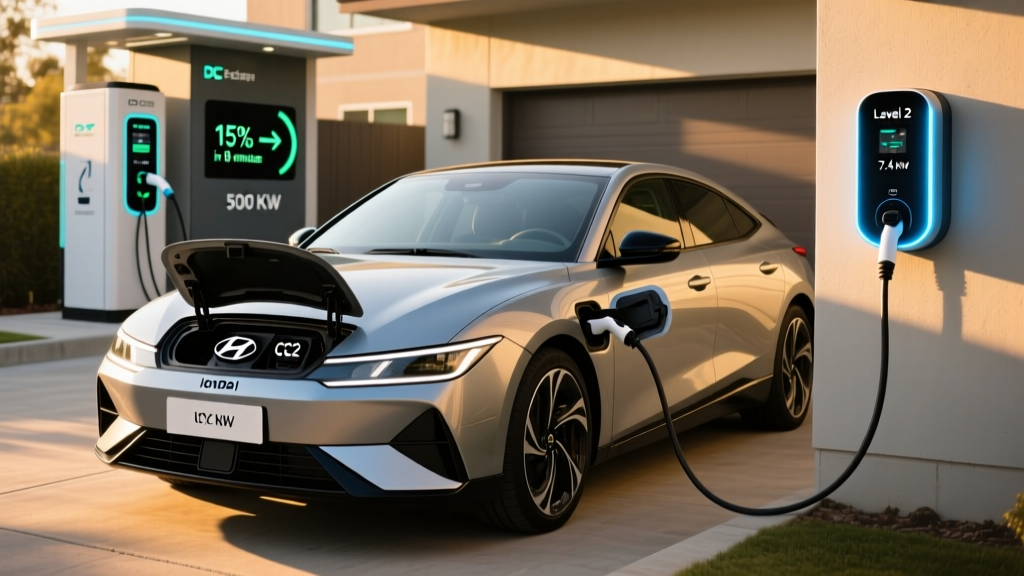
| DC Fast Charge | 400V+ DC | Up to ~150 kW peak | ~130+ mi/hr (peak) | ~30 min (10–80%) |
The bZ4X's DC Fast-Charging Curve: What "150 kW Peak" Really Means
Toyota rates the bZ4X at approximately 150 kW peak DC fast-charging speed. However, no EV sustains its peak rate for the entire session. The bZ4X's charge curve typically behaves as follows:
- 10–40% SoC: Charges near peak (~130–150 kW) if the battery is preconditioned and ambient temps are moderate.
- 40–60% SoC: Rate tapers to roughly 80–100 kW.
- 60–80% SoC: Further taper to 50–70 kW.
- Above 80%: Dramatically slower (under 30 kW) to protect battery health. Avoid DCFC past 80% unless necessary — it wastes time and money.
Practical takeaway: The published ~30-minute 10–80% time assumes favorable conditions (warm battery, functioning station). In cold weather or at a congested station sharing power, plan for 35–45 minutes.
Home Level 2 Charger Installation: Requirements, Costs, and Panel Gotchas
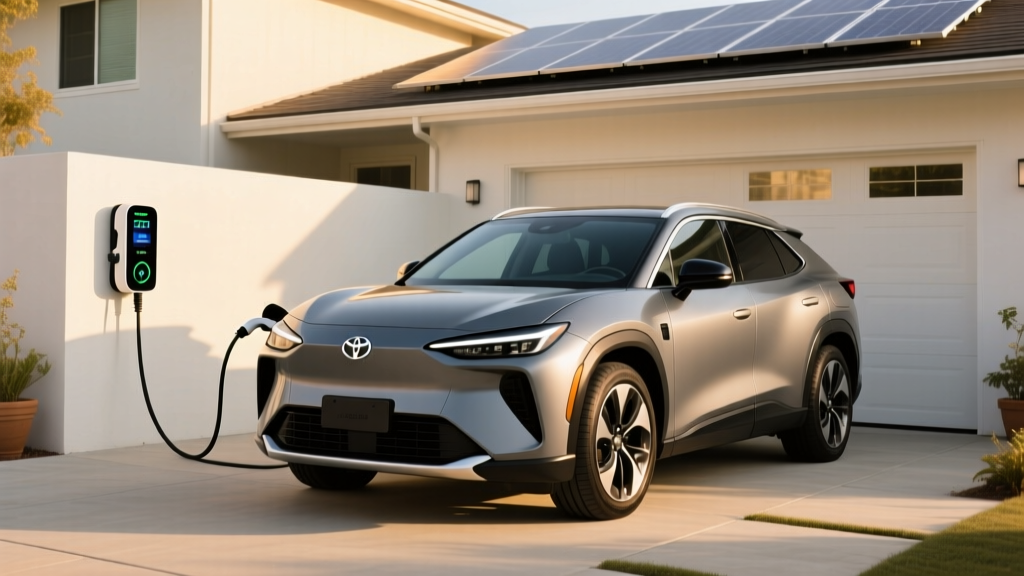
The bZ4X's 7.7 kW onboard charger means you don't need a 48-amp home station to max it out. A 40-amp circuit with a 32-amp charger is the sweet spot — and this is where many bZ4X owners can save money compared to EVs with larger onboard chargers.
Electrical Requirements for the bZ4X
- Circuit: Dedicated 240V, 40-amp breaker (NEMA 14-50 outlet or hardwired)
- Wire gauge: 6 AWG copper (for 40A circuit; 8 AWG may suffice for some hardwired 32A units per local code)
- Panel capacity: Your home's main panel must have at least 40 amps of available headroom. A typical 100-amp panel in an older home may already be near capacity with existing appliances.
- Permit: Most jurisdictions require an electrical permit for new 240V circuits — budget $50–$200 depending on your municipality.
Installation Cost Breakdown
| Item | Low Estimate | High Estimate | Notes |
|---|---|---|---|
| Level 2 Charger (hardware) | $300 | $700 | 32A–40A smart charger, 20–25 ft cable |
| Electrician labor | $400 | $1,500 | Depends on run length from panel to garage |
| Electrical permit | $50 | $200 | Varies by city/county |
| Panel upgrade (if needed) | $1,500 | $4,000+ | 100A→200A service upgrade; not always required |
| Total (no panel upgrade) | $750 | $2,400 | Most homes with 200A service |
| Total (with panel upgrade) | $2,250 | $6,400+ | Older homes with 100A panels |
How to check if you need a panel upgrade: Look at your main breaker — if it reads 100A, you likely need an upgrade before adding a 40A EV circuit. A 200A panel usually has enough headroom. Have a licensed electrician perform a load calculation (NEC Article 220) before committing to equipment.
Connector Compatibility: CCS1, NACS, and the Adapter Question
The 2025 Toyota bZ4X ships with a CCS1 (Combined Charging System) port, which integrates the J1772 connector for Level 1/Level 2 AC charging and two additional DC pins below for fast charging. Here's how that maps to the current charging network landscape:
| Network / Connector | Native Fit? | Adapter Needed? | Notes |
|---|---|---|---|
| Electrify America (CCS) | ✅ Yes | No | Largest CCS network; plug and charge |
| EVgo (CCS stalls) | ✅ Yes | No | Check station for CCS availability |
| ChargePoint (Level 2, J1772) | ✅ Yes | No | All J1772 Level 2 stations work natively |
| Tesla Supercharger (NACS) | ❌ No | Yes — CCS-to-NACS adapter (~$200–$250) | Toyota has confirmed Supercharger access for bZ4X with approved adapter; verify compatibility on Toyota's site before purchase |
| Tesla Destination (J1772/NACS) | Partial | J1772 adapter (included with most chargers) or NACS adapter | Older Tesla Wall Connectors need J1772 adapter |
Key adapter note: As Tesla opens its Supercharger network to non-Tesla EVs, a CCS-to-NACS adapter unlocks thousands of additional fast-charging stalls. Toyota has been working to ensure bZ4X compatibility — check Toyota's official EV charging page for the latest approved adapter list before buying third-party hardware. Not all adapters support the bZ4X's communication protocol, and an incompatible adapter can result in failed charging sessions.
Cost to Charge the bZ4X: Home vs. Public vs. Gas Comparison
The bZ4X FWD earns an EPA-rated 114 MPGe combined, which translates to approximately 29 kWh per 100 miles. Here's what that means for your wallet across different charging scenarios, compared to a 2025 Toyota RAV4 gasoline AWD (estimated 30 MPG combined) at $3.40/gallon:
| Scenario | Rate | Cost per Mile | Cost for 252 Miles (full "tank") |
|---|---|---|---|
| Home — off-peak utility rate | $0.10/kWh | $0.029 | $7.31 |
| Home — average US rate | $0.17/kWh | $0.049 | $12.43 |
| Public Level 2 (e.g., ChargePoint) | $0.25/kWh | $0.073 | $18.27 |
| DC Fast Charge (Electrify America) | $0.48/kWh | $0.139 | $35.09 |
| RAV4 Gas AWD (30 MPG, $3.40/gal) | $3.40/gallon | $0.113 | $28.56 |
The bottom line: Home charging on an off-peak rate makes the bZ4X roughly 4× cheaper per mile than a gas RAV4. Even at average residential rates, you save about 57% per mile. However, exclusive reliance on DC fast charging is actually more expensive than gasoline — a critical reason why home Level 2 access is essential for EV economics.
Recommended Level 2 Chargers for the Toyota bZ4X
Since the bZ4X caps AC charging at 7.7 kW (32A), you don't need a 48-amp charger. A quality 32A or 40A unit will fully utilize the car's onboard charger while leaving room on the circuit for future flexibility.
Power: 40A / 9.6 kW (bZ4X will draw 32A max)
Connector: J1772 (CCS-compatible)
Cable: 24 ft
Smart features: Wi-Fi, app scheduling, solar integration, energy monitoring
Price: ~$399
Why for bZ4X: Best value smart charger; scheduling lets you charge during off-peak utility windows automatically.
Power: Configurable 16A–50A (set to 40A for bZ4X)
Connector: J1772
Cable: 23 ft
Smart features: Wi-Fi, app, Alexa, scheduling, amperage adjustable
Price: ~$549
Why for bZ4X: Adjustable amperage means you can dial it to match any circuit — ideal if your electrician recommends a 30A or 40A circuit.
Power: 40A / 9.6 kW
Connector: J1772
Cable: 24 ft
Smart features: OCPP-compatible, app control, over-the-air updates
Price: ~$449
Why for bZ4X: Built in Canada, rated to -40°F for outdoor installs in cold climates. Robust build quality.
Safety, Code, and Installation Best Practices
EV charging involves sustained high-current draw — unlike a dryer that cycles on and off, a Level 2 charger can run at maximum load for 8+ hours. This demands proper installation:
- Dedicated circuit: NEC 625.40 requires EVSE to be on a dedicated branch circuit — you cannot share with other appliances.
- GFCI protection: NEC 2020 and later requires GFCI protection for receptacles used for EV charging (240V outlets). Hardwired installations may not require a GFCI breaker depending on jurisdiction — ask your electrician.
- Outdoor rating: If installing outside, ensure the charger carries a NEMA 4 (or IP65+) rating. All recommended units above qualify.
- NEMA 14-50 vs. hardwired: A NEMA 14-50 outlet offers portability (take your charger when you move) but requires GFCI and may be subject to local restrictions on outlet height/placement. Hardwired units avoid GFCI requirements and allow slightly higher amperage on the same circuit.
- Load management: If your panel is tight on capacity, consider a charger with built-in load management (e.g., Emporia Vue with smart panel monitoring) that dynamically reduces charge rate to avoid tripping the main breaker.
Frequently Asked Questions
How much does it cost to install a home EV charger for the bZ4X?
For a typical home with a 200-amp panel and a short wire run to the garage, expect $750–$2,400 total (charger hardware + electrician + permit). Older homes with 100-amp panels may need a $1,500–$4,000 panel upgrade, pushing the total to $2,250–$6,400+. Always get a load calculation from a licensed electrician before purchasing equipment.
How fast will each charging level add range to the bZ4X?
Level 1 (120V) adds roughly 3–4 miles per hour — enough only for overnight top-ups if your daily drive is under 30 miles. Level 2 (240V, 32A) adds about 22–25 miles per hour, fully recharging the 71.4 kWh battery in roughly 9–10 hours. DC fast charging at peak rate can add over 130 miles per hour, but the rate tapers significantly above 60% state of charge.
Which connector and charger is compatible with my 2025 bZ4X?
The bZ4X uses the CCS1 connector (J1772 for AC + DC combo pins). It works natively with all Electrify America, EVgo CCS, and ChargePoint stations. For Tesla Supercharger access, you'll need a CCS-to-NACS adapter — verify Toyota's approved adapter list before purchasing, as communication-protocol compatibility is essential.
How much does charging the bZ4X cost per mile vs. a gas RAV4?
At the US average residential rate of ~$0.17/kWh, the bZ4X costs about $0.049 per mile — roughly 57% less than a RAV4 gas AWD at $0.113/mile ($3.40/gal, 30 MPG). With off-peak utility rates around $0.10/kWh, the bZ4X drops to under $0.03/mile. However, exclusive DC fast charging at $0.48/kWh pushes cost to ~$0.14/mile, which is more expensive than gasoline.
What electrical upgrades might I need for a home charger?
The most common upgrade is a panel service increase from 100A to 200A ($1,500–$4,000+). You may also need a new 240V circuit with 6 AWG wire, a NEMA 14-50 outlet or hardwired junction box, and a permit. Some utilities offer rebates that offset panel upgrades — check with your local provider before scheduling work.
Sources: EPA fueleconomy.gov, Toyota bZ4X Official Specs, IRS §30D Clean Vehicle Credit. Prices and specs reflect 2025 model year data. Federal tax credit eligibility depends on MSRP caps, buyer income limits, and battery-sourcing requirements — consult a tax professional for personal eligibility.