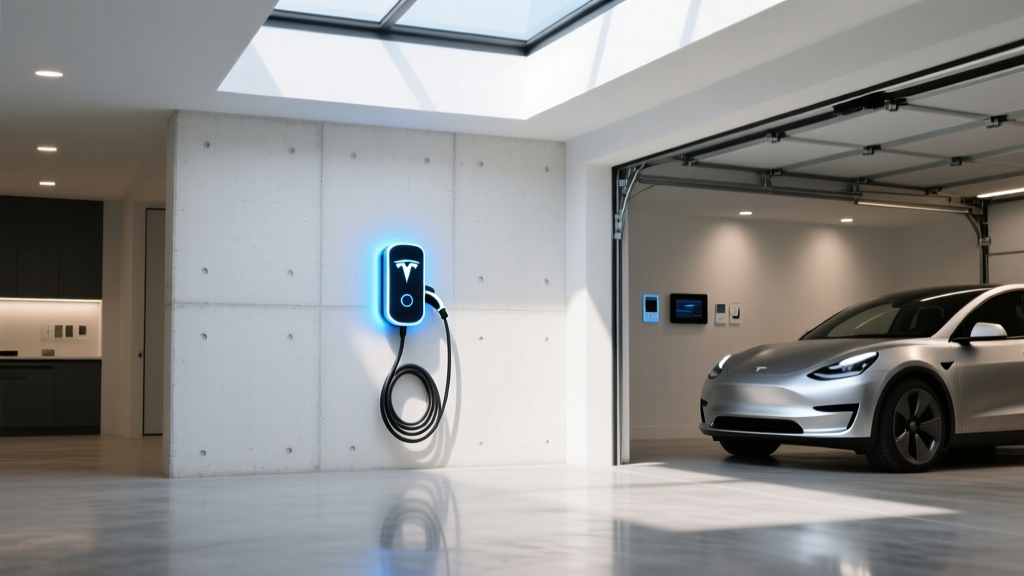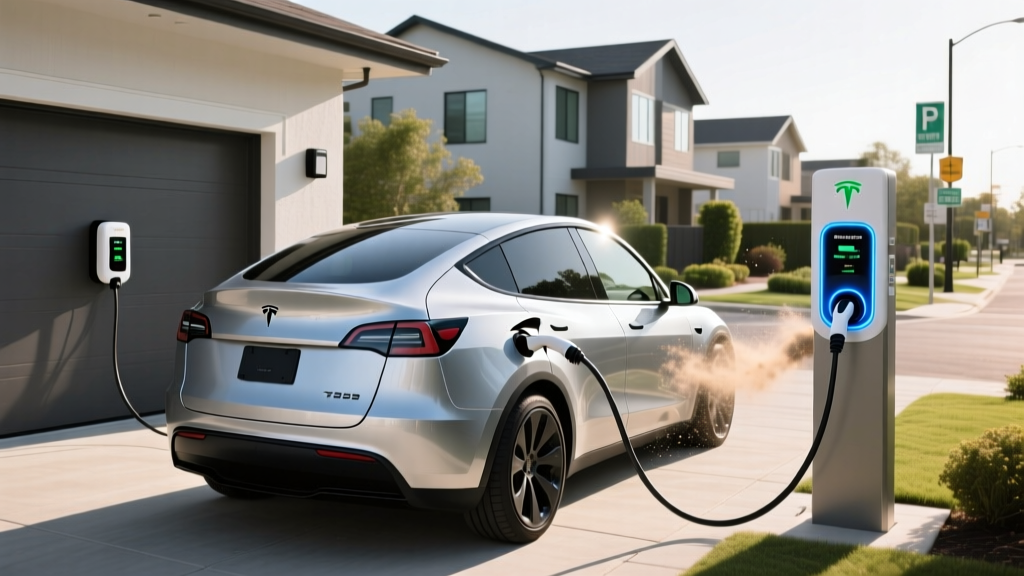
The 2025 Tesla Model Y Long Range RWD pairs an EPA-estimated 320 miles of range with Tesla's native NACS charging port and access to the Supercharger network. But range is only half the ownership equation — how you charge, how fast, and what it costs determines whether the Model Y Long Range RWD is a daily-driver dream or a logistics headache. This guide breaks down every charging scenario for the 2025 Model Y Long Range RWD, from a 120V trickle in the garage to a 250 kW DC fast charge on a road trip, with exact numbers for install costs, electrical requirements, and per-mile economics.
2025 Tesla Model Y Long Range RWD: Charging Specs at a Glance
| Specification | Value |
|---|---|
| EPA Range | 320 miles (real-world highway ~270–290 mi; cold weather ~240–260 mi) |
| Battery Capacity (usable) | ~75 kWh (NMC chemistry) |
| Onboard AC Charger (Level 2) | 11.5 kW max (48A at 240V) |
| Peak DC Fast Charge Rate | ~250 kW |
| 10–80% DC Fast Charge Time | ~27 minutes (at V3 Supercharger, preconditioned) |
| Charging Port | NACS (native Tesla) |
| Efficiency | 122 MPGe combined / 28 kWh/100 mi |
| Battery & Drive Unit Warranty | 8 years / 120,000 miles (min 70% retention) |
| Base MSRP | $44,990 (before incentives) |
Charging Levels Explained: How Fast Will Each Level Add Range?
EV charging operates at three distinct levels. The critical distinction: kW (kilowatts) measures power — the rate of energy delivery, like water flow from a hose. kWh (kilowatt-hours) measures energy — the total amount stored in the battery, like gallons in a tank. A 11.5 kW charger delivers 11.5 kWh of energy per hour of charging.
| Level | Voltage / Amps | Power (kW) | Miles of Range per Hour | 0–100% Time (75 kWh) |
|---|---|---|---|---|
| Level 1 (Standard Outlet) | 120V / 12A | ~1.4 kW | ~3–4 mi/hr | ~54 hours |
| Level 2 (Home / Public AC) | 240V / 48A | 11.5 kW (max onboard) | ~37–40 mi/hr | ~6.5 hours |
| DC Fast Charge (Supercharger V3) | 400V+ DC | Up to 250 kW peak | ~200+ mi in 15 min | 10–80% in ~27 min |
Level 1 is emergency-only for a 75 kWh battery. Plugging into a standard household outlet overnight adds roughly 30–40 miles — enough for a short commute but inadequate as a primary strategy.
Level 2 is the home-charging sweet spot. At the Model Y's maximum 11.5 kW AC acceptance rate, a full charge from empty takes about 6.5 hours. Most owners plug in overnight and wake to a full battery every morning.
DC Fast Charging bypasses the onboard charger and delivers DC power directly to the battery. The Model Y Long Range RWD peaks at approximately 250 kW on a V3 Supercharger, but this peak only sustains at low states of charge (typically 10–30%). The charge curve tapers significantly above 60% SoC, and slows to a trickle past 80% to protect battery longevity. This is why manufacturers quote 10–80% times rather than full-charge times.
Home Charger Installation: Electrical Requirements, Costs & Panel Upgrades
Installing a Level 2 home charger for your Model Y Long Range RWD requires a dedicated 240V circuit — the same type of electrical service that powers an electric dryer or oven. Here's what's involved.
Electrical Requirements
To achieve the Model Y's full 11.5 kW (48A) AC charging rate, you need a 60-amp dedicated circuit with a NEMA 14-60 outlet or a hardwired connection. National Electrical Code (NEC) requires that continuous loads (defined as running 3+ hours, which EV charging qualifies as) use only 80% of a circuit's rated capacity. So a 48A charger requires a 60A breaker.
If your electrical panel has limited capacity or you opt for a lower-amperage charger (e.g., 32A / 40A circuit), you'll charge at roughly 7.7 kW — still adding ~25 miles per hour, and sufficient for most overnight needs.
Installation Cost Breakdown
| Component | Typical Cost Range | Notes |
|---|---|---|
| Level 2 Charger Equipment | $400 – $700 | Tesla Wall Connector, ChargePoint, Emporia, etc. |
| Electrician Labor (standard install) | $500 – $1,500 | Depends on run length from panel to garage/carport |
| Permit & Inspection | $50 – $250 | Varies by municipality; some jurisdictions waive for EV |
| Electrical Panel Upgrade (if needed) | $1,500 – $3,500 | Required if panel is 100A or has no spare breaker slots |
| Total (no panel upgrade) | $950 – $2,450 | Most homes with 200A service and nearby panel |
| Total (with panel upgrade) | $2,450 – $5,950 | Older homes with 100A service or full panels |
Safety & Code Considerations
- Dedicated circuit: NEC requires a dedicated breaker for EV charging — no sharing with other appliances.
- GFCI protection: NEC 2020+ requires GFCI protection for all 125V–250V receptacles in garages. Hardwired chargers may bypass this requirement depending on local code interpretation.
- Outdoor rating: If your charger is mounted outside (carport, driveway), ensure it carries a NEMA 4 or IP65 weather-resistance rating.
- Cable management: Choose a cable length (18–24 ft typical) that reaches your charge port without stretching across walkways.
- Qualified installer: Always use a licensed electrician. DIY high-voltage work voids insurance and violates code in most jurisdictions.
Connector Compatibility: NACS, CCS1 & Adapter Requirements
The 2025 Tesla Model Y Long Range RWD comes equipped with the NACS (North American Charging Standard) port — Tesla's proprietary connector, now formally adopted as SAE J3400. This is both an advantage and a consideration.
| Connector Type | Compatibility | Adapter Needed? |
|---|---|---|
| NACS (Tesla native) | Full compatibility — all Tesla Superchargers and Destination Chargers | No |
| NACS (non-Tesla networks) | Compatible with Electrify America, EVgo, and others deploying NACS stalls (2025+) | No (native NACS stalls) |
| CCS1 | Requires adapter for non-Tesla CCS stations | Yes — Tesla CCS Adapter (~$175–$250) |
| CHAdeMO | Requires adapter; increasingly rare in the US | Yes — third-party CHAdeMO-to-NACS adapter (~$300+) |
| J1772 (Level 2 public) | Requires J1772-to-NACS adapter | Yes — included with Tesla vehicle or ~$95 aftermarket |
Key advantage: The Model Y's native NACS port grants seamless access to Tesla's Supercharger network — over 20,000 stalls in North America, consistently rated the most reliable DC fast-charging network by JD Power and EV driver surveys.
Key consideration: As other automakers adopt NACS (Ford, GM, Rivian, Hyundai, and others began in 2025), Supercharger congestion at popular corridors may increase. Tesla has begun expanding stall counts at high-traffic locations, but plan road-trip stops with backup options via PlugShare or A Better Routeplanner.
Charging Cost: Per-Mile Economics vs. Gasoline
One of the strongest ownership arguments for the 2025 Model Y Long Range RWD is fuel-cost savings. Here's how the numbers break down across charging scenarios.
| Charging Scenario | Rate ($/kWh) | Cost for 75 kWh (Full Battery) | Cost per Mile (320 mi range) |
|---|---|---|---|
| Home (off-peak utility rate) | $0.08 – $0.12 | $6.00 – $9.00 | $0.019 – $0.028 |
| Home (standard residential avg) | $0.15 – $0.18 | $11.25 – $13.50 | $0.035 – $0.042 |
| Public Level 2 (workplace, mall) | $0.20 – $0.35 | $15.00 – $26.25 | $0.047 – $0.082 |
| Tesla Supercharger (avg US) | $0.28 – $0.36 | $21.00 – $27.00 | $0.066 – $0.084 |
| Non-Tesla DC Fast (EA, EVgo) | $0.35 – $0.55 | $26.25 – $41.25 | $0.082 – $0.129 |
Gasoline comparison: A comparable gas-powered compact SUV averaging 28 MPG combined, with fuel at $3.40/gallon, costs approximately $0.121 per mile. Home-charging the Model Y at off-peak rates costs roughly $0.02–0.03 per mile — a 75–80% reduction in per-mile fuel cost.
Even exclusive Supercharger use ($0.07–0.08/mi) undercuts gasoline by 30–35%. The savings widen further if your utility offers time-of-use (TOU) plans with overnight rates below $0.10/kWh.
Recommended Home Charging Equipment for the Model Y
The 2025 Model Y Long Range RWD's 11.5 kW onboard charger means you can take full advantage of a 48-amp Level 2 unit. Here are three chargers matched to this vehicle's capabilities.
Tesla Wall Connector (Gen 3)
- Power Output: Up to 11.5 kW (48A at 240V)
- Connector: NACS (native — no adapter needed)
- Cable Length: 24 feet
- Smart Features: Wi-Fi connectivity, OTA firmware updates, power sharing between two units, load management
- Price: ~$475
- Verdict: Best-in-class for Tesla owners. Seamless integration, no adapter clutter, and power-sharing lets you install two units on a single 60A circuit (each delivering up to 48A when used alone, splitting when both are active).
Emporia Vue Level 2 EV Charger
- Power Output: Up to 11.5 kW (48A at 240V)
- Connector: J1772 (requires Tesla's included J1772-to-NACS adapter)
- Cable Length: 24 feet
- Smart Features: Energy monitoring via Emporia Vue panel integration, scheduled charging, solar-aware charging
- Price: ~$399
- Verdict: Ideal if you have Emporia's whole-home energy monitor. Solar-aware mode can charge only when excess solar production is available, maximizing renewable energy use.
ChargePoint Home Flex
- Power Output: Up to 12 kW (50A at 240V) — configurable down to 16A
- Connector: J1772 (requires Tesla adapter)
- Cable Length: 23 feet
- Smart Features: Alexa integration, charge scheduling, detailed session history app, adjustable amperage to match your circuit
- Price: ~$699
- Verdict: Most flexible option — the adjustable amperage (16A–50A) means it works on circuits from 20A to 60A without needing a different unit. Good choice if your panel can't support a full 60A circuit.
Why not the Tesla Mobile Connector? The included Mobile Connector delivers up to 3 kW on a standard 120V outlet (Level 1) or up to ~7.2 kW with a NEMA 14-50 adapter on a 240V outlet (32A). It's a solid backup and travel charger, but for daily home use, a dedicated wall unit at 48A charges roughly 45% faster and is hardwired for reliability.
Public Charging & Road-Trip Strategy
The 2025 Model Y Long Range RWD's 320-mile EPA range and Supercharger access make it one of the most road-trip-capable EVs in its class. Here's how to optimize public charging.
Preconditioning: The Secret to Fast DC Charging
Tesla's battery preconditioning system warms the battery to optimal temperature before a fast-charging session. When you navigate to a Supercharger in the Tesla app or in-car navigation, the car automatically begins preconditioning 15–30 minutes before arrival. Skip this step and your peak charge rate may drop from 250 kW to 150 kW or less, adding 5–10 minutes to your stop. Always navigate to your charging stop rather than driving there manually.
Supercharger Network Tips
- V3 stalls (250 kW): Prioritize these for the fastest 10–80% times (~27 min). Most urban and corridor Superchargers are now V3.
- V4 stalls: Newer installations with CCS-compatible cables alongside NACS. Power output comparable to V3.
- Stall sharing: At older V2 stations, stalls are paired (1A/1B). Plugging into both stalls of a pair splits the power. V3 and V4 stalls do not share power.
- Idle fees: Tesla charges $0.50–$1.00/minute if your car remains plugged in after reaching its charge limit and the station is at 50%+ capacity. Move promptly.
Charging Time Examples: Common Road-Trip Scenarios
| Scenario | SoC Range | Energy Added | Time at 250 kW Peak | Real-World Time (with taper) |
|---|---|---|---|---|
| Quick top-up | 30–50% | ~15 kWh | ~5 min | ~7–8 min |
| Standard road-trip stop | 10–80% | ~52.5 kWh | ~14 min (theoretical) | ~27 min |
| Extended stop | 10–95% | ~63.75 kWh | — | ~45–50 min |
The charge curve taper is significant: the Model Y may sustain 200+ kW from 10–30% SoC, then gradually reduce to 150 kW by 50%, 80 kW by 70%, and below 40 kW past 85%. This is normal battery-protection behavior and applies to all lithium-ion EVs.
Federal Tax Credit & Incentives for Home Charging
While the IRS §30D clean vehicle credit applies to the vehicle purchase (up to $7,500, subject to MSRP caps, buyer income limits, and battery-sourcing requirements — consult a tax professional for eligibility), a separate incentive covers charging equipment:
- §30C Alternative Fuel Vehicle Refueling Property Credit: Up to $1,000 (30% of equipment + installation cost, capped at $1,000) for home EV charger installation. This credit was extended through 2025 under the Inflation Reduction Act. Eligibility requires installation in a qualifying census tract (low-income or non-urban). Check IRS.gov §30C for tract eligibility and current-year rules.
- Utility rebates: Many utilities offer $200–$500 rebates for Level 2 charger installation, sometimes stacked with TOU rate enrollment. Check with your local provider.
- State incentives: Vary widely — some states offer additional rebates for charger equipment or panel upgrades. Consult your state energy office for current programs.
Frequently Asked Questions
How much does it cost to install a home EV charger for the 2025 Tesla Model Y Long Range RWD?
A standard Level 2 installation (Tesla Wall Connector on a 60A circuit, with the panel within 30–50 feet of the garage) typically costs $950–$2,450 including equipment, electrician labor, and permit. If your home requires a panel upgrade from 100A to 200A service, add $1,500–$3,500, bringing the total to $2,450–$5,950.
How fast will each charging level add range to the Model Y Long Range RWD?
Level 1 (120V) adds roughly 3–4 miles per hour. Level 2 (240V, 48A) adds approximately 37–40 miles per hour. DC fast charging at a V3 Supercharger adds roughly 200 miles in 15 minutes at peak rate, though real-world 10–80% sessions take about 27 minutes due to charge-curve taper.
Which connector and charger are compatible with the 2025 Model Y Long Range RWD?
The Model Y uses the NACS connector natively. It charges directly at all Tesla Superchargers and Destination Chargers without an adapter. For CCS1 public DC stations, you'll need Tesla's CCS adapter (~$175–$250). For J1772 public Level 2 stations, use the J1772-to-NACS adapter included with the vehicle.
How much does charging the Model Y cost per mile compared to gasoline?
Home charging at off-peak rates costs approximately $0.02–$0.03 per mile. Supercharger use costs roughly $0.07–$0.08 per mile. A comparable gas SUV at 28 MPG and $3.40/gallon costs about $0.12 per mile. Home charging saves 75–80% per mile; even exclusive Supercharger use saves 30–35%.
What electrical upgrades might I need for a home Level 2 charger?
You need a dedicated 60A, 240V circuit for full 11.5 kW charging. If your electrical panel is 100A with limited spare slots, a panel upgrade to 200A may be required ($1,500–$3,500). If your panel has adequate capacity but the charger location is far from the panel (100+ feet of wire run), expect higher labor costs for conduit and wire. A licensed electrician should perform a load calculation before installation.
Can I use a NEMA 14-50 outlet instead of hardwiring?
Yes. A NEMA 14-50 outlet on a 50A circuit allows 40A continuous charging (~9.6 kW), adding roughly 30–32 miles per hour. This is slightly slower than hardwired 48A but offers portability — you can unplug the Mobile Connector and take it when you move or travel. Ensure the outlet is installed by a licensed electrician with a dedicated circuit; poorly installed 14-50 outlets are a known fire risk.
Sources: EPA Fuel Economy — 2025 Tesla Model Y, Tesla Home Charging Installation Guide, IRS §30C Refueling Property Credit.