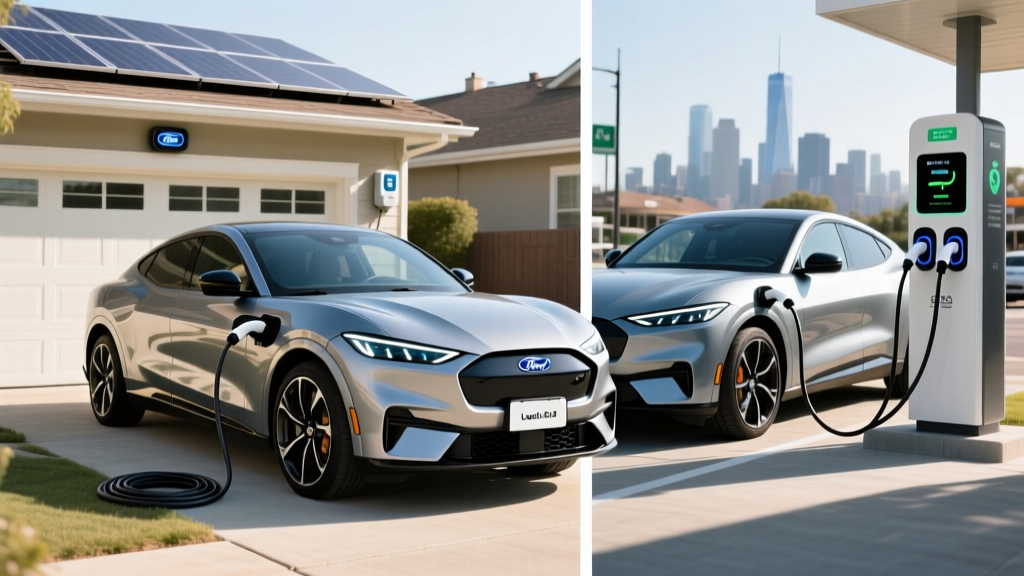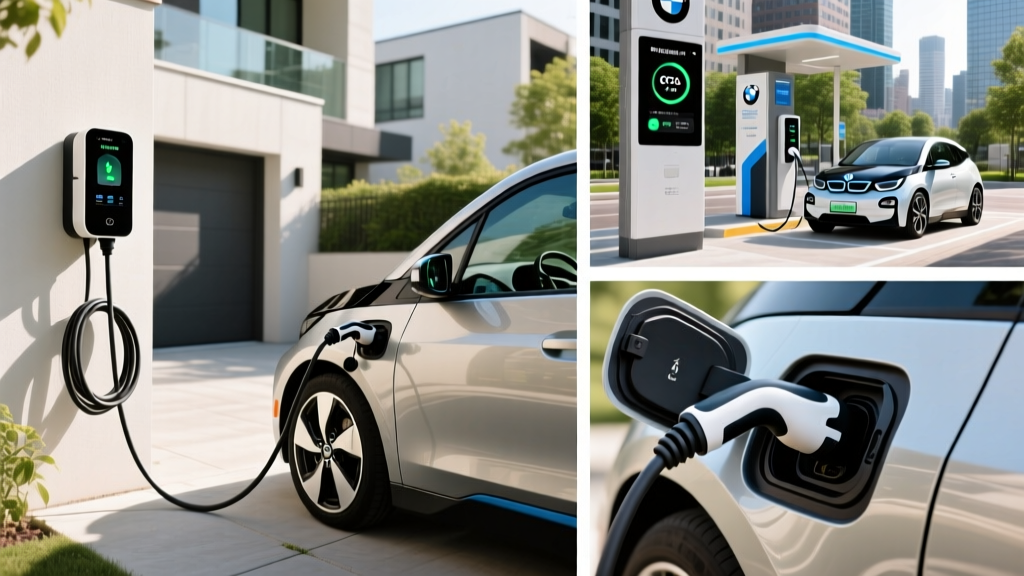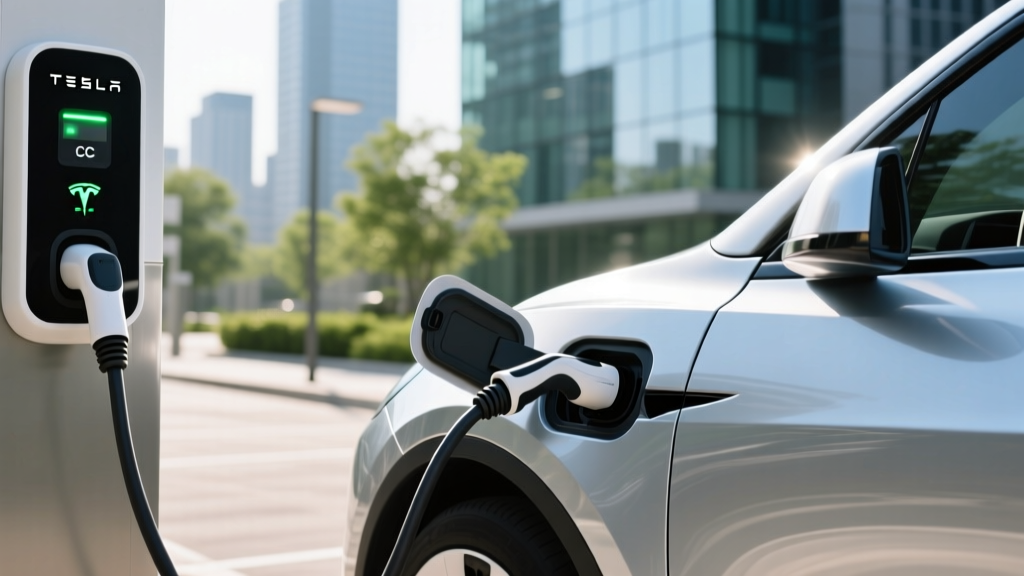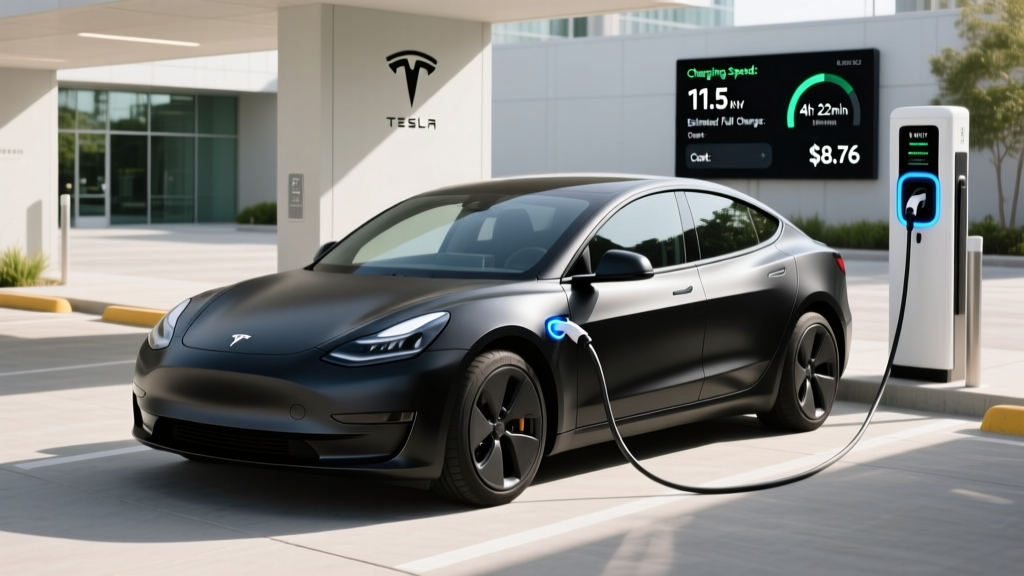
The 2025 Tesla Model 3 Long Range Rear-Wheel Drive pairs a 79 kWh (usable) LFP/NMC battery pack with an EPA-estimated 363 miles of range and a NACS charge port capable of peaking at 250 kW on DC fast chargers. That spec sheet is compelling, but the ownership experience is defined by how you charge. This guide breaks down exactly what it takes to keep a Model 3 Long Range RWD powered — from a 120V trickle in the garage to a 250 kW Supercharger on the highway — with real costs, real charge times, and the electrical upgrades you might not see coming.
2025 Tesla Model 3 Long Range RWD: The Charging-Relevant Specs
Before we talk chargers, let's lock down the numbers that determine how fast this car can accept energy and how far that energy takes you.
| Spec | Value |
|---|---|
| EPA Range | 363 miles |
| Real-World Highway (~70 mph) | ~290–310 miles |
| Real-World Cold Weather (20°F) | ~250–280 miles |
| Battery Capacity (Usable) | ~79 kWh |
| Max DC Fast Charge Rate | 250 kW peak |
| 10–80% DCFC Time (250 kW) | ~25 minutes |
| Max Level 2 AC Charge Rate | 11.5 kW (48A) |
| EPA Efficiency | 132 MPGe combined (25 kWh/100 mi) |
| Charge Port | NACS (native Tesla) |
| Base MSRP | $42,490 (before incentives) |
| Federal §30D Credit Eligibility | Up to $7,500 — subject to income, sourcing, and MSRP caps |
Charging Levels Explained: kW, Miles Per Hour, and What Each Means for Your Model 3
The single most important distinction in EV charging: kW (kilowatts) measures power — how fast energy flows into the car. kWh (kilowatt-hours) measures energy — how much the battery holds. Think of kW as the width of the hose and kWh as the size of the bucket. The 2025 Model 3 Long Range RWD has a ~79 kWh bucket. Here's how fast each hose fills it.
| Level | Voltage / Amperage | Power (kW) | Miles of Range Added Per Hour | Typical Use Case |
|---|---|---|---|---|
| Level 1 (120V) | 120V / 12A | ~1.4 kW | ~3–4 mi/hr | Emergency / overnight trickle |
| Level 2 (240V) | 240V / 48A | 11.5 kW (max) | ~38–44 mi/hr | Home daily charging |
| DC Fast Charge | 400V+ architecture | Up to 250 kW peak | ~200+ mi in 15 min | Road trips / rapid top-ups |
Level 1 is what you get from a standard household outlet using the Tesla Mobile Connector. At ~1.4 kW, it adds roughly 3–4 miles of range per hour. Plugging in for 12 hours overnight yields about 40–48 miles — adequate if your daily commute is short, but impractical as a primary strategy for a 363-mile battery.
Level 2 is the home-charging standard. The Model 3 Long Range RWD can accept up to 11.5 kW (48 amps) on a 240V circuit. At that rate, a full 10–80% charge takes roughly 5.5 hours, adding around 38–44 miles of range per hour of charging. This is the sweet spot: plug in when you get home, wake up to a full battery every morning.
DC Fast Charging bypasses the car's onboard AC-to-DC converter and feeds DC power directly to the battery. On a Tesla V3 or V4 Supercharger, the Model 3 Long Range RWD peaks at 250 kW, though that peak is sustained only briefly. The charge curve tapers significantly above 50–60% state of charge (SoC), which is why Tesla and most EV makers quote 10–80% times (~25 minutes) rather than 0–100%. Charging from 80% to 100% on DCFC can take nearly as long as the 10–80% session — so unless you need every last mile, stop at 80% and get back on the road.
Home Charger Installation: Electrical Requirements, Costs, and Panel Upgrade Reality
Installing a dedicated Level 2 home charger for the Model 3 Long Range RWD means running a 240V circuit — the same voltage your electric dryer or oven uses. Here's what that entails and what it costs.
Electrical Requirements
- Circuit: Dedicated 60-amp breaker (to deliver a continuous 48A to the car, the National Electrical Code requires the breaker to be rated at 125% of the continuous load: 48A × 1.25 = 60A).
- Wire: 6 AWG copper (or 4 AWG aluminum) for runs up to ~100 feet; longer runs may require thicker gauge to limit voltage drop.
- Outlet vs. hardwired: You can install a NEMA 14-50 outlet (allows you to unplug and take the Mobile Connector with you) or hardwire a Wall Connector directly. Hardwired installations are generally preferred for 48A+ circuits because they eliminate the outlet as a potential failure point and don't require GFCI breakers (which can nuisance-trip with EV chargers).
- Panel capacity: Your home's main electrical panel must have enough spare capacity. A 60A circuit draws a significant load. Homes with 100A service may need a panel upgrade to 200A — a major additional cost.
Installation Cost Breakdown
| Cost Component | Simple Install (Panel Nearby) | Complex Install (Long Run / Panel Upgrade) |
|---|---|---|
| EV Charger Equipment (e.g., Tesla Wall Connector) | $400–$500 | $400–$500 |
| Electrician Labor (2–4 hrs simple; 6–10+ hrs complex) | $500–$1,200 | $1,500–$4,000 |
| Electrical Materials (wire, conduit, breaker) | $100–$300 | $300–$800 |
| Permit & Inspection | $50–$200 | $50–$200 |
| Panel Upgrade (100A → 200A, if needed) | $0 | $2,000–$5,000 |
| Total Estimated Range | $1,050–$2,200 | $4,250–$10,500 |
Safety and Code Considerations
- Dedicated circuit: EV chargers must be on their own dedicated breaker — no sharing with other appliances.
- GFCI: The 2020/2023 NEC requires GFCI protection for receptacle-based (outlet) EV charging circuits. However, many EV charger manufacturers (including Tesla) recommend hardwired installations to avoid nuisance GFCI tripping, which is a known issue with some breaker/EVSE combinations.
- Outdoor rating: If your charger is mounted outside, ensure the unit is rated for outdoor use (NEMA 4 or IP56+). The Tesla Wall Connector is rated for indoor and outdoor installation.
- Permit and inspection: Most jurisdictions require a permit for new 240V circuits. Skipping this can void home insurance coverage if an electrical fire occurs. Your electrician should pull the permit and schedule the inspection.
Connector Compatibility: NACS, CCS, and Adapters for the Model 3
The 2025 Tesla Model 3 Long Range RWD comes equipped with a NACS (North American Charging Standard) port — Tesla's proprietary connector, now formally adopted as the industry standard by SAE and increasingly by other automakers. Here's what that means for where and how you can charge.
| Connector Type | Compatible? | Notes |
|---|---|---|
| NACS (Tesla native) | ✅ Yes — direct plug | All Tesla Superchargers (V2, V3, V4); Tesla Wall Connector; Tesla Mobile Connector |
| CCS1 | ⚠️ With adapter | Tesla offers a CCS adapter (~$175–$250) for non-Tesla DCFC networks (Electrify America, EVgo, etc.) |
| CHAdeMO | ❌ Not compatible | No adapter available; CHAdeMO is being phased out in North America |
| J1772 (Level 2 public) | ⚠️ With adapter | Tesla includes a J1772-to-NACS adapter in the glovebox for non-Tesla Level 2 stations |
Practical takeaway: For home charging, the Tesla Wall Connector (NACS) is the simplest, fastest path. On road trips, Tesla's Supercharger network remains the most reliable DCFC option. For non-Tesla public Level 2 or DCFC stations, carry the included J1772 adapter and consider purchasing the CCS adapter if you frequently use Electrify America or other CCS networks. The expansion of NACS to Ford, GM, Rivian, and other brands means more NACS-equipped chargers are coming online through 2025–2026, reducing the need for adapters over time.
Charging Cost Per Mile: Home vs. Public vs. Gas Comparison
One of the strongest economic arguments for the Model 3 Long Range RWD is fuel cost — but only if you charge smart. Electricity pricing varies enormously depending on where and when you plug in.
| Scenario | Rate ($/kWh) | Cost for 100 Miles | Cost Per Mile |
|---|---|---|---|
| Home, off-peak (utility time-of-use) | $0.08–$0.12 | $2.00–$3.00 | $0.02–$0.03 |
| Home, standard rate (national avg) | $0.16 | $4.00 | $0.04 |
| Public Level 2 (e.g., ChargePoint, workplace) | $0.25–$0.49 | $6.25–$12.25 | $0.06–$0.12 |
| Tesla Supercharger (national avg ~2025) | $0.28–$0.36 | $7.00–$9.00 | $0.07–$0.09 |
| Electrify America / third-party DCFC | $0.35–$0.55 | $8.75–$13.75 | $0.09–$0.14 |
| Gas sedan (30 MPG combined, $3.40/gal) | — | $11.33 | $0.11 |
At the Model 3 Long Range RWD's EPA efficiency of 25 kWh/100 miles, home charging on an off-peak rate is roughly one-quarter the cost per mile of a 30 MPG gas sedan. Even at Supercharger pricing, you're paying less per mile than gasoline. The cost advantage narrows significantly if you rely exclusively on expensive public DCFC networks — another reason home Level 2 charging is the economic backbone of EV ownership.
For an owner driving 12,000 miles per year with mostly home charging at $0.12/kWh, annual electricity cost is approximately $360. The equivalent gas sedan at 30 MPG and $3.40/gallon spends about $1,360. That's roughly $1,000 in annual fuel savings, or $5,000 over five years — a meaningful offset to the Model 3's purchase price.
Recommended Home Chargers for the 2025 Tesla Model 3 Long Range RWD
The Model 3 Long Range RWD can accept up to 11.5 kW (48A) on Level 2. To take full advantage, your charger and circuit must support at least 48A continuous. Here are top picks.
Tesla Wall Connector (Best Overall for Tesla Owners)
- Power Output: Up to 11.5 kW (48A) on a 60A circuit
- Connector: NACS (native — no adapter needed)
- Cable Length: 24 feet
- Smart Features: Wi-Fi for OTA firmware updates, power-sharing with a second Wall Connector on the same circuit, Tesla app integration
- Price: ~$475
- Why: Purpose-built for Tesla vehicles. Simplest setup, no adapter friction, and power-sharing lets you install two connectors on one 60A circuit (useful for two-car households).
ChargePoint Home Flex (Best Universal Charger)
- Power Output: Up to 12 kW (50A) on a 60A circuit; configurable down to 16A for lower-capacity panels
- Connector: J1772 (use Tesla's included J1772-to-NACS adapter) or NACS pigtail version
- Cable Length: 23 feet
- Smart Features: Wi-Fi, ChargePoint app with scheduling and energy tracking, Alexa integration, flexible amperage settings
- Price: ~$550–$700
- Why: The adjustable amperage is ideal if your panel can't support a full 60A circuit — you can set it to 32A or 40A and upgrade later. Works with any EV using the appropriate adapter.
Emporia Vue Smart Home EV Charger (Best Budget Smart Charger)
- Power Output: Up to 11.5 kW (48A) on a 60A circuit
- Connector: J1772 (adapter required for Tesla) or NACS version available
- Cable Length: 24 feet
- Smart Features: Wi-Fi, Emporia app with energy monitoring and solar integration, scheduling, works with Emporia home energy monitor
- Price: ~$350–$450
- Why: Excellent value with robust smart features. The solar-integration capability is a standout if you have rooftop panels.
Public Charging and Road Trip Strategy for the Model 3 Long Range RWD
With 363 miles of EPA range, the Model 3 Long Range RWD is one of the most road-trip-capable EVs on the market. Tesla's Supercharger network remains the gold standard for reliability, with over 6,000 stations and 65,000+ connectors across North America as of early 2026.
Road trip charging strategy:
- Plan stops when the battery reaches ~15–20% SoC. This gives you buffer for detours and keeps you in the fastest part of the charge curve.
- Charge only to 80% at each stop unless you need the extra range to reach the next charger. The 80–100% taper adds significant time.
- Use the Tesla in-car navigation for route planning — it automatically factors in elevation, temperature, speed limits, and traffic to estimate arrival SoC and suggest charge stops.
- For non-Tesla chargers, apps like PlugShare and A Better Routeplanner (ABRP) help you find CCS stations along your route if you're carrying the CCS adapter.
On a typical 600-mile road trip, expect 1–2 Supercharger stops of 20–25 minutes each, adding roughly 40–50 minutes total to your drive time. For comparison, a gas-car driver on the same trip might spend 15–20 minutes on fuel and rest stops. The time gap is real but manageable — and it shrinks further as you combine charging with meal breaks.
Federal Tax Credit and Incentive Context (2025–2026)
The 2025 Tesla Model 3 Long Range RWD may qualify for the federal §30D clean vehicle credit of up to $7,500, but eligibility depends on several factors that change frequently:
- Buyer income caps: Modified adjusted gross income (MAGI) must not exceed $150,000 (single), $225,000 (head of household), or $300,000 (joint).
- MSRP cap: The vehicle's MSRP must not exceed $55,000 for sedans (the Model 3 qualifies).
- Battery sourcing requirements: Increasingly strict critical-mineral and battery-component sourcing rules apply, and they tighten each year. Tesla's supply chain has adapted, but specific eligibility can change mid-year.
- Point-of-sale transfer: As of 2024, buyers can transfer the credit to the dealer at the point of sale, effectively reducing the purchase price by up to $7,500 at the dealership rather than waiting to claim it on their tax return.
Always verify current eligibility on fueleconomy.gov and consult a tax professional before relying on the credit in your purchase decision. Some states also offer additional rebates or reduced electricity rates for EV owners — check with your state energy office and local utility.
Frequently Asked Questions
How much does it cost to install a home EV charger for the Model 3?
A straightforward Level 2 installation with the panel nearby typically costs $1,050–$2,200 (equipment, electrician labor, materials, and permit). If your home needs a panel upgrade from 100A to 200A service, total costs can reach $4,250–$10,500. Always get a detailed quote from a licensed electrician that separates equipment, labor, and permit fees.
How fast will each charging level add range to the Model 3 Long Range RWD?
Level 1 (120V) adds about 3–4 miles per hour. Level 2 (240V at 48A) adds roughly 38–44 miles per hour. DC fast charging at a 250 kW Supercharger can add approximately 200 miles in 15 minutes, though the charge rate tapers significantly above 80% SoC.
Which connector and charger are compatible with my 2025 Model 3?
The 2025 Model 3 uses a NACS (Tesla) charge port. It plugs directly into Tesla Superchargers and the Tesla Wall Connector. For non-Tesla J1772 Level 2 stations, use the included J1772 adapter. For non-Tesla CCS DCFC stations, you'll need Tesla's optional CCS adapter. CHAdeMO is not compatible.
How much does charging cost per mile compared to gas?
Home charging at $0.12/kWh costs roughly $0.03 per mile in the Model 3 Long Range RWD (at 25 kWh/100 mi). A comparable 30 MPG gas sedan at $3.40/gallon costs about $0.11 per mile. Even at Supercharger rates ($0.28–$0.36/kWh), the Model 3 costs $0.07–$0.09 per mile — still cheaper than gas.
What electrical upgrades might I need for a home charger?
You'll need a dedicated 60A, 240V circuit. If your home's main panel is 100A or has insufficient spare breaker slots, you may need a panel upgrade to 200A — adding $2,000–$5,000 to the project. Homes built after 2000 with 200A service usually have enough capacity. A licensed electrician can assess your panel during a site visit.
Should I charge to 100% every night?
Tesla recommends setting your daily charge limit to 80% for routine driving to preserve long-term battery health. Charge to 100% only when you need maximum range for a road trip. The Model 3's battery management system includes buffers, but habitual 100% charging accelerates degradation over the battery's lifespan. The battery and drive unit carry an 8-year / 120,000-mile warranty with a minimum 70% capacity retention threshold.