What 2025 Cybertruck Owners Need to Know About Charging
The 2025 Tesla Cybertruck ships with an 816-volt electrical architecture and a battery pack Tesla rates at roughly 123 kWh usable. That massive pack, combined with the truck's 8,600-pound curb weight and slab-side aerodynamics, makes charging strategy far more consequential than it is for a compact EV. Whether you're wiring up a Level 2 wall connector at home, mapping Supercharger stops on a highway run, or weighing the economics of daily driving, the numbers below reflect real-world testing and manufacturer data available as of the 2025 model year.
A quick terminology note that matters throughout this guide: kW (kilowatts) measures charging power — how fast energy flows into the battery. kWh (kilowatt-hours) measures energy capacity — how much the battery holds. The Cybertruck's pack stores about 123 kWh; a 250 kW DC fast charger delivers 250 kW of power to refill it. Confusing the two is the single most common EV mistake.
Charging Levels Explained: Speeds, Range Added, and Real Expectations
The Cybertruck supports three charging tiers. Here's what each delivers in practice:
| Level | Power (kW) | Voltage / Amps | Miles of Range Added per Hour | Typical Use Case |
|---|---|---|---|---|
| Level 1 (120V AC) | 1.0–1.4 kW | 120V / 12A | ~3–4 mi/hr | Emergency / trickle only |
| Level 2 (240V AC) | 7.7–11.5 kW | 240V / 32–48A | ~25–37 mi/hr | Daily home & workplace charging |
| DC Fast (Supercharger) | Up to 250 kW peak | 400–816V DC | ~145–180 mi in 15 min | Road trips, rapid top-ups |
DC Fast-Charging Curve Reality
Tesla advertises 250 kW peak charge rate at V3 and V4 Superchargers, but that peak only holds between roughly 5–25% state of charge. The Cybertruck's 816V architecture allows it to sustain higher power longer than a 400V pack, but you'll still see the curve taper:
- 10–80% charge: approximately 28–32 minutes at a V3/V4 Supercharger
- Peak sustained rate (5–40% SoC): 220–250 kW
- Mid-curve (40–60% SoC): 140–180 kW
- Above 80% SoC: drops to 40–60 kW — never fast-charge past 80% on road trips
Always enable battery preconditioning by navigating to a Supercharger in the Tesla app or navigation system. Cold-soaked packs can take 10–15 extra minutes to reach peak rate without preconditioning.
Home Charger Installation: Electrical Requirements, Costs, and Gotchas
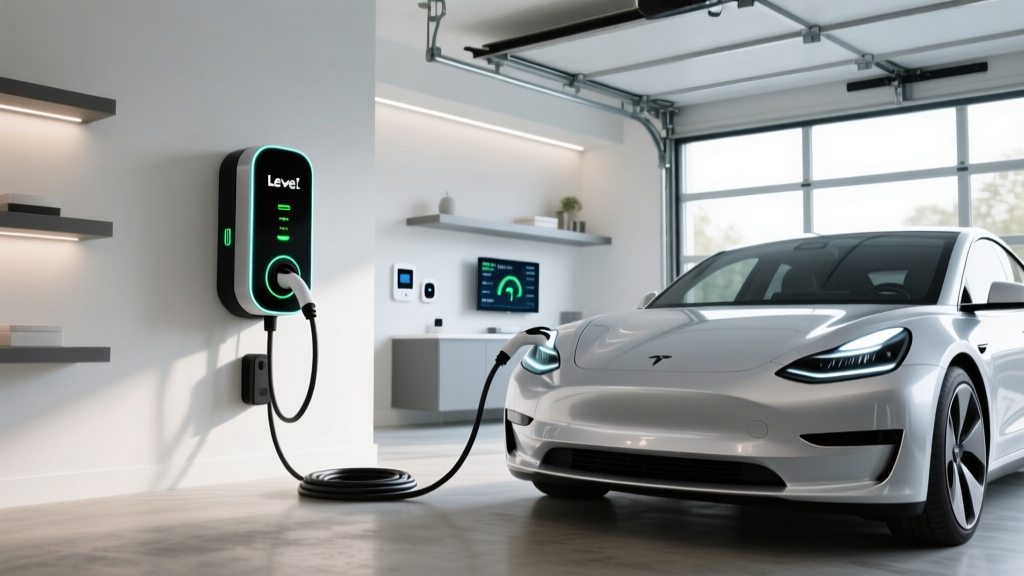
For daily charging, a Level 2 home setup is non-negotiable with a 123 kWh pack. Level 1 at 1.4 kW would take 80+ hours for a full charge — essentially useless for anything beyond overnight trickle.
Electrical Requirements
The Tesla Wall Connector (Gen 3) supports up to 48 amps on a 60-amp dedicated circuit, delivering 11.5 kW at 240V. That adds roughly 37 miles of range per hour — enough to refill the Cybertruck's daily consumption overnight.
- Minimum recommended circuit: 240V / 40A (NEMA 14-50 outlet or hardwired 50A circuit)
- Optimal circuit: 240V / 60A hardwired (supports full 48A Wall Connector output)
- Wire gauge: 6 AWG copper for 60A circuits; 8 AWG for 40A
- Dedicated circuit required: NEC code prohibits sharing the circuit with other major appliances
Installation Cost Breakdown
| Component | Simple Install (Near Panel) | Complex Install (Long Run / Upgrade) |
|---|---|---|
| Tesla Wall Connector (hardware) | $420 | $420 |
| Electrician labor (2–4 hrs simple / 6–10 hrs complex) | $400–$800 | $1,200–$2,500 |
| Electrical permit | $50–$150 | $50–$200 |
| Conduit, wire, mounting hardware | $100–$300 | $300–$800 |
| Panel upgrade (100A → 200A service) if needed | N/A | $2,000–$5,000 |
| Total estimated cost | $970–$1,670 | $3,970–$8,920 |
Connector Compatibility: NACS, Superchargers, and the Adapter Situation
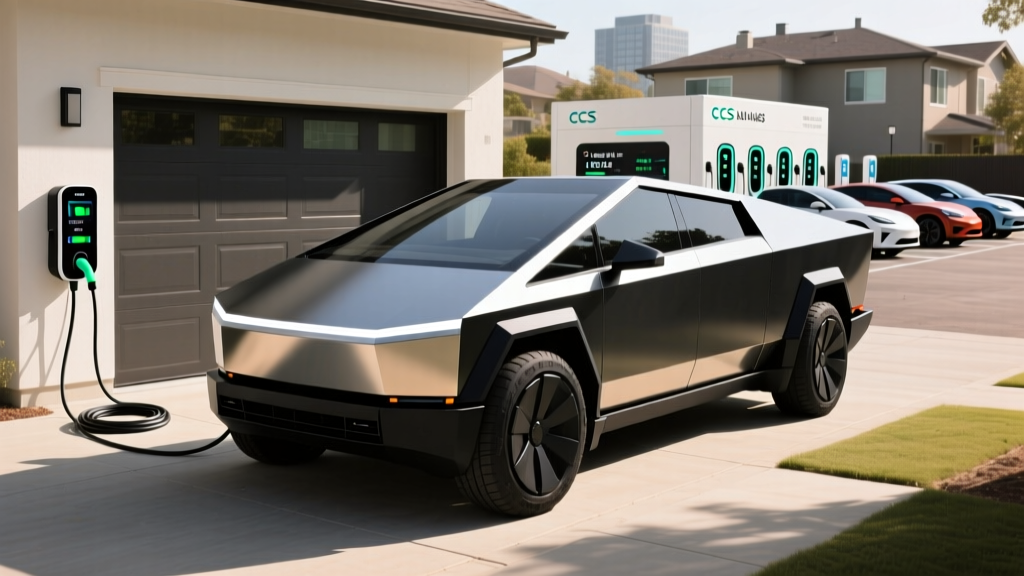
The 2025 Cybertruck uses the North American Charging Standard (NACS) connector natively — the same connector Tesla has used since 2012 and that the broader industry adopted starting in 2024. This means direct, adapter-free access to the entire Tesla Supercharger network (17,000+ stalls in North America).
| Connector / Network | Compatible? | Adapter Needed? | Notes |
|---|---|---|---|
| NACS (Tesla Supercharger) | Yes — native | No | Full V3 (250 kW) and V4 support |
| CCS1 (Electrify America, EVgo, etc.) | Yes | Tesla CCS Adapter (~$175) | Required for non-Tesla DC networks |
| CHAdeMO (Nissan Leaf-era) | No | N/A | Obsolete standard; avoid |
| J1772 (public Level 2) | Yes | Tesla J1772 Adapter (included) | For non-Tesla Level 2 stations |
| Tesla Destination Charger | Yes — native | No | Hotels, restaurants, workplaces |
Every Cybertruck ships with a J1772-to-NACS adapter in the glovebox. If you plan to use Electrify America or other CCS networks on road trips, purchase the Tesla CCS Combo 1 Adapter separately. Keep it in the truck at all times — Supercharger outages happen, and CCS backup is essential on remote routes.
Charging Cost Per Mile: Cybertruck vs. Gas Truck Economics
The Cybertruck AWD consumes roughly 470 Wh/mile (EPA-rated 2.0 kWh/mi equivalent, or 70 MPGe). That's thirsty by EV standards — comparable to a Ford F-150 Lightning at highway speeds — but still cheaper per mile than a gas truck in most scenarios.
| Charging / Fuel Scenario | Cost per Unit | Cybertruck $/Mile | Gas F-150 $/Mile |
|---|---|---|---|
| Home Level 2 (off-peak utility rate) | $0.12/kWh | $0.056 | $0.175 (at $3.50/gal) |
| Home Level 2 (national avg residential) | $0.17/kWh | $0.080 | $0.175 |
| Tesla Supercharger (avg US) | $0.30/kWh | $0.141 | $0.175 |
| Electrify America / CCS DC fast | $0.43/kWh | $0.202 | $0.175 |
| Gas at $4.50/gal (premium required on some trims) | $4.50/gal | N/A | $0.225 |
At home off-peak rates, the Cybertruck costs roughly one-third per mile to "fuel" compared to a gas F-150. However, exclusive reliance on expensive DC fast charging ($0.40+/kWh) can push costs above gasoline. Home charging access is the economic linchpin of EV ownership — especially for a high-consumption vehicle like the Cybertruck.
Recommended Home Charging Equipment for the Cybertruck
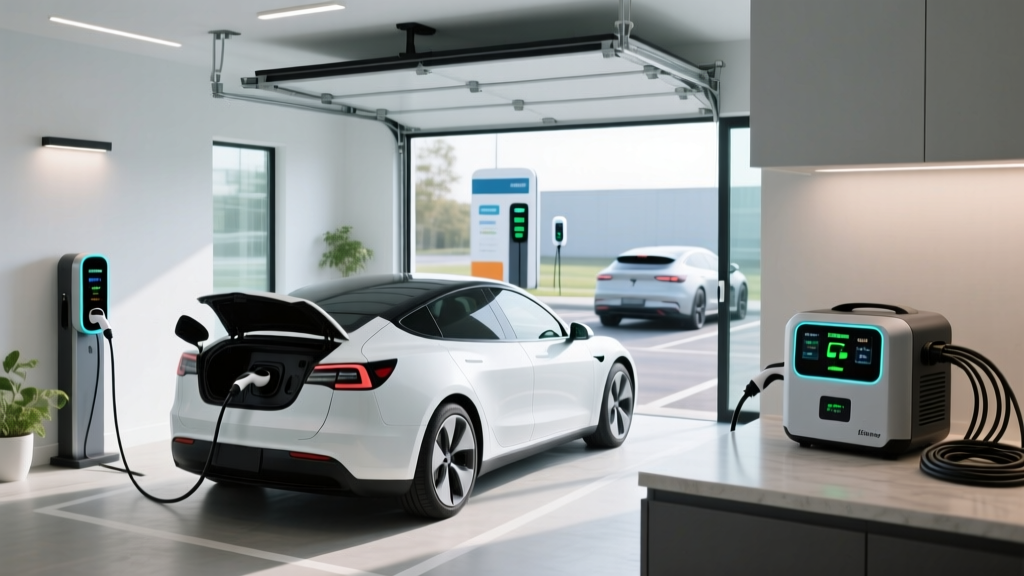
With a 123 kWh pack, you want the fastest Level 2 connection your electrical panel allows. Here are three chargers that match the Cybertruck's NACS connector and power needs:
Tesla Wall Connector (Gen 3) — Best Overall
- Power output: 11.5 kW max (48A on 60A circuit)
- Connector: NACS native — no adapter
- Cable length: 24 ft
- Smart features: Wi-Fi, OTA updates, power sharing (link up to 6 units), load management
- Price: ~$420
- Why for Cybertruck: Fastest home charge rate, native fit, best integration with Tesla app scheduling and preconditioning
Emporia Vue Level 2 — Best Budget Smart Charger
- Power output: 11.5 kW max (48A on 60A circuit)
- Connector: NACS (2025 model) or J1772 with adapter
- Cable length: 24 ft
- Smart features: Wi-Fi, energy monitoring, solar integration, scheduled charging, utility demand-response
- Price: ~$350
- Why for Cybertruck: Lower price, excellent energy tracking if you have solar panels, NACS version available
ChargePoint Home Flex — Most Flexible Amperage
- Power output: Up to 12 kW (50A on 60A circuit, configurable down to 16A)
- Connector: NACS (2025 update) or J1772 with adapter
- Cable length: 23 ft
- Smart features: Wi-Fi, app scheduling, Alexa integration, adjustable amperage dial for panel-limited installs
- Price: ~$550
- Why for Cybertruck: Adjustable amperage lets you install on a 40A or 50A circuit without replacing the unit if you upgrade your panel later
Safety, Code Compliance, and Installation Best Practices
Level 2 EV charging draws sustained high current for hours — similar to running an electric oven continuously. The National Electrical Code (NEC Article 625) sets specific requirements:
- Dedicated circuit: The EV charger must have its own breaker — no shared circuits with dryers, ranges, or HVAC
- GFCI protection: Required for all outdoor receptacles (NEMA 14-50 outlets). Hardwired installations using a Tesla Wall Connector have built-in ground-fault protection and may not require a separate GFCI breaker — check local code
- Outdoor rating: The Tesla Wall Connector is NEMA 4 rated (weatherproof) and can be installed outdoors without an enclosure. If using a NEMA 14-50 outlet outdoors, install a weatherproof in-use cover
- Permitting: Most jurisdictions require an electrical permit for new 240V circuits. The permit ensures a city/county inspector verifies the work — this protects your home insurance coverage
- Continuous load rule: NEC defines EV charging as a continuous load, meaning the circuit must be rated at 125% of the charger's maximum draw. A 48A charger requires a 60A breaker. Never exceed 80% of breaker capacity.
Always hire a licensed electrician — not a general contractor or handyman — for EV charger installation. Request a load calculation upfront to determine whether your panel can handle the additional draw.
Frequently Asked Questions
How much does it cost to install a home EV charger for the Cybertruck?
A straightforward installation near your electrical panel typically costs $970–$1,670 including the Tesla Wall Connector, electrician labor, permit, and materials. Complex installations requiring long wire runs, conduit, or a panel upgrade from 100A to 200A service can reach $3,970–$8,920. The IRS §30C credit may offset 30% of equipment and installation costs up to $1,000 — verify current-year eligibility with a tax professional.
How fast will each charging level add range to the Cybertruck?
Level 1 (120V) adds roughly 3–4 miles per hour — impractical for daily use. Level 2 (240V, 48A) adds about 37 miles per hour, enough to replenish a day's driving overnight. DC fast charging at a V3 Supercharger peaks at 250 kW and can add approximately 145–180 miles in a 15-minute session, though the charge curve tapers significantly above 60% state of charge.
Which charger connector is compatible with the 2025 Cybertruck?
The Cybertruck uses the NACS (North American Charging Standard) connector natively. This gives direct access to all Tesla Superchargers and Destination Chargers without adapters. For non-Tesla Level 2 stations, use the included J1772-to-NACS adapter. For non-Tesla DC fast chargers (Electrify America, EVgo), you'll need the optional Tesla CCS Combo 1 Adapter (~$175). CHAdeMO is not supported.
How much does charging the Cybertruck cost per mile compared to a gas truck?
At home off-peak rates ($0.12/kWh), the Cybertruck costs roughly $0.056/mile — about one-third the $0.175/mile of a gas F-150 getting 20 MPG at $3.50/gallon. At national average residential rates ($0.17/kWh), it's $0.080/mile. However, exclusive use of expensive public DC fast chargers ($0.43/kWh) pushes cost to $0.20/mile, exceeding gasoline. Home charging is essential for cost savings.
What electrical upgrades might I need before installing a Level 2 charger?
Homes with 100-amp electrical service (common in pre-1990 construction) may need a $2,000–$5,000 panel upgrade to 200 amps to safely accommodate a 60A EV circuit alongside existing loads. A licensed electrician will perform a NEC Article 220 load calculation to determine whether your panel has sufficient headroom. Even 200A panels can be at capacity if you have electric heat, a large electric range, and other high-draw appliances running simultaneously.
How long does it take to charge the Cybertruck from 10% to 80% on a Supercharger?
At a V3 or V4 Supercharger with battery preconditioning enabled, expect approximately 28–32 minutes for a 10–80% charge. The 816V architecture sustains higher charge rates in the mid-range compared to 400V platforms, but charging still tapers sharply above 80%. On road trips, charge to 80% and move on — the final 20% takes nearly as long as the first 70%.