Why Your Charging Setup Directly Impacts 2025 Taycan Range
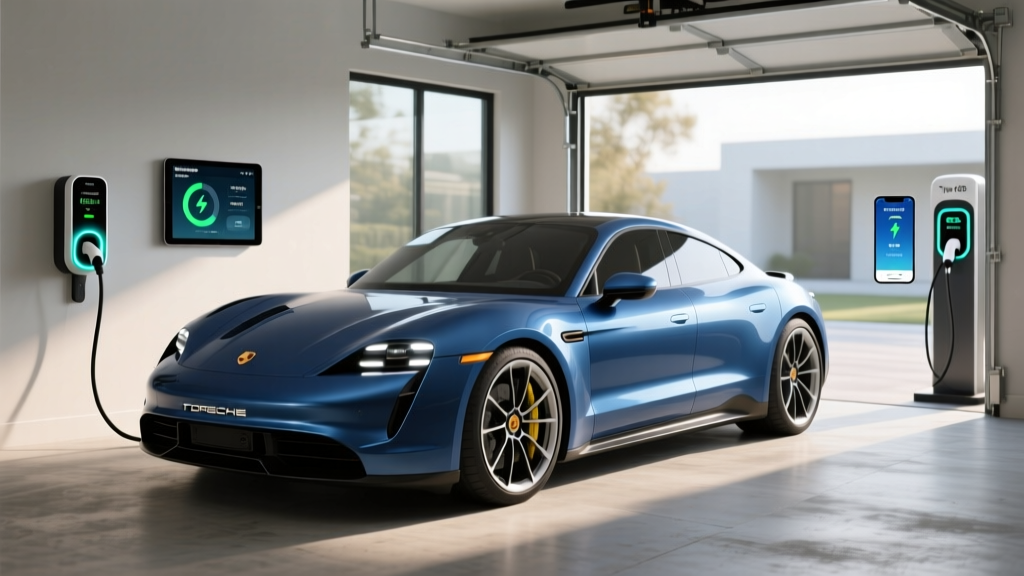
The 2025 Porsche Taycan lineup offers EPA range estimates from 225 miles (base Taycan with 79.2 kWh battery) up to 318 miles (Taycan 4S with Performance Battery Plus and 93.4 kWh pack, per fueleconomy.gov). But your real-world range depends heavily on how and where you charge. Consistent access to proper Level 2 charging preserves battery health and ensures you start every day with a full pack, while understanding DC fast-charging curves means you spend less time at public stations on road trips.
This guide breaks down exactly what charging infrastructure the 2025 Taycan requires, what it costs to install at home, which public networks are compatible, and how charging costs compare to gasoline — with precise numbers for every Taycan variant.
Charging Levels Explained: kW, Speed, and Taycan Compatibility
Before evaluating equipment, understand the three charging tiers available to Taycan owners. Power is measured in kilowatts (kW) — the rate of energy delivery — while battery capacity is measured in kilowatt-hours (kWh), the total energy stored. The 2025 Taycan's Performance Battery Plus holds approximately 83.7 kWh of usable energy.
| Charging Level | Voltage | Power (kW) | Miles of Range Added per Hour | Best For |
|---|---|---|---|---|
| Level 1 (Standard Outlet) | 120V AC | 1.0–1.4 kW | 3–5 miles | Emergency/overnight trickle only |
| Level 2 (Home/Public AC) | 240V AC | 7.2–19.2 kW | 22–58 miles | Daily home charging, destination charging |
| DC Fast Charging | 400V–800V DC | 50–320 kW | 180–600+ miles (peak rate) | Road trips, quick top-ups |
The 2025 Taycan's onboard AC charger accepts up to 19.2 kW on Level 2 (with the optional 19.2 kW onboard charger; standard is 11 kW on some trims). On DC fast charging, the Taycan's 800V architecture enables peak rates up to 320 kW on the latest models with Performance Battery Plus, enabling a 10–80% charge in approximately 18 minutes under ideal conditions at a compatible 350 kW charger. However, sustained rates taper above 80% State of Charge (SoC) to protect battery longevity — expect 80–100% to take an additional 15–20 minutes.
Home Level 2 Installation: Electrical Requirements, Costs, and Panel Upgrades
To unlock the Taycan's full 19.2 kW Level 2 capability at home, you need a 240V circuit on a dedicated breaker. Here is what the electrical infrastructure demands:
- Circuit rating: 80-amp breaker for continuous 64A draw (supporting 19.2 kW), or a 60-amp breaker for 48A draw (11.5 kW). A 50-amp breaker supports 40A/9.6 kW, which still adds roughly 30 miles per hour.
- Wire gauge: 2 AWG copper for 80A circuits; 4 AWG copper for 60A circuits (per NEC Article 625).
- Panel capacity: Your main electrical panel must have sufficient spare amperage. Most modern homes have 200A service, but adding a 60–80A EV circuit may require a load calculation.
- Permit: Nearly all jurisdictions require an electrical permit for EV charger installation, typically $50–$250 depending on municipality.
Panel Upgrade: The Hidden Cost for Older Homes
If your home has 100A service (common in homes built before 1990) or your panel is near capacity, an upgrade to 200A service may be required. This involves replacing the main panel and potentially the service drop from the utility. Costs range from $1,500 to $4,000+ depending on accessibility and local utility requirements. Always request a load calculation from your electrician before committing to a charger amperage.
| Component | Cost Range | Notes |
|---|---|---|
| Level 2 EV Charger (Equipment) | $400–$1,200 | Varies by power output, cable length, smart features |
| Electrician Labor (standard install) | $500–$1,500 | Depends on panel-to-outlet distance, wall type, conduit run |
| Electrical Permit | $50–$250 | Required in most jurisdictions |
| Panel Upgrade (if needed) | $1,500–$4,000+ | Only if existing panel lacks capacity |
| Total (no panel upgrade) | $950–$2,950 | Typical range for most homeowners |
| Total (with panel upgrade) | $2,450–$6,950 | Older homes or high-draw setups |
The federal Alternative Fuel Vehicle Refueling Property Credit (IRS Form 8911) may cover up to 30% of home charging equipment and installation costs (capped at $1,000), subject to income and census-tract eligibility. Consult a tax professional for your specific situation.
Connector Compatibility: What Plugs Into the 2025 Taycan?
The 2025 Porsche Taycan sold in North America uses the CCS1 (Combined Charging System) connector for both AC Level 2 and DC fast charging. Porsche has not adopted the NACS (North American Charging Standard, Tesla's connector) for the Taycan as of the 2025 model year, though future models may transition.
| Connector Type | Used By | Taycan Compatibility |
|---|---|---|
| CCS1 | Porsche Taycan, VW ID.4, Ford Mustang Mach-E, Hyundai Ioniq 5, BMW iX, most non-Tesla EVs | Native — built-in port |
| NACS (Tesla) | Tesla (all models), Ford F-150 Lightning (2025+), GM Ultium vehicles (2025+), Rivian (2025+) | Not native; adapter required for Tesla Supercharger access |
| CHAdeMO | Nissan Leaf, Mitsubishi Outlander PHEV (legacy) | Not compatible — largely obsolete for new EVs |
Tesla Supercharger Access: Porsche has not officially enabled NACS adapter support for the 2025 Taycan at Tesla Superchargers as of early 2026. CCS-to-NACS adapters (such as those from A2Z or Lectron, approximately $200–$300) exist but may not be officially supported by Porsche — verify warranty implications before purchasing. The Electrify America network remains the primary DC fast-charging partner for Taycan owners, offering CCS-native stations with up to 350 kW capability.
Charging Cost Per Mile: Taycan vs. Gasoline Sports Sedans
Electricity pricing varies dramatically by location, time of day, and charging tier. Below are representative scenarios for a 2025 Taycan 4S (Performance Battery Plus, 83.7 kWh usable, EPA combined efficiency of approximately 2.2 kWh/mile or ~150 MPGe per fueleconomy.gov).
| Charging Scenario | Price per kWh | Cost for Full Charge (83.7 kWh) | Cost per Mile (est. 260 mi real-world) |
|---|---|---|---|
| Home Off-Peak (utility time-of-use rate) | $0.08–$0.12 | $6.70–$10.04 | $0.026–$0.039 |
| Home Standard Residential (national avg.) | $0.16 | $13.39 | $0.052 |
| Public Level 2 (ChargePoint, EVgo L2) | $0.25–$0.39 | $20.93–$32.64 | $0.081–$0.126 |
| DC Fast Charging (Electrify America, EVgo DCFC) | $0.35–$0.55 | $29.30–$46.04 | $0.113–$0.177 |
Gasoline comparison: A Porsche Panamera 4 (comparable gas sports sedan averaging 22 MPG combined) at $3.50/gallon costs approximately $0.159 per mile. Even at the most expensive DC fast-charging rates, the Taycan matches or beats gasoline per-mile cost. At home off-peak rates, the Taycan costs roughly 75% less per mile to fuel.
Equipment Recommendations: Best Level 2 Chargers for the Taycan
For Taycan owners seeking maximum Level 2 speed (19.2 kW), you need a charger rated for 80 amps on a 100-amp circuit. Few residential chargers support this — most max out at 48 amps (11.5 kW). Below are recommended units across power tiers:
Best for Maximum Speed: Porsche Mobile Charger Connect
- Power Output: Up to 19.2 kW (80A) with appropriate circuit
- Connector: CCS1 (J1772 + CCS combo)
- Cable Length: 25 feet
- Smart Features: Wi-Fi, Porsche Connect app integration, scheduled charging, solar integration
- Price: ~$1,200 (often included or discounted with Taycan purchase)
Best Value: ChargePoint Home Flex
- Power Output: Up to 11.5 kW (50A) on 60A circuit; configurable down to 32A/40A
- Connector: J1772 (CCS adapter included with Taycan)
- Cable Length: 23 feet
- Smart Features: Wi-Fi, app scheduling, energy tracking, Alexa integration
- Price: ~$699
Best Smart Features: Emporia Level 2 EV Charger
- Power Output: Up to 11.5 kW (48A) on 60A circuit
- Connector: J1772
- Cable Length: 24 feet
- Smart Features: Wi-Fi, detailed energy dashboard, solar-aware charging, load management
- Price: ~$399
Best for Outdoor Install: Tesla Wall Connector (with CCS adapter)
- Power Output: Up to 11.5 kW (48A)
- Connector: NACS (requires CCS-to-NACS adapter for Taycan, sold separately)
- Cable Length: 24 feet
- Smart Features: Wi-Fi, power sharing, over-the-air updates
- Price: ~$475 (plus ~$200 adapter)
Safety, Code, and Installation Best Practices
EV charging draws sustained high current for hours — unlike typical household appliances that cycle on and off. This places unique demands on your electrical system:
- Dedicated circuit: Your EV charger must be on its own dedicated breaker. Sharing a circuit with other appliances risks tripping or overheating.
- GFCI protection: NEC 2023 (Article 625.54) requires GFCI protection for all EV charging outlets rated 150V to ground or less and 50A or less. Hardwired units may have different requirements — your electrician will determine compliance.
- Outdoor rating: If installing outdoors, the charger must carry a NEMA 4 (or NEMA 4X) weatherproof rating. All recommended units above are outdoor-rated.
- Load management: If your panel is near capacity but you want to avoid a costly upgrade, consider a smart load-management system (such as Emporia's or the myenergi hub) that dynamically reduces charger draw when other household loads spike.
- Permit and inspection: Always pull a permit. Unpermitted work can void home insurance claims and complicate future home sales.
Frequently Asked Questions
How much does it cost to install a home EV charger for my 2025 Taycan?
For a typical Level 2 installation without a panel upgrade, expect $950–$2,950 total (equipment, electrician labor, and permit). If your home requires a 200A panel upgrade, add $1,500–$4,000+. Get at least three quotes from licensed electricians and ask for a load calculation before committing to a specific amperage.
How fast will each charging level add range to the Taycan?
Level 1 (120V) adds approximately 3–5 miles per hour — essentially unusable for daily needs on an 83.7 kWh battery. Level 2 at 11.5 kW adds roughly 35 miles per hour; at 19.2 kW, approximately 58 miles per hour. DC fast charging at 320 kW peak can add up to 180 miles in under 10 minutes, though sustained rates taper significantly above 80% SoC.
Which connector is compatible with the 2025 Taycan?
The 2025 Taycan uses CCS1 natively. This works at Electrify America, EVgo, ChargePoint DCFC, and most non-Tesla public chargers. Tesla Supercharger access requires a CCS-to-NACS adapter, which is not officially endorsed by Porsche for the 2025 model year — verify warranty implications before use.
How much does charging the Taycan cost per mile compared to gas?
At home on standard residential rates (~$0.16/kWh), the Taycan costs approximately $0.05 per mile. A comparable gasoline Porsche Panamera costs roughly $0.16 per mile. Even at expensive public DC fast-charging rates ($0.48/kWh average), the Taycan costs about $0.11 per mile — still below gasoline.
What electrical upgrades might my home need for a Taycan charger?
If you have a 200A electrical panel with spare capacity, you likely need only a new dedicated breaker and wiring run. Homes with 100A service, older panels (Federal Pacific, Zinsco), or panels near full capacity may require a full panel upgrade ($1,500–$4,000+). A licensed electrician can perform a NEC Article 220 load calculation to determine your exact requirements.