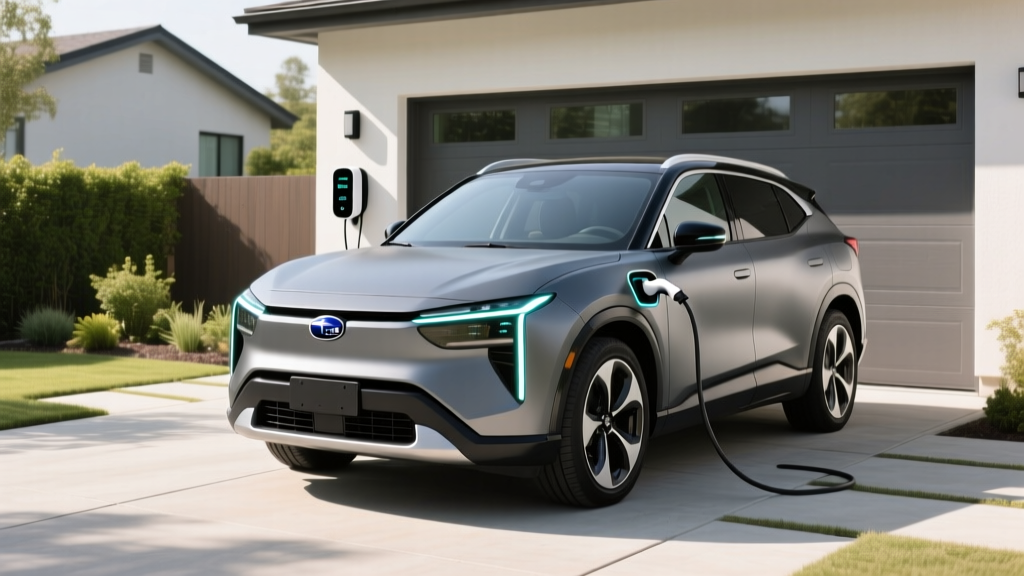
The 2025 Subaru Solterra enters its third model year with meaningful charging-hardware upgrades that address the most common criticism of the 2023 launch model. Built on the shared Toyota-Subaru e-TNGA platform, the Solterra now features a heat pump across all trims and an improved DC fast-charging curve — changes that directly affect how far you can go and how quickly you can recharge. But the 2025 Solterra's real-world range still demands an honest look, especially if you're planning road trips or live in a cold climate.
This guide covers the 2025 Solterra range you can actually expect, the charging hardware you need at home, public charging compatibility, and the full cost picture — from your electrical panel to your monthly energy bill.
2025 Solterra Range: EPA Numbers vs. Real-World Expectations
The 2025 Subaru Solterra is offered in three trims — Premium, Limited, and Touring — all sharing a 72.8 kWh (gross) lithium-ion battery pack with NMC (nickel manganese cobalt) chemistry. EPA range varies slightly by trim due to wheel size and weight:
| Trim | EPA Range | Battery (Usable) | MPGe Combined | 0-60 mph | MSRP |
|---|---|---|---|---|---|
| Premium | 228 mi | ~68 kWh | 107 MPGe | 6.5 sec | $39,995 |
| Limited | 227 mi | ~68 kWh | 105 MPGe | 6.5 sec | $43,495 |
| Touring | 222 mi | ~68 kWh | 102 MPGe | 6.5 sec | $46,995 |
Source: EPA fueleconomy.gov
Charging Speeds by Level: What the 2025 Solterra Actually Accepts
Understanding charging requires separating kW (power — the rate electricity flows) from kWh (energy — the total capacity stored in the battery). Think of kW as how wide the pipe is, and kWh as how big the tank is. The 2025 Solterra's ~68 kWh usable battery fills faster or slower depending on which "pipe" you use.
| Level | Power (kW) | Voltage / Amps | Miles Added per Hour | 10-80% Time |
|---|---|---|---|---|
| Level 1 (120V household) | ~1.2-1.4 kW | 120V / 12A | ~3-4 mi/hr | ~48-55 hours |
| Level 2 (240V home/public) | Up to 7.2 kW | 240V / 30-32A | ~18-22 mi/hr | ~7.5-8.5 hours |
| DC Fast Charging | Peak ~100 kW | 400V architecture | ~200-250 mi/hr (peak) | ~35 minutes |
The 2025 Solterra's onboard AC charger handles up to 7.2 kW on Level 2. This is the maximum rate regardless of how powerful your home charger is — a 48-amp (11.5 kW) wallbox won't charge the Solterra any faster than a 32-amp (7.7 kW) unit, because the car's onboard charger caps intake at 7.2 kW. You can still install a higher-output charger for future-proofing if you plan to own a different EV later.
On DC fast charging, Subaru improved the 2025 model's charge curve over the 2023 original. The Solterra peaks near 100 kW at low state-of-charge but tapers progressively above 50% SoC. Expect a 10-80% session in approximately 35 minutes at a 150 kW+ station, which is competitive but not class-leading. The 400V architecture limits peak speed compared to 800V rivals like the Hyundai Ioniq 5 (which peaks at ~240 kW and does 10-80% in ~18 minutes).
Which Connector Does the 2025 Solterra Use?
The 2025 Subaru Solterra comes equipped with a CCS1 (Combined Charging System) port. This is the standard connector used by most non-Tesla EVs in North America. However, the connector landscape is shifting rapidly as manufacturers adopt the NACS (North American Charging Standard) developed by Tesla.
| Connector | Compatibility with 2025 Solterra | Notes |
|---|---|---|
| CCS1 | Native — built in | Works at Electrify America, EVgo, ChargePoint DC stations |
| NACS (Tesla) | Requires adapter | Subaru has announced NACS adapter availability; required for Tesla Supercharger access |
| CHAdeMO | Not compatible | Largely discontinued standard; avoid CHAdeMO-only stations |
| J1772 (Level 2) | Native — built in | Standard for all home and public AC Level 2 charging |
Key takeaway: If you plan to use Tesla Superchargers — which now form the largest and most reliable DC fast-charging network — you will need a CCS-to-NACS adapter. Subaru has confirmed adapter compatibility for the Solterra. Check with your dealer for availability and pricing (typically $200-$250 for OEM adapters). Without the adapter, you'll rely on Electrify America, EVgo, and other CCS-native networks.
Home Charger Installation: Electrical Requirements and Full Cost Breakdown
Most Solterra owners will do 80-90% of their charging at home on Level 2. Here's what your home electrical system needs to support and what it will cost.
Electrical Requirements for the 2025 Solterra
Because the Solterra's onboard charger maxes out at 7.2 kW, you need a 240V circuit rated for at least 40 amps (which delivers 32 amps continuous to the vehicle, per the National Electrical Code's 80% rule for continuous loads). A 40-amp circuit requires 8-gauge copper wire (8 AWG THHN or equivalent).
If you want to future-proof for a vehicle with a larger onboard charger, a 60-amp circuit with 6 AWG wire supports up to 48 amps continuous (11.5 kW). The extra wire cost during initial installation is typically $100-$200 more than 8 AWG — cheap insurance if your next EV can accept higher AC rates.
Do You Need a Panel Upgrade?
This is the single biggest cost variable. If your home has a 200-amp electrical panel with available breaker slots and sufficient remaining capacity, you likely won't need an upgrade. If your home has a 100-amp panel (common in homes built before 2000), or if your panel is already near capacity with existing loads (electric range, dryer, HVAC, water heater), you may need a panel upgrade to 200A or even a service upgrade from the utility.
A licensed electrician will perform a load calculation (per NEC Article 220) to determine if your panel can handle the added EV circuit. Don't skip this step — it's a code requirement in most jurisdictions and a safety necessity.
| Component | Cost Range | Notes |
|---|---|---|
| Level 2 charger (hardware) | $300 - $700 | 32A-48A smart charger, 25ft cable |
| Electrical permit | $50 - $250 | Varies by municipality; required in most jurisdictions |
| Electrician labor (standard install) | $500 - $1,500 | Short run from panel to garage, no panel upgrade |
| Electrical panel upgrade (if needed) | $1,500 - $3,500 | 200A panel replacement or service upgrade |
| Total (no panel upgrade) | $850 - $2,450 | Typical scenario for modern homes |
| Total (with panel upgrade) | $2,350 - $5,950 | Older homes with 100A service |
Federal incentive: The IRS Residential Clean Energy Credit (25C) covers 30% of home EV charger equipment and installation costs, up to $1,000. This applies to the charger hardware and the electrical work. Consult a tax professional for eligibility based on your specific situation.
Level 2 Charger Recommendations for the Solterra
Since the Solterra caps at 7.2 kW, a 32-amp charger (7.7 kW) is the practical sweet spot. A 48-amp unit (11.5 kW) works perfectly too and future-proofs for your next EV. Here are three proven options:
Power output: 11.5 kW max (48A) | Connector: J1772 (NACS version available) | Cable: 24 ft | Smart features: Wi-Fi, energy monitoring, solar integration, scheduling via app | Price: ~$399
Best for: Budget-conscious buyers who want smart features and energy tracking. Excellent value.
Power output: 12 kW max (50A) | Connector: J1772 | Cable: 23 ft | Smart features: Wi-Fi, app scheduling, Alexa integration, adjustable amperage (16-50A via DIP switch) | Price: ~$699
Best for: Flexibility — adjustable amperage lets you match any circuit size without buying a new unit.
Power output: 9.6 kW max (40A) | Connector: J1772 | Cable: 24 ft | Smart features: Wi-Fi, OCPP protocol, OTA updates, works with utility demand-response programs | Price: ~$499
Best for: Cold-climate durability (rated to -40°F) and utility program compatibility. Built in Canada.
All three are UL-listed (or equivalent), hardwire-capable, and NEMA 4-rated for outdoor installation. For the Solterra specifically, the 40-amp Grizzl-E or the 48-amp Emporia will deliver the car's maximum 7.2 kW rate without overspending on unnecessary capacity.
Charging Cost: Electricity vs. Gasoline Per Mile
One of the strongest ownership arguments for the Solterra is fuel-cost savings. Here's how the numbers break down across common charging scenarios, using the Solterra's real-world efficiency of approximately 3.0 miles per kWh (derived from its 102-107 MPGe combined rating):
| Scenario | Cost per kWh | Cost per Mile | Full "Tank" Cost (68 kWh) |
|---|---|---|---|
| Home — off-peak utility rate | $0.08 - $0.12 | $0.027 - $0.040 | $5.44 - $8.16 |
| Home — average US rate | $0.16 - $0.18 | $0.053 - $0.060 | $10.88 - $12.24 |
| Public Level 2 (ChargePoint, etc.) | $0.25 - $0.40 | $0.083 - $0.133 | $17.00 - $27.20 |
| DC Fast Charging (Electrify America) | $0.35 - $0.55 | $0.117 - $0.183 | $23.80 - $37.40 |
| Gasoline equivalent (25 MPG, $3.40/gal) | — | $0.136 | — |
At home off-peak rates, the Solterra costs roughly 3-4 cents per mile to "fuel" — about one-quarter the cost of a comparable gas-powered Subaru Outback getting 25 MPG combined. Even at public DC fast-charging rates, the Solterra is often cheaper per mile than gasoline, though the gap narrows significantly. The savings are largest when you charge at home overnight on a time-of-use (TOU) utility plan.
For a driver covering 12,000 miles annually with 80% home charging at $0.14/kWh and 20% public DC charging at $0.45/kWh, the estimated annual fuel cost is approximately $730. A comparable gas vehicle at 25 MPG and $3.40/gallon would cost about $1,632 — a savings of roughly $900 per year.
Safety, Electrical Code, and Installation Best Practices
EV charging draws sustained high current for hours — this is fundamentally different from short-burst appliances. Proper installation is non-negotiable for safety and insurance compliance.
- Dedicated circuit: Your Level 2 charger must be on its own dedicated breaker — never shared with other outlets or appliances.
- GFCI protection: The 2023 NEC (Article 625.54) requires GFCI protection for all EV receptacles. Most modern hardwired chargers include internal ground-fault protection. If you use a NEMA 14-50 receptacle instead of hardwiring, a GFCI breaker is required (add ~$80-$150 to the breaker cost).
- Outdoor rating: If your charger is installed outside or in an unconditioned garage, ensure it carries a NEMA 4 (or IP65+) rating for weather resistance. All three chargers recommended above meet this standard.
- Hardwire vs. plug: Hardwiring is preferred for circuits above 40 amps because NEMA 14-50 receptacles have been associated with overheating incidents under sustained EV charging loads. If you use a 14-50 receptacle, choose a commercial-grade (Hubbell or Bryant) receptacle — not a residential-grade unit from a big-box store.
- Permit and inspection: Most jurisdictions require an electrical permit and final inspection for EV charger installations. This protects you: if an unpermitted installation causes a fire, your homeowner's insurance may deny the claim. The permit fee ($50-$250) is a small price for coverage.
Always hire a licensed electrician familiar with NEC Article 625 (Electric Vehicle Charging System Equipment). Ask whether they've performed EV charger load calculations before — this is a specialized skill that not all residential electricians have practiced.
Public Charging Tips for 2025 Solterra Owners
The Solterra's 100 kW peak DC rate means you'll want to target stations that can actually deliver that power. Here's how to optimize:
- Precondition the battery: The 2025 Solterra's navigation system will precondition the battery when you route to a DC fast charger. This warms the pack to optimal temperature and can shave 5-10 minutes off your session, especially in cold weather. Always use the built-in nav for charging stops.
- Target 150 kW+ stations: While the Solterra peaks at ~100 kW, arriving at a 50 kW station will bottleneck your charge. Use Electrify America, EVgo, or Tesla Superchargers (with adapter) for fastest sessions.
- Charge to 80%, then go: The charge curve tapers significantly above 80% SoC. Charging from 80-100% can take as long as 10-80%. On road trips, plan shorter, more frequent stops rather than waiting for a full battery.
- Download network apps before you travel: PlugShare, Electrify America, and EVgo apps show real-time station availability. Check station status before diverting from your route — out-of-service chargers remain a real frustration on some networks.
Frequently Asked Questions
How much does it cost to install a home EV charger for the 2025 Solterra?
A standard Level 2 installation with an existing 200-amp panel typically costs $850-$2,450 total (charger, electrician, permit). If your home needs a panel upgrade from 100A to 200A, add $1,500-$3,500. The 30% federal 25C credit can offset up to $1,000 of these costs.
How fast will each charging level add range to the Solterra?
Level 1 (120V) adds roughly 3-4 miles per hour — enough only for overnight top-ups if you drive under 30 miles daily. Level 2 (240V at 32A) adds about 18-22 miles per hour, fully replenishing the battery overnight in 7-8 hours. DC fast charging adds 200-250 miles per hour at peak rate, delivering a 10-80% session in about 35 minutes.
Which connector and charger is compatible with the 2025 Solterra?
The Solterra uses a CCS1 connector natively for DC fast charging and a J1772 inlet for Level 1 and Level 2 AC charging. For Tesla Supercharger access, you need a CCS-to-NACS adapter (available through Subaru dealers). Any J1772 Level 2 home charger will work — the car's 7.2 kW onboard charger limits the maximum AC rate regardless of the charger's output rating.
How much does charging cost per mile vs. gas?
Charging at home at average US electricity rates ($0.16-$0.18/kWh), the Solterra costs about 5-6 cents per mile. A comparable gas vehicle at 25 MPG costs about 13-14 cents per mile. Home charging saves roughly $900 per year for a 12,000-mile driver. Public DC fast charging is more expensive (12-18 cents per mile) but still competitive with gasoline in most markets.
What electrical upgrades might I need?
If your home has a 100-amp electrical panel, you'll likely need a panel upgrade to 200 amps ($1,500-$3,500). Even with a 200-amp panel, an electrician must perform a load calculation — if you have multiple large electric loads (range, dryer, HVAC, water heater), you may need a load-management device or a panel upgrade. Homes with 200-amp panels and gas appliances (rather than electric) almost never need upgrades.
Does the 2025 Solterra qualify for the federal EV tax credit?
Federal §30D tax credit eligibility depends on MSRP caps (the Solterra qualifies at under $80,000 for SUVs), buyer income limits ($150K single / $300K joint AGI), and battery sourcing requirements that have tightened significantly. The credit can be transferred to the dealer as a point-of-sale discount. Check the current eligibility on IRS.gov and consult a tax professional, as sourcing rules change frequently.
Sources: EPA fueleconomy.gov, Subaru of America specifications, IRS New Clean Vehicle Credit, National Electrical Code Article 625.