The 2025 Range Rover plug-in hybrid (PHEV) pairs a turbocharged inline-six with an electric motor and a 23.3 kWh lithium-ion battery pack, delivering an EPA-estimated 51 miles of electric-only range. That's one of the longest EV-only ranges in the luxury PHEV segment — but only if you can reliably charge it. Unlike full battery-electric vehicles, the Range Rover PHEV does not support DC fast charging, which makes your home charging setup the single most important factor in how much you'll actually drive on electricity versus gasoline.
This guide covers everything you need to know about charging the 2025 Range Rover PHEV at home and in public: electrical requirements, installation costs, equipment picks, connector compatibility, and real cost-per-mile comparisons against the gas-only Range Rover.
2025 Range Rover PHEV: Charging Specifications at a Glance
Before evaluating chargers and electrical upgrades, here are the hard numbers from fueleconomy.gov and Land Rover's official specifications for the 2025 Range Rover P550e plug-in hybrid:
| Specification | Value |
|---|---|
| Battery Capacity (usable) | 23.3 kWh |
| Battery Chemistry | Lithium-ion (NMC) |
| EPA Electric-Only Range | 51 miles |
| EPA MPGe (electric + gas) | 42 MPGe |
| Gas-Only Fuel Economy | 21 MPG combined |
| Onboard Charger (AC) | 7.4 kW (single-phase) |
| Max DC Fast Charge | Not supported |
| Charge Port / Connector | J1772 (AC) / CCS1 inlet (AC only) |
| Level 1 (120V) Charge Time 0–100% | ~24 hours |
| Level 2 (240V, 32A) Charge Time 0–100% | ~4.5 hours |
| Base MSRP (SE P550e) | $110,500 |
| Powertrain Warranty | 4 years / 50,000 miles |
| Hybrid Battery Warranty | 8 years / 100,000 miles |
Understanding Charging Levels: What Each Adds to Your Range Rover PHEV
Because the Range Rover PHEV does not accept DC fast charging, your practical options are Level 1 and Level 2. Here's how each translates into real charging speed for a 23.3 kWh battery:
| Level | Voltage / Amperage | Power (kW) | Miles of Range Added per Hour | 0–100% Time (23.3 kWh) |
|---|---|---|---|---|
| Level 1 (Trickle) | 120V / 12A | 1.4 kW | ~3 mi/hr | ~24 hours |
| Level 2 (Standard Home) | 240V / 32A | 7.4 kW (capped by vehicle) | ~16 mi/hr | ~4.5 hours |
| Level 2 (Higher Output) | 240V / 48A | 11.5 kW (vehicle caps at 7.4 kW) | ~16 mi/hr | ~4.5 hours |
| DC Fast Charging | N/A | Not supported | N/A | N/A |
Real-world takeaway: Level 1 charging on a standard 120V household outlet will recover roughly 3 miles of EV range per hour. If you drive 30 miles round-trip and plug in overnight for 10 hours, you'll recover about 30 miles — just barely enough to replenish a typical commute. This works for low-mileage drivers but leaves little margin for errands, detours, or cold-weather range loss.
Level 2 charging at 240V is the practical standard for PHEV ownership. At 7.4 kW, the Range Rover PHEV recovers its full 51 miles of electric range in roughly 4.5 hours. Plug in when you get home at 6 PM, and the battery is full before 11 PM — ready for the next morning's commute entirely on electricity.
Home Charger Installation: Electrical Requirements and Costs
Installing a Level 2 home charger for the Range Rover PHEV requires a dedicated 240-volt circuit. The specific amperage depends on your chosen charger, but here are the key considerations:
Electrical Requirements
- Circuit amperage: A 40-amp dedicated circuit is the standard recommendation for a 32-amp continuous-draw charger (the National Electrical Code requires circuits to be rated at 125% of continuous load: 32A × 1.25 = 40A).
- Wire gauge: 8 AWG copper wire for a 40A circuit; 6 AWG for a 50A circuit.
- Breaker: Dedicated 40A or 50A double-pole breaker in your main panel.
- Outlet vs. hardwired: A NEMA 14-50 outlet offers flexibility (you can unplug the charger and take it with you), but hardwired installations are required for chargers above 40A and are generally more reliable with fewer connection points that can overheat.
- GFCI protection: NEC 2020+ requires GFCI protection for garage outlets; hardwired chargers with built-in ground-fault protection may satisfy this requirement, but local inspectors interpret codes differently.
Panel Capacity: The Hidden Cost Factor
Before installing any Level 2 charger, a licensed electrician must perform a load calculation on your electrical panel. Most homes built after 2000 have 200-amp service, which typically supports a 40A EV circuit without an upgrade. However, older homes with 100-amp or 150-amp panels — or homes already running electric ranges, dryers, and HVAC on a 200A panel — may need a panel upgrade.
A panel upgrade from 100A to 200A typically costs $1,500–$3,000 and requires a separate permit and utility coordination. This is the single largest variable in home charger installation costs and the reason you should get an electrician's load calculation before purchasing equipment.
Installation Cost Breakdown
| Component | Typical Range | Notes |
|---|---|---|
| Level 2 Charger (Equipment) | $350 – $750 | 32A–48A Wi-Fi-enabled units |
| Electrical Labor (standard install) | $500 – $1,500 | Runs 10–50 ft from panel to garage; longer runs cost more |
| Materials (wire, conduit, breaker) | $150 – $400 | Varies with wire gauge and run length |
| Permit Fee | $50 – $200 | Required by most jurisdictions; varies by city/county |
| Panel Upgrade (if needed) | $1,500 – $3,000 | Only if existing panel lacks capacity |
| Total (no panel upgrade) | $1,050 – $2,850 | Most homes with 200A service |
| Total (with panel upgrade) | $2,550 – $5,850 | Older homes with 100A–150A panels |
These figures assume the charger is installed in an attached garage or on an exterior wall near the electrical panel. Detached garages, underground conduit runs, and concrete trenching can add $500–$2,000+ to the total.
Connector Compatibility: What Fits the Range Rover PHEV?
The 2025 Range Rover PHEV uses a J1772 connector for AC charging. In North America, J1772 is the universal AC charging standard — every Level 1 and Level 2 charger sold for the North American market includes a J1772 plug.
| Connector Type | Compatible? | Notes |
|---|---|---|
| J1772 (AC Level 1 & 2) | ✅ Yes — native | Standard on all North American PHEVs and BEVs (except Tesla) |
| NACS / Tesla (AC) | ❌ No — adapter needed | Tesla Wall Connector now includes J1772 adapter in some packages; otherwise use a separate adapter (~$50–$100) |
| CCS1 (DC Fast) | ❌ Not applicable | Vehicle does not support DC fast charging; CCS1 inlet on the vehicle handles AC only |
| CHAdeMO (DC Fast) | ❌ Not applicable | Vehicle does not support DC fast charging |
Key point: You do not need a Tesla-specific charger or a NACS adapter for the Range Rover PHEV. Any J1772 Level 2 charger will work. If you own or plan to own a Tesla alongside the Range Rover, consider a charger with a J1772 connector and purchase a separate Tesla Mobile Connector, or choose a dual-connector station like the Lectron V-Box Pro.
Equipment Recommendations: Best Level 2 Chargers for the Range Rover PHEV
Since the Range Rover PHEV caps AC charging at 7.4 kW (32A on 240V), a 40A charger is the sweet spot — it maxes out the vehicle's onboard charger without paying for unused capacity. However, a 48A charger on a 60A circuit provides future-proofing if you add a full BEV later.
Emporia Vue Level 2 Charger
- Power Output: 48A (11.5 kW) — vehicle caps at 7.4 kW
- Connector: J1772
- Cable Length: 24 ft
- Smart Features: Wi-Fi, energy monitoring, scheduling via app, solar integration
- Installation: Hardwired or NEMA 14-50 plug
- Price: ~$399
Best for: Budget-conscious buyers who want smart scheduling and energy tracking. Excellent app interface and solar-aware charging.
ChargePoint Home Flex
- Power Output: Up to 50A (12 kW) — adjustable via dip switches
- Connector: J1772
- Cable Length: 23 ft
- Smart Features: Wi-Fi, Alexa integration, scheduling, charging history
- Installation: NEMA 14-50 or hardwired
- Price: ~$699
Best for: Buyers who want a proven brand with strong app support and adjustable amperage to match their circuit capacity.
Wallbox Pulsar Plus
- Power Output: 40A (9.6 kW)
- Connector: J1772
- Cable Length: 25 ft
- Smart Features: Wi-Fi + Bluetooth, Power Sharing (daisy-chain two units on one circuit), eco-smart solar mode
- Installation: Hardwired only
- Price: ~$449
Best for: Two-EV households. Power Sharing lets you run two Pulsar Plus units on a single 60A circuit, splitting amperage dynamically.
Editor's pick for Range Rover PHEV owners: The Emporia Vue offers the best value at $399, with 48A output that future-proofs for a BEV purchase and energy monitoring that helps you track electricity costs precisely. The 40A Wallbox Pulsar Plus is ideal if you don't need the extra amperage and prefer Bluetooth connectivity in areas with weak Wi-Fi.
Charging Cost: Electricity vs. Gasoline for the Range Rover
The strongest argument for the Range Rover PHEV is daily commuting on electricity at a fraction of the gasoline cost. Here's how the math works out across different charging and driving scenarios:
| Scenario | Cost per kWh / Gallon | Cost per Mile | Annual Cost (12,000 mi) |
|---|---|---|---|
| Home charging (off-peak utility rate) | $0.13/kWh | $0.045 | $540 (electric portion) |
| Home charging (peak / standard rate) | $0.22/kWh | $0.076 | $912 (electric portion) |
| Public Level 2 (e.g., ChargePoint) | $0.35/kWh | $0.12 | $1,440 (electric portion) |
| Gas-only Range Rover (P400, 21 MPG combined) | $3.60/gallon | $0.171 | $2,057 |
The Range Rover PHEV consumes roughly 34 kWh per 100 miles in electric mode (based on EPA MPGe conversion). At the national average residential electricity rate of ~$0.17/kWh (per EIA data), that works out to about $0.058 per mile on electricity.
Compare that to the gas-only Range Rover P400 at 21 MPG combined and $3.60/gallon: $0.171 per mile. The PHEV saves roughly $0.11 per mile when driving on electricity — or about $1,320 per year if you cover 12,000 miles entirely on electric power. In reality, you'll use gasoline for longer trips, but if your daily commute stays within the 51-mile EV range, the majority of your miles will be electric.
Public Charging Options for the Range Rover PHEV
While home charging will handle the vast majority of your charging needs, public Level 2 chargers can top up your battery while you shop, dine, or work. The Range Rover PHEV's J1772 connector is compatible with virtually all public Level 2 stations in the United States, including:
- ChargePoint: Largest public Level 2 network; typically $0.25–$0.49/kWh or $1.00–$2.00/hour session fees
- EVgo: Growing Level 2 presence alongside their DC fast network; pricing varies by market
- Electrify America: Primarily DC fast chargers, but some locations include Level 2 units
- Workplace and retail chargers: Often free or subsidized; check PlugShare or your vehicle's infotainment system for locations
Time-of-use (TOU) utility rates are your best friend for home charging. Many utilities offer off-peak rates between 10 PM and 6 AM that are 30–50% cheaper than standard rates. Use your charger's scheduling feature (available on all recommended models above) to start charging at 10 PM and finish by 5 AM — you'll wake up with a full battery at the lowest possible cost.
Safety, Code, and Practical Considerations
EV charger installation is electrical work that must comply with the National Electrical Code (NEC) and local building codes. Key requirements to discuss with your electrician:
- Dedicated circuit: Your Level 2 charger must be on its own dedicated circuit — it cannot share a circuit with other appliances.
- Permit and inspection: Most jurisdictions require an electrical permit and a post-installation inspection. Skipping this step can void your homeowner's insurance coverage for electrical fires.
- Outdoor rating: If you install the charger outdoors or in an unenclosed carport, ensure the unit carries a NEMA 4 (weatherproof) rating. All three recommended chargers above are rated for outdoor installation.
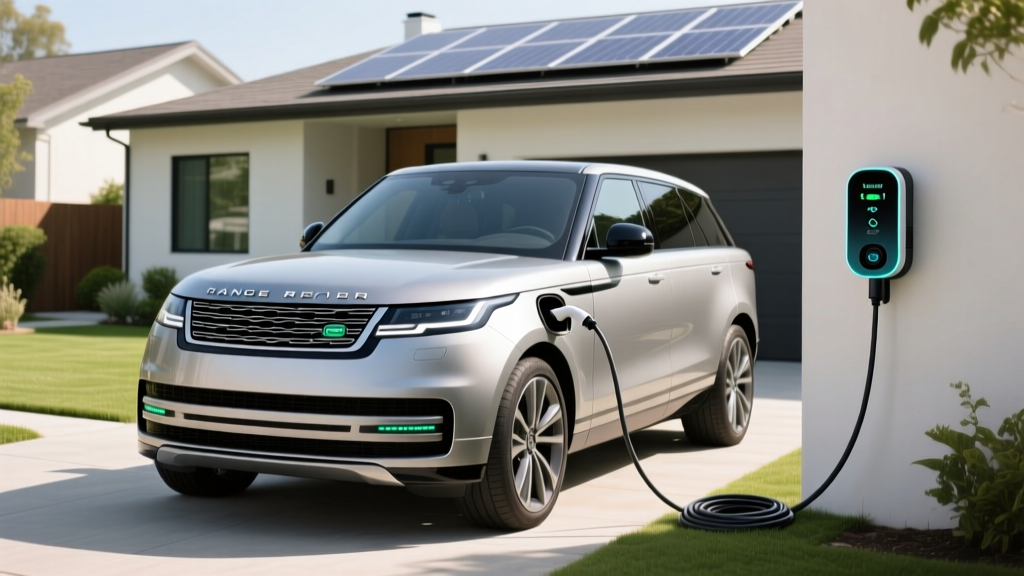
- Cable management: A 23–25 ft cable is long enough to reach from a wall-mounted charger to the Range Rover's driver-side charge port in most garage configurations. If your charge port is on the opposite side from the charger, consider a ceiling-mounted cable retractor or a longer-cable charger model.
- Ventilation: Level 2 chargers generate minimal heat and do not require dedicated ventilation in a garage. However, the installation location should be free from water spray and direct exposure to sprinkler systems.
Federal Tax Credit and Incentives for Home Charger Installation
The IRS §30C Alternative Fuel Vehicle Refueling Property Credit covers 30% of the cost of home EV charger equipment and installation, up to a maximum of $1,000. This credit applies to both the charger hardware and the electrician's labor.
Key eligibility requirements:
- The charger must be installed at your primary residence
- The property must be located in an eligible census tract (generally non-urban or low-income communities — check the Treasury Department's census tract tool)
- The credit covers 30% of total costs, capped at $1,000
- You claim the credit on your federal income tax return using Form 8911
State and utility incentives may stack on top of the federal credit. Many utilities offer rebates of $200–$500 for Level 2 charger installation, and some states (notably California, Colorado, and Massachusetts) offer additional credits. Check your utility's website and your state energy office for current programs.
Frequently Asked Questions
How much does it cost to install a home EV charger for the Range Rover PHEV?
Expect $1,050–$2,850 for a standard installation (equipment, electrician, materials, and permit) if your home has a 200-amp electrical panel with sufficient spare capacity. If your home requires a panel upgrade from 100A to 200A, the total can reach $2,550–$5,850. Get a load calculation from a licensed electrician before purchasing equipment.
How fast will each charging level add range to the Range Rover PHEV?
Level 1 (120V) adds roughly 3 miles of EV range per hour. Level 2 (240V, 32A) adds about 16 miles of EV range per hour. A full 0–100% charge on Level 2 takes approximately 4.5 hours. The vehicle does not support DC fast charging.
Which connector and charger are compatible with the Range Rover PHEV?
The 2025 Range Rover PHEV uses a standard J1772 connector for all AC charging. Any J1772 Level 2 charger will work — you do not need a Tesla or NACS-specific charger. A 40A (9.6 kW) charger on a dedicated 50A circuit is the practical sweet spot, though a 32A charger on a 40A circuit is sufficient since the vehicle caps at 7.4 kW.
How much does charging cost per mile vs. gas for the Range Rover?
At the national average electricity rate of $0.17/kWh, the Range Rover PHEV costs about $0.058 per mile on electricity. The gas-only Range Rover P400 at 21 MPG costs about $0.171 per mile at $3.60/gallon. The PHEV saves approximately $0.11 per mile when driving on electricity, or roughly $1,320 annually for a 12,000-mile driver who stays within the EV range for most trips.
What electrical upgrades might I need for a Level 2 charger?
You need a dedicated 240V circuit (typically 40A for a 32A charger or 50A for a 40A charger). If your electrical panel lacks spare capacity — common in homes with 100A or 150A service, or homes already running multiple high-draw electric appliances — you may need a panel upgrade to 200A, which adds $1,500–$3,000 to the project. A licensed electrician's load calculation is the only way to know for certain.
Does the 2025 Range Rover PHEV qualify for the $7,500 federal EV tax credit?
Federal tax credit eligibility for PHEVs is governed by IRS §30D rules, which include MSRP caps ($80,000 for SUVs), buyer income limits, and battery component/critical mineral sourcing requirements. At a base MSRP exceeding $110,000, the 2025 Range Rover PHEV exceeds the SUV MSRP cap and does not qualify for the §30D new clean vehicle credit. However, the §30C charger installation credit (up to $1,000) may still apply. Consult a tax professional for your specific situation.