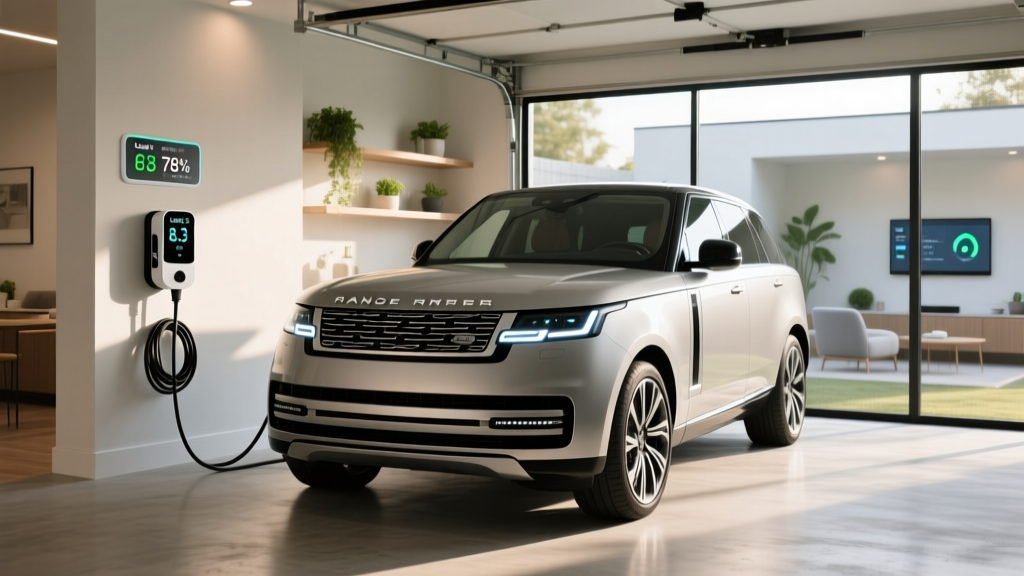
If you've just ordered—or are considering—the 2025 Land Rover Range Rover PHEV (officially the Range Rover P550e), you're looking at a luxury SUV that pairs a turbocharged inline-six with a 38.2 kWh usable battery pack. That's one of the largest plug-in hybrid batteries on the market, delivering an EPA-estimated 51 miles of electric-only range. But a battery that large demands a deliberate charging strategy. Relying on a standard 120V wall outlet means waiting over 24 hours for a full charge. This guide covers exactly how to charge the 2025 Range Rover PHEV at home and on the road, what electrical upgrades you may need, and how the per-mile cost compares to filling its 23.8-gallon tank.
2025 Range Rover PHEV: Battery, Range, and Charging Specs at a Glance
Before we get into chargers and wiring, here are the hard numbers that dictate your charging setup. The 2025 Range Rover P550e uses a 38.2 kWh (usable) lithium-ion NMC battery pack positioned under the rear floor. Unlike most PHEVs, it accepts DC fast charging—a rarity in the plug-in hybrid segment.
| Specification | Value |
|---|---|
| Usable battery capacity | 38.2 kWh (NMC chemistry) |
| EPA electric-only range | 51 miles |
| Real-world electric range (highway/cold) | ~35–45 miles |
| Onboard AC charger (Level 2 max) | 7.2 kW |
| DC fast charge capability | Up to 50 kW (CCS1) |
| Level 2 charge time (0–100%) | ~5.5 hours at 7.2 kW |
| DC fast charge (0–80%) | ~60 minutes at 50 kW |
| Charge connector (US market) | CCS1 (J1772 AC inlet + CCS DC pins) |
| Gas tank | 23.8 gallons (premium recommended) |
| Combined MPGe (electric + gas) | 42 MPGe |
| Gas-only combined MPG | 21 MPG |
| Base MSRP (P550e SE) | $115,800 |
Charging Levels Explained: Speeds, Power, and What Each Means for Your Range Rover
There are three charging levels available to Range Rover PHEV owners. Understanding the difference between kW (power—how fast energy flows) and kWh (energy—how much the battery holds) is essential. Think of kW as the width of a hose and kWh as the size of the bucket. A wider hose (higher kW) fills the bucket faster.
| Level | Voltage | Max Power (kW) | Range Added per Hour | Full Charge Time (38.2 kWh) |
|---|---|---|---|---|
| Level 1 (standard outlet) | 120V / 12A | ~1.4 kW | ~4–5 miles | ~27+ hours |
| Level 2 (home/public AC) | 240V / 32A | 7.2 kW (vehicle-limited) | ~22–25 miles | ~5.5 hours |
| DC Fast Charging | 400V DC | Up to 50 kW | ~150+ miles/hr equivalent | 0–80% in ~60 min |
Level 1 is the emergency fallback. The included portable charge cord plugs into any standard 120V household outlet, but at 1.4 kW, replenishing the Range Rover's 38.2 kWh pack takes well over a full day. This works only if you drive fewer than 15 miles daily and can leave the vehicle plugged in for 12+ hours overnight.
Level 2 is the practical daily solution. The Range Rover P550e has a 7.2 kW onboard charger, meaning even if you connect to a 48A (11.5 kW) home charger, the vehicle will only draw 7.2 kW maximum. A 32A Level 2 circuit delivers exactly 7.2 kW and is the sweet spot for this vehicle. Overnight charging from 20% to 100% takes roughly 5 hours—easily completed while you sleep.
DC Fast Charging is unusual for a PHEV. The Range Rover supports up to 50 kW via its CCS1 connector at public DC stations. This is valuable for road trips: you can recover 80% of battery capacity in about an hour. However, 50 kW is modest compared to full EVs (which can pull 150–350 kW), so don't expect Tesla-like 20-minute pit stops.
Home Charger Installation: Electrical Requirements, Costs, and Panel Upgrades
Installing a dedicated Level 2 home charger for the 2025 Range Rover PHEV requires a 240V circuit—similar to what a clothes dryer or electric oven uses. Because the vehicle's onboard charger maxes at 7.2 kW (32A continuous), you need a dedicated 40A breaker (the National Electrical Code requires circuits to be rated at 125% of continuous load: 32A × 1.25 = 40A).
Electrical Requirements Summary
- Circuit: Dedicated 40A, 240V breaker
- Wire gauge: 8 AWG copper (or 6 AWG for runs over 50 feet)
- Outlet option: NEMA 14-50 receptacle (allows charger portability) or hardwired connection
- GFCI protection: Required by NEC 2020+ for EV outlets in garages
- Outdoor rating: If mounting outside, charger must be NEMA 4 rated
Do You Need a Panel Upgrade?
This is the cost variable that catches homeowners off guard. Your electrical panel must have sufficient spare capacity to add a 40A circuit. Here's how to assess:
- 200A panel with spare slots: Most modern homes (built after 2000) have a 200A panel. If your existing loads (HVAC, oven, dryer, water heater) don't regularly exceed ~160A combined, adding a 40A EV circuit is usually fine. A licensed electrician will perform a load calculation per NEC Article 220.
- 100A panel: Common in homes built before the 1990s. Adding a 40A EV circuit often exceeds safe capacity, requiring a panel upgrade to 200A—a significant expense.
- Signs you'll need an upgrade: Panel is already near-full with existing breakers, you have electric heat plus an electric dryer and oven, or your panel is a known problematic brand (Federal Pacific, Zinsco).
Home Charger Installation Cost Breakdown
| Cost Component | Simple Install (panel nearby) | Complex Install (long run or panel upgrade) |
|---|---|---|
| Level 2 charger unit (32A–40A) | $350–$700 | $350–$700 |
| Electrician labor (2–4 hrs typical) | $300–$600 | $800–$1,500 |
| Materials (wire, conduit, breaker) | $100–$250 | $300–$600 |
| Permit and inspection | $50–$150 | $50–$200 |
| Panel upgrade (if needed: 100A → 200A) | N/A | $1,500–$3,500 |
| Total estimated cost | $800–$1,700 | $3,000–$6,500 |
Most Range Rover PHEV owners with a modern 200A panel and a garage-side panel location will land in the $1,000–$1,800 range for a professional install. The IRS §30D credit does not cover home charging equipment for PHEVs purchased after 2022 (the separate §30C alternative fuel infrastructure credit expired for residential use), though some utilities offer rebates of $200–$500 for Level 2 charger installation. Check with your local utility before purchasing equipment.
Connector Compatibility: What Plug Does the 2025 Range Rover PHEV Use?
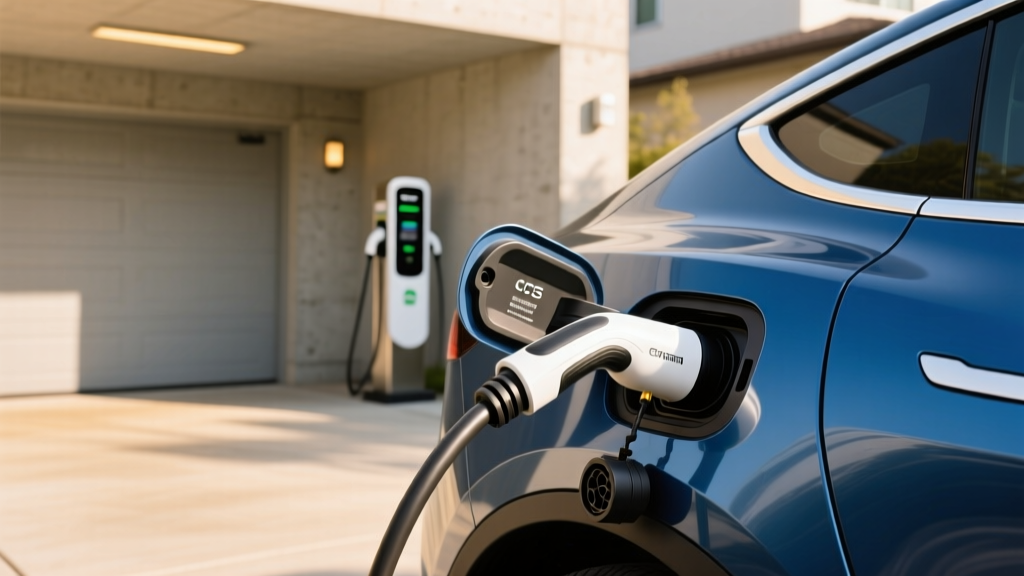
The 2025 Range Rover P550e sold in the United States uses the CCS1 (Combined Charging System) connector. This is the same J1772-based AC inlet with two additional DC pins below it. As the North American EV industry transitions toward Tesla's NACS connector, Land Rover has not yet adopted NACS for the 2025 model year—though this may change for 2026+ vehicles.
| Connector Type | Compatible? | Notes |
|---|---|---|
| J1772 (Level 1/2 AC) | Yes — native | Standard for all US AC charging; included portable cord works |
| CCS1 (DC fast) | Yes — native | Used at Electrify America, EVgo, most non-Tesla DC stations |
| NACS / Tesla (AC) | Adapter required | Tesla Mobile Connector with J1772 adapter works; or purchase a NACS-to-J1772 adapter (~$150–$250) |
| Tesla Supercharger (DC) | Adapter required (Magic Dock or third-party) | Tesla has opened select Superchargers via Magic Dock; CCS1 adapters for Superchargers are emerging |
| CHAdeMO | No | Obsolete standard; no adapter available for CCS vehicles |
Practical takeaway: For home Level 2 charging, any J1772 charger works natively. For public DC fast charging, stick to Electrify America and EVgo stations with CCS1 cables. If you frequently travel routes dominated by Tesla Superchargers, invest in a quality NACS-to-J1772 adapter such as the Lectron or A2Z adapter for AC charging at Tesla wall connectors.
Charging Cost Per Mile: Electricity vs. Premium Gasoline
One of the strongest ownership arguments for the Range Rover PHEV is the per-mile cost when driving on electricity versus gasoline. Here's a realistic breakdown using national average energy prices.
| Scenario | Energy Cost | Efficiency | Cost Per Mile |
|---|---|---|---|
| Home charging (off-peak utility rate) | $0.13/kWh | 2.4 mi/kWh (51 mi ÷ ~21 kWh used*) | $0.054/mile |
| Home charging (standard rate) | $0.18/kWh | 2.4 mi/kWh | $0.075/mile |
| Public Level 2 (ChargePoint, etc.) | $0.30/kWh | 2.4 mi/kWh | $0.125/mile |
| DC fast charging ( Electrify America) | $0.43/kWh | 2.4 mi/kWh | $0.179/mile |
| Gasoline only (premium $4.50/gal) | $4.50/gal | 21 MPG combined | $0.214/mile |
*Note: The 38.2 kWh total usable capacity yields 51 EPA miles, but real-world consumption accounts for charging losses (~10–15%), so wall-to-wheel consumption is closer to 2.0–2.4 miles per kWh drawn from the grid.
At off-peak home rates, the Range Rover PHEV costs roughly $0.05 per mile on electricity versus $0.21 per mile on premium gas—a 75% reduction. Over a year of 12,000 miles driven with 70% electric coverage, that's approximately $1,200 in annual fuel savings compared to driving the gas-only Range Rover P400. The math works best when you charge at home; frequent reliance on public DC fast charging narrows the gap considerably.
Recommended Level 2 Chargers for the 2025 Range Rover PHEV
Since the P550e's onboard charger is capped at 7.2 kW (32A), you don't need a 48A or 80A charger. However, buying a 40A or 48A unit provides future-proofing if you add a full EV later. Here are three proven options that pair well with this vehicle:
Emporia Level 2 Smart Charger
- Power: 48A (11.5 kW) — vehicle will draw 32A/7.2 kW
- Connector: J1772 (NACS version available)
- Cable length: 24 ft
- Smart features: Wi-Fi, app scheduling, solar integration, energy monitoring
- Price: ~$399
- Best for: Budget-conscious owners who want smart scheduling for off-peak rates
ChargePoint Home Flex
- Power: Configurable 16A–50A (set to 32A for Range Rover)
- Connector: J1772 (NACS adapter available)
- Cable length: 23 ft
- Smart features: Wi-Fi, Alexa, scheduling, ChargePoint network integration
- Price: ~$599
- Best for: Owners who want adjustable amperage to match existing panel capacity
Tesla Wall Connector (with adapter)
- Power: 48A (11.5 kW) — vehicle will draw 32A/7.2 kW
- Connector: NACS (requires J1772 adapter for Range Rover)
- Cable length: 24 ft
- Smart features: Wi-Fi, OTA updates, power sharing between two units
- Price: ~$450 (charger) + ~$180 (NACS-to-J1772 adapter)
- Best for: Multi-EV households with both Tesla and J1772 vehicles
For a single Range Rover PHEV household, the ChargePoint Home Flex set to 32A on a 40A circuit is the most practical choice—its adjustable amperage lets your electrician match the circuit to your panel's available capacity without overspending on wire gauge.
Safety, Permits, and Code Considerations
EV charging circuits carry sustained high current for hours, making proper installation non-negotiable. Key safety and code requirements for your Range Rover PHEV home charger:
- Dedicated circuit: The Level 2 charger must be on its own dedicated breaker—never shared with other appliances. This prevents overloads and tripped breakers during long charge sessions.
- GFCI protection: The 2020 and 2023 National Electrical Code (NEC Article 625) requires GFCI protection for EV charging outlets. Many modern Level 2 chargers include built-in GFCI, but if yours doesn't, a GFCI breaker is required.
- Permit and inspection: Virtually all jurisdictions require an electrical permit for a new 240V circuit. Permits typically cost $50–$200. The inspection verifies wire gauge, breaker sizing, grounding, and GFCI compliance. Skipping the permit risks insurance claim denial if a fire occurs.
- Outdoor installations: If your charger is mounted outside or in an exposed carport, it must carry a NEMA 4 (weatherproof) rating. All outdoor wiring must be in conduit. The ChargePoint Home Flex and Emporia both carry NEMA 4 ratings.
- Ventilation: Indoor garage installations of Level 2 chargers do not require special ventilation for the vehicle (the Range Rover PHEV battery is sealed). However, ensure the charger itself isn't enclosed in a tight cabinet that traps heat.
Always hire a licensed electrician familiar with NEC Article 625 (Electric Vehicle Charging Systems). Ask specifically whether they've installed EV circuits before—this specialty knowledge matters for correct load calculations and GFCI implementation.
Frequently Asked Questions
How much does it cost to install a home EV charger for the 2025 Range Rover PHEV?
A straightforward installation with a 200A panel and short wire run typically costs $800–$1,700 including the charger, electrician labor, materials, and permit. If your home needs a panel upgrade from 100A to 200A, expect $3,000–$6,500 total. Get at least two quotes from licensed electricians who can perform a proper NEC Article 220 load calculation.
How fast will each charging level add range to the Range Rover PHEV?
Level 1 (120V) adds roughly 4–5 miles of electric range per hour. Level 2 (240V at 32A/7.2 kW) adds about 22–25 miles per hour, fully replenishing the 51-mile battery in approximately 5.5 hours. DC fast charging at 50 kW can recover 0–80% in about 60 minutes, adding range at roughly 150+ miles-per-hour equivalent.
Which connector and charger is compatible with my 2025 Range Rover PHEV?
The US-market 2025 Range Rover P550e uses the CCS1 connector (J1772 for AC charging, CCS1 for DC fast charging). Any J1772 Level 2 home charger is natively compatible. For Tesla destination chargers or wall connectors, you'll need a NACS-to-J1772 adapter. CHAdeMO stations are not compatible.
How much does charging cost per mile compared to gas?
Charging at home at off-peak rates (~$0.13/kWh) costs approximately $0.05 per mile on electricity. Driving on premium gasoline ($4.50/gal at 21 MPG combined) costs about $0.21 per mile. That's a 75% savings per mile on electricity, translating to roughly $1,200 in annual savings if you drive 12,000 miles with 70% electric coverage.
What electrical upgrades might I need for a Range Rover PHEV home charger?
You need a dedicated 40A, 240V breaker. If your home has a 200A electrical panel with available capacity, no upgrade is typically needed. If you have a 100A panel (common in pre-1990 homes) or your panel is already near capacity with existing loads, you'll likely need a panel upgrade to 200A, costing $1,500–$3,500. A licensed electrician's load calculation will determine this definitively.
Does the 2025 Range Rover PHEV qualify for the federal tax credit?
PHEV eligibility for the IRS §30D Clean Vehicle Credit depends on battery capacity (the 38.2 kWh pack qualifies), MSRP caps ($80,000 for SUVs—the Range Rover P550e at $115,800 exceeds this cap and does not qualify), buyer income limits, and critical mineral/battery sourcing requirements. Because the Range Rover PHEV's MSRP is well above the $80,000 SUV cap, it is ineligible for the federal credit regardless of buyer income. Consult a tax professional for your specific situation.
Can I use a Tesla Supercharger with the 2025 Range Rover PHEV?
Not directly. The Range Rover uses CCS1, while Tesla Superchargers use NACS. Tesla has begun opening select Supercharger stations to non-Tesla vehicles via the built-in "Magic Dock" CCS adapter, but availability is limited. For AC charging at Tesla Wall Connectors (at hotels or destinations), a NACS-to-J1772 adapter allows compatibility. Third-party CCS1-to-NACS DC adapters are emerging but verify safety certification before use.