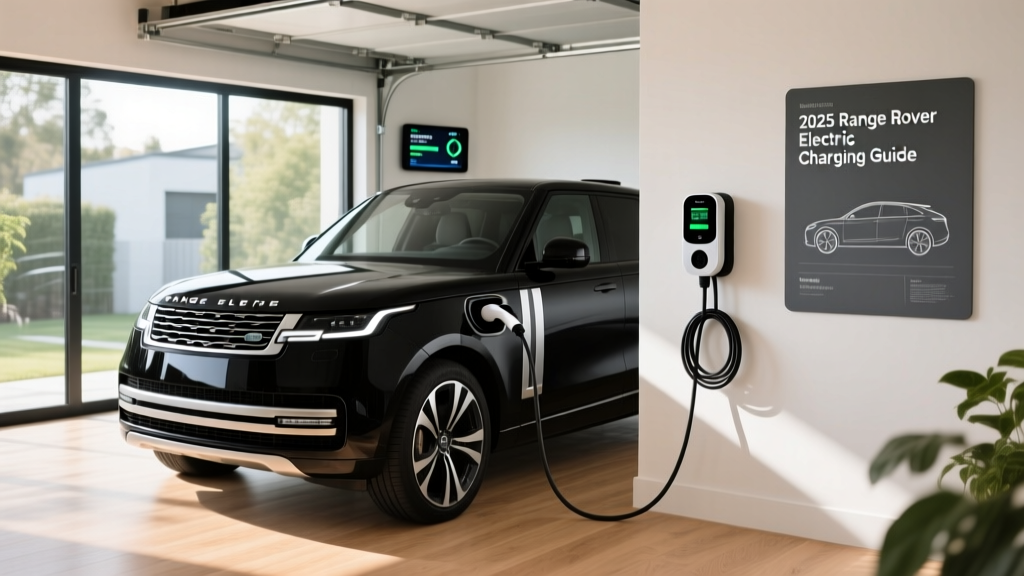
The 2025 Range Rover Electric marks Jaguar Land Rover's first all-electric flagship luxury SUV, built on the modular MLA-Flex architecture. With an anticipated battery capacity north of 100 kWh and an EPA-estimated range target around 300 miles, this full-size luxury EV demands a thoughtful charging strategy — especially given its large battery pack and premium buyer expectations for convenience.
This guide covers everything from home Level 2 installation requirements to DC fast-charging realities, connector compatibility, and the true cost of keeping a Range Rover Electric powered up. Whether you're preparing your garage before delivery or evaluating public charging options for road trips, the numbers below will help you plan with precision.
Understanding Charging Levels: What Each Adds to Your Range Rover Electric
Before discussing equipment or costs, let's clarify the three charging tiers and what they mean for a large-battery luxury SUV. The distinction between kW (kilowatts — the rate of power delivery) and kWh (kilowatt-hours — the total energy stored in the battery) is critical. Think of kW as how fast water flows from a hose, and kWh as the total volume of the tank you're filling.
The Range Rover Electric's estimated ~100+ kWh battery is among the largest in the luxury SUV segment, meaning charging times scale accordingly. Here's what each level delivers:
| Charging Level | Power (kW) | Voltage / Amperage | Miles of Range Added Per Hour | Best Use Case |
|---|---|---|---|---|
| Level 1 (Standard Outlet) | 1.4–1.9 kW | 120V / 12–16A | 3–5 miles/hr | Emergency top-ups only |
| Level 2 (Home / Workplace) | 7.2–19.2 kW | 240V / 30–80A | 20–55 miles/hr | Daily home charging |
| DC Fast Charging | 50–250+ kW | 400–800V DC | 150–500+ miles/hr (peak) | Road trips, quick stops |
For a vehicle with a ~100 kWh battery, Level 1 charging is impractical as a daily solution — a full charge would take well over 50 hours. Level 2 at 11.5 kW (48A) is the realistic home standard, replenishing roughly 30–35 miles of range per hour and achieving a full overnight charge in approximately 9–10 hours.
Home Charger Installation: Electrical Requirements and Real Costs
Installing a Level 2 home charger for the Range Rover Electric requires a dedicated 240-volt circuit, similar to what powers an electric dryer or oven. Given the vehicle's large battery, we recommend a minimum 60-amp circuit (delivering 48A continuous to the vehicle at 11.5 kW) to ensure reasonable overnight charge times.
Electrical Panel Considerations
Most modern homes with a 200-amp electrical panel can accommodate a 60-amp EV circuit without a panel upgrade. However, older homes with 100-amp service or panels already near capacity (common with electric heating, hot tubs, or workshop equipment) may require a panel upgrade to 200A, which adds $1,500–$3,500 to the project. A licensed electrician will perform a load calculation per NEC Article 220 to determine if your panel has headroom.
According to NEC 625 (the National Electrical Code article governing EV charging), the circuit must be rated at 125% of the continuous load — meaning a charger drawing 48A continuous requires a 60A breaker.
| Cost Component | Low-End Estimate | High-End Estimate | Notes |
|---|---|---|---|
| Level 2 Charger Equipment | $400 | $1,200 | Depends on brand, power, smart features |
| Electrician Labor (standard install) | $500 | $1,500 | Varies by run length, conduit, wall type |
| Permit Fees | $50 | $300 | Municipality-dependent |
| Electrical Panel Upgrade (if needed) | $1,500 | $3,500 | 100A → 200A service upgrade |
| Total (no panel upgrade) | $950 | $3,000 | Typical range for most homes |
| Total (with panel upgrade) | $2,450 | $6,500 | Older homes or maxed-out panels |
Safety and Code Requirements
Any compliant installation must include:
- Dedicated circuit: The EV charger must have its own breaker — no sharing with other appliances.
- GFCI protection: Required for outdoor installations and recommended for garages per NEC 2023 updates.
- NEMA 14-50 receptacle or hardwired connection: Hardwired units eliminate the receptacle as a failure point and are preferred for 60A+ circuits.
- Outdoor-rated equipment: If mounted outside, the charger must carry a NEMA 4 or IP55+ weather rating.
- Proper wire gauge: 6 AWG copper for 60A circuits; 4 AWG for longer runs to minimize voltage drop.
DC Fast Charging: Road Trip Speeds and Charge Curve Reality
The Range Rover Electric is expected to support DC fast charging at up to 150–200 kW peak on its 400V+ architecture (preliminary specifications — JLR has not confirmed final numbers as of early 2026). At peak speed, this translates to roughly 10–80% in approximately 28–35 minutes, depending on battery temperature and state of charge.
Estimated 10–80% Charge Times for the Range Rover Electric (~100 kWh Battery)
| Charger Type | Peak Power | Estimated 10–80% Time | Miles Added in 20 Min |
|---|---|---|---|
| 50 kW DC Fast | 50 kW | ~110 minutes | ~35 miles |
| 150 kW DC Fast | 150 kW | ~35 minutes | ~100 miles |
| 250 kW DC Fast (if supported) | 250 kW | ~28 minutes | ~130 miles |
| Level 2 Home (11.5 kW) | 11.5 kW | ~6.5 hours | N/A (overnight) |
Connector Compatibility: NACS, CCS, and the Range Rover Electric
The EV charging connector landscape in North America has shifted dramatically. As of 2025–2026, the industry is consolidating around the North American Charging Standard (NACS), originally developed by Tesla and now adopted by most major automakers.
JLR has confirmed that the Range Rover Electric will launch with a CCS1 (Combined Charging System) port in North America. However, with Tesla opening its Supercharger network to CCS-equipped vehicles via the Magic Dock adapter, and Electrify America and other networks supporting CCS natively, Range Rover Electric owners will have broad access.
| Connector Standard | Primary Networks | Range Rover Electric Compatibility |
|---|---|---|
| CCS1 | Electrify America, EVgo, ChargePoint, Ionity (EU) | Native — built-in port |
| NACS (Tesla) | Tesla Supercharger network | Via adapter (expected from JLR or aftermarket) |
| CHAdeMO | Largely legacy/deprecated in US | Not compatible — not recommended |
| J1772 (Level 2 AC) | Public Level 2, home chargers | Native — CCS port includes J1772 inlet |
Adapter strategy: If you plan to use Tesla Superchargers frequently (which offer superior reliability and coverage per Tesla's network data), budget $150–$250 for a CCS-to-NACS adapter once JLR or a certified third party (such as Lectron or A2Z) offers a compatible unit. Verify that any adapter supports the full amperage of your target chargers.
Cost to Charge: Home vs. Public vs. Gas Comparison
One of the strongest ownership arguments for the Range Rover Electric over its V8 and PHEV siblings is per-mile energy cost. Let's break down real scenarios using a ~100 kWh battery and an estimated efficiency of 2.5 miles/kWh (approximately 40 kWh/100 miles — reasonable for a 6,000+ lb luxury SUV).
| Charging Scenario | Cost per kWh | Cost for Full Charge (~100 kWh) | Cost per Mile (est. 2.5 mi/kWh) |
|---|---|---|---|
| Home (off-peak utility rate) | $0.13 | $13.00 | $0.052 |
| Home (average US rate) | $0.17 | $17.00 | $0.068 |
| Public Level 2 (ChargePoint, etc.) | $0.25–$0.35 | $25–$35 | $0.10–$0.14 |
| DC Fast Charging (Electrify America) | $0.38–$0.48 | $38–$48 | $0.15–$0.19 |
| Gas equivalent (Range Rover V8, 18 MPG combined, $3.50/gal) | — | ~$58 per 300 mi | $0.194 |
At home off-peak rates, the Range Rover Electric costs roughly $0.05 per mile — about 74% less than a gasoline Range Rover at $3.50/gallon. Even at DC fast-charging prices, you're paying roughly the same per mile as the gas version, with the convenience of no oil changes and fewer moving parts. According to fueleconomy.gov, the average US electricity rate for EV charging hovers around $0.17/kWh, making home charging the clear economic winner.
Recommended Home Charging Equipment for the Range Rover Electric
Given the Range Rover Electric's large battery, you want a Level 2 charger that delivers maximum practical amperage (48A on a 60A circuit) to minimize overnight charge time. Here are three proven units suited to this application:
ChargePoint Home Flex
- Power: Up to 12 kW (50A) on 60A circuit
- Connector: J1772 (CCS-compatible for AC)
- Cable Length: 23 feet
- Smart Features: Wi-Fi, app scheduling, Alexa integration
- NEMA Rating: NEMA 4 (indoor/outdoor)
- Price: ~$699
Wallbox Pulsar Plus
- Power: Up to 11.5 kW (48A) on 60A circuit
- Connector: J1772
- Cable Length: 25 feet
- Smart Features: Wi-Fi + Bluetooth, app, power sharing for dual installs
- NEMA Rating: NEMA 4
- Price: ~$649
Emporia Vue Level 2 Charger
- Power: Up to 11.5 kW (48A) on 60A circuit
- Connector: J1772
- Cable Length: 24 feet
- Smart Features: Energy monitoring integration, solar-aware scheduling
- NEMA Rating: NEMA 4
- Price: ~$399
For Range Rover Electric owners with solar panels, the Emporia or Wallbox units offer smart scheduling that aligns charging with peak solar production. All three units support hardwired installation (preferred for 60A circuits) and meet NEC safety requirements.
Frequently Asked Questions
How much does it cost to install a home EV charger for the Range Rover Electric?
A standard Level 2 installation with a 60-amp dedicated circuit typically costs $950–$3,000 total (equipment, electrician labor, and permit). If your home requires an electrical panel upgrade from 100A to 200A, add $1,500–$3,500. Get at least two quotes from licensed electricians familiar with NEC 625 EV charging requirements.
How fast will each charging level add range to the Range Rover Electric?
Level 1 (120V) adds roughly 3–5 miles per hour — essentially useless for a ~100 kWh battery. Level 2 at 11.5 kW adds approximately 30–35 miles per hour, sufficient for a full overnight charge. DC fast charging at 150+ kW can add 100+ miles in 20 minutes, though speeds taper significantly above 60% State of Charge.
Which connector and charger are compatible with the Range Rover Electric?
The Range Rover Electric uses a CCS1 port for both Level 2 AC and DC fast charging. It is natively compatible with Electrify America, EVgo, and ChargePoint DC stations. For Tesla Supercharger access, a CCS-to-NACS adapter will be required. Level 2 home chargers with a standard J1772 plug will work directly with the vehicle's CCS inlet.
How much does charging cost per mile compared to gasoline?
At a national average home electricity rate of $0.17/kWh and estimated efficiency of 2.5 miles/kWh, home charging costs about $0.07 per mile. A comparable gasoline Range Rover (18 MPG combined at $3.50/gallon) costs roughly $0.19 per mile — making home EV charging about 63% cheaper per mile. Even public DC fast charging at $0.40/kWh ($0.16/mile) undercuts gasoline.
What electrical upgrades might I need before installing a charger?
The most common upgrade is a panel capacity increase if your existing 100-amp service cannot accommodate an additional 60-amp continuous load. Your electrician will perform a load calculation. Other potential needs include: running new conduit from the panel to the garage (especially if the panel is on the opposite side of the house), upgrading from a NEMA 14-50 receptacle to a hardwired connection for higher-amperage circuits, and adding a GFCI breaker for outdoor installations per current NEC requirements.
Can I use the federal §30D tax credit for home charger installation?
The Alternative Fuel Vehicle Refueling Property Credit (IRC §30C) — separate from the vehicle purchase credit — offers up to $1,000 (30% of equipment + installation costs) for home charger installations in eligible census tracts. Check the IRS website for current eligibility maps, as qualifying areas are limited to certain low-income and rural census tracts starting in 2023.
Ownership Planning: Key Takeaways for Range Rover Electric Buyers
The Range Rover Electric's large battery makes home Level 2 charging a near-requirement rather than a luxury. Relying exclusively on public DC fast charging would mean 30+ minute stops multiple times per week and significantly higher per-mile costs. Budget $1,500–$3,000 for a professional 60A/11.5 kW home installation before your vehicle arrives, and confirm your electrical panel's capacity early — a load calculation from a licensed electrician costs $100–$200 and prevents expensive surprises.
For road trips, the CCS1 port gives you access to Electrify America's growing network, and a CCS-to-NACS adapter (once available) will unlock Tesla Superchargers. Plan charging stops around the 10–80% sweet spot to avoid the steep charge-curve taper, and precondition the battery using the vehicle's navigation system before arriving at a DC station for optimal charging speed.