Understanding the 2025 Nissan Leaf Range and Efficiency
The 2025 Nissan Leaf continues to serve as one of the most accessible battery-electric vehicles on the US market, but its real-world utility hinges on understanding both its EPA-rated range and the charging ecosystem it relies on. The Leaf is offered with two battery packs: a 40 kWh pack in the S trim delivering an EPA-estimated 149 miles of range, and a 60 kWh pack in the SV Plus rated at 212 miles (fueleconomy.gov). These figures represent combined city/highway driving under ideal conditions.
Efficiency ratings land at 111 MPGe combined for the S trim and 104 MPGe for the SV Plus, translating to roughly 30 kWh/100mi and 32 kWh/100mi respectively. The heavier 60 kWh pack sacrifices a small amount of efficiency for the additional range. For context, the Leaf consumes less energy per mile than most crossover EVs but trails the aerodynamic efficiency of sedans like the Hyundai Ioniq 6 or Tesla Model 3.
Charging Levels Explained: Level 1, Level 2, and DC Fast
Before plugging in any EV, it's essential to distinguish between kW (kilowatts) — the rate of power delivery, analogous to water flow from a hose — and kWh (kilowatt-hours) — the total energy stored in the battery, analogous to the size of a water tank. A charger's kW rating determines how quickly it fills your battery's kWh capacity.
| Level | Power (kW) | Voltage / Amperage | Miles of Range Added per Hour | 40 kWh Battery (10–80%) | 60 kWh Battery (10–80%) |
|---|---|---|---|---|---|
| Level 1 (Standard 120V outlet) | ~1.4 kW | 120V / 12A | ~3–5 mi/hr | ~14–16 hours | ~21–24 hours |
| Level 2 (Home/Public 240V) | 3.3 kW (Leaf onboard limit) | 240V / 14–16A | ~10–12 mi/hr | ~8–9 hours | ~12–13 hours |
| DC Fast Charging (CHAdeMO) | Up to 50 kW (100 kW peak on SV Plus) | 400V DC | ~90–150 mi/hr (peak) | ~45–60 min | ~55–70 min |
A critical limitation of the 2025 Leaf is its 3.3 kW onboard charger for Level 2 AC charging. Even if you install a 48-amp (11.5 kW) home charger, the Leaf will only draw 3.3 kW. This means overnight home charging is adequate for replenishing daily driving miles (30–50 miles typically requires 3–5 hours), but it is slow compared to most modern EVs equipped with 7–11 kW onboard chargers.
On DC fast charging, the Leaf uses the CHAdeMO connector, which is increasingly rare at new public charging installations. Most new DC fast chargers being deployed in 2025–2026 feature CCS1 or NACS connectors. The SV Plus with the larger battery can accept up to 100 kW peak, but charging tapers significantly above 80% State of Charge (SoC) to protect battery health — a full 10–100% session takes considerably longer than the 10–80% figures above.
Home Charger Installation: Electrical Requirements, Costs, and Permits
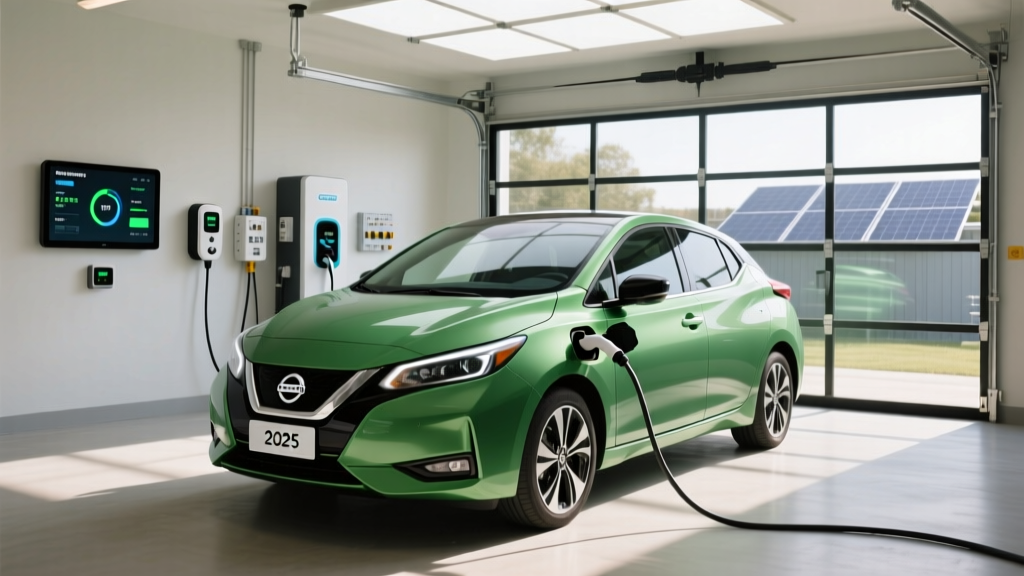
Installing a dedicated Level 2 home charger is the single most impactful upgrade for daily EV ownership. However, the Leaf's 3.3 kW onboard charger means you do not need a high-amperage circuit to achieve its maximum home charging speed. A 20-amp, 240V circuit delivering 3.8 kW (16A continuous) is sufficient and keeps installation costs lower than a full 48-amp setup.
Electrical Requirements for the Nissan Leaf
- Circuit: 240V dedicated circuit, 20A minimum (supports 3.8 kW supply; Leaf draws 3.3 kW)
- Breaker: Double-pole 20A breaker in your main service panel
- Wire gauge: 12 AWG copper (for runs up to 50 feet); 10 AWG recommended for longer runs
- Outlet type: NEMA 6-20 (240V/20A) or hardwired connection
- Panel capacity: Minimum 100A service panel; 200A recommended if running multiple high-draw appliances
Do You Need a Panel Upgrade?
Homes built before the 1990s often have 100A or even 60A service panels. If your panel is already near capacity — running electric range, dryer, HVAC, and water heater — adding a 20A EV circuit may push total load beyond safe limits. An electrician will perform a load calculation per NEC Article 220 to determine if your panel can accommodate the new circuit. A panel upgrade from 100A to 200A typically costs $1,500–$3,500 and may be required in older homes.
| Component | Cost Range | Notes |
|---|---|---|
| Level 2 EVSE equipment (16A–32A) | $250–$700 | J1772 connector; smart Wi-Fi models cost more |
| Electrician labor (2–6 hours) | $400–$1,500 | Varies by run length, wall type, conduit needs |
| Electrical permit | $50–$250 | Required in most jurisdictions; inspected after install |
| Panel upgrade (if needed) | $1,500–$3,500 | 100A→200A; not always required |
| Total (no panel upgrade) | $700–$2,450 | Typical for homes with adequate panel capacity |
| Total (with panel upgrade) | $2,200–$5,950 | Older homes with undersized service |
Safety and Code Considerations
The 2023 National Electrical Code (NEC) requires GFCI protection for all EV charging outlets rated 150V to ground or less — which includes your 240V Level 2 circuit (Article 625.54). Outdoor installations must use equipment rated for wet locations (NEMA 4 or higher enclosure). A dedicated circuit — not shared with other appliances — is mandatory. Your electrician should pull a permit and schedule an inspection; unpermitted work can void homeowner's insurance coverage in the event of an electrical fire.
Connector Compatibility: CHAdeMO, CCS1, and NACS
The 2025 Nissan Leaf is one of the last mainstream EVs sold in the US that still uses the CHAdeMO DC fast-charging connector. This creates a growing compatibility challenge as the industry transitions to NACS (Tesla's connector, now adopted by most automakers) and CCS1.
| Connector | Type | Leaf Compatible? | Network Availability (2026) |
|---|---|---|---|
| J1772 | AC Level 1 & 2 | ✅ Yes (native) | Universal — all public Level 2 stations |
| CHAdeMO | DC Fast | ✅ Yes (native) | Declining — legacy Electrify America, some EVgo stations |
| CCS1 | DC Fast | ❌ No (no adapter available) | Widespread — Electrify America, EVgo, ChargePoint |
| NACS (Tesla) | DC Fast & AC | ❌ No (no adapter available) | Expanding rapidly — Tesla Superchargers opening to non-Tesla |
Cost to Charge: Home, Public, and Per-Mile Comparison
One of the strongest ownership arguments for the Leaf is its low per-mile energy cost — particularly when charging at home during off-peak hours.
| Scenario | Rate ($/kWh) | Cost per 100 Miles | Cost per Mile |
|---|---|---|---|
| Home off-peak (utility TOU rate) | $0.08–$0.12 | $2.56–$3.84 | $0.026–$0.038 |
| Home standard rate (national avg) | $0.16 | $5.12 | $0.051 |
| Public Level 2 (ChargePoint, EVgo) | $0.25–$0.49 | $8.00–$15.68 | $0.080–$0.157 |
| DC Fast Charging (CHAdeMO) | $0.35–$0.55 | $11.20–$17.60 | $0.112–$0.176 |
| Gas car baseline (30 MPG, $3.40/gal) | — | $11.33 | $0.113 |
At home off-peak rates, the Leaf SV Plus costs roughly 2.6–3.8 cents per mile to fuel — about one-third the cost of a 30 MPG gasoline car at $3.40/gallon. Even at standard residential rates, the Leaf undercuts gasoline on a per-mile basis. However, relying exclusively on public DC fast charging erases much of the cost advantage, making home charging access a critical factor in the Leaf's economic proposition.
Recommended Level 2 Home Chargers for the Nissan Leaf
Because the Leaf's onboard charger maxes out at 3.3 kW, you do not need an expensive 48-amp charger. A quality 16-amp or 32-amp unit provides all the speed the Leaf can accept while leaving headroom if you add a second EV in the future.
Emporia Vue Level 2 Charger
- Power output: 48A max (11.5 kW) — Leaf will draw 3.3 kW
- Connector: J1772 (compatible with Leaf natively)
- Cable length: 24 feet
- Smart features: Wi-Fi, app scheduling, energy monitoring, TOU optimization
- Price: ~$399
- Best for: Budget-conscious buyers who want smart scheduling for off-peak rates
ChargePoint Home Flex
- Power output: Configurable 16A–50A (up to 12 kW) — set to 20A for Leaf
- Connector: J1772
- Cable length: 23 feet
- Smart features: Wi-Fi, Alexa integration, ChargePoint app, detailed session history
- Price: ~$699
- Best for: Owners who want a proven brand with robust app features and future-proofing
Grizzl-E Smart
- Power output: 40A max (9.6 kW)
- Connector: J1772
- Cable length: 24 feet
- Smart features: Wi-Fi, OCPP-compatible, works with utility demand-response programs
- Price: ~$549
- Best for: Cold-climate owners — rated to -40°F, rugged aluminum enclosure
All three chargers use the J1772 connector, which the Leaf uses for AC charging. None of these units provide DC fast charging — that capability is only available at public stations.
2025 Nissan Leaf Pricing, Tax Credit, and Ownership Considerations
The 2025 Leaf starts at a base MSRP of approximately $28,140 for the S trim (40 kWh) and $36,190 for the SV Plus (60 kWh), including destination charges. These prices position the Leaf as one of the least expensive new EVs available in the US market.
Federal tax credit eligibility under IRS §30D is complex for the Leaf. The credit amount depends on battery component sourcing and critical mineral requirements that shift annually. As of 2025, the Leaf may qualify for $3,750 or $7,500 depending on the specific battery's supply-chain compliance. Buyer income caps apply ($150,000 single / $300,000 joint AGI), and the point-of-sale transfer option allows dealers to apply the credit as a down-payment reduction. Always verify current eligibility with your dealer and a tax professional before purchase.
The Leaf's battery carries an 8-year/100,000-mile warranty covering capacity loss below 9 bars (out of 12) on the battery health gauge — roughly corresponding to 66.25% of original capacity. Nissan's warranty threshold is less generous than competitors like Hyundai (70% capacity retention over 10 years/100,000 miles). Battery replacement for a 60 kWh Leaf pack currently costs approximately $6,500–$9,000 including labor at a Nissan dealer, though this is rarely needed within the warranty period for vehicles with passive air-cooled battery systems driven in moderate climates.
Frequently Asked Questions
How much does it cost to install a home EV charger for the Nissan Leaf?
A basic Level 2 installation on a 20A/240V circuit typically costs $700–$2,450 including the charger unit, electrician labor, and permit — assuming your electrical panel has sufficient capacity. If a panel upgrade from 100A to 200A is needed, add $1,500–$3,500. The Leaf's low 3.3 kW onboard charger means you can use a less expensive, lower-amperage circuit than most other EVs require.
How fast will each charging level add range to the Leaf?
Level 1 (120V standard outlet) adds roughly 3–5 miles of range per hour — adequate only for overnight trickle charging of short daily commutes. Level 2 (240V home charger) adds approximately 10–12 miles per hour, limited by the Leaf's 3.3 kW onboard charger. DC fast charging via CHAdeMO can add 90–150 miles per hour at peak power, though real-world sessions average 45–70 minutes for a 10–80% charge depending on battery size and ambient temperature.
Which connector and charger is compatible with the 2025 Nissan Leaf?
For AC Level 1 and Level 2 charging, the Leaf uses the standard J1772 connector, which is universal across all non-Tesla public Level 2 stations and all home chargers sold in the US. For DC fast charging, the Leaf uses CHAdeMO — a connector that is becoming increasingly rare as the industry transitions to CCS1 and NACS. No adapter currently exists to convert the Leaf's CHAdeMO port to CCS1 or NACS.
How much does charging the Leaf cost per mile compared to gas?
Charging at home during off-peak hours costs approximately 2.6–3.8 cents per mile for the SV Plus trim. A comparable 30 MPG gasoline car at $3.40/gallon costs about 11.3 cents per mile. Home charging saves roughly $0.07–$0.09 per mile, or about $700–$900 per year for a driver covering 10,000 miles annually. Public DC fast charging at $0.35–$0.55/kWh narrows the gap, costing 11–18 cents per mile.
What electrical upgrades might I need for a home charger?
The most common upgrade is a panel capacity increase if your home's main service panel is already near its load limit. Homes with 100A service may need an upgrade to 200A ($1,500–$3,500). You will also need a dedicated 240V circuit with a double-pole breaker — this is standard work for any licensed electrician. If your garage or parking area is far from the panel (over 50 feet of wire run), expect higher material and labor costs. Outdoor installations require weather-rated (NEMA 4+) equipment and may need conduit runs.