The 2025 Ford Mustang Mach-E remains one of the most popular mainstream electric SUVs, but its real-world usability hinges on two things: how far it actually goes on a charge, and how efficiently you can recharge it at home or on the road. This guide breaks down every range figure, charging speed, and home installation detail you need before you buy — or before you plug in for the first time.
2025 Mustang Mach-E: EPA Range vs. Real-World Expectation
EPA sticker: 250 mi (Standard Range) to 320 mi (Extended Range RWD).
Real-world highway (70 mph, 65°F): Expect ~210–275 mi depending on battery pack and drivetrain.
Cold-weather (32°F, highway): Subtract 20–30% — a 320-mi Extended Range model may deliver ~225–250 mi in winter conditions.
Source: fueleconomy.gov and manufacturer specifications.
2025 Mustang Mach-E Range by Trim and Battery
Ford offers the 2025 Mach-E with two battery packs and multiple drivetrain configurations. The numbers below reflect EPA estimates; your results will vary based on speed, terrain, temperature, and climate-control use.
| Trim / Config | Battery (usable kWh) | Drivetrain | EPA Range | 0-60 mph | HP | Base MSRP |
|---|---|---|---|---|---|---|
| Select SR | 75.7 kWh (LFP) | RWD | 250 mi | 6.3 s | 266 | $42,495 |
| Select SR | 75.7 kWh (LFP) | AWD | 230 mi | 5.2 s | 325 | $45,495 |
| Premium ER | 91 kWh (NMC) | RWD | 320 mi | 5.8 s | 290 | $48,995 |
| Premium ER | 91 kWh (NMC) | AWD | 290 mi | 4.8 s | 365 | $51,995 |
| GT ER | 91 kWh (NMC) | AWD | 280 mi | 3.5 s | 480 | $59,995 |
| Rally | 91 kWh (NMC) | AWD | 265 mi | 3.4 s | 500 | $61,995 |
The Standard Range pack uses LFP (lithium iron phosphate) chemistry — heavier and slightly lower energy density, but excellent cycle life and Ford recommends you can charge it to 100% daily without degradation concerns. The Extended Range pack uses NMC (nickel manganese cobalt), which offers higher energy density for longer range but benefits from an 80% daily charge limit to maximize longevity.
Charging Levels Explained: How Fast Will Each Add Range?
Understanding charging speed requires distinguishing between kW (power — how fast energy flows) and kWh (energy — how much the battery stores). A 10 kW charger delivers 10 kWh of energy in one hour. The Mach-E's battery stores either 75.7 kWh or 91 kWh of usable energy.
| Charging Level | Voltage | Max Power (kW) | Miles of Range Added per Hour | Best For |
|---|---|---|---|---|
| Level 1 (120V outlet) | 120V | ~1.2 kW | ~3–4 mi/hr | Overnight top-ups, emergencies |
| Level 2 (240V home/public) | 240V | Up to 10.5 kW (Mach-E onboard limit) | ~25–32 mi/hr | Daily home charging |
| DC Fast Charging | 400V+ | Up to 150 kW (Mach-E peak) | ~180–230 mi/hr (at peak) | Road trips, quick stops |
The 2025 Mach-E's onboard AC charger is rated at 10.5 kW, which is the ceiling for Level 2 charging regardless of how powerful your home charger is. Even if you install a 48-amp (11.5 kW) wallbox, the car will only accept 10.5 kW. On DC fast charging, the Extended Range pack peaks at 150 kW, while the Standard Range pack peaks at roughly 115 kW.
10-80% DC Fast Charging Times
- Standard Range (75.7 kWh, LFP): ~38 minutes at a 150 kW+ station
- Extended Range (91 kWh, NMC): ~45 minutes at a 150 kW+ station
Note that charge speed is not linear. The Mach-E pulls peak power only between roughly 10–50% state of charge. Above 60%, the charge curve tapers significantly — going from 80% to 100% on DC fast charging can take nearly as long as the 10–80% portion. Plan road-trip stops around 80% for the best time efficiency.
Home Charger Installation: Requirements, Costs, and Electrical Upgrades
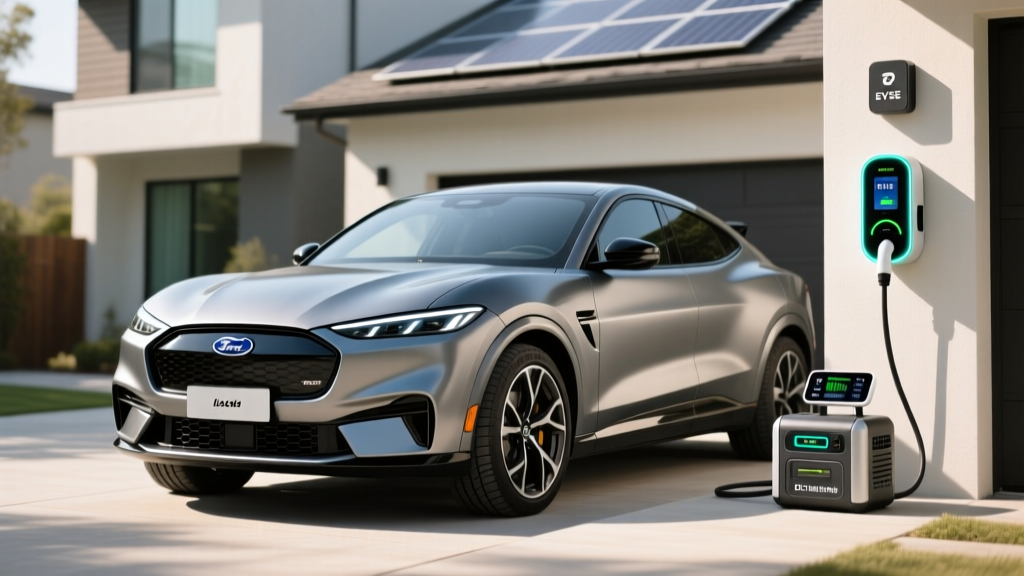
Most Mach-E owners will want a Level 2 home charger — it's the single biggest quality-of-life upgrade in EV ownership. A full charge from empty on a 10.5 kW Level 2 unit takes about 7.5 hours for the Standard Range and 9 hours for the Extended Range pack, meaning you'll wake up full every morning.
Electrical Requirements
A Level 2 charger for the Mach-E requires a 240V circuit. To maximize the car's 10.5 kW onboard charger, you'll want a 48-amp charger on a 60-amp dedicated circuit (electrical code requires the circuit to be rated at 125% of the continuous load). A 40-amp charger on a 50-amp circuit will deliver ~9.6 kW — close enough for most owners.
How Much Does It Cost to Install a Home EV Charger?
Installation costs vary widely depending on your home's electrical panel capacity, the distance from the panel to the charger location, and local permit fees. Here's a realistic breakdown:
| Cost Component | Simple Install (panel near garage) | Complex Install (long run, panel upgrade) |
|---|---|---|
| Level 2 charger equipment | $400–$700 | $400–$700 |
| Electrician labor (2–4 hrs simple / 6–12 hrs complex) | $500–$1,200 | $1,500–$3,500 |
| Electrical permit | $50–$150 | $50–$200 |
| Panel upgrade (100A → 200A, if needed) | Not required | $1,500–$3,000 |
| Conduit, wiring, misc. materials | $100–$300 | $300–$800 |
| Total estimated cost | $1,050–$2,350 | $3,750–$8,200 |
Panel Upgrade Reality Check
Homes built before the 1990s often have 100-amp electrical panels. Adding a 60-amp EV circuit to an already-loaded 100A panel may require a service upgrade to 200 amps. Budget $1,500–$3,000 for this work and factor in utility coordination time (2–6 weeks in some areas). A licensed electrician can perform a load calculation to determine whether an upgrade is necessary. Some utilities offer rebates that offset panel-upgrade costs — check with your local provider.
What Electrical Upgrades Might I Need?
- Load calculation: Your electrician will tally existing loads (HVAC, dryer, oven, water heater) against your panel's capacity. If the math doesn't leave room for 48–60 amps, you'll need a panel upgrade or a smart load-management device.
- Smart load management: Devices like the Emporia Smart Load Center or the Tesla Wall Connector's built-in load-sharing feature can dynamically reduce charger amperage when other appliances kick on — potentially avoiding a panel upgrade entirely.
- Dedicated circuit: Never share the EV charger circuit with other outlets or appliances. NEC code requires a dedicated breaker.
- GFCI protection: The 2020 NEC requires GFCI protection for EV receptacles (NEMA 14-50 outlets). Hardwired chargers often include ground-fault protection internally.
- Outdoor rating: If your charger is mounted outside, ensure it carries a NEMA 4 or NEMA 4X rating for weather resistance.
Connector Compatibility: NACS, CCS, and the Adapter Question
The 2025 Mustang Mach-E ships with a CCS1 (Combined Charging System) port for both Level 2 AC and DC fast charging. However, Ford has announced that future model years will transition to the NACS (Tesla-style) connector, and 2025 Mach-E owners can access Tesla Superchargers using a Ford-provided or aftermarket adapter.
| Connector | Used By | Mach-E Compatibility | Notes |
|---|---|---|---|
| CCS1 | Ford, GM, Hyundai, VW, most non-Tesla brands | Native port on 2025 Mach-E | Standard for Electrify America, EVgo, ChargePoint DC stations |
| NACS (Tesla) | Tesla (native); Ford, GM, Rivian via adapter | Via Ford NACS adapter (included or ~$200 aftermarket) | Access to 25,000+ Tesla Superchargers; verify adapter rating |
| CHAdeMO | Nissan Leaf (legacy), Mitsubishi | Not compatible | Effectively discontinued in the US for new vehicles |
| J1772 | All EVs (Level 2 AC standard) | Native (CCS1 includes J1772 upper portion) | Standard for all Level 2 public and home AC charging |
Adapter guidance: If you plan to use Tesla Superchargers regularly, the Ford NACS adapter is essential. Ford has offered the adapter at no cost to qualifying Mach-E owners — check with your dealer. Third-party adapters (e.g., Lectron) are available for $150–$230 but confirm they support the full amperage your charger requires. For home Level 2 charging, any J1772 charger works natively with the Mach-E.
Charging Cost Per Mile: Mach-E vs. Gas Equivalent
One of the strongest arguments for the Mach-E is fuel cost savings, but the math depends heavily on where and when you charge.
| Charging Scenario | Avg. Cost ($/kWh) | Cost to Fill 91 kWh ER Pack | Cost per Mile (320-mi range) |
|---|---|---|---|
| Home, off-peak utility rate | $0.08–$0.12 | $7.28–$10.92 | $0.023–$0.034 |
| Home, standard residential rate | $0.14–$0.18 | $12.74–$16.38 | $0.040–$0.051 |
| Public Level 2 (ChargePoint, etc.) | $0.25–$0.40 | $22.75–$36.40 | $0.071–$0.114 |
| DC fast charging (Electrify America, EVgo) | $0.35–$0.55 | $31.85–$50.05 | $0.100–$0.156 |
For comparison, a gas SUV getting 25 MPG combined at $3.40/gallon costs $0.136 per mile. Home-charged Mach-E owners typically pay 60–80% less per mile than a gas equivalent. However, exclusive reliance on DC fast charging narrows the gap considerably — in some markets, public DC charging costs nearly as much per mile as gasoline.
Time-of-Use Rates Matter
Many utilities offer time-of-use (TOU) plans where off-peak electricity (typically 10 PM – 6 AM) costs 40–60% less than peak rates. Setting your Mach-E or your home charger to charge only during off-peak hours can cut your home charging bill nearly in half. Check with your utility about EV-specific TOU plans — some offer rates as low as $0.06/kWh overnight.
Best Level 2 Home Chargers for the Mustang Mach-E
Since the Mach-E's onboard charger maxes out at 10.5 kW, any quality 48-amp (or higher) Level 2 charger will saturate its AC charging capability. Here are three proven options:
ChargePoint Home Flex
- Power output: Up to 12 kW (50 amps) — adjustable down to 16A
- Connector: J1772 (works natively with Mach-E)
- Cable length: 23 feet
- Smart features: Wi-Fi, app scheduling, Alexa integration, utility TOU optimization
- Price: ~$550–$650
- Verdict: Best all-around smart charger with flexible amperage for older panels
Ford Connected Charge Station
- Power output: 10.5 kW (48 amps)
- Connector: J1772
- Cable length: 25 feet
- Smart features: Integrates with FordPass app, scheduled charging, charge status notifications
- Price: ~$600–$700 (sometimes included or discounted with new Mach-E purchase)
- Verdict: Tightest FordPass integration; ideal for owners who want a single-app experience
Emporia Level 2 EV Charger
- Power output: Up to 11.5 kW (48 amps)
- Connector: J1772
- Cable length: 24 feet
- Smart features: Wi-Fi, real-time energy monitoring via Emporia app, solar integration, load management
- Price: ~$399–$450
- Verdict: Best value — excellent energy monitoring and the lowest price among smart 48A chargers
All three chargers are hardwired-capable and NEMA 4 rated for outdoor installation. Hardwiring is generally preferred over a NEMA 14-50 receptacle because it avoids the NEC GFCI breaker requirement (which can cause nuisance tripping with some chargers) and provides a cleaner, more reliable connection.
Federal Tax Credits and Incentives for Home Charging
The federal Alternative Fuel Vehicle Refueling Property Credit (IRS §30C) can cover up to 30% of home charger equipment and installation costs, capped at $1,000. This credit applies to both the charger hardware and the electrical work. Eligibility depends on your census tract meeting certain low-income or non-urban criteria — the IRS provides a lookup tool. As with all tax credits, consult a tax professional to confirm your eligibility based on current-year rules.
For the vehicle itself, the 2025 Mach-E may qualify for the §30D federal EV tax credit (up to $7,500), but eligibility is subject to MSRP caps ($80,000 for SUVs), buyer income limits ($300,000 joint / $150,000 single AGI), and battery critical-mineral and component sourcing requirements that change annually. The point-of-sale transfer option allows dealers to apply the credit as an immediate discount if you qualify. Always verify current-year rules at irs.gov.
Safety and Code Considerations
- Dedicated circuit: Your Level 2 charger must be on its own dedicated breaker — never share with a dryer, HVAC, or general outlet circuit.
- GFCI protection: Required by NEC 2020 for EV receptacles. Hardwired chargers with built-in ground-fault protection can simplify compliance.
- Outdoor rating: For exterior installs, use a NEMA 4-rated charger and weatherproof conduit fittings.
- Wire gauge: 6 AWG copper for 48A/60A circuits; 4 AWG for longer runs (over 100 feet) to minimize voltage drop. Your electrician will size this correctly.
- Permit and inspection: Most jurisdictions require an electrical permit for EV charger installation. The inspection ensures your install meets NEC and local code — don't skip this step, as unpermitted work can void insurance claims.
- Surge protection: Consider a whole-panel surge protector ($150–$300 installed) to safeguard your charger and vehicle from grid voltage spikes, especially in areas with frequent lightning or unstable utility power.
Frequently Asked Questions
How far can the 2025 Mustang Mach-E really go on a charge?
The Extended Range RWD model carries a 320-mile EPA rating, but expect 260–280 miles in mixed real-world driving, and as low as 225 miles in cold highway conditions. The Standard Range model's 250-mile EPA figure translates to roughly 200–215 miles in real-world highway use.
Can I charge the Mach-E at a Tesla Supercharger?
Yes, with a Ford-approved NACS adapter. Ford has provided adapters to qualifying owners, and third-party adapters are also available. The Mach-E's CCS1 native port works with all non-Tesla DC fast-charging networks (Electrify America, EVgo, ChargePoint).
Is a panel upgrade required for a home Level 2 charger?
Not always. Homes with 200-amp service and moderate existing loads typically have room for a 60-amp EV circuit. Homes with 100-amp panels or heavy existing loads may need an upgrade. A licensed electrician will perform a load calculation to determine this — budget $1,500–$3,000 if an upgrade is needed.
Does the Mach-E support one-pedal driving?
Yes. The Mach-E offers a one-pedal driving mode with strong regenerative braking that can bring the vehicle to a complete stop without touching the brake pedal in most city-driving scenarios. This recovers energy back into the battery, improving efficiency in stop-and-go traffic.
What is the battery warranty on the 2025 Mach-E?
Ford covers the high-voltage battery for 8 years or 100,000 miles, whichever comes first. The warranty guarantees the battery will retain a minimum capacity (typically 70% of original) during that period. The electric powertrain components are also covered under the same 8-year/100,000-mile term.
For official efficiency data, see fueleconomy.gov. For safety ratings, check NHTSA and IIHS.