Quick Charging Profile: 2025 Tesla Model Y Long Range AWD
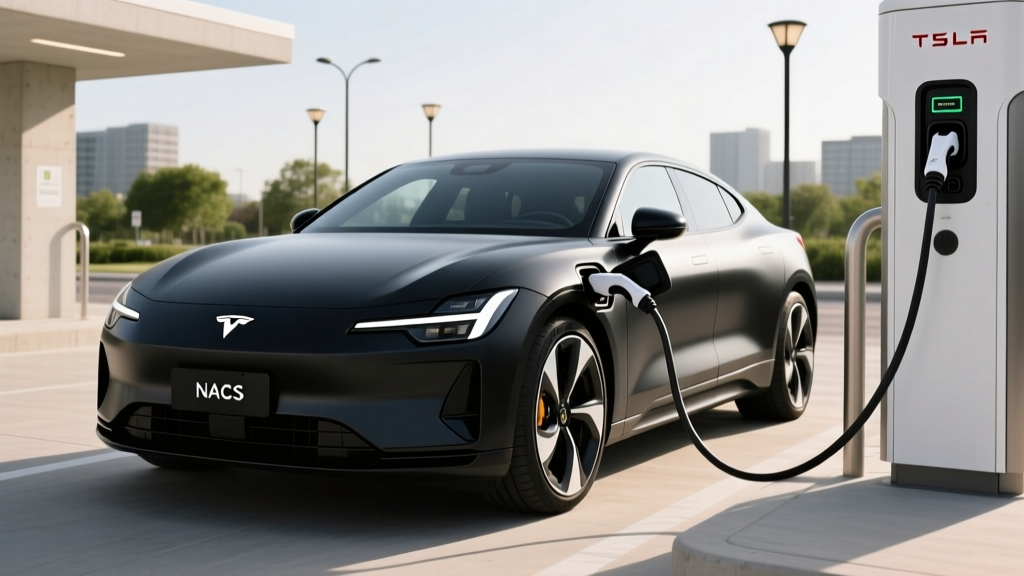
The 2025 Tesla Model Y Long Range AWD pairs a ~75 kWh usable NMC lithium-ion battery with a native NACS (North American Charging Standard) port, making it one of the most straightforward EVs to charge at home and on the road. With an EPA-estimated 320 miles of range and a peak DC fast-charge rate of 250 kW at V3 Superchargers, the Long Range AWD can recover 10–80% in roughly 25–28 minutes under ideal thermal conditions. On a 48-amp Level 2 home charger, a full 10–100% session takes approximately 9–10 hours.
But those headline numbers assume a properly configured home electrical system, favorable battery temperature, and access to functioning chargers. This guide walks through every charging scenario you'll encounter as a Model Y owner, with exact costs, electrical requirements, and real-world timing.
| Spec | Value |
|---|---|
| EPA Range | 320 miles (real-world highway ~270–290 mi; cold weather ~230–255 mi) |
| Battery Capacity (usable) | ~75 kWh, NMC chemistry |
| Peak DC Fast Charge Rate | 250 kW (V3 Supercharger, NACS native) |
| 10–80% DC Fast Charge Time | ~25–28 minutes (preconditioned) |
| Level 2 Max Acceptance Rate | 11.5 kW (48A at 240V) |
| Level 2 Charge Time (10–100%) | ~9–10 hours at 48A |
| Level 1 Charge Rate (120V) | ~1.4 kW (12A), adds ~3–4 mi/hr |
| Charging Port | NACS (native, no adapter needed for Tesla Superchargers) |
| Base MSRP (Long Range AWD) | $48,990 (before incentives) |
| Federal Tax Credit (§30D) | Up to $7,500 (point-of-sale); subject to income, sourcing rules |
Charging Levels Explained: Speed, Power, and Practical Use
EV charging operates at three distinct levels, each defined by voltage, amperage, and resulting power output measured in kilowatts (kW). Understanding the difference between kW (power — the rate of energy delivery) and kWh (energy — the total capacity of your battery) is essential. Think of kW as the width of a hose and kWh as the size of the bucket you're filling.
| Level | Voltage | Typical Power (kW) | Miles of Range Added Per Hour | Best Use Case |
|---|---|---|---|---|
| Level 1 | 120V AC | 1.0–1.9 kW | 3–5 mi/hr | Overnight trickle, emergency top-up |
| Level 2 | 240V AC | 7.2–19.2 kW | 22–60+ mi/hr | Daily home charging, workplace, destinations |
| DC Fast Charging | 400–800V DC | 50–350 kW | 150–800+ mi/hr (peak) | Road trips, rapid recovery |
For the 2025 Model Y Long Range AWD, the onboard charger maxes out at 11.5 kW on Level 2 AC power. Even if you install a 19.2 kW (80A) charger, the vehicle will only accept 48 amps. That means a 48A/11.5 kW circuit is the practical ceiling for home charging — anything beyond that won't charge your Model Y any faster.
Level 1: The Included Mobile Connector
Tesla includes a Mobile Connector with the Model Y. Plugged into a standard 120V household outlet at 12 amps, it delivers approximately 1.4 kW, adding 3–4 miles of range per hour. A full charge from 10% to 100% would take roughly 40+ hours. This is viable only for drivers with short daily commutes (under 30 miles round-trip) who can leave the car plugged in every night. For most Model Y owners, Level 1 is a backup or travel solution, not a primary charging strategy.
Level 2: The Daily Workhorse
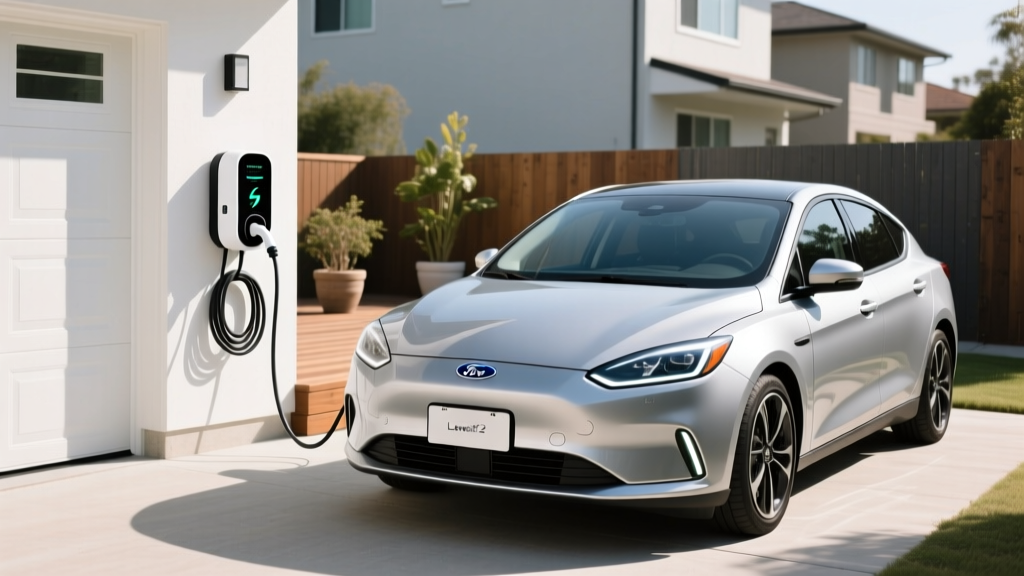
A 240V Level 2 connection is what makes EV ownership effortless. At 48 amps, your Model Y accepts 11.5 kW and recovers roughly 35–40 miles of range per hour. A depleted battery (10% SoC) reaches full in about 9–10 hours — perfect for overnight charging on a time-of-use electricity plan.
DC Fast Charging: Road-Trip Power
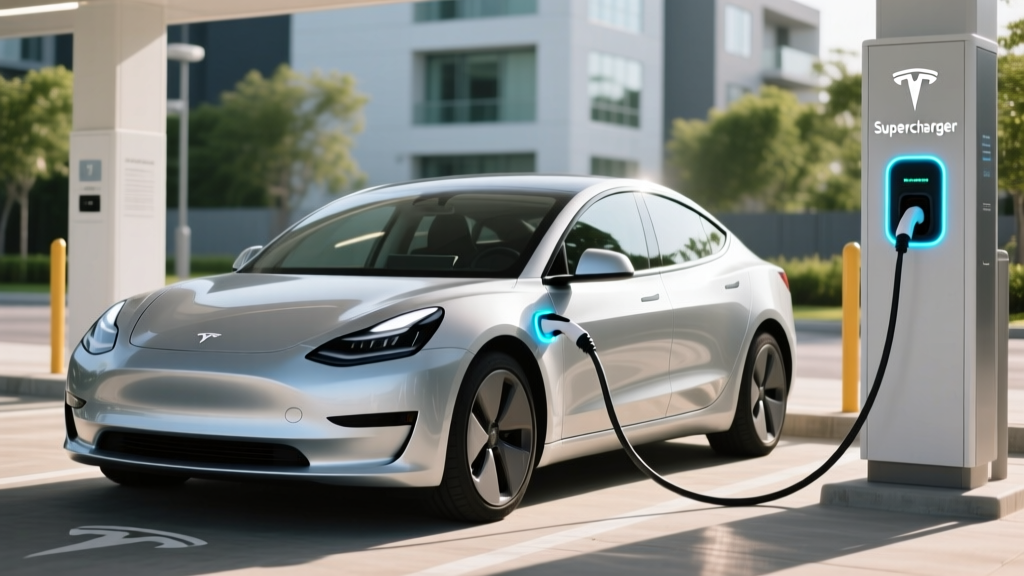
Tesla's V3 Superchargers deliver up to 250 kW directly to the Model Y's NACS port. The charging curve is not linear: the battery accepts peak power between roughly 10–30% SoC, then progressively tapers. By 60% SoC, the rate drops to approximately 150 kW; above 80%, it falls further to 50–75 kW. This is why 10–80% takes ~25–28 minutes but 80–100% can add another 20–30 minutes. On road trips, charge to 80% and move on — the taper makes topping off inefficient.
Home Charger Installation: Electrical Requirements and Costs
Installing a Level 2 home charger for your Model Y Long Range AWD requires a dedicated 240V circuit, typically 60 amps (to support a 48A continuous charger load — the National Electrical Code requires circuits rated at 125% of continuous load). Here's what's involved and what it costs.
Electrical Requirements
- Circuit: Dedicated 60A breaker, 240V, using 6 AWG copper wire (or 4 AWG aluminum)
- Connector: NEMA 14-50 receptacle or hardwired connection (hardwired is preferred for 48A+ chargers — many jurisdictions no longer permit 14-50 receptacles at 60A for EV charging due to thermal concerns)
- Panel capacity: Your main service panel must have sufficient spare capacity. A 200A panel with adequate spare slots can usually accommodate a 60A EV circuit. Older homes with 100A or 150A service may need a panel upgrade ($1,500–$3,500) or a load-management device
- Permit: Required in virtually all jurisdictions; involves an electrical inspection after installation
- GFCI: NEC 2020+ requires GFCI protection for receptacle-based EV circuits in garages; hardwired chargers with built-in ground-fault protection may not require an external GFCI breaker
| Item | Low Estimate | High Estimate | Notes |
|---|---|---|---|
| Level 2 Charger (Equipment) | $250 | $700 | Tesla Wall Connector, ChargePoint, Emporia, etc. |
| Electrician Labor | $500 | $2,000 | Depends on wire run length, wall/floor penetration |
| Electrical Permit | $50 | $300 | Varies by municipality |
| Panel Upgrade (if needed) | $1,500 | $3,500 | 100A→200A service upgrade; not always required |
| Total (no panel upgrade) | $800 | $3,000 | Most homes with 200A service |
| Total (with panel upgrade) | $2,300 | $6,500 | Older homes with insufficient service |
The single biggest cost variable is wire run length. If your panel is adjacent to the garage, expect costs near the low end. If the wire must run 80+ feet through finished walls, crawlspaces, or underground conduit, labor and materials climb quickly. Always get at least three quotes from licensed electricians and confirm they hold the appropriate state/local license and insurance.
Panel Upgrade: The Hidden Cost
Homes built before 1990 often have 100A or 150A service. Adding a 60A EV circuit to a fully loaded 100A panel is a code violation and a fire risk. A licensed electrician will perform a load calculation (NEC Article 220) to determine if your panel can support the additional circuit. If it can't, you have two options: a full panel upgrade to 200A ($1,500–$3,500 depending on your utility and region) or a smart load-management device like the Emporia Smart Load Manager or Tesla Wall Connector's built-in load-sharing feature, which dynamically reduces charger amperage when other household loads spike.
Connector Compatibility and the NACS Ecosystem
The 2025 Model Y Long Range AWD uses the NACS (North American Charging Standard) connector — Tesla's proprietary design, now adopted as the industry standard by Ford, GM, Rivian, Hyundai, and most major automakers. This gives the Model Y native access to the Tesla Supercharger network (17,000+ stalls in North America) without any adapter.
| Connector Type | Compatibility | Adapter Required? | Network Access |
|---|---|---|---|
| NACS (Tesla) | Native | No | Tesla Superchargers, Tesla Destination Chargers |
| CCS1 | Via adapter | Yes — Tesla CCS Adapter (~$175) | Electrify America, EVgo, ChargePoint DC stations |
| CHAdeMO | Via adapter | Yes — third-party (e.g., Lectron, ~$200–$300) | Limited; network is being phased out in the US |
| J1772 (Level 2 AC) | Via adapter | Yes — included with Tesla Mobile Connector or J1772 adapter (~$75) | Public Level 2 stations, non-Tesla destination chargers |
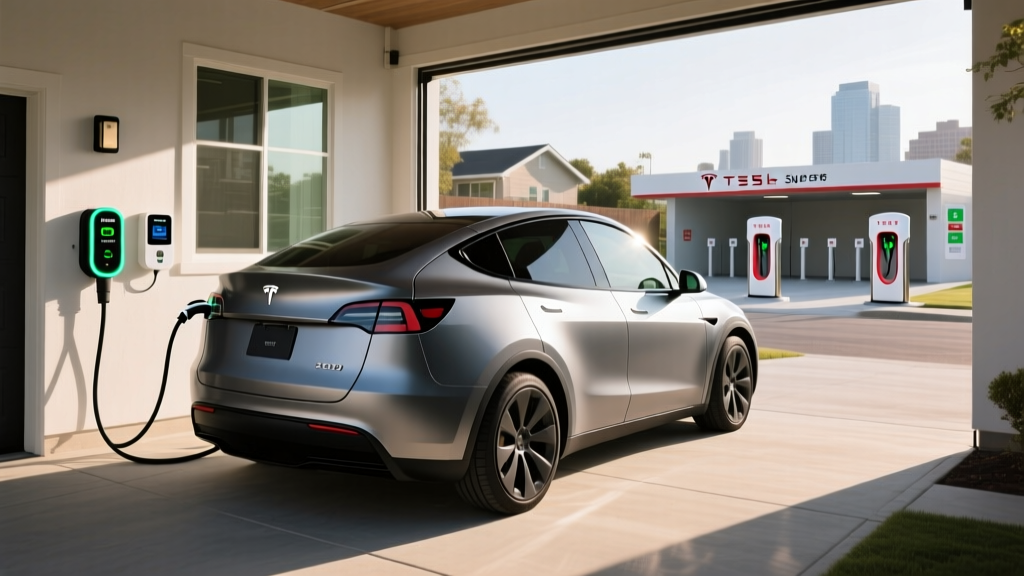
For daily home charging, you'll use the NACS port directly with a Tesla Wall Connector or a NACS-equipped third-party charger. For public DC fast charging outside the Supercharger network, the Tesla CCS1 adapter unlocks Electrify America, EVgo, and other CCS-based networks. Keep the adapter in your frunk for road trips through areas with sparse Supercharger coverage.
Charging Cost Per Mile: Home vs. Public vs. Gas
The economics of EV charging depend heavily on where and when you plug in. Here's how the 2025 Model Y Long Range AWD stacks up across common scenarios, using its EPA efficiency of approximately 28 kWh/100 miles (or ~3.57 miles/kWh).
| Scenario | Cost per kWh | Cost per Mile | Notes |
|---|---|---|---|
| Home (off-peak utility rate) | $0.10–$0.14 | $0.03–$0.04 | Time-of-use plans; cheapest option |
| Home (average US residential) | $0.16–$0.17 | $0.045–$0.05 | National avg per EIA data |
| Public Level 2 (network charging) | $0.25–$0.49 | $0.07–$0.14 | Varies widely; ChargePoint, EVgo, etc. |
| Tesla Supercharger (V3) | $0.25–$0.40 | $0.07–$0.11 | Peak pricing in metro areas can exceed $0.50/kWh |
| Non-Tesla DC Fast (EA, EVgo) | $0.35–$0.55 | $0.10–$0.15 | Idle fees and session fees may apply |
| Gasoline SUV (25 MPG, $3.40/gal) | — | $0.136 | Comparable AWD crossover baseline |
At the national average residential electricity rate of ~$0.17/kWh, charging your Model Y at home costs roughly $0.045–$0.05 per mile — about one-third the per-mile fuel cost of a comparable 25 MPG gasoline AWD SUV at $3.40/gallon. Over 15,000 annual miles, home charging saves approximately $1,200–$1,400 per year versus gasoline. Even frequent Supercharger use at $0.35/kWh ($0.10/mile) still undercuts gasoline on a per-mile basis.
According to fueleconomy.gov, the 2025 Model Y Long Range AWD achieves 117 MPGe combined, translating to 28 kWh per 100 miles. Use this figure to calculate your personal cost per mile based on your utility rate.
Recommended Home Charging Equipment for the Model Y
The Model Y's 11.5 kW onboard charger means a 48-amp, 240V hardwired charger is the optimal home setup. Here are proven units that pair well with this vehicle.
Tesla Wall Connector (Gen 3)
- Power Output: Up to 11.5 kW (48A) at 240V
- Connector: NACS native
- Cable Length: 24 feet
- Smart Features: Wi-Fi, OTA firmware updates, load sharing between multiple units, access control
- Price: ~$450
- Best For: Tesla-only households; seamless integration with vehicle app
Emporia Level 2 EV Charger
- Power Output: Up to 11.5 kW (48A) at 240V
- Connector: NACS or J1772 (configurable)
- Cable Length: 24 feet
- Smart Features: Energy monitoring, solar integration, load management with Emporia panel sensors, app scheduling
- Price: ~$350–$400
- Best For: Homes with solar panels or Emporia energy monitors; budget-conscious buyers
ChargePoint Home Flex (NACS)
- Power Output: Up to 12 kW (50A) at 240V
- Connector: NACS (2025+ models) or J1772 with adapter
- Cable Length: 23 feet
- Smart Features: Alexa integration, scheduling, charging history, flexible amperage settings (16–50A)
- Price: ~$600–$700
- Best For: Mixed-EV households; adjustable amperage for older panels
For most Model Y owners, the Tesla Wall Connector is the default choice — it's competitively priced, NACS-native, and supports load sharing if you add a second EV later. The Emporia charger stands out for homes with solar or energy-monitoring setups, while the ChargePoint Home Flex offers adjustable amperage (dial it down to 32A or 40A if your panel can't support a 60A circuit).
Safety, Code Compliance, and Installation Best Practices
EV charging draws sustained high current for hours — this is fundamentally different from intermittent loads like a dryer or oven. Proper installation is non-negotiable for safety and insurance coverage.
- Dedicated circuit: Your Level 2 charger must be on its own dedicated breaker — never shared with other appliances
- Hardwired vs. receptacle: Hardwired connections (no plug) are preferred for 48A+ chargers. They eliminate the thermal failure point of a receptacle and often don't require GFCI breakers, which can nuisance-trip on EV loads
- Outdoor rating: If your charger is mounted outside or in an unenclosed carport, ensure it carries a NEMA 4 or IP65 rating for weather resistance
- Wire gauge: 6 AWG copper for 60A circuits; undersized wire causes overheating and is a fire hazard
- Permit and inspection: Skipping the permit voids homeowner's insurance coverage for electrical fires. The inspection costs $50–$150 and takes 20 minutes — it's cheap protection
- Utility notification: Some utilities offer EV-specific rate plans or rebates for charger installation. Contact your provider before installing
Frequently Asked Questions
How much does it cost to install a home EV charger for the 2025 Model Y?
Expect $800–$3,000 for a standard installation on an existing 200A panel, including the charger ($250–$700), electrician labor ($500–$2,000), and permit ($50–$300). Homes needing a panel upgrade to 200A should budget an additional $1,500–$3,500. Get multiple quotes and verify the electrician's license and insurance.
How fast will each charging level add range to the Model Y Long Range AWD?
Level 1 (120V): approximately 3–4 miles per hour. Level 2 (240V, 48A): approximately 35–40 miles per hour. DC Fast Charging (Tesla V3 Supercharger, 250 kW peak): up to 200+ miles in 15 minutes during the peak portion of the charge curve, tapering significantly above 60% SoC.
Which connector and charger is compatible with the 2025 Model Y?
The 2025 Model Y Long Range AWD has a native NACS port. It connects directly to Tesla Superchargers and NACS-equipped home chargers without adapters. For CCS1-based public DC networks (Electrify America, EVgo), you'll need the Tesla CCS Adapter (~$175). For J1772 Level 2 public stations, a J1772-to-NACS adapter (~$75) is needed. CHAdeMO is increasingly rare and requires a third-party adapter.
How much does charging cost per mile compared to gas?
At the national average residential electricity rate (~$0.17/kWh), home charging costs roughly $0.045–$0.05 per mile. A comparable 25 MPG AWD gasoline SUV at $3.40/gallon costs about $0.136 per mile. Home charging saves approximately $0.08–$0.09 per mile, or $1,200–$1,400 annually at 15,000 miles/year. Public DC fast charging at $0.35–$0.40/kWh ($0.10–$0.11/mile) still beats gasoline but narrows the gap.
What electrical upgrades might I need before installing a Level 2 charger?
A licensed electrician will perform a NEC Article 220 load calculation. Common upgrades include: panel upgrade from 100A/150A to 200A service ($1,500–$3,500); adding spare breaker slots if the panel is full; upgrading service entrance conductors; or installing a smart load-management device ($200–$500) that dynamically reduces charger amperage when household demand spikes, avoiding the need for a full panel upgrade.
Does the 2025 Model Y Long Range AWD qualify for the federal EV tax credit?
The 2025 Model Y Long Range AWD is eligible for up to $7,500 under IRS §30D, available as a point-of-sale transfer to the dealer. Eligibility depends on your modified adjusted gross income (AGI caps: $300,000 joint / $225,000 head of household / $150,000 single), the vehicle's MSRP (SUV cap: $80,000 — the Model Y qualifies), and battery critical-mineral and component sourcing requirements that tighten annually. Always verify current-year rules on IRS.gov and consult a tax professional before purchase.
Should I charge to 100% every night?
For the NMC battery in the Model Y Long Range AWD, Tesla recommends setting the daily charge limit to 80–90% and charging to 100% only before long trips. Sustained storage at 100% SoC accelerates NMC degradation. Set your charge limit in the Tesla app or in-car settings. (Note: LFP-equipped Standard Range models can and should be charged to 100% regularly — but the Long Range AWD uses NMC.)