2025 Kia Niro EV Range and Battery Basics
Before mapping out a charging strategy, you need the numbers. The 2025 Kia Niro EV (second generation, SG2 platform) carries a 64.8 kWh usable lithium-ion NMC battery pack and delivers an EPA-estimated 239 miles of combined range on a full charge. That figure applies to the single front-wheel-drive powertrain, rated at 201 horsepower and 188 lb-ft of torque, with a 0-60 mph time of approximately 7.8 seconds.
EPA 239 mi combined. Expect roughly 210-225 mi in mixed highway driving at 70 mph, and as low as 160-180 mi in sustained sub-freezing winter conditions or steep mountain grades. Summer city driving with regen can occasionally exceed 240 mi.
Efficiency lands at approximately 113 MPGe combined (30 kWh/100mi). This efficiency figure directly dictates your charging costs and how quickly each kilowatt-hour translates to actual miles on the road.
| Spec | Value |
|---|---|
| EPA Range | 239 miles |
| Battery (Usable) | 64.8 kWh (NMC) |
| Max DC Fast Charge | ~80 kW (peak) |
| 10-80% DC Charge Time | ~44 minutes |
| Level 2 AC Charge Rate | 7.2 kW (onboard charger) |
| Connector | CCS1 (J1772 + DC pins) |
| Efficiency | 113 MPGe / 30 kWh/100mi |
| Base MSRP (Wind trim) | ~$40,875 |
| Battery Warranty | 10 years / 100,000 miles |
Charging Levels Explained: Speeds in kW and Miles Per Hour
The single most common EV confusion is between kW (kilowatts — the rate of power delivery, like water pressure) and kWh (kilowatt-hours — the energy stored, like the size of the tank). The Niro EV's battery holds 64.8 kWh of energy. How fast you refill it depends on the kW output of your charger.
| Level | Power (kW) | Miles of Range Per Hour | Use Case |
|---|---|---|---|
| Level 1 (120V outlet) | 1.0 - 1.4 kW | ~3 - 5 mi/hr | Overnight top-ups, emergencies |
| Level 2 (240V home/public) | 7.2 kW (max onboard) | ~24 - 28 mi/hr | Daily home charging, workplace |
| DC Fast Charging | Up to ~80 kW peak | ~160 - 200 mi/hr (peak) | Road trips, highway corridors |
A critical reality: the Niro EV's onboard AC charger caps at 7.2 kW. Even if you install a 48-amp (11.5 kW) Level 2 wall connector, the car will only accept 7.2 kW. This means you do not need the most powerful home charger on the market — a 32-amp (7.7 kW) unit is the practical sweet spot.
On DC fast charging, the Niro EV peaks around 80 kW. That's modest by 2025 standards — competitors like the Hyundai Ioniq 5 peak at 240 kW. The charge curve tapers significantly above 60% state of charge, which is why Kia quotes a 10-80% time of approximately 44 minutes on a capable DC charger. If you frequently road-trip, this is a meaningful limitation worth internalizing.
How Much Does It Cost to Install a Home EV Charger?
Most Niro EV owners will want a dedicated Level 2 wallbox at home. The total installed cost depends heavily on your electrical panel's capacity and the distance from the panel to your parking spot.
| Component | Cost Range |
|---|---|
| Level 2 EVSE Equipment (32A-40A) | $350 - $700 |
| Electrician Labor (standard install) | $500 - $1,500 |
| Electrical Permit | $50 - $200 |
| Panel Upgrade (if needed: 100A → 200A) | $1,500 - $3,500+ |
| Total (no panel upgrade) | $900 - $2,400 |
| Total (with panel upgrade) | $2,400 - $5,900+ |
Electrical Requirements for the Niro EV
For a 32-amp Level 2 charger (the practical maximum for the Niro's 7.2 kW onboard charger), you need a 240V / 40A dedicated circuit. National Electrical Code requires continuous loads to be derated to 80% of breaker capacity, so a 40A breaker supports 32A continuous draw. A 48A charger would need a 60A breaker — but since the Niro caps at 7.2 kW (30A at 240V), the extra circuit capacity goes unused.
Panel upgrade gotcha: Homes built before 1990 often have 100-amp or even 60-amp service panels. Adding a 40A EV circuit to an already-loaded 100A panel may require a service upgrade to 200A. This is the single biggest cost variable. Have a licensed electrician perform a load calculation before committing to equipment.
Connector Compatibility: CCS1, NACS, and Adapter Reality
The 2025 Kia Niro EV ships with a CCS1 (Combo 1) charge port — a J1772 AC connector with two DC fast-charge pins below it. This is the legacy North American standard, and it remains widely supported at Electrify America, EVgo, and ChargePoint DC stations.
| Connector Type | Native Support? | Notes |
|---|---|---|
| J1772 (Level 2 AC) | Yes — native | All public Level 2 stations |
| CCS1 (DC Fast) | Yes — native | Electrify America, EVgo, most networks |
| NACS (Tesla) | No — adapter needed | Kia has announced NACS adoption for future models; check for adapter availability |
| CHAdeMO | No | Largely deprecated in North America |
Tesla Supercharger access: As of 2025, Kia has not officially enabled NACS adapter access to Tesla's Supercharger network for the Niro EV. Some CCS-to-NACS adapters are entering the market, but compatibility is not guaranteed and may void warranty coverage. Check Kia's official communications before purchasing any adapter. The CCS1 network remains robust for the Niro's needs.
Cost to Charge: Home vs. Public vs. Gas Comparison
Charging economics depend entirely on your electricity rate. Here's how the Niro EV's 30 kWh/100mi efficiency translates to real costs, compared against a comparable gas-powered Kia Niro hybrid (EPA 53 MPG combined) and a typical 25 MPG ICE crossover.
| Scenario | Cost Per kWh / Gallon | Cost Per Mile |
|---|---|---|
| Home (off-peak utility rate) | $0.12/kWh | $0.036 |
| Home (average US rate) | $0.17/kWh | $0.051 |
| Public Level 2 (e.g., ChargePoint) | $0.25-$0.35/kWh | $0.075 - $0.105 |
| DC Fast Charge (e.g., Electrify America) | $0.35-$0.55/kWh | $0.105 - $0.165 |
| Kia Niro Hybrid (53 MPG) | $3.40/gal | $0.064 |
| Gas Crossover (25 MPG) | $3.40/gal | $0.136 |
At home off-peak rates, the Niro EV costs roughly one-quarter per mile compared to a 25 MPG gas crossover. Even at DC fast-charge prices, it often undercuts gasoline. The key takeaway: home charging is where the economics shine. If you can't charge at home, public charging costs can approach or exceed hybrid fuel costs.
Best Level 2 Chargers for the Kia Niro EV
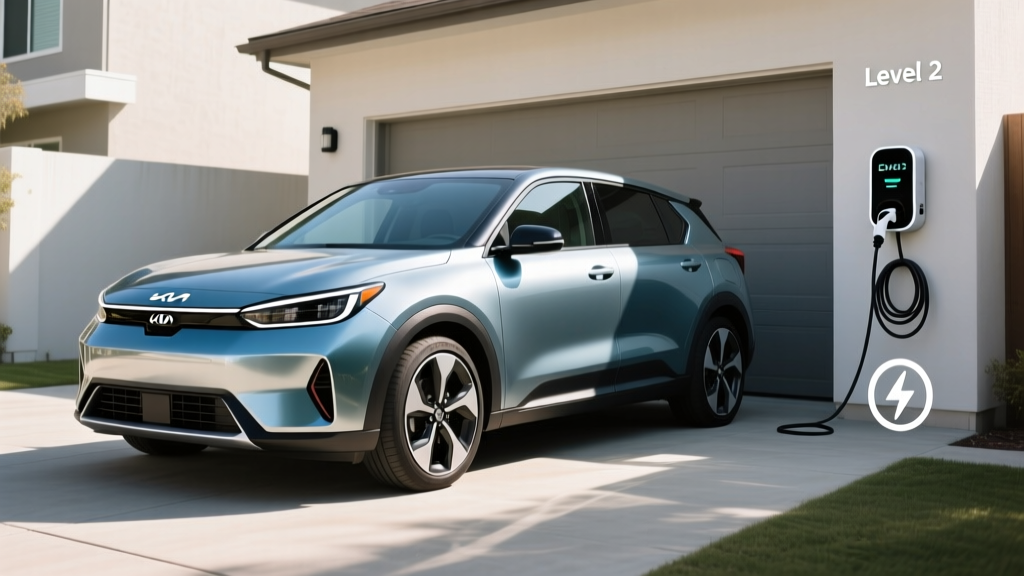
Since the Niro EV caps at 7.2 kW AC, you don't need a 48-amp charger. A quality 32-amp unit delivers full speed at lower install cost. Here are three proven options:
Emporia Vue Smart Charger (40A)
Power Output: Up to 9.6 kW (Niro will draw 7.2 kW max)
Connector: J1772
Cable Length: 24 ft
Smart Features: Wi-Fi, app scheduling, energy monitoring, solar integration
Price: ~$400
Why it fits: The energy monitoring pairs well with solar-panel owners, and the price undercuts competitors while delivering full Niro EV charging speed.
ChargePoint Home Flex (up to 50A)
Power Output: Configurable 16A-50A (set to 32A for Niro)
Connector: J1772
Cable Length: 23 ft
Smart Features: Wi-Fi, Alexa integration, app scheduling, flexible amperage
Price: ~$550-$650
Why it fits: The adjustable amperage means you can dial it to exactly 32A on a 40A circuit — no wasted capacity, no overspending on electrical work.
Wallbox Pulsar Plus (40A)
Power Output: Up to 9.6 kW
Connector: J1772
Cable Length: 25 ft
Smart Features: Wi-Fi + Bluetooth, app control, load balancing, compact form factor
Price: ~$500-$600
Why it fits: Compact design, solid app, and load-balancing capability if your panel is tight on capacity.
Safety, Code, and Installation Best Practices
EV charging is a high-draw continuous load — the equivalent of running a space heater for 8 hours straight. Cutting corners on installation is a fire risk.
- Dedicated circuit: Your Level 2 charger must be on its own dedicated breaker. Do not share the circuit with a dryer, HVAC, or other large appliance.
- GFCI protection: NEC 2020 and later requires GFCI protection for EVSE outlets in garages and all outdoor locations. Hardwired units may have different requirements — your electrician will confirm.
- Outdoor rating: If your parking spot is outside, ensure the EVSE is rated NEMA 4 (weather-resistant). All three chargers above carry outdoor ratings.
- Permit and inspection: Most jurisdictions require an electrical permit for new 240V circuits. The inspection ensures the work meets code and protects your homeowner's insurance coverage.
- Cable management: Use a wall-mounted holster or cable organizer to prevent tripping hazards and cord damage from being run over.
Tax Credits and Incentives for Home Charging
The federal §30D Clean Vehicle Credit applies to the EV purchase itself, not the charger. However, the Alternative Fuel Vehicle Refueling Property Credit (Form 8911) can cover up to 30% of home charger equipment and installation costs, capped at $1,000. Eligibility depends on your census tract meeting certain income or rural criteria — check the latest IRS guidance for your ZIP code. Some utilities also offer rebates of $200-$500 for installing a smart Level 2 charger; check your local provider.
Frequently Asked Questions
How much does it cost to install a home EV charger for the Niro EV?
Expect $900-$2,400 total for a standard installation (equipment, electrician labor, and permit) if your electrical panel has adequate capacity. If a panel upgrade from 100A to 200A is needed, add $1,500-$3,500+. Always get a load calculation from a licensed electrician first.
How fast will each charging level add range to the Niro EV?
Level 1 (120V): roughly 3-5 miles per hour. Level 2 (240V, 32A): roughly 24-28 miles per hour, fully recharging the 64.8 kWh battery in about 9-10 hours. DC fast charging: peaks around 80 kW, adding up to ~200 miles per hour at peak, with a 10-80% session taking approximately 44 minutes.
Which connector and charger is compatible with the 2025 Kia Niro EV?
The Niro EV uses CCS1 (J1772 for AC, CCS combo for DC). Any J1772 Level 2 charger works natively. For DC fast charging, use CCS-equipped stations on Electrify America, EVgo, and similar networks. NACS (Tesla) adapter compatibility is not confirmed for this model year.
How much does charging the Niro EV cost per mile versus gas?
At home off-peak rates ($0.12/kWh), the Niro EV costs about $0.036 per mile. At average US electricity rates ($0.17/kWh), it's about $0.051/mi. A comparable 25 MPG gas crossover at $3.40/gallon costs $0.136/mi — nearly 3-4x more per mile when charging at home.
What electrical upgrades might I need for a Level 2 charger?
You need a 240V / 40A dedicated circuit for a 32-amp charger. Homes with older 100A panels may require a service upgrade to 200A, especially if you already run electric HVAC, a dryer, and an electric range. A licensed electrician's load calculation will determine whether an upgrade is necessary. Budget an additional $1,500-$3,500 if one is needed.
Can I use a Tesla Supercharger with the 2025 Niro EV?
Not natively. The Niro EV has a CCS1 port, and Tesla Superchargers use the NACS connector. While some CCS-to-NACS adapters exist, Kia has not officially approved adapter use for this model. Using an unofficial adapter may affect warranty coverage. Stick to CCS-equipped networks for reliable charging.
How does cold weather affect the Niro EV's range and charging speed?
In temperatures below 32°F, expect 15-30% range reduction depending on severity and whether you use cabin heating. The Niro EV has a battery heating system, but DC fast-charge speeds will still taper in extreme cold until the battery warms. Preconditioning the battery (via the Kia Access app) while still plugged in at home mitigates this — it draws power from the grid rather than the battery.