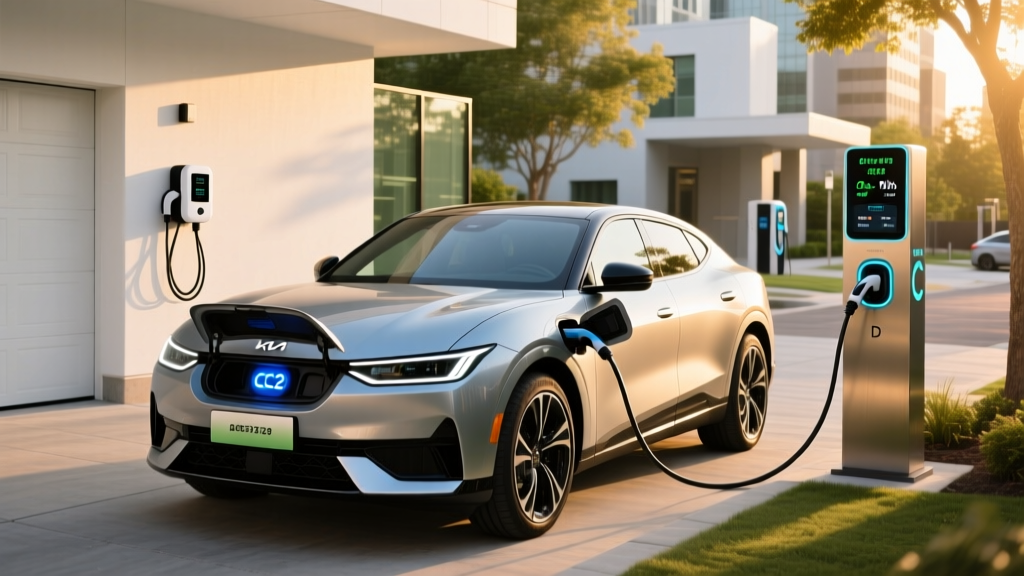
The 2025 Kia EV6 Light Long Range pairs a 77.4 kWh usable battery with rear-wheel-drive efficiency, delivering an EPA-estimated 310 miles of range. But owning this EV means understanding how to keep that battery charged — at home, on road trips, and without overspending on electricity or installation. This guide breaks down every charging scenario the EV6 Light Long Range faces, with exact numbers for speeds, costs, and equipment.
2025 Kia EV6 Light Long Range: Key Charging Specs at a Glance
Before plugging in anywhere, here's the baseline data every EV6 Light Long Range owner needs. The EV6 is built on Hyundai Motor Group's E-GMP platform, which supports 800-volt DC fast charging — a significant advantage that enables some of the quickest charging times in its class.
| Spec | Value |
|---|---|
| Battery Capacity (usable) | 77.4 kWh (NMC chemistry) |
| EPA Range | 310 miles |
| Real-World Highway Range | ~255–275 miles (70+ mph, moderate climate) |
| Cold-Weather Range (20°F) | ~230–250 miles |
| Max DC Fast Charge Rate | ~239 kW peak (800V architecture) |
| DC Fast Charge 10–80% | ~18 minutes (optimal conditions) |
| Level 2 Onboard Charger | 10.9 kW (single-phase, 48A max) |
| Level 1 (120V) Charge Rate | ~1.4 kW |
| Charge Port / Connector | CCS1 (Combined Charging System) |
| EPA Efficiency | 134 MPGe combined (25 kWh/100mi) |
| Base MSRP (Light Long Range RWD) | ~$42,600 |
| Battery Warranty | 10 years / 100,000 miles |
Charging Levels Explained: How Fast Will Each Level Add Range?
EV charging happens at three distinct levels, each defined by its power output in kilowatts (kW). Remember: kW measures power (how fast energy flows), while kWh measures energy (how much the battery stores). Think of kW as the flow rate of a hose and kWh as the size of the bucket.
| Level | Voltage | Power (kW) | Miles of Range Added per Hour | Best For |
|---|---|---|---|---|
| Level 1 (Standard Outlet) | 120V AC | ~1.4 kW | ~4–5 miles/hr | Overnight top-ups, emergencies, low-mileage drivers |
| Level 2 (Home/Public AC) | 240V AC | Up to 10.9 kW | ~35–40 miles/hr | Daily home charging, workplace, shopping centers |
| DC Fast Charging | 400V–800V DC | Up to ~239 kW peak | ~600–900 miles/hr (peak) | Road trips, rapid top-ups along highways |
Level 1 uses a standard 120V household outlet and the portable charging cable included with the EV6. At roughly 1.4 kW, it adds about 4–5 miles of range per hour. A full charge from empty would take over 50 hours — impractical for most drivers, but sufficient if you drive under 30 miles daily and can plug in overnight.
Level 2 is the standard for daily EV ownership. A 240V home charger delivering 10.9 kW (matching the EV6's onboard charger limit) can replenish roughly 35–40 miles per hour. A full 0–100% charge takes approximately 7.5–8 hours, meaning an overnight session easily refills the battery.
DC Fast Charging bypasses the onboard charger and sends direct current straight to the battery. The EV6's 800V architecture allows it to accept up to ~239 kW at compatible chargers, achieving a 10–80% charge in roughly 18 minutes under optimal conditions. However, the charge curve tapers significantly above 80% to protect battery health — charging from 80–100% on DC fast can take an additional 15–20 minutes.
Home Charger Installation: Electrical Requirements, Costs, and Panel Upgrades
Installing a Level 2 home charger is the single biggest ownership setup task for an EV6 Light Long Range owner. The EV6's 10.9 kW onboard charger means you'll want a 240V circuit capable of delivering at least 48 amps to take full advantage. Here's what that requires electrically and financially.
Electrical Requirements
- Circuit: Dedicated 60-amp breaker (a 48A continuous load requires a circuit rated at 125% of that, per National Electrical Code)
- Wiring: 6 AWG copper wire (or 4 AWG aluminum) run from the panel to the charger location
- Voltage: 240V single-phase (standard for US residential)
- GFCI Protection: Required by NEC 2020+ for EV charging outlets; hardwired units may have built-in ground-fault protection
- Outdoor Rating: If installing in a garage or exterior wall, the charger must carry a NEMA 4 (weatherproof) rating
Do You Need a Panel Upgrade?
This is where costs can escalate. Most modern homes have a 200-amp electrical panel. If your panel is already near capacity (running electric HVAC, a dryer, an electric range, and a water heater), adding a 60A EV circuit may exceed the panel's safe load. A licensed electrician will perform a load calculation to determine if your panel can handle the additional draw.
If your home has a 100-amp panel (common in homes built before the 1990s), a panel upgrade to 200 amps is almost certainly required. This adds $1,500–$3,500 to the project. Some homeowners opt for a lower-amperage charger (32A / 7.7 kW on a 40A circuit) to avoid a panel upgrade — this still adds ~26 miles of range per hour, which is adequate for most daily needs.
Home Charger Installation Cost Breakdown
| Item | Cost Range | Notes |
|---|---|---|
| Level 2 Charger (Equipment) | $350–$700 | Smart Wi-Fi chargers, 40–48A, 18–25 ft cable |
| Electrician Labor | $500–$2,000 | Depends on run length from panel, wall type, conduit |
| Electrical Permit | $50–$200 | Required in most jurisdictions; varies by city/county |
| Wiring & Materials | $100–$400 | 6 AWG copper, conduit, junction boxes |
| Panel Upgrade (if needed) | $1,500–$3,500 | 100A → 200A service upgrade |
| Total (No Panel Upgrade) | $1,000–$3,300 | Most homeowners fall in this range |
| Total (With Panel Upgrade) | $2,500–$6,800 | Older homes with 100A service |
Always hire a licensed electrician and pull the required permits. Unpermitted work can void homeowner's insurance coverage and create fire hazards. Many utilities offer rebates of $250–$500 for home charger installation — check with your local provider before scheduling work.
Connector Compatibility: CCS1, NACS, and Adapter Options
The 2025 Kia EV6 comes equipped with a CCS1 (Combined Charging System) port, which is the standard connector for most non-Tesla EVs in North America. However, the connector landscape is shifting as Tesla's North American Charging Standard (NACS) gains adoption across the industry.
| Connector Type | Compatibility | Where You'll Find It |
|---|---|---|
| CCS1 | Native (built-in) | Electrify America, EVgo, ChargePoint DC stations, most public Level 2 |
| NACS (Tesla) | Adapter required | Tesla Supercharger network (access expanding to non-Tesla EVs) |
| CHAdeMO | Not compatible | Legacy Nissan Leaf standard; increasingly rare |
| J1772 (Level 2 AC) | Native (CCS1 includes J1772) | Public Level 2 stations, home chargers |
Tesla Supercharger access: Kia has announced that EV6 owners will gain access to Tesla's Supercharger network using a Kia-supplied NACS adapter. As of the 2025 model year, check with your dealer on adapter availability and whether your EV6's software supports Supercharger routing through the Kia Connect app or a third-party app. Tesla Superchargers equipped with a "Magic Dock" CCS adapter cable can also charge the EV6 without a personal adapter at select locations.
For home charging: Any J1772-compatible Level 2 charger works natively with the EV6. This includes virtually all consumer home chargers sold in North America. No adapter is needed for Level 2 home charging.
Recommended Home Chargers for the Kia EV6 Light Long Range
To maximize the EV6's 10.9 kW onboard charger, select a Level 2 unit that delivers at least 48 amps. Here are three proven options suited to the EV6's capabilities.
ChargePoint Home Flex
- Power Output: Up to 12 kW (50A) — adjustable down to 16A
- Connector: J1772 (native fit for EV6 Level 2)
- Cable Length: 23 feet
- Smart Features: Wi-Fi, app scheduling, energy tracking, Alexa integration
- Price: ~$699
- Best For: Flexible amperage settings if your panel is tight on capacity
Emporia Level 2 EV Charger
- Power Output: Up to 11.5 kW (48A)
- Connector: J1772
- Cable Length: 24 feet
- Smart Features: Wi-Fi, app control, energy monitoring, solar integration
- Price: ~$399
- Best For: Budget-conscious buyers who still want smart scheduling
Wallbox Pulsar Plus
- Power Output: Up to 11.5 kW (48A)
- Connector: J1772
- Cable Length: 25 feet
- Smart Features: Wi-Fi + Bluetooth, app scheduling, Power Sharing for dual installs
- Price: ~$649
- Best For: Compact form factor and clean garage aesthetics
Any of these chargers will fully replenish the EV6's 77.4 kWh battery overnight in roughly 7.5–8 hours. Plug in when you get home, wake up to a full battery every morning.
Charging Cost: Home vs. Public vs. Gas — What's the Real Cost per Mile?
One of the strongest financial arguments for the EV6 Light Long Range is lower fueling cost. But the savings depend heavily on where you charge. Here's a realistic breakdown using the EV6's efficiency rating of 25 kWh per 100 miles (or 0.25 kWh per mile).
| Scenario | Rate | Cost for 77.4 kWh (Full Charge) | Cost per Mile |
|---|---|---|---|
| Home (Off-Peak Utility Rate) | $0.09/kWh | $6.97 | $0.023/mile |
| Home (National Avg Residential) | $0.16/kWh | $12.38 | $0.040/mile |
| Public Level 2 (Network Pricing) | $0.25–$0.40/kWh | $19.35–$30.96 | $0.063–$0.100/mile |
| DC Fast Charging (EA, EVgo) | $0.35–$0.55/kWh | $27.09–$42.57 | $0.087–$0.138/mile |
| Gasoline Vehicle (28 MPG avg, $3.30/gal) | $3.30/gallon | N/A | $0.118/mile |
Key takeaways:
- Charging at home on off-peak rates makes the EV6 roughly 5x cheaper per mile than a comparable gas vehicle.
- Even at the national average residential rate, the EV6 costs less than half per mile compared to gas.
- Exclusive DC fast charging at $0.45+/kWh can erode savings — on the most expensive networks, per-mile costs can approach or briefly exceed gas. This is why home charging is essential to the EV ownership economics.
- Many utilities offer time-of-use (TOU) plans that drop rates to $0.06–$0.10/kWh overnight. Enrolling in a TOU plan is one of the highest-impact moves an EV6 owner can make.
For a driver covering 12,000 miles per year and charging primarily at home at $0.12/kWh, annual fuel cost is roughly $360. A comparable 28 MPG gas vehicle at $3.30/gallon spends $1,414 on fuel. That's over $1,000 in annual savings before considering maintenance reductions (no oil changes, reduced brake wear from regenerative braking).
Public Charging Networks: Where Can the EV6 Charge?
The EV6's CCS1 port gives it access to the largest public charging networks in the United States. Here's what to expect from the major providers:
- Electrify America: The EV6 qualifies for Kia's complimentary charging plan (typically 1,000 kWh over 3 years at EA stations). EA chargers commonly deliver 150–350 kW, and the EV6's 800V system can take full advantage of 350 kW stalls, peaking near 239 kW.
- EVgo: Growing network of 350 kW-capable stalls in urban and highway corridors. Compatible with CCS1 natively.
- ChargePoint: Extensive Level 2 and DC fast network. The ChargePoint app is useful for locating chargers and checking real-time availability.
- Tesla Supercharger (with adapter): Expanding access for CCS-equipped vehicles. Check Kia's official guidance for adapter availability and supported Supercharger locations via the Kia owner portal.
Preconditioning matters: The EV6 can precondition its battery for optimal DC fast charging when you navigate to a charger using the built-in navigation system. This warms the battery to its ideal charging temperature, reducing the time spent at lower charge rates. Always use the nav-based routing to chargers in cold weather to activate preconditioning automatically.
Frequently Asked Questions
How much does it cost to install a home EV charger for the Kia EV6?
For most homes with a 200-amp panel, expect $1,000–$3,300 total, including the charger ($350–$700), electrician labor ($500–$2,000), permits ($50–$200), and materials. If your home has a 100-amp panel requiring an upgrade, total costs can reach $2,500–$6,800. Always get 2–3 quotes from licensed electricians and verify they pull the required local permits.
How fast will each charging level add range to the EV6?
Level 1 (120V) adds roughly 4–5 miles per hour. Level 2 (240V, 48A) adds approximately 35–40 miles per hour. DC fast charging at a 350 kW-capable station can add up to ~200 miles in 18 minutes (10–80% SoC), though real-world rates depend on battery temperature, state of charge, and charger availability.
Which connector is compatible with the 2025 Kia EV6 Light Long Range?
The EV6 uses a CCS1 connector natively, which works with virtually all non-Tesla public chargers and all J1772 Level 2 stations. Tesla Supercharger access requires a NACS adapter — check with your Kia dealer for availability. The EV6 is not compatible with CHAdeMO chargers.
How much does charging the EV6 cost per mile compared to gas?
At the national average residential electricity rate of ~$0.16/kWh, the EV6 costs about $0.04 per mile. A comparable 28 MPG gas vehicle at $3.30/gallon costs roughly $0.12 per mile. Home charging on off-peak rates can drop the EV6's cost to $0.02–$0.03 per mile — roughly one-quarter the cost of gasoline.
What electrical upgrades might I need for a Level 2 charger?
You'll need a dedicated 60-amp, 240V circuit with 6 AWG copper wiring. If your electrical panel is a 100-amp service or is already near capacity, a panel upgrade to 200 amps ($1,500–$3,500) may be necessary. A licensed electrician will perform a load calculation to determine your home's capacity. Some homeowners choose a lower-power 32A charger to avoid a panel upgrade.
Does the 2025 EV6 Light Long Range qualify for the federal EV tax credit?
Federal tax credit eligibility under IRS §30D depends on several factors: the vehicle's MSRP must not exceed $55,000 for sedans (the EV6 qualifies), the buyer's adjusted gross income must fall below $150,000 (single) or $300,000 (joint), and the vehicle must meet battery component and critical mineral sourcing requirements that change annually. The credit can now be transferred to the dealer as a point-of-sale discount. Check the latest rules at IRS.gov and consult a tax professional for your specific situation.
How long does a full charge take on the EV6 at home?
With a 48A Level 2 charger delivering 10.9 kW, a full 0–100% charge of the 77.4 kWh battery takes approximately 7.5–8 hours. Most owners never charge from 0% — plugging in at 20–30% remaining and charging to 80–90% takes roughly 4–5 hours, easily completed overnight. For daily driving, charging to 80% preserves long-term battery health, especially with NMC chemistry.