What the 2025 Ioniq 5 Range Means for Your Charging Strategy
The 2025 Hyundai Ioniq 5 is one of the most efficient and fastest-charging EVs on the market, but its real-world usability hinges on how you set up charging at home and what networks you rely on in public. Before we map out hardware and costs, let's anchor the numbers that drive every decision downstream.
| Spec | Standard Range (RWD) | Long Range (RWD) | Long Range (AWD) | Ioniq 5 N |
|---|---|---|---|---|
| EPA Range | 245 mi | 303 mi | 266 mi | 260 mi |
| Battery (usable) | 58 kWh (NMC) | 77.4 kWh (NMC) | 77.4 kWh (NMC) | 84 kWh (NMC) |
| Peak DC Charge Rate | ~175 kW | ~240 kW | ~240 kW | ~240 kW |
| 10–80% DC Time | ~22 min | ~18 min | ~18 min | ~18 min |
| Onboard AC Charger | 10.9 kW | 10.9 kW | 10.9 kW | 10.9 kW |
| 0–60 mph | ~7.4 s | ~6.7 s | ~4.5 s | ~3.4 s |
| Starting MSRP | $42,600 | $46,650 | $50,100 | $66,200 |
| EPA Efficiency | 132 MPGe | 117 MPGe | 110 MPGe | 95 MPGe |
Source: fueleconomy.gov and Hyundai USA specs. Real-world highway range typically runs 10–15% below EPA; cold-weather (below 32°F) can reduce range 20–30%.
Charging Levels Explained: kW, Speeds, and Miles Per Hour
Understanding EV charging starts with one critical distinction: kW (kilowatts) measures power — how fast energy flows into your car. kWh (kilowatt-hours) measures energy — the total capacity of your battery. Think of kW as the width of a hose and kWh as the size of the bucket you're filling. The Ioniq 5 Long Range has a 77.4 kWh bucket; how quickly you fill it depends on the hose.
| Level | Power Source | Max kW | Miles of Range Per Hour | Best For |
|---|---|---|---|---|
| Level 1 | 120V household outlet | ~1.4 kW | ~3–5 mi/hr | Emergency / overnight top-ups |
| Level 2 (Home/Public) | 240V (residential/commercial) | ~7.7–19.2 kW | ~25–65 mi/hr | Daily home charging |
| DC Fast Charging | 480V+ public stations | Up to 240 kW (Ioniq 5) | ~600–900 mi/hr (peak) | Road trips, quick top-ups |
Miles-per-hour estimates based on the Ioniq 5 Long Range RWD at ~3.8 miles/kWh. Actual rates vary by state of charge, temperature, and charger capability.
For daily ownership, Level 2 is where you'll spend 90% of your charging time. The Ioniq 5's 10.9 kW onboard AC charger means that even if you plug into a 19.2 kW station, the car caps intake at 10.9 kW — roughly 41 miles of range per hour of charging. A full 0–100% Level 2 session on the 77.4 kWh Long Range battery takes about 7.5 hours.
Home Charger Installation: Electrical Requirements and Costs
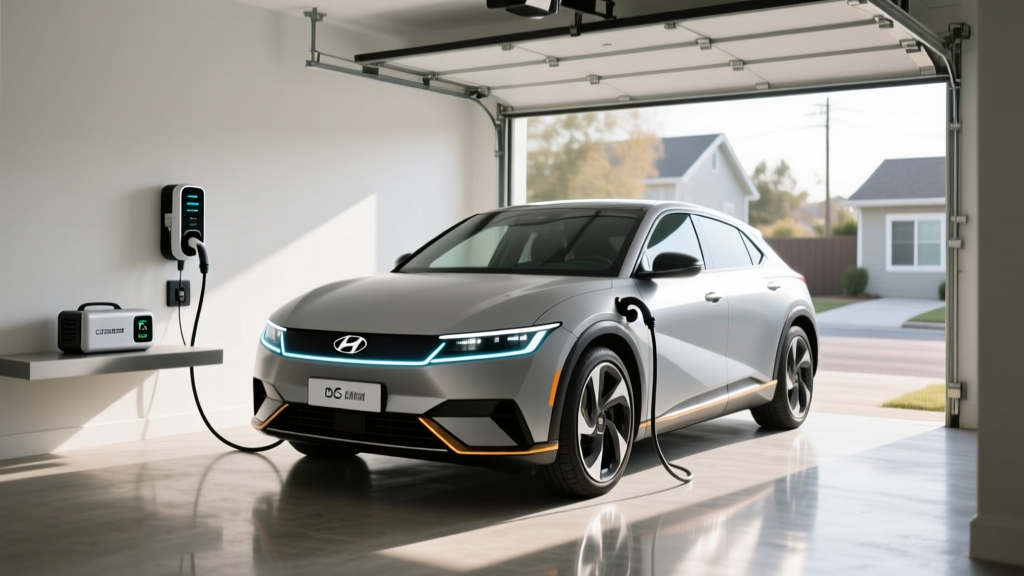
Installing a Level 2 charger at home is the single biggest ownership upgrade for any Ioniq 5 driver. Here's what's involved electrically and financially.
Electrical Requirements
To unlock the Ioniq 5's full 10.9 kW AC charging capability, you need a 240V circuit rated for at least 48 amps (a 48A charger requires a 60A circuit per NEC 80% continuous-load rules). Most homeowners opt for a 40A charger on a 50A circuit, which delivers ~9.6 kW — close enough to max the car's onboard charger and significantly cheaper to wire.
Your home's electrical panel is the gating factor. Modern homes with 200A service usually have enough headroom. Older homes with 100A or 150A panels, or panels already loaded with HVAC, electric oven, and dryer circuits, may need a panel upgrade — a $1,500–$3,500 job on its own.
| Component | Typical Cost Range | Notes |
|---|---|---|
| Level 2 Charger (Hardware) | $350–$750 | 40A–48A smart chargers; see picks below |
| Electrician Labor | $500–$2,000 | Depends on run distance from panel to garage |
| Permit & Inspection | $100–$400 | Required in most jurisdictions; varies by city/county |
| Panel Upgrade (if needed) | $1,500–$3,500 | Only if existing panel lacks capacity |
| Total (no panel upgrade) | $950–$3,150 | Most common scenario for post-2000 homes |
| Total (with panel upgrade) | $2,450–$6,650 | Older homes or high-load panels |
Always get 2–3 quotes from licensed electricians. Some utilities offer rebates of $250–$500 for smart charger installation — check your local provider. Federal §30C Alternative Fuel Vehicle Refueling Property Credit may cover up to 30% of equipment + installation (max $1,000 for residential), subject to income and location requirements.
Safety and Code Considerations
- Dedicated circuit: Your Level 2 charger must have its own dedicated breaker — never share with other appliances.
- GFCI protection: NEC 2020+ requires GFCI breakers for EV charging circuits in garages and all outdoor installations. Budget an extra $50–$100 for a GFCI breaker if your jurisdiction enforces this.
- Outdoor rating: If your charger mounts outside, ensure it carries a NEMA 4 (weatherproof) rating. Indoor garage installations only need NEMA 3R or NEMA 1.
- Cable management: A 25-foot cable covers most garage layouts. If your parking spot is far from the wall, specify a charger with a longer cable or plan conduit routing.
- Hardwired vs. plug: Hardwired chargers (directly connected to wiring) avoid the need for a 240V receptacle and allow higher amperage. NEMA 14-50 plug-in installations offer portability but cap at 40A continuous.
Connector Compatibility: NACS, CCS, and the Ioniq 5
The 2025 Ioniq 5 ships with a CCS1 (Combined Charging System) port for both AC Level 2 and DC fast charging in North America. However, the charging landscape has shifted dramatically: Tesla's NACS connector is now the dominant standard, and Hyundai has committed to adopting NACS on new vehicles starting with the 2025 model year for some markets and broadly by 2026.
| Connector | Used By | Ioniq 5 Compatible? | Adapter Needed? |
|---|---|---|---|
| CCS1 | Hyundai, Kia, VW, BMW, Ford (legacy), GM (legacy), Rivian | Yes — native port | No |
| NACS (Tesla) | Tesla (all), Ford (2025+), GM (2025+), Rivian (2025+), Volvo, Polestar | Yes, with adapter | CCS-to-NACS adapter (~$200–$250) |
| CHAdeMO | Nissan Leaf (legacy), Mitsubishi Outlander PHEV | No | N/A — CHAdeMO networks declining |
| J1772 (AC only) | All EVs for Level 1/2 AC | Yes — CCS includes J1772 | No (J1772 is the top half of CCS1) |
What this means in practice: The Ioniq 5 charges natively at Electrify America, EVgo, ChargePoint, and other CCS-equipped networks. To access Tesla Superchargers — which now welcome non-Tesla EVs at many locations — you'll need a CCS-to-NACS adapter. Hyundai may provide one with newer deliveries; check with your dealer. Tesla Superchargers tend to offer better uptime and availability than third-party networks, making the adapter a worthwhile $200 investment for road-trip-heavy owners.
Recommended Home Chargers for the Ioniq 5
These Level 2 chargers pair well with the Ioniq 5's 10.9 kW onboard charger. All recommendations are CCS1-native; NACS-connector versions are noted where available.
ChargePoint Home Flex
- Power Output: Up to 12 kW (50A) — adjustable down to 16A
- Connector: CCS1 (J1772 + CCS combo)
- Cable Length: 23 feet
- Smart Features: Wi-Fi, app scheduling, utility demand-response integration, Alexa
- Installation: Hardwired or NEMA 14-50 plug
- Price: ~$599 (often $499 on sale)
Best for: Most Ioniq 5 owners. Flexible amperage means it works on 40A or 50A circuits without swapping hardware.
Emporia Vue Level 2 Charger
- Power Output: Up to 11.5 kW (48A)
- Connector: CCS1
- Cable Length: 24 feet
- Smart Features: Wi-Fi, app control, energy monitoring, solar integration
- Installation: Hardwired or NEMA 14-50 plug
- Price: ~$399
Best for: Budget-conscious buyers who still want smart scheduling and energy tracking. Excellent value.
Wallbox Pulsar Plus
- Power Output: Up to 11.5 kW (48A)
- Connector: CCS1 (J1772 variant also available)
- Cable Length: 25 feet
- Smart Features: Wi-Fi, Bluetooth, app scheduling, load balancing for multi-charger homes
- Installation: Hardwired only (no plug option)
- Price: ~$499
Best for: Compact wall footprint and clean install. Slightly smaller than competitors. Hardwire-only means professional installation is mandatory.
Tesla Wall Connector (with NACS-to-CCS adapter)
- Power Output: Up to 11.5 kW (48A)
- Connector: NACS (requires CCS adapter for Ioniq 5)
- Cable Length: 24 feet
- Smart Features: Wi-Fi, power sharing between multiple units, OTA updates
- Installation: Hardwired only
- Price: ~$450 (charger) + ~$200 (adapter)
Best for: Multi-EV households with both Tesla and non-Tesla vehicles. Overkill if you only own a CCS car.
Charging Cost Per Mile: Home vs. Public vs. Gas
One of the Ioniq 5's strongest ownership arguments is fuel cost savings — but the math varies enormously depending on where and when you charge.
| Scenario | Cost per kWh / Gallon | Cost Per Mile (Ioniq 5) | Cost Per Mile (Gas SUV at 27 MPG) |
|---|---|---|---|
| Home Charging (off-peak utility rate) | $0.12/kWh | $0.032 | $0.130 ($3.50/gal) |
| Home Charging (average US rate) | $0.17/kWh | $0.045 | $0.130 ($3.50/gal) |
| Home Charging (high-cost state like CA) | $0.30/kWh | $0.079 | $0.167 ($4.50/gal) |
| Public Level 2 (ChargePoint, etc.) | $0.25–$0.49/kWh | $0.066–$0.129 | $0.130–$0.167 |
| DC Fast Charging (Electrify America, EVgo) | $0.35–$0.55/kWh | $0.092–$0.145 | $0.130–$0.167 |
| Tesla Supercharger (with adapter, non-Tesla pricing) | $0.35–$0.50/kWh | $0.092–$0.132 | $0.130–$0.167 |
Ioniq 5 Long Range RWD consumes ~26.3 kWh/100 miles (~3.8 mi/kWh). Gas SUV baseline assumes 27 MPG combined. Source: fueleconomy.gov, EIA electricity/gas price data.
The takeaway: Home charging on off-peak rates delivers fuel costs at roughly 25% of gasoline. Even at expensive California utility rates, home charging beats gas. But frequent DC fast charging at public rates narrows the advantage significantly — sometimes to near parity with gas. The Ioniq 5's ultra-fast 18-minute 10–80% charge time makes DC stops painless on road trips, but relying on DC as your primary charging source erodes cost savings and accelerates battery wear.
DC Fast Charging in Practice: Charge Curves and Real-World Times
The Ioniq 5's 800V architecture enables peak charge rates up to 240 kW — but peak is not sustained. Here's what a typical DC fast-charge session looks like for the 77.4 kWh Long Range model:
- 10–40% SoC: Sustains near peak 220–240 kW (~12–14 minutes)
- 40–60% SoC: Tapers to ~180–200 kW (~6–7 minutes)
- 60–80% SoC: Tapers further to ~130–150 kW (~5–6 minutes)
- 80–100% SoC: Drops sharply below 60 kW — avoid charging past 80% on road trips unless necessary
Total 10–80% time: approximately 18 minutes at a 350 kW-capable station (like Electrify America's newest stalls). At a 150 kW station, expect 25–30 minutes. At a 50 kW CHAdeMO/CCS station (increasingly rare), plan for 60+ minutes.
Preconditioning matters: the Ioniq 5 will warm its battery automatically when you navigate to a DC charger in the Hyundai app or built-in navigation. Arriving with a cold battery can add 5–10 minutes to your session and reduce peak kW by 30–50%. Always precondition in cold weather.
Public Charging Networks: Reliability and Access
The Ioniq 5's CCS1 port connects to every major non-Tesla public network. Here's the reliability landscape as of early 2026:
- Electrify America: Largest CCS network; 350 kW stalls available at many locations. Reliability has improved but still experiences occasional payment-app glitches.
- Tesla Supercharger: Best uptime in the industry. Non-Tesla access expanding — requires CCS-to-NACS adapter and Tesla app. Not all Supercharger locations are open to non-Tesla vehicles yet; check the app map.
- EVgo: Good urban coverage; mixed 50/100/350 kW stalls. Pricing varies by time of day.
- ChargePoint: Dominates Level 2 public charging (workplaces, retail). DC fast stations are less common.
For road trips, plan stops using the A Better Route Planner (ABRP) or Hyundai's built-in route planner, which accounts for elevation, temperature, and charge-curve taper.
Federal Tax Credits and Incentives for Charging Equipment
The §30C Alternative Fuel Vehicle Refueling Property Credit covers up to 30% of home charger hardware and installation costs, capped at $1,000 for residential property. Key eligibility requirements:
- Income limits: Adjusted gross income must not exceed $150,000 (single) or $300,000 (joint) — verify current-year thresholds on IRS.gov.
- Location requirement: Equipment must be installed in a qualifying census tract (generally non-urban or low-income communities). Check the IRS census tract tool.
- Eligible costs: Charger hardware + electrical labor + permits. Does not cover panel upgrades.
- Claim method: File IRS Form 8911 with your federal tax return. This is a non-refundable credit — it reduces tax owed but won't generate a refund beyond your tax liability.
Additionally, many utilities and states offer rebates of $250–$1,000 for smart Level 2 charger installations. Check with your local utility and your state energy office for current programs.
Frequently Asked Questions
How much does it cost to install a home EV charger?
A typical Level 2 home charger installation runs $950–$3,150 all-in (equipment + electrician + permit) for homes that don't need a panel upgrade. If your electrical panel requires an upgrade to 200A service, add $1,500–$3,500. Always get multiple quotes from licensed electricians and check for utility rebates that can offset $250–$500 of the cost.
How fast will each charging level add range to the Ioniq 5?
Level 1 (120V): ~3–5 miles per hour. Level 2 (240V, 40–48A): ~25–41 miles per hour. DC fast charging: up to ~900 miles per hour at peak 240 kW, but tapering significantly above 60% state of charge. For the Ioniq 5 Long Range, a 10–80% DC fast charge takes about 18 minutes at a 350 kW station.
Which connector and charger is compatible with my 2025 Ioniq 5?
The 2025 Ioniq 5 uses a CCS1 connector natively. It works with all CCS-equipped public chargers (Electrify America, EVgo, ChargePoint) and all J1772 Level 2 stations. To charge at Tesla Superchargers, you need a CCS-to-NACS adapter ($200–$250). CHAdeMO is not compatible.
How much does charging cost per mile vs. gas?
Home charging at the US average rate of ~$0.17/kWh costs about $0.045 per mile in the Ioniq 5 Long Range — roughly 65% cheaper than a 27 MPG gas SUV at $3.50/gallon ($0.13/mile). Public DC fast charging at $0.40–$0.50/kWh brings the cost to $0.10–$0.13 per mile, narrowing the advantage. Off-peak home charging is where EVs deliver maximum savings.
What electrical upgrades might I need?
The most common upgrade is a new 50A or 60A 240V circuit from your main panel. If your panel is already near capacity (common in homes with electric HVAC, oven, dryer, and water heater), you may need a panel upgrade from 100A/150A to 200A service — a $1,500–$3,500 job. Some jurisdictions also now require GFCI breakers for EV circuits ($50–$100 extra). An electrician's load calculation during the quoting phase will identify any needed upgrades.
Will DC fast charging damage my Ioniq 5 battery?
Occasional DC fast charging is fine — the Ioniq 5's thermal management system actively cools the battery during high-power sessions. However, daily DC fast charging can accelerate long-term degradation compared to Level 2 charging. Hyundai's battery warranty covers 8 years/100,000 miles with a minimum 70% capacity retention threshold. For daily use, Level 2 home charging at 80% state of charge is the longevity-optimal approach.
Does the Ioniq 5 qualify for the $7,500 federal EV tax credit?
Eligibility for the §30D New Clean Vehicle Credit depends on MSRP caps (under $55,000 for sedans, $80,000 for SUVs — the Ioniq 5 qualifies on most trims except the N), buyer income limits ($150K single / $300K joint), and battery critical-mineral and component sourcing requirements that tighten each year. As of 2026, sourcing rules have reduced the number of qualifying trims. Check IRS.gov or consult a tax professional for your specific eligibility — credit amounts may be $3,750 or $7,500 depending on which sourcing thresholds the vehicle meets.