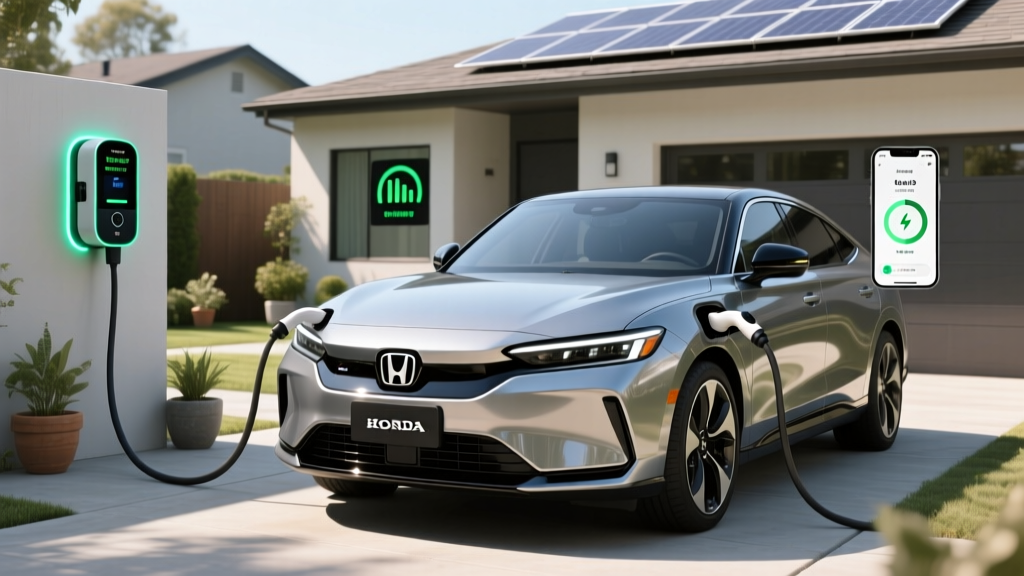
The 2025 Honda Prologue is Honda's first mass-market electric SUV, built on GM's Ultium platform and sharing its bones with the Chevrolet Blazer EV. For buyers researching the 2025 Honda Prologue range and how to actually keep it charged at home and on the road, the numbers tell a specific story: an 85 kWh usable battery, up to 296 miles of EPA-rated range on FWD trims, and peak DC fast charging at 155 kW. Below, we break down the real-world range you can expect, exactly what each charging level adds per hour, what a home Level 2 install costs in 2026, and how charging economics stack up against gasoline.
2025 Honda Prologue Range, Battery, and Efficiency Specs
Before plugging in, it helps to know the energy budget you're working with. The Prologue uses an 85 kWh (usable) Ultium lithium-ion battery pack with NMC chemistry, shared across the GM-Honda partnership. Range and efficiency vary by drivetrain.
| Trim / Drivetrain | EPA Range | MPGe (City/Hwy/Combined) | Battery (usable) | Peak DC Charge | 0-60 mph |
|---|---|---|---|---|---|
| EX FWD | 296 mi | 107 / 91 / 99 MPGe | 85 kWh | 155 kW | ~7.6 sec |
| Touring FWD | 296 mi | 107 / 91 / 99 MPGe | 85 kWh | 155 kW | ~7.6 sec |
| Touring AWD | 281 mi | 101 / 87 / 94 MPGe | 85 kWh | 155 kW | ~6.5 sec |
| Elite AWD | 273 mi | 98 / 84 / 91 MPGe | 85 kWh | 155 kW | ~6.5 sec |
EPA 296 mi is the FWD ceiling; expect 240–265 mi on sustained highway driving at 70+ mph, and 200–230 mi in sub-30°F winter conditions due to battery heating demand and cabin HVAC load. AWD trims (281/273 mi EPA) typically deliver 225–250 mi real-world in mixed driving. On road trips, plan stops around the 200-mile mark to preserve a safety buffer.
Charging Levels Explained: kW, Miles per Hour, and the Prologue
EV charging falls into three tiers. The critical distinction: kW (kilowatts) measures power — how fast energy flows, while kWh (kilowatt-hours) measures energy — the battery's capacity. Think of kW as the hose diameter and kWh as the size of the tank you're filling.
| Level | Power Source | Max Power (kW) | Miles of Range per Hour | Typical Use Case |
|---|---|---|---|---|
| Level 1 | 120V / 12A household outlet | ~1.4 kW | ~3–4 mi/hr | Overnight top-up, emergencies |
| Level 2 (Home/Public) | 240V / 32–48A | 7.7–11.5 kW | ~22–34 mi/hr | Daily home charging, workplace, malls |
| DC Fast Charging | 400V DC public stations | 155 kW peak | ~250 mi in ~30 min (10–80%) | Road trips, highway corridors |
Charging time examples for the Prologue's 85 kWh pack:
- Level 1 (1.4 kW): 0–100% in roughly 60+ hours — impractical for full charges, but fine for recovering 30–40 miles overnight.
- Level 2 at 48A / 11.5 kW: 0–100% in approximately 8–9 hours; 10–80% in about 5.5 hours. This is the realistic daily standard.
- DC Fast at 155 kW peak: 10–80% in approximately 30–32 minutes. Note that peak 155 kW is sustained only between roughly 10–40% SoC; the charge curve tapers significantly above 60%, dropping below 60 kW past 80%. This is standard NMC behavior to protect battery longevity.
Home Level 2 Charger Installation: Electrical Requirements & Cost Breakdown
Most Prologue owners will want a 240V Level 2 home charger. Here's what that involves electrically and financially in 2026.
Electrical requirements: A 48A Level 2 charger requires a dedicated 240V / 60A circuit (NEC code mandates the circuit be rated 125% of the continuous load, so 48A × 1.25 = 60A breaker). A 32A charger needs a 40A breaker. Your electrical panel must have capacity for this additional load — typically at least 2–4 open slots and sufficient amperage headroom on a 200A service panel.
| Component | Cost Range | Notes |
|---|---|---|
| Level 2 Charger Equipment (48A, hardwired) | $400–$700 | Smart WiFi-enabled units; non-smart models from $300 |
| Electrician Labor (run 240V line, 60A breaker) | $600–$1,800 | Depends on run length from panel to garage/carport |
| Permit & Inspection | $50–$250 | Varies by municipality; required for code compliance |
| Electrical Panel Upgrade (if needed) | $1,500–$3,500 | Required if panel is 100A or fully loaded; 200A upgrade standard |
| Total — Simple Install (no panel upgrade) | $1,050–$2,750 | Most homes with 200A service and short runs |
| Total — With Panel Upgrade | $2,550–$6,250 | Older homes with 100A service or maxed-out panels |
Panel upgrade reality: Homes built before 1990 often have 100A service. Adding a 60A EV circuit to an already-loaded 100A panel is unsafe and will likely fail inspection. Budget for a 200A upgrade if this is your situation — it's the single largest variable in home charging cost and the one most online guides gloss over.
Connector Compatibility: NACS, CCS1, and the Prologue's Port
The 2025 Honda Prologue ships with a CCS1 (Combo) charge port. However, Honda has confirmed that future models will adopt NACS, and Honda owners already have access to the Tesla Supercharger network via a CCS1-to-NACS adapter (provided by Honda for early buyers or available aftermarket for ~$150–$250).
| Connector Standard | Network | Prologue Compatible? | Adapter Needed? |
|---|---|---|---|
| CCS1 | Electrify America, EVgo, ChargePoint | Yes — native port | No |
| NACS (Tesla) | Tesla Supercharger (15,000+ stalls) | Yes, with adapter | CCS1-to-NACS adapter (~$150–$250) |
| CHAdeMO | Largely legacy/deprecated | No | No adapter available; avoid |
| J1772 (Level 2 AC) | Public Level 2, home chargers | Yes — built-in | No (CCS port includes J1772 inlet) |
Practical tip: Tesla's Supercharger network remains the most reliable DC fast-charging option in the U.S. by uptime percentage. Even though the Prologue uses CCS1 natively, obtaining the NACS adapter is strongly recommended for road-trip flexibility. Honda's included adapter (for qualifying original purchasers) is a significant ownership perk.
Level 2 Home Charger Equipment Recommendations for the Prologue
The Prologue's onboard charger accepts up to 11.5 kW (48A) on Level 2 AC. To maximize that, you need a 48A-capable charger on a 60A circuit. Here are three proven units:
- Power Output: 48A / 11.5 kW (240V)
- Connector: J1772 (CCS compatible)
- Cable Length: 24 ft
- Smart Features: WiFi, energy monitoring, solar integration, app scheduling
- Price: ~$400
- Best For: Budget-conscious buyers who want smart features and energy tracking
- Power Output: Up to 50A / 12 kW (configurable 16–50A)
- Connector: J1772
- Cable Length: 23 ft
- Smart Features: WiFi, app scheduling, Alexa integration, NEMA 14-50 or hardwired
- Price: ~$550–$700
- Best For: Flexible amperage settings if your panel can't support a full 60A circuit
- Power Output: 48A / 11.5 kW
- Connector: J1772
- Cable Length: 24 ft
- Smart Features: WiFi, over-the-air updates, load sharing with second unit
- Price: ~$550
- Best For: Clean design, reliable firmware, future-proof if you add a Tesla to the household
All three units are hardwired (recommended for 48A), UL-listed, and rated for indoor/outdoor use (NEMA 4 rating). A NEMA 14-50 plug configuration is possible on some units at 40A (which limits the Prologue to ~9.6 kW), but hardwiring at 48A unlocks the full 11.5 kW onboard charging rate.
Cost to Charge the Prologue: Home vs. Public vs. Gas
Electricity pricing varies enormously by region, time-of-use plan, and whether you're charging at home or on a public DC fast charger. Here's how the Prologue's 85 kWh battery translates to real costs.
| Scenario | Rate ($/kWh) | Full Charge Cost | Cost per Mile | Annual Fuel Cost (12,000 mi) |
|---|---|---|---|---|
| Home Off-Peak (national avg) | $0.13 | $11.05 | $0.037 | $449 |
| Home Peak (TOU plan) | $0.28 | $23.80 | $0.080 | $965 |
| Public Level 2 (avg) | $0.30 | $25.50 | $0.086 | $1,032 |
| DC Fast Charger (EA, EVgo avg) | $0.48 | $40.80 | $0.138 | $1,654 |
| Gasoline SUV (25 MPG, $3.40/gal) | — | — | $0.136 | $1,632 |
The takeaway: Home off-peak charging delivers fuel costs at roughly one-quarter the price of gasoline. Even public DC fast charging at $0.48/kWh is roughly cost-parity with a 25 MPG gas SUV at current fuel prices. The Prologue's economics are best when home charging dominates your routine — if you rely exclusively on public DC fast charging, the cost advantage over gas narrows substantially or disappears.
For context on utility rate structures, the U.S. Energy Information Administration (EIA) publishes state-by-state average residential electricity rates monthly. Many utilities offer time-of-use (TOU) plans that make overnight EV charging dramatically cheaper — check with your local provider.
Safety, Code, and Electrical Considerations
EV charging is a high-draw, continuous electrical load. Cutting corners here risks fire, failed inspections, or voided insurance claims. Key requirements:
- Dedicated circuit: Your Level 2 charger must be on its own dedicated breaker — it cannot share a circuit with other appliances. NEC Article 625 governs EV charging installations.
- GFCI protection: NEC 2020 and later require GFCI protection for outdoor receptacles used for EV charging. Hardwired installations may have different requirements depending on jurisdiction — your electrician will determine compliance.
- Outdoor rating: If your charger is mounted outside (carport, driveway), it must carry a NEMA 4 or NEMA 4X rating for weather resistance. All three chargers recommended above meet this standard.
- Wire gauge: A 60A circuit requires 6 AWG copper wire (THHN in conduit) or 4 AWG aluminum. Your electrician will size this based on run length and local code.
- Permit and inspection: Most jurisdictions require a permit for new 240V circuits. Skipping this risks code violations, insurance denial in the event of a fire, and complications at home resale. Budget $50–$250 for the permit and expect a post-install inspection.
Federal Tax Credit and Incentives for Home Charging
The IRS §30C Alternative Fuel Vehicle Refueling Property Credit covers 30% of home charger equipment and installation costs, up to $1,000, for chargers placed in service in 2025–2026. Eligibility depends on your census tract meeting specific low-income or non-urban criteria — not all homeowners qualify. Consult IRS guidance or a tax professional before assuming the credit applies to your installation.
Separately, the Prologue itself may qualify for the §30D New Clean Vehicle Credit of up to $7,500, subject to MSRP caps ($80,000 for SUVs), buyer income limits ($300K joint / $150K single), and critical-mineral/battery-sourcing requirements that shift annually. As of 2026, verify Prologue eligibility on the IRS clean vehicle portal before purchase, as sourcing rules have tightened.
Frequently Asked Questions
How much does it cost to install a home EV charger for the Honda Prologue?
A typical 48A Level 2 home installation runs $1,050–$2,750 total (charger + electrician + permit) if your panel has capacity. If your home needs a 200A panel upgrade, expect $2,550–$6,250 all-in. The single biggest cost variable is whether your existing electrical panel can handle a new 60A circuit.
How fast will each charging level add range to the Prologue?
Level 1 (120V) adds roughly 3–4 miles per hour. Level 2 (240V / 48A) adds approximately 30–34 miles per hour. DC fast charging at 155 kW peak can add roughly 150+ miles in 15–20 minutes during the initial charge phase (10–40% SoC), tapering significantly above 60%.
Which connector and charger is compatible with my 2025 Prologue?
The Prologue uses CCS1 natively for DC fast charging and J1772 for Level 2 AC. For Tesla Supercharger access, you'll need a CCS1-to-NACS adapter (included by Honda for qualifying original purchasers, or available aftermarket for ~$150–$250). CHAdeMO is not compatible.
How much does charging the Prologue cost per mile compared to gas?
At home off-peak rates ($0.13/kWh), the Prologue costs approximately $0.037/mile — roughly one-quarter the cost of a 25 MPG gas SUV at $3.40/gallon ($0.136/mile). Public DC fast charging at $0.48/kWh brings cost to ~$0.138/mile, essentially parity with gasoline.
What electrical upgrades might I need for a Level 2 charger?
If your home has a 200A electrical panel with available breaker slots and load capacity, you likely need only a new 60A breaker and a 240V wire run. Homes with 100A service, older panels, or panels already near capacity will require a full panel upgrade to 200A — a $1,500–$3,500 job that adds to your total installation cost.
Can I charge the Prologue on a regular 120V outlet?
Yes, but at only ~1.4 kW (3–4 miles of range per hour), a full charge takes over 60 hours. Level 1 is practical only for overnight top-ups of 30–40 miles or as a backup. For daily use, a 240V Level 2 installation is strongly recommended.
Does the Prologue's charging speed taper at higher battery levels?
Yes — this is normal for NMC battery chemistry. The Prologue's 155 kW peak rate is sustained only in the lower state-of-charge window (roughly 10–40%). Above 60% SoC, charge speed drops progressively, and above 80% it falls below 50 kW. For road trips, plan to charge from 10–80% and move on rather than waiting for a full 100%, which adds significant time.