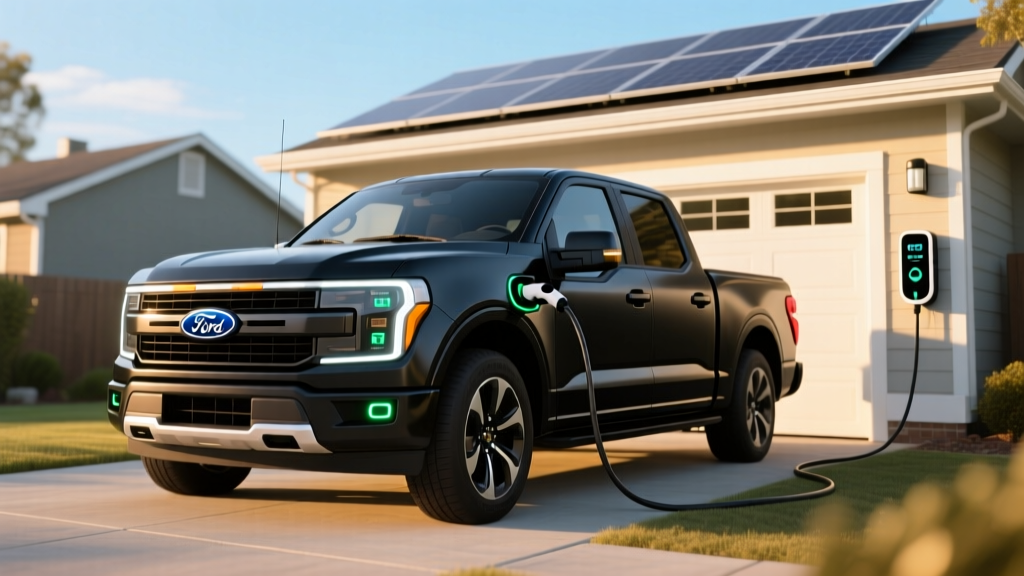
If you've been searching for a "2025 F150 supercharged" and landed here, let's clear the air immediately: Ford does not offer a supercharged F-150 for the 2025 model year. What Ford does offer is the F-150 Lightning — the all-electric variant that delivers supercar-rivaling torque (775 lb-ft) without a supercharger in sight. If you're considering this electric truck or already have one on order, understanding how to charge it efficiently at home and on the road is essential. This guide covers every charging level, real installation costs, connector compatibility, and what you'll actually pay per mile compared to a gas F-150.
F-150 Lightning Battery and Charging Specs at a Glance
Before plugging in, you need to know what you're working with. The 2025 F-150 Lightning comes in two battery configurations depending on trim:
| Specification | Standard Range | Extended Range |
|---|---|---|
| Usable Battery Capacity | ~98 kWh (LFP/NMC) | ~131 kWh (NMC) |
| EPA Range | 240 miles | 320 miles |
| Real-World Highway Range | ~190–210 miles | ~255–280 miles |
| Max DC Fast Charge Rate | 150 kW | 150 kW |
| Onboard Charger (Level 2) | 11.3 kW (single) / 19.2 kW (dual) | 19.2 kW |
| 10–80% DC Fast Charge Time | ~44 minutes | ~55 minutes |
| Connector (2025 MY) | NACS (native Tesla Supercharger access) | |
Understanding EV Charging Levels: Speeds in kW and Miles Per Hour
EV charging comes in three tiers. The critical distinction: kW (kilowatts) measures the rate of energy delivery — like water pressure from a hose. kWh (kilowatt-hours) measures the total energy stored in the battery — like the size of the tank. Never confuse them.
| Level | Voltage | Power (kW) | Miles Added Per Hour | Best For |
|---|---|---|---|---|
| Level 1 | 120V AC | 1.0–1.4 kW | 2–5 mi/hr | Overnight top-ups, emergencies |
| Level 2 | 240V AC | 7.2–19.2 kW | 20–65 mi/hr | Daily home charging, workplace |
| DC Fast Charge | 400V+ DC | 50–350 kW | 150–250+ mi in 20 min | Road trips, rapid top-ups |
For the F-150 Lightning Extended Range with its 131 kWh battery, Level 1 charging is essentially impractical for full replenishment — it would take roughly 5+ days from empty. Level 2 at 19.2 kW (using the dual onboard charger) will fully recharge overnight in about 7–8 hours. DC fast charging at 150 kW gets you from 10–80% in under an hour.
Home Charger Installation: Electrical Requirements, Costs, and Panel Upgrades
Installing a Level 2 home charger is the single best upgrade an F-150 Lightning owner can make. Here's what's actually involved.
Electrical Requirements
A Level 2 charger requires a dedicated 240V circuit. For a 48-amp charger (the sweet spot for most EVs), you need a 60-amp breaker (NEC code requires circuits rated at 125% of continuous load). The F-150 Lightning's optional 19.2 kW onboard charger can accept up to 80 amps, requiring a 100-amp breaker — but most owners find 48 amps (11.5 kW) perfectly adequate for overnight charging.
Panel Upgrade Reality
Many homes built before 2000 have 100-amp or 150-amp electrical panels that may already be near capacity. Adding a 60-amp EV circuit could push you over. A panel upgrade to 200 amps typically costs $1,500–$3,500 and is the single biggest variable in installation cost. Have an electrician perform a load calculation before quoting your install.
| Component | Low End | High End | Notes |
|---|---|---|---|
| Level 2 Charger (Equipment) | $400 | $750 | 48A smart charger, NACS connector |
| Electrician Labor | $500 | $2,000 | Depends on run length, conduit, wall type |
| Permit & Inspection | $50 | $300 | Varies by municipality |
| Panel Upgrade (if needed) | $1,500 | $3,500 | 100A → 200A service upgrade |
| Total (no panel upgrade) | $950 | $3,050 | Most common scenario |
| Total (with panel upgrade) | $2,450 | $6,550 | Older homes |
Some utility companies offer rebates of $250–$500 for Level 2 charger installation, and certain states provide additional incentives. Check your local utility before committing. Note: the federal Residential Clean Energy Credit (25C) does not cover EV chargers installed after 2022 in most cases — the Alternative Fuel Vehicle Refueling Property Credit (30C) may apply but has census-tract eligibility restrictions.
Connector Compatibility: NACS, CCS, and the Supercharger Network
The 2025 F-150 Lightning ships with a NACS (North American Charging Standard) port — the Tesla connector. This is a major shift from earlier model years that used CCS1. Here's what it means for your charging options:
| Network / Connector | 2025 F-150 Lightning Compatibility | Adapter Needed? |
|---|---|---|
| Tesla Supercharger (NACS) | ✅ Native — full access | No |
| Electrify America (CCS1) | ⚠️ Via NACS-to-CCS adapter | Yes — Ford provides or sells adapter |
| EVgo (NACS + CCS1) | ✅ NACS stalls native; CCS via adapter | Depends on stall |
| ChargePoint (J1772 Level 2) | ⚠️ Via NACS-to-J1772 adapter | Yes — included with most chargers |
| CHAdeMO | ❌ No adapter available | N/A — network is sunsetting |
Cost to Charge: Per-Mile Economics vs. a Gas F-150
The F-150 Lightning Extended Range consumes roughly 48 kWh per 100 miles (combined EPA). Let's translate that into dollars per mile under different charging scenarios and compare against a gas F-150 getting 20 MPG combined.
| Scenario | Cost per kWh | Cost per 100 Miles | Cost per Mile |
|---|---|---|---|
| Home Off-Peak (utility rate) | $0.08–$0.12 | $3.84–$5.76 | $0.04–$0.06 |
| Home Standard Rate | $0.15–$0.18 | $7.20–$8.64 | $0.07–$0.09 |
| Public Level 2 (ChargePoint, etc.) | $0.25–$0.35 | $12.00–$16.80 | $0.12–$0.17 |
| DC Fast Charge (Tesla Supercharger) | $0.28–$0.38 | $13.44–$18.24 | $0.13–$0.18 |
| DC Fast Charge (Electrify America) | $0.35–$0.48 | $16.80–$23.04 | $0.17–$0.23 |
| Gas F-150 (20 MPG, $3.40/gal) | $3.40/gallon | $17.00 | $0.17 |
The bottom line: Charging at home on off-peak rates costs roughly one-third to one-quarter what you'd spend on gas. Even DC fast charging on the road is roughly comparable to or slightly cheaper than gasoline. The savings compound: a driver covering 15,000 miles/year could save $1,200–$1,800 annually by charging primarily at home vs. fueling a gas F-150.
Recommended Home Chargers for the F-150 Lightning
Here are three chargers well-suited to the Lightning's capabilities, with exact specs and pricing as of early 2026:
Tesla Wall Connector (NACS) — Best Overall Value
- Power Output: Up to 11.5 kW (48A) on a 60A circuit
- Connector: Native NACS — plugs directly into the Lightning
- Cable Length: 24 feet
- Smart Features: Wi-Fi, OTA updates, power-sharing with second unit, scheduling via app
- Price: ~$475
- Why it works: No adapter needed, reliable, clean integration with NACS vehicles
ChargePoint Home Flex (NACS) — Best for Smart Features
- Power Output: Up to 12 kW (50A) on a 60A circuit; adjustable down to 16A
- Connector: Available with NACS pigtail (2025+ models)
- Cable Length: 23 feet
- Smart Features: App scheduling, energy tracking, Alexa integration, flexible amperage
- Price: ~$699
- Why it works: Adjustable amperage lets you match your panel's capacity — ideal if you're tight on amps
Grizzl-E Smart (NACS) — Best Budget/Durability Pick
- Power Output: Up to 11.5 kW (48A) on a 60A circuit
- Connector: NACS version available
- Cable Length: 24 feet
- Smart Features: Wi-Fi, app control, OCPP-compatible (works with utility demand-response programs)
- Price: ~$449
- Why it works: Built for extreme cold (-40°C rated), 3-year warranty, Canadian-made, rugged outdoor enclosure
Safety, Code Compliance, and Installation Best Practices
A Level 2 charger installation is permanent electrical work — not a DIY project. Here's what code requires and what you should insist on:
- Dedicated Circuit: Your charger must be on its own breaker — no sharing with other appliances. A 48A charger requires a 60A dedicated circuit per NEC Article 625.
- GFCI Protection: NEC 2020+ requires GFCI protection for outdoor receptacles. Hardwired chargers (recommended) avoid the nuisance-tripping issues that GFCI breakers can cause with some EVSEs.
- Hardwired vs. Plug-In: Hardwired installations (no plug) are preferred for 48A+ chargers — they're safer, avoid NEMA 14-50 receptacle wear issues, and don't require GFCI breakers in many jurisdictions.
- Outdoor Rating: If mounting outside, ensure your charger carries a NEMA 4 or IP65 weather rating. All three recommended above are outdoor-rated.
- Permit and Inspection: Nearly all jurisdictions require an electrical permit for EVSE installation. Skipping this can void your homeowner's insurance in the event of an electrical fire. Budget $50–$300 and 1–2 weeks for inspection.
- Wire Gauge: A 60A circuit requires 4 AWG copper wire (or 2 AWG aluminum) for typical runs. Longer runs may need upsizing to prevent voltage drop. Your electrician will calculate this.
Frequently Asked Questions
How much does it cost to install a home EV charger for the F-150 Lightning?
Expect $950–$3,050 for a standard installation (equipment + electrician + permit) if your electrical panel has sufficient capacity. If you need a panel upgrade from 100A to 200A service, add $1,500–$3,500. The national average for a straightforward 48A hardwired install is approximately $1,200–$1,800.
How fast will each charging level add range to my Lightning?
Level 1 (120V) adds roughly 2–5 miles per hour — essentially useless for a 131 kWh battery. Level 2 at 48A (11.5 kW) adds approximately 24–28 miles per hour. The Lightning's available 80A (19.2 kW) onboard charger adds up to 42–48 miles per hour. DC fast charging at 150 kW can add 120+ miles in 20 minutes, but the charge curve tapers significantly above 80% SoC.
Which connector does the 2025 F-150 Lightning use?
The 2025 model year Lightning uses the NACS connector natively, giving it direct access to Tesla's Supercharger network (now opened to Ford vehicles via the Ford Network). For CCS-based public chargers like Electrify America, you'll need a NACS-to-CCS adapter, which Ford typically includes or sells as an accessory.
How much does charging the Lightning cost per mile vs. gas?
Charging at home on off-peak electricity ($0.10/kWh) costs approximately $0.05 per mile. A gas F-150 at 20 MPG with $3.40/gallon fuel costs $0.17 per mile. Home charging saves roughly 65–70% per mile. Even public DC fast charging at $0.35/kWh ($0.17/mile) is cost-competitive with gasoline.
What electrical upgrades might my home need for a Level 2 charger?
The most common upgrade is a panel capacity increase. If your home has a 100A service and existing loads consume more than 80% of that capacity (per NEC load calculation), you'll need a 200A upgrade ($1,500–$3,500). Other potential needs: running new conduit from the panel to your garage or driveway (adds $200–$800 depending on distance), and upgrading from aluminum to copper wiring for long runs. Always get a professional load calculation before assuming your panel is sufficient.
Can I use a Tesla Supercharger with my F-150 Lightning?
Yes. The 2025 Lightning's native NACS port grants access to Tesla's Supercharger network, which now includes thousands of V3 (250 kW) and V4 stalls across the US. The Lightning will charge at its maximum rate of 150 kW on these stalls. Use the FordPass app or the truck's built-in navigation to route to Superchargers with preconditioning enabled for optimal charge speed.
Is preconditioning important for DC fast charging?
Critical. The Lightning's battery management system performs best when the pack is pre-warmed to approximately 95–105°F before a DC fast charge session. Navigate to a charger using the truck's built-in navigation, and the system will automatically begin preconditioning 15–30 minutes before arrival. Skip this step in cold weather, and your peak charge rate could drop from 150 kW to under 80 kW, adding 15–20 minutes to your stop.
Sources: EPA F-150 Lightning data (fueleconomy.gov), Ford F-150 Lightning specifications, IRS 30C Refueling Property Credit.